Best Human Resources Degree Programs
Compare 730+ accredited Human Resource Management programs at 630+ colleges, with net price after aid, graduation rates, earnings and debt from IPEDS and the U.S. College Scorecard.

A bachelor's degree in human resource management qualifies you for entry-level specialist work, mostly: recruiting, compensation analysis, benefits administration, employee relations. The Bachelor of Science (B.S.) in Human Resources is the most common version of that credential, and the coursework also lays groundwork for the SHRM-CP and PHR exams many HR professionals sit for once they have experience behind them.
The tension is price against payoff. In-state tuition at the public programs ranked here runs from roughly $6,565 to nearly $13,000 a year, and online and private options price on a different logic entirely. Two people with the same HR generalist title can finish school carrying very different debt.
Key Points
- Texas A&M University-Central Texas posts a $1,300 average net price.
- SHRM alignment requires three knowledge domains and three competency clusters.
- A bachelor's opens HR doors, but management usually requires experience first.
The 10 Best Human Resources Bachelor's Degree Programs for 2027
Value shows up twice on this list: in what students pay and in what graduates go on to earn. The ten programs below hold up on both counts, and they range from large public business schools to a tightly structured private HR major and a public online college built for working adults. Each entry gives the school-wide graduation rate and, where the data is published, program-level earnings so you can compare like with like.
Brigham Young University
#1Provo, UT · $15,000 – $20,000/yr (est.)
Best for: Campus seekers wanting an ethics-led business core
The Marriott School's HRM bachelor's is deliberately compact at 63 credit hours, and students only enter after clearing pre-business coursework in accounting, finance, statistics, and economics. Coursework leans on compensation, benefits, performance management, and organizational change consulting, with ethics and HR legal issues running through the core. The school-wide graduation rate is 81%, and HR graduates report median earnings of $92,395 five years after entry.
- 63 total credit hours in the HRM major
- Formal acceptance required after pre-business courses
- Covers compensation, benefits, and performance management
- Organizational development and change consulting focus
- Qualitative and quantitative analysis built into coursework
- Ethics and HR legal issues woven through the core
- Marriott School exit survey required to confirm completion
North Carolina State University at Raleigh
#2Raleigh, NC · $9,000 – $33,000/yr (est.)
Best for: Aspiring people-analytics specialists
Poole College treats HR as a concentration inside the Business Administration degree, and the 46-credit People Management track is one of the heavier HR loads on this list. People analytics, rewards, and talent management sit alongside a capstone strategy course, and a student SHRM chapter plus an advisory board of working HR professionals keep the coursework tied to current practice. The school-wide graduation rate is 85%.
- 120 credit hours, 46 in the People Management concentration
- Courses in people analytics, rewards, and talent management
- Capstone business strategy course required
- Career-fair video simulation mentored by working HR pros
- Student SHRM chapter and HR advisory board
- Business core spans accounting, finance, marketing, operations
San Jose State University
#3San Jose, CA · ~$14,000/yr (est.)
Best for: California transfer students eyeing HR roles
San Jose State keeps the HR concentration lean at 18 units, which makes it easy to pair with a second interest or to finish quickly. Required courses cover workforce planning, staffing and training, employment law, and compensation and reward systems, and students close out with a senior seminar. The school-wide graduation rate is 69%, and HR graduates report median earnings of $108,084 five years after entry.
- 18-unit concentration inside a 120-unit business degree
- Five required HR courses plus one elective
- Covers workforce planning, staffing, and training
- Legal issues in HR and compensation systems required
- Senior seminar caps the concentration
- C- or better required in concentration courses
- Four-year roadmap and transfer pathways posted online
Indiana University-Bloomington
#4Bloomington, IN · $12,000 – $42,000/yr (est.)
O'Neill School students take fourteen major courses spanning hiring and selection, compensation systems, employment law, and workforce diversity, then fill out a 120-credit degree with electives and a required experiential learning component. The curriculum follows the SHRM HR Curriculum Guide, and qualified students can sit for the SHRM-CP exam before they graduate. A Kelley School business minor and study abroad in Barbados, Ireland, or South Korea are optional add-ons. The school-wide graduation rate is 80%.
- 14 major courses in hiring, compensation, and employment law
- Curriculum follows the SHRM HR Curriculum Guide
- Qualified students can sit for the SHRM-CP before graduating
- Required experiential learning component
- Kelley School business minor can be added
- Study abroad in Barbados, Ireland, or South Korea
CUNY Bernard M Baruch College
#5New York, NY · $7,000 – $15,000/yr (est.)
Zicklin's Management BBA with an HR track gives students a full business degree at a public-university price, organized into 124 credits that front-load general education and pre-business coursework. Three admission paths into Zicklin let students enter directly, early after four pre-business courses, or after the full pre-business sequence, and a liberal arts minor is required to graduate. The school-wide graduation rate is 72%.
- 124 credits: 42 Pathways, 21 pre-business, 27 business base
- 24 major credits plus 12 electives from an approved list
- Liberal arts minor required to graduate
- Three admission paths into the Zicklin School
- 2.0 GPA minimum for standing and graduation
- Term-by-term sample schedules posted for four years
University of Washington-Seattle Campus
#6Seattle, WA · ~$14,000/yr (est.)
Foster School students earn a BA in Business Administration with an HR major that draws on psychology, sociology, and organizational behavior rather than sitting purely inside a business silo. Recruiting, selection systems, employee law, ethics, and negotiation round out the coursework, and Seattle's employer base supplies internships and networking. The school-wide graduation rate is 85%, and HR graduates report median earnings of $92,897 five years after entry.
- 180 quarter credits for the business administration BA
- HR major housed inside the Foster School of Business
- Blends psychology, sociology, and organizational behavior
- Covers recruiting, selection systems, and employee law
- Negotiation and ethics coursework included
- Student SHRM chapter and honors options available
- Two start dates per year, fall and winter
Florida International University
#7Miami, FL · ~$9,000/yr (est.)
FIU's HR bachelor's is a full BBA, so students complete the standard business core before specializing in staffing, compensation, training and development, and union-management relations. Coursework includes HR information systems and training-needs analysis, and HR courses require a grade of C or higher to count toward the degree. The school-wide graduation rate is 74%, and HR graduates report median earnings of $67,696 five years after entry.
- 120 credits split between lower and upper division work
- HR courses require a grade of C or higher
- Covers staffing, compensation, training, and labor relations
- Includes HR information systems and training-needs analysis
- Graduates work in hospitals, banks, nonprofits, staffing firms
Charter Oak State College
#8New Britain, CT · $15,000 – $20,000/yr (est.)
Charter Oak is Connecticut's public online college, which makes it the practical pick for adults who need to keep working while they finish a degree. Students take employment law, diversity and inclusion, training and development, and a capstone, and the college accepts credit for prior credentials while letting students bank graduate credits through a Fast Track option. Six start dates a year keep the calendar flexible. The school-wide graduation rate is 67%.
- Six start dates a year
- Credit for prior credentials accepted
- Fast Track option banks graduate credits toward a master's
- Courses in employment law, diversity and inclusion, training
- Capstone required to finish the degree
- Prepares students for HR generalist and recruiter roles
University of Houston
#9Houston, TX · $10,000 – $23,000/yr (est.)
Bauer College runs HR as a track inside the Management B.B.A., with 15 required HR credit hours plus six elective credits inside a 42-credit track. Strategic HR, legal and ethical issues, compensation and benefits, staffing, and training and career development make up the core, and an accelerated B.B.A./M.S. pathway lets strong students start graduate business courses early. The school-wide graduation rate is 65%, and HR graduates report median earnings of $69,010 five years after entry.
- 15 required HR credit hours plus six elective credits
- HR track totals 42 credit hours inside the B.B.A.
- Covers compensation, staffing, and training and development
- Legal and ethical issues in HR management course
- Accelerated B.B.A./M.S. pathway available
- Bauer Code of Ethics and business writing evaluation required
University of Wisconsin-Madison
#10Madison, WI · ~$17,000/yr (est.)
Wisconsin's BBA in Human Resource Management sits in an AACSB-accredited business school, with a full core in accounting, finance, marketing, operations, and strategy before HR electives in talent acquisition, compensation, performance management, and employee relations. The Strategic Human Resource Management Center adds industry mentorship, career events, and corporate partnerships, and every student gets an academic advisor plus a career coach. The school-wide graduation rate is 90%.
- AACSB-accredited BBA in human resource management
- Core in accounting, finance, marketing, and strategy
- HR electives in talent acquisition, compensation, employee relations
- Capstone required; 3.0 GPA minimum to stay in
- Strategic Human Resource Management Center offers industry mentors
- Assigned academic advisor and career coach for each student
Cost & outcomes by school
Federal data for the highest-earning Human Resource Management programs, independent of the ranking above. Earnings are this field's bachelor's graduates four years after completing where the Scorecard reports them, else the school's undergraduate median.
| School | Net price / yr | Grad rate | Earnings | Debt | Grads/yr | Format |
|---|---|---|---|---|---|---|
| Bentley University MA | $37,930 | 87% | $120,959 | $25,023 | — | Campus |
| Northwestern University IL | $29,167 | 95% | $108,498 | $33,332 | 6 | Online |
| Bethel University MN | $28,556 | 71% | $101,195 | $25,000 | 4 | Campus |
| Brigham Young University UT | $15,564 | 81% | $96,354 | $11,069 | 55 | Campus |
| Bucknell University PA | $40,766 | 86% | $93,807 | $27,000 | — | Campus |
| University of Richmond VA | $31,309 | 85% | $92,389 | $19,500 | 77 | Campus |
| California Polytechnic State University-San Luis Obispo CA | $16,665 | 86% | $90,768 | $18,500 | — | Campus |
| Michigan State University MI | $19,680 | 81% | $85,886 | $23,250 | 124 | Campus |
| Saint Mary's University of Minnesota MN | $11,704 | 66% | $83,079 | $21,500 | 13 | Online |
| Illinois Institute of Technology IL | $18,425 | 75% | $82,592 | $25,000 | — | Campus |
| Ohio State University OH | $17,339 | 88% | $82,371 | $19,500 | 51 | Campus |
| Pennsylvania State University PA | $32,875 | 86% | $81,755 | $27,000 | 289 | Campus |
Sources: U.S. Department of Education. Net price, graduation rate, earnings and debt: College Scorecard (earnings and debt for this field's bachelor's graduates where reported, else school-wide); graduates: IPEDS. A dash means no figure is reported.
Cost, debt & payoff
Median earnings of this field's bachelor's graduates (4 yrs after completing, else the school's undergraduate median) vs. their median federal loan debt · U.S. College Scorecard
Across these programs the median graduate earns about $57,190 and finishes with roughly $23,000 in debt — a ratio that clears a common rule of thumb (keep debt below first-year salary). Net price and debt vary widely school to school, so check the per-school figures in the table above before you shortlist.
How We Scored Each HR Program
Cost and graduate outcomes carry the most weight in the scoring, because most HR students are watching their budgets and many are working adults balancing a degree with a job.
The Five Factors
- Affordability: what you actually pay after grants and scholarships, not sticker tuition.
- Graduate outcomes: program-level earnings and debt for HR bachelor's completers.
- Completion: the institution-wide graduation rate.
- Flexibility: whether the degree is offered online, on campus, or hybrid.
- Selectivity: how hard it is to get in.
Affordability and outcomes count most. A low-cost degree that leads to solid pay with manageable debt serves a budget-sensitive student better than a famous name with a heavy loan load.
Limits of the Data
The graduation rate and the average net price are school-wide figures, so they describe the whole institution, not the HR major alone. Earnings come from College Scorecard program data for HR bachelor's completers, which reflects past graduates and can shift as new cohorts are reported.
What the Ranking Leaves Out
The scores do not capture teaching quality, advising, internship placement, or the strength of an alumni network. Those matter in HR, where hiring often runs through relationships. Before you apply, ask admissions for HR-specific placement details, sit in on a class if you can, and talk with recent graduates. Treat the ranking as a starting shortlist, then do that homework yourself.
What a Bachelor's Degree in Human Resource Management Covers
The Credential Employers Expect
For the most common entry point, the answer is clear: the Bureau of Labor Statistics reports that human resources specialists typically enter the field with a bachelor's degree. The acceptable majors are broader than many applicants assume, covering human resources, business, communications, or a related field. BLS also lists no on-the-job training as typical, which tells you something important: employers expect you to arrive with working knowledge, not to be taught the fundamentals after you are hired. Job postings vary widely in how they phrase requirements, and there is no single reliable figure for how often a degree is mandatory, so treat the bachelor's as the standard rather than an absolute gate.
Core Coursework You Can Expect
Most bachelor's programs in HR organize the major around the same functional areas that structure an actual HR department:
- Recruiting and staffing: sourcing, interviewing, selection methods, and onboarding.
- Compensation and benefits: pay structures, job evaluation, and benefits administration.
- Employment law: Title VII, ADA, FMLA, wage and hour rules, and compliance practice.
- Employee relations: conflict resolution, discipline, investigations, and labor relations.
- Training and development: needs assessment, program design, and performance management.
- HR analytics: turnover metrics, workforce planning, and reporting with spreadsheets or HRIS data.
Why the Business Core Matters
Almost every HR bachelor's sits inside a business school curriculum, so you will also take accounting, finance, statistics, management, and organizational behavior. That pairing is deliberate. HR decisions carry budget consequences, and the specialists who advance are the ones who can defend a compensation proposal or a turnover reduction plan in financial terms a CFO recognizes.
The Internship Bridge
An internship, practicum, or senior capstone is standard in these programs and frequently becomes the first job offer. Treat it as part of the degree, not an extra.
Business and psychology majors do land HR roles regularly. A dedicated HR degree simply gets you there with less catching up on law, compliance, and practice.
Choosing Between a B.S., B.A., or BBA for an HR Career
There is no single best degree for a career in human resources. The right credential depends on which part of HR you want to work in. Federal occupational data lists human resources, business, communications, or a related field as acceptable preparation for HR specialist roles, so all three credentials lead to the same entry point. Employers rarely screen on the letters themselves. Regional or programmatic accreditation and real internship experience tend to matter more.
| Factor | B.S. in Human Resources | B.A. in Human Resources | BBA in Human Resource Management |
|---|---|---|---|
| Typical emphasis | Quantitative: analytics, statistics, compensation modeling | Liberal arts: communication, psychology, writing | Broad business core: accounting, finance, marketing, management |
| Best-fit HR roles | HRIS analyst, compensation and benefits analyst, workforce analytics | Employee relations, training and development, recruiting | HR generalist, business partner, future HR management |
| Coursework you can expect | Statistics, HR metrics, data systems, total rewards | Organizational communication, labor relations, behavioral science | Core business courses plus HR management, staffing, and employment law |
| Typical entry-level education for HR specialists | Bachelor's degree (May 2025) | Bachelor's degree (May 2025) | Bachelor's degree (May 2025) |
| HR specialist median pay | $75,940 per year (May 2025) | $75,940 per year (May 2025) | $75,940 per year (May 2025) |
| HR manager median pay | $149,280 per year (May 2025); typically 5 years or more of related experience | $149,280 per year (May 2025); typically 5 years or more of related experience | $149,280 per year (May 2025); typically 5 years or more of related experience |
| What employers weigh most | Accreditation, internships, and technical skills | Accreditation, internships, and interpersonal skills | Accreditation, internships, and business fluency |
Related Articles
Cheapest Online and Affordable Human Resources Degree Options
Texas A&M University-Central Texas is the cheapest online human resources degree in our data, with a $1,300 average net price, well ahead of Florida International University's online BBA at $9,288, but keep in mind that net price in federal IPEDS and College Scorecard data is a school-wide yearly average after grants and scholarships, not a quote for one program; all three lowest-cost options below are public universities, where in-state tuition and fees run about $6,500 to $7,500 a year versus roughly $15,400 to $19,000 for out-of-state students, while private schools generally charge one rate regardless of residency and rely on institutional aid to lower the sticker price. Flat online rates can tell a different story than campus net price: published per-credit tuition for online HR bachelor's programs runs from $300 at Avila University to $368 at Northwest Missouri State University, $385 at CSU Global, $398 at Franklin University for 2026-27 and $473 at UW-Parkside (the same rate in and out of state, with fees included), while UMGC charges $337 to $499 per credit depending on residency or military status, and course, proctoring and book fees can add to several of these figures. Transfer credit is the biggest cost lever, because most of these online programs accept up to 90 credits (Franklin allows up to 94 of its 124, Northwest Missouri up to 81), so a student bringing 90 credits into SNHU's $354-per-credit program would owe tuition on about 30 credits, roughly $10,620 instead of the $42,480 full-program price, though every school requires a minimum number of credits earned in residence and evaluates each transcript individually.
| School | Location | Public or Private | Format | Average Net Price After Aid (School-Wide) | In-State Tuition and Fees | Out-of-State Tuition and Fees |
|---|---|---|---|---|---|---|
| Texas A&M University-Central Texas | Killeen, TX | Public | Online | $1,300 | $7,363 | $17,154 |
| CUNY Bernard M. Baruch College | New York, NY | Public | Campus | $3,033 | $7,464 | $15,414 |
| Florida International University | Miami, FL | Public | Online | $9,288 | $6,565 | $18,964 |
SHRM-Aligned Programs and Your Path to SHRM-CP or PHR
SHRM's Academic Alignment program is free to U.S. colleges and universities, and an approved bachelor's degree in human resource management must cover three knowledge domains plus three behavioral competency clusters. That makes alignment a verifiable curriculum signal. The designation covers undergraduate and graduate HR degrees, not doctoral or certificate programs, and it must be renewed periodically. To confirm a school's status, search SHRM's HR Program Directory at portal.shrm.org/Education/Institution/Directory.aspx rather than relying on a program's own marketing page. SHRM's published curriculum guidelines are the 2022 edition, with a 2026 revalidation cycle; check the directory for the current listing.
Why Alignment Helps Beyond Admission
Aligned coursework maps to the SHRM Body of Applied Skills and Knowledge, the same framework behind the SHRM-CP exam. Students who have studied those domains and competencies encounter fewer unfamiliar topics during prep. Alignment is not a guarantee of passing, and it does not replace exam study, but it reduces the gap between classroom content and test content.
SHRM-CP Versus aPHR and PHR
SHRM-CP eligibility requires no HR experience, no HR job title, no membership and no employment. Current students may test in their final year, and since 2022 student status requires only active enrollment in a degree program. The student rate is limited to those enrolled in an HR degree program. New bachelor's graduates apply under the same general criteria, with no separate waiting period. SHRM recommends basic HR knowledge or an aligned degree, but neither is mandatory. HRCI's aPHR also requires zero years of experience and no degree, and the credential is valid for three years. The PHR is different: it requires professional-level HR work experience, so a new bachelor's graduate should not assume the degree alone qualifies.1
Make an Internship Part of the Plan
Certification tests knowledge; internships build the judgment that HR roles demand. Ask each program how it handles placement support and whether internships carry academic credit. A for-credit internship can extend financial aid eligibility and keep you on a full-time enrollment track, and it gives you concrete examples to discuss in interviews and exam scenarios.
Median Pay for HR Managers Nationwide
A bachelor's degree in human resources is the usual starting point for HR managers, one of the best-paid roles in the field.
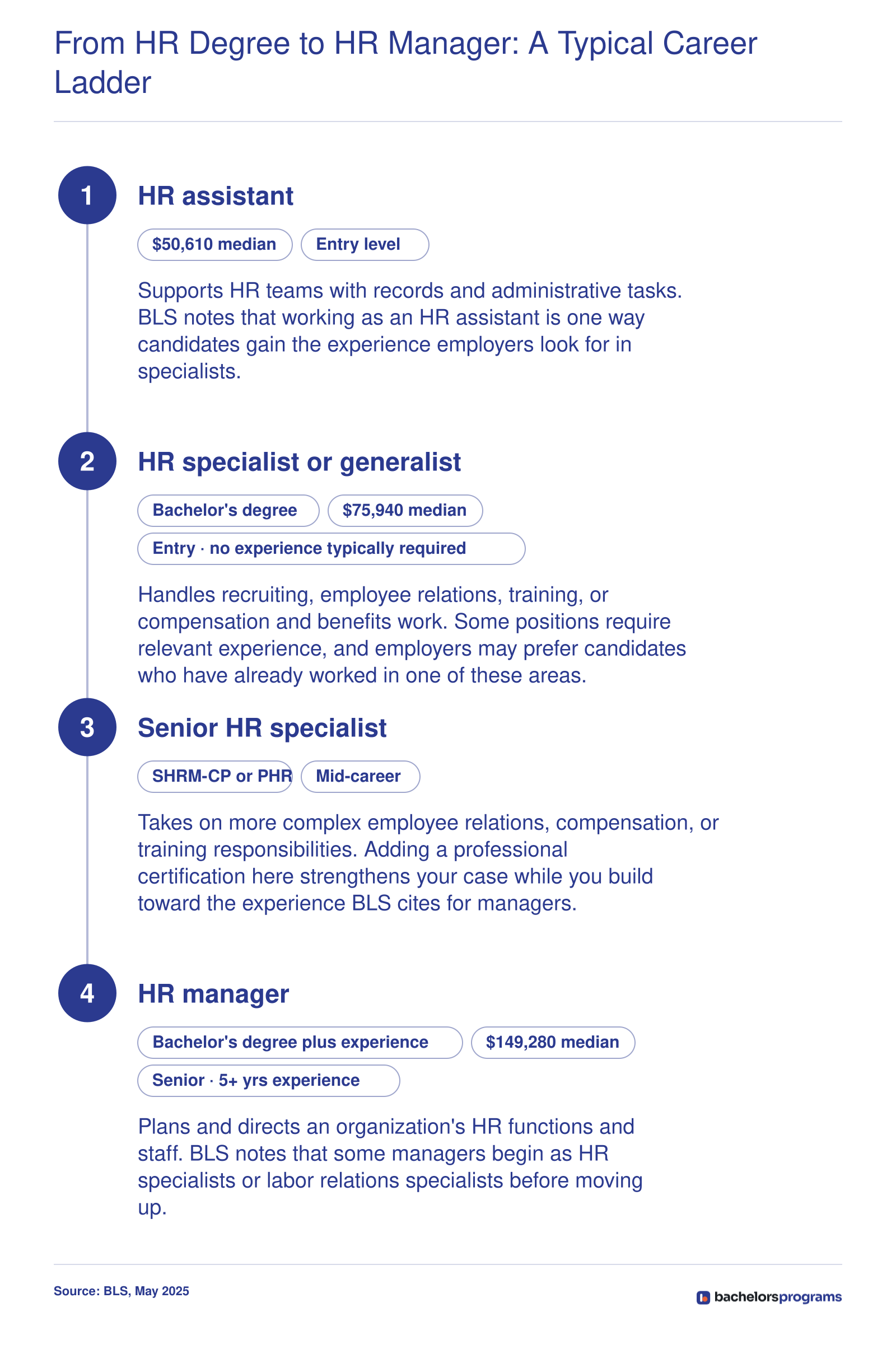
From HR Degree to HR Manager: A Typical Career Ladder
A bachelor's degree opens the door to HR work, but it rarely carries you straight into management. The Bureau of Labor Statistics lists a bachelor's degree as the typical entry education for both HR specialists and HR managers, yet managers typically also bring 5 years or more of related work experience, so the median pay gap between the two roles, $75,940 versus $149,280 as of May 2025, reflects time on the job rather than extra coursework. Many professionals use those middle years to earn a SHRM-CP or PHR, which documents their HR knowledge for employers and helps them stand out when manager roles open up.
Questions to Ask Yourself
How many prior college credits could you transfer, and does the program cap them?
Do you plan to sit for the SHRM-CP or aPHR soon after graduating, and is the curriculum SHRM-aligned?
Are you aiming for analytics-heavy roles like compensation or HRIS, or for generalist and management tracks?
Do you need fully asynchronous online courses, or can you commit to a campus or hybrid schedule?
Human Resource Management programs by state
Compare Human Resource Management programs on the data that matters
Explore more Business & Management majors or browse every field of study.
All Business & Management programs Browse every field of study