Best Management Degree Programs
Compare 1,400+ accredited Management programs, with net price after aid, graduation rates, earnings and debt from IPEDS and the U.S. College Scorecard.

Published 2026 tuition for management bachelor's programs runs from roughly $12,700 at Penn Foster to about $100,896 at Temple University, and the price gap rarely tracks quality. The harder question is which programs pair AACSB-accredited business schools with schedules that fit a working adult and a total cost that earns itself back.
Programs below span online, hybrid, and campus formats, so you can compare delivery styles side by side.
Most management graduates start in supervisory, operations, or HR coordinator roles, where the credential matters less than the school's accreditation and the concentration behind it.
Key Points
- Published 2026 prices run from about $12,700 (Penn Foster) to $100,896 (Temple).
- Business and management graduates earn a $55,206 median one year out.
- AACSB accredits the entire business school, not individual management degrees.
The 10 Best Management Degree Programs, Ranked
The ten programs below have a few things in common: management-focused curricula rather than generic business degrees, concentrations that map to specific hiring tracks, and schedules that run from evening and hybrid formats to full residential programs. Credit loads and completion timelines differ sharply from school to school, and business-school accreditation is granted school by school rather than to a whole university, so confirm current status before you apply. Each entry below highlights the detail that most separates that program from the rest.
Pacific States University
#1Los Angeles, CA
Best for: Career changers drawn to analytics
A small Los Angeles business school whose BBA leans unusually hard on quantitative work: at least 90 of its 180 quarterly units must come from business statistics or other STEM courses, and every student completes a faculty-supervised thesis. Evening and online classes keep the degree workable for employed students, and the university is authorized to enroll F-1 international students. Emphases in accounting analytics, business analytics and marketing analytics give the degree an analytics spine that is rare at the bachelor's level.
- 180 quarterly units across 45 courses, including a 12-unit senior thesis
- At least 90 units in business statistics or other STEM coursework
- Evening and online classes extend the hybrid on-campus format
- Emphases in accounting analytics, business analytics or marketing analytics
- Authorized to enroll F-1 international students and issue I-20s
- Minimum 2.00 GPA; finish all requirements within six years
Women's Institute of Torah Seminary and College
#2Baltimore, MD · $10,000 – $15,000/yr (est.)
Best for: Students seeking faith-integrated business study
A Baltimore seminary and college where business study sits inside a Judaic studies framework. The 120-credit business administration degree pairs a standard core, including Principles of Management and Organizational Behavior, with 36 credits of Jewish studies and the option to double major. Students can complete an internship of up to 135 classroom hours, and at least 30 credits must be earned at the institution, 15 of them at the upper level.
- 120 credits: 60 general education, 36 in the major, 24 free electives
- 36 credits of Jewish studies required alongside the business core
- Core includes Principles of Management and Organizational Behavior
- Internship of up to 135 classroom hours available
- At least 30 credits at WITS, 15 of them at the 300 or 400 level
- Option to double major in Judaic Studies
Lincoln University
#3Oakland, CA · ~$13,000/yr (est.)
Best for: Transfer students with prior college credit
An Oakland institution offering a broad business administration degree with a management track that accepts up to 92 transfer credits, which makes it a practical finish line for students arriving with prior college work. The 123-unit curriculum runs full time or part time, with cohort and distance formats, and a joint BA/MBA path that trims time to both degrees. Concentrations run from management and management information systems to marketing and business communications.
- 123 total units, with an estimated five-year completion timeline
- Up to 92 transfer credits accepted from prior college work
- Joint BA/MBA pathway shortens time to both degrees
- Concentrations include management, management information systems and marketing
- Cohort and distance education formats support flexible scheduling
- Full-time and part-time enrollment with a 2.00 GPA minimum
University of California-Berkeley
#4Berkeley, CA · ~$13,000/yr (est.)
Berkeley's Haas School runs the Global Management Program, an undergraduate business degree built around a sophomore fall term in Cape Town with consulting projects alongside local students. Participants choose from hundreds of exchange course options and face no required first-year summer terms. Starting with the Class of 2029, Global Management students take classes alongside their Spieker Undergraduate Business Program peers.
- Four-year Global Management Program with a fall term in Cape Town
- Sophomore fall abroad includes consulting projects with local peers
- Hundreds of exchange course options at the partner campus
- No required first-year summer terms
- Global Management students join Spieker business peers starting with the Class of 2029
International Baptist College and Seminary
#5Chandler, AZ · $10,000 – $15,000/yr (est.)
A Chandler, Arizona bible college where business study arrives as an organizational leadership emphasis inside the BA in Bible and Christian Service. The emphasis carries 38 credit hours of business coursework, from Principles of Management and Business Law to Strategic Planning and a senior capstone, wrapped in 30 hours of Bible and theology. Listed career paths include business administrator, ministry director and church administrator, and the program feeds graduate study in ministry and Christian education.
- Organizational Leadership emphasis inside the BA in Bible and Christian Service
- 38 credit hours of business and leadership coursework
- Includes Principles of Management, Business Law and Strategic Planning
- 2-credit senior capstone closes out the emphasis
- Paired with 30 hours of Bible and theology coursework
- Listed roles include business administrator, ministry director and church administrator
Georgia Institute of Technology
#6Atlanta, GA · ~$12,000/yr (est.)
Georgia Tech's business school pairs a business administration degree with the analytical rigor you would expect from an engineering-focused campus. The General Management concentration sits among eight options, and students declare by the end of sophomore year with dedicated advising support. A large elective block and an optional BSMS pathway let strong students shape the degree or start graduate work early.
- General Management concentration within the BS in Business Administration
- Students declare a concentration by the end of sophomore year
- Large elective block lets students tailor the degree
- BSMS pathway lets qualified students double-count credits toward a master's
- Eight concentration options across the business school
University of North Carolina at Chapel Hill
#7Chapel Hill, NC · ~$12,000/yr (est.)
Carolina's Management and Society major takes an interdisciplinary route, drawing on economics, sociology, psychology and public policy rather than a traditional business core. Core courses are often cross-listed across departments, and many students pair the major with a second field. Honors theses, for-credit internships and mentored research give the degree practical grounding for private, nonprofit and public sector work.
- Interdisciplinary major linking management to economics, sociology and policy
- Core courses cross-listed with economics and sociology
- Honors thesis, independent study and for-credit internships available
- Commonly paired with a second major in another field
- Prepares students for private, nonprofit and public sector work
University of Michigan
#8Ann Arbor, MI · $18,000 – $61,000/yr (est.)
Michigan's Ross School of Business offers a BBA with a General Management path that prepares students for rotational and fast-track programs across industries. The program reports a median starting salary of $71,000 and a median signing bonus of $5,000 for general management graduates. Career coaching, peer advisors and a broad elective list, from Marketing Analytics to Revenue Management, support students building an individualized plan.
- General Management path within the BBA at the Ross School of Business
- General management graduates report a median $71,000 starting salary
- Median signing bonus of $5,000 reported for the same group
- Electives include Marketing Analytics, Leadership in Organizations and Revenue Management
- Dedicated career coach for general management roles
- Eleven concentration options across the business school
University of Florida
#9Gainesville, FL · ~$4,800/yr (est.)
The University of Florida's Heavener School of Business grants a 120-credit BSBA in management with coursework in organizational behavior, human resource management and business strategy. A required career readiness sequence includes a 150-hour internship, which study abroad can replace, plus the Capsim comprehensive exam before graduation. Leadership programs, study abroad and student organizations round out a degree built for careers across nearly every sector.
- 120-credit BSBA in management from the Heavener School of Business
- Coursework spans organizational behavior, human resources and strategy
- Career readiness sequence includes a 150-hour internship before senior year
- Study abroad can substitute for the internship requirement
- Capsim comprehensive exam required for graduation
- Florida Leadership Academy and student organizations build a network
University of California-Irvine
#10Irvine, CA · $14,000/yr (est. net price)
UC Irvine's Merage School offers a BA in Business Administration with an Organization and Management emphasis that pulls from negotiations, teams, leadership and human resources analytics courses. Students take eleven business courses plus at least five electives and can stack more than one of the six emphases. Admission is competitive, and junior-level transfers need a 3.0 GPA plus coursework in calculus, economics, statistics and accounting.
- Organization and Management emphasis within the BA in Business Administration
- Eleven business courses plus at least five business electives
- Emphasis courses cover negotiations, teams, HR analytics and leadership
- Six emphases, and students may complete more than one
- Junior transfers need a 3.0 GPA plus calculus, economics, statistics and accounting
- International business requirement can be met through study abroad
Cost & outcomes by school
Federal data for the highest-earning Management programs, independent of the ranking above. Earnings are this field's bachelor's graduates four years after completing where the Scorecard reports them, else the school's undergraduate median.
| School | Net price / yr | Grad rate | Earnings | Debt | Grads/yr | Format |
|---|---|---|---|---|---|---|
| Carnegie Mellon University PA | $31,944 | 94% | $160,783 | $23,250 | 204 | Campus |
| University of Michigan MI | $13,138 | 93% | $144,654 | $19,000 | 635 | Campus |
| University of California-Berkeley CA | $13,481 | 93% | $144,599 | $11,300 | 408 | Campus |
| Massachusetts Institute of Technology MA | $20,111 | 96% | $143,372 | $14,768 | — | Campus |
| University of Pennsylvania PA | $28,699 | 97% | $136,806 | $20,348 | 86 | Campus |
| University of North Carolina at Chapel Hill NC | $11,655 | 91% | $135,874 | $14,239 | 435 | Campus |
| California Institute of Technology CA | $16,075 | 94% | $128,566 | — | — | Campus |
| Maine Maritime Academy ME | $23,414 | 58% | $123,155 | $27,000 | — | Campus |
| Boston College MA | $41,704 | 91% | $123,144 | $18,125 | 74 | Campus |
| Georgetown University DC | $40,815 | 95% | $117,733 | $14,975 | 45 | Campus |
| California Polytechnic State University-San Luis Obispo CA | $16,665 | 86% | $110,902 | $16,633 | 777 | Campus |
| Santa Clara University CA | $50,062 | 88% | $109,183 | $19,162 | — | Campus |
Sources: U.S. Department of Education. Net price, graduation rate, earnings and debt: College Scorecard (earnings and debt for this field's bachelor's graduates where reported, else school-wide); graduates: IPEDS. A dash means no figure is reported.
Cost, debt & payoff
Median earnings of this field's bachelor's graduates (4 yrs after completing, else the school's undergraduate median) vs. their median federal loan debt · U.S. College Scorecard
Across these programs the median graduate earns about $61,967 and finishes with roughly $23,250 in debt — a ratio that clears a common rule of thumb (keep debt below first-year salary). Net price and debt vary widely school to school, so check the per-school figures in the table above before you shortlist.
How We Ranked These Management Programs
What makes one management degree program better than another? We scored each school on five weighted criteria that matter most to students choosing a bachelor's in management:
- Accreditation: Institutional accreditation plus AACSB business accreditation, which signals academic quality to employers and graduate schools.
- Affordability: Tuition and total cost of attendance.
- Graduation rate and outcomes: How many students finish and what graduates earn early in their careers.
- Format flexibility: Online, hybrid and campus options, along with part-time pathways.
- Concentration breadth: The range of tracks offered, such as human resource management, operations or entrepreneurship.
Where the Outcomes Data Comes From
Graduation rates come from federal NCES reporting on first-time, full-time students. Earnings come from the 2026 College Scorecard release, which reports median earnings for federal aid recipients four years after they complete a bachelor's in business administration, management and operations.1 Those figures draw on federal tax records and are adjusted for inflation. Scorecard withholds earnings for fields with fewer than 30 graduates, so smaller programs may show no earnings figure.
How This List Differs From U.S. News
U.S. News ranks undergraduate business programs through peer assessment alone: deans and senior faculty rate programs on a 1 to 5 scale, and a program needs at least 10 ratings to qualify.2 That captures reputation, not price or access. Because many of our readers work full time or study from home, we weighted affordability and online availability more heavily.
Every Format Was Eligible
Online, campus and hybrid programs competed on equal footing. The ranking table labels each program's format, so you can spot the delivery style that fits your schedule.
Tuition and Total Cost at Each Ranked Program
Published 2026 prices for these management programs span a wide range, from an estimated $12,700 to $13,100 for the full Penn Foster bachelor's to roughly $100,896 at Temple University. Among public universities, Kennesaw State University stands out with a $192 online per-credit rate and an estimated $23,040 total. Annual in-state and out-of-state figures reflect each school's published tuition and may not match online per-credit pricing, so confirm your residency status and fees directly with any school on your shortlist.
| School | In-State Tuition (Annual) | Out-of-State Tuition (Annual) | Online Per-Credit Rate | Estimated Total Program Cost |
|---|---|---|---|---|
| Penn Foster (Bachelor's Degree in Business Management) | N/A | N/A | $109 | $12,700 to $13,100 |
| Kennesaw State University (Online B.B.A. in Management) | $5,808 | $17,736 | $192 | $23,040 |
| University of North Texas (Online Management) | N/A | N/A | $280 | $33,600 |
| Oklahoma State University (Online Management) | $10,234 | $25,754 | $322.73 | $38,728 |
| George Mason University (Online Management) | $14,220 | $38,688 | $358.40 | $43,008 |
| University of Tennessee at Chattanooga (Online Management) | N/A | N/A | $421 | $50,520 |
| Northwest Missouri State University (B.S. in Business Management) | N/A | N/A | $368 | $50,880 |
| University of Minnesota Crookston (Online Management) | $13,288 | $13,288 | $436.53 | $52,384 |
| University of Wisconsin-Madison (Online Management) | $11,603 | $42,103 | $450 | $54,000 |
| University of North Dakota (Online Management) | $10,951 | $15,570 | $476 | $57,120 |
| Florida Institute of Technology (B.A. in Management, 121 credits) | N/A | N/A | $572.92 | $69,323.32 |
| Syracuse University (Online Management) | $65,528 | $65,528 | $750 | $90,000 |
| Temple University (Online Management) | N/A | N/A | $840.80 | $100,896 |
| University of West Florida (B.S.B.A. in Management) | $26,427.60 | $43,358.40 | $220.23 | N/A |
Why AACSB Accreditation Matters for Management Majors
AACSB accreditation belongs to a business school, not to a single management degree or an individual student. The Association to Advance Collegiate Schools of Business reviews the school as a whole: faculty qualifications, how current the curriculum is, teaching effectiveness, learner success, and evidence of continuous improvement. Earning the seal takes a multi-year, peer-reviewed process built around the school's own mission. The 2026 standards took effect on July 1, 2026.
How Rare Is It?
As of November 2, 2026, AACSB reports 1,104 accredited institutions across 72 countries and territories. AACSB describes its accredited schools as representing roughly 6 percent of institutions offering business degrees worldwide. That scarcity is the point: a management program inside an AACSB-accredited business school has cleared a review that most business schools have not.
Three Practical Payoffs
- Employer recognition: Large employers and recruiters often use AACSB accreditation as a quick screen when comparing business graduates from unfamiliar schools.
- Credit transfer: Regionally accredited, AACSB-accredited business schools tend to recognize each other's coursework more readily, which matters if you change schools or add a second major.
- MBA admission: Graduate business admissions committees know the AACSB stamp, and an undergraduate degree from an accredited business school can reduce questions about your transcript's rigor.
Not All Business Accreditation Is the Same
AACSB, ACBSP, and IACBE all accredit business schools, but they differ in evidence and quality-assurance model. AACSB's approach is mission-linked, principles-based, and peer-reviewed, with a strong research and continuous-improvement component. ACBSP and IACBE are legitimate specialized accreditors with their own standards; check which one a school holds rather than assuming they are interchangeable.
None of this replaces institutional accreditation, the recognition that makes a college eligible for federal financial aid and widely accepted transfer credit. Treat institutional accreditation as the non-negotiable baseline and AACSB as the specialized seal that adds weight for management majors.
Related Articles
Online vs. Campus vs. Hybrid Management Degrees
Pay for management roles does not depend on how you earned the degree, but employer perception still leans slightly toward in-person study. The research from the Graduate Management Admission Council and others does not break out hybrid graduates, so the table compares online and campus formats. A hybrid program blends the two, so weigh these findings by how much of your coursework would happen in each setting.
| Measure | Online | On Campus |
|---|---|---|
| Median annual wage, management occupations (May 2025) | $126,520 | $126,520 |
| Starting salary paid by employers (2023) | Same as in-person hires | Same as online hires |
| Employers that hired graduates and paid equal salary (2025) | 87.4% had hired online-degree graduates, and 100% of them paid the same salary | Baseline credential, paid the same |
| Full-time employment, postgraduate degree holders (2023) | 79% | 78% |
| Professional or managerial roles, postgraduate degree holders (2023) | 85% | 88% |
| Interview likelihood (2023) | 2.5% lower when a candidate's degree is listed as online | Baseline |
| Employers seeing both formats as equally credible (2025) | Only 28% agreed | Only 28% agreed |
| Employer view of skills (2023) | Ambivalence about differences in technical skills | Seen as stronger in leadership, communication, and technical skills |
Admission and Transfer-Credit Requirements for Online Management Programs
Online management programs set different bars for first-time freshmen and transfer students. Use this checklist to compare the schools' published rules before you apply.
- Diploma or GEDAPUS accepts a high school diploma or GED. Avila requires a high school diploma.
- Minimum GPAAvila and Alabama list 2.0. Texas State ranges from 2.0 to 2.5 by credit hours earned. ASU's direct-admission options include a 3.00.
- TestingAPUS doesn't require the SAT or ACT. Alabama waives scores through Fall 2026. Texas State isn't test-optional for all freshmen.
- Transfer capsAvila, APUS, and Northwood accept up to 90 credits. Texas State takes up to 72 community-college hours. UW–Stout cites 60 credits but notes that many students transfer more.
- Associate degreesNorthwood grants junior status for an accredited associate degree. Strayer awards 54 block credits for a technical associate degree.
- Degree-completion entryBoise State requires an associate degree or at least 60 credits. Strayer requires 12 or more transfer courses.
- Grades and residencyNorthwood generally requires a C or better in transfer courses. UW–Stout requires 32 credits earned at Stout.
- Work experienceUW–Stout's adult-learner program expects about four years of progressive career experience.
- Prior learning and military creditAsk admissions how prior learning and military training are evaluated. Policies vary by school.
What Management Graduates Earn Early in Their Careers
Nationally, bachelor's graduates in business administration, management and operations earn a median of $55,206 one year after finishing their degree. This is a graduate earnings figure, not an occupational wage.
Is a Management Degree Worth the Cost?
How long does it take a management degree to pay for itself? A rough answer comes from pairing the total program costs in the tuition table above with what graduates actually earn.
The payback math
Federal College Scorecard data puts median earnings for bachelor's graduates in business administration, management and operations at $68,257.1 Median federal loan debt for the same group sits at $18,7141, a figure that counts Direct, Federal Family Education and Graduate PLUS loans but leaves out private loans, Perkins loans and Parent PLUS borrowing, so a family financing part of the bill outside those programs will see a higher real number.
Set against earnings, typical debt lands at roughly a quarter of a single year's median earnings. At the lower-cost programs here, a graduate who borrows at or below the median and earns anywhere near it can clear the balance in a handful of years rather than a decade.
Three levers that shrink the real cost
- Transfer credit: Bringing in an associate degree or prior coursework can remove a year or more of tuition from the sticker price, particularly at programs with generous transfer caps.
- Residency: In-state rates at public universities often run far below the out-of-state figure, and some online programs charge one flat rate regardless of where you live.
- Employer tuition assistance: Many large employers reimburse part of an undergraduate bill for current staff. If you are already working, check the benefits handbook before you apply, not after.
The verdict
A management degree pays off most clearly when two things line up: a low total cost at an accredited program, and a job that sits on a visible promotion ladder, such as operations, retail, logistics or HR, where supervisory roles are the normal next step. Pay a premium price for a program with no accreditation and no employer pipeline, and the math stops working.
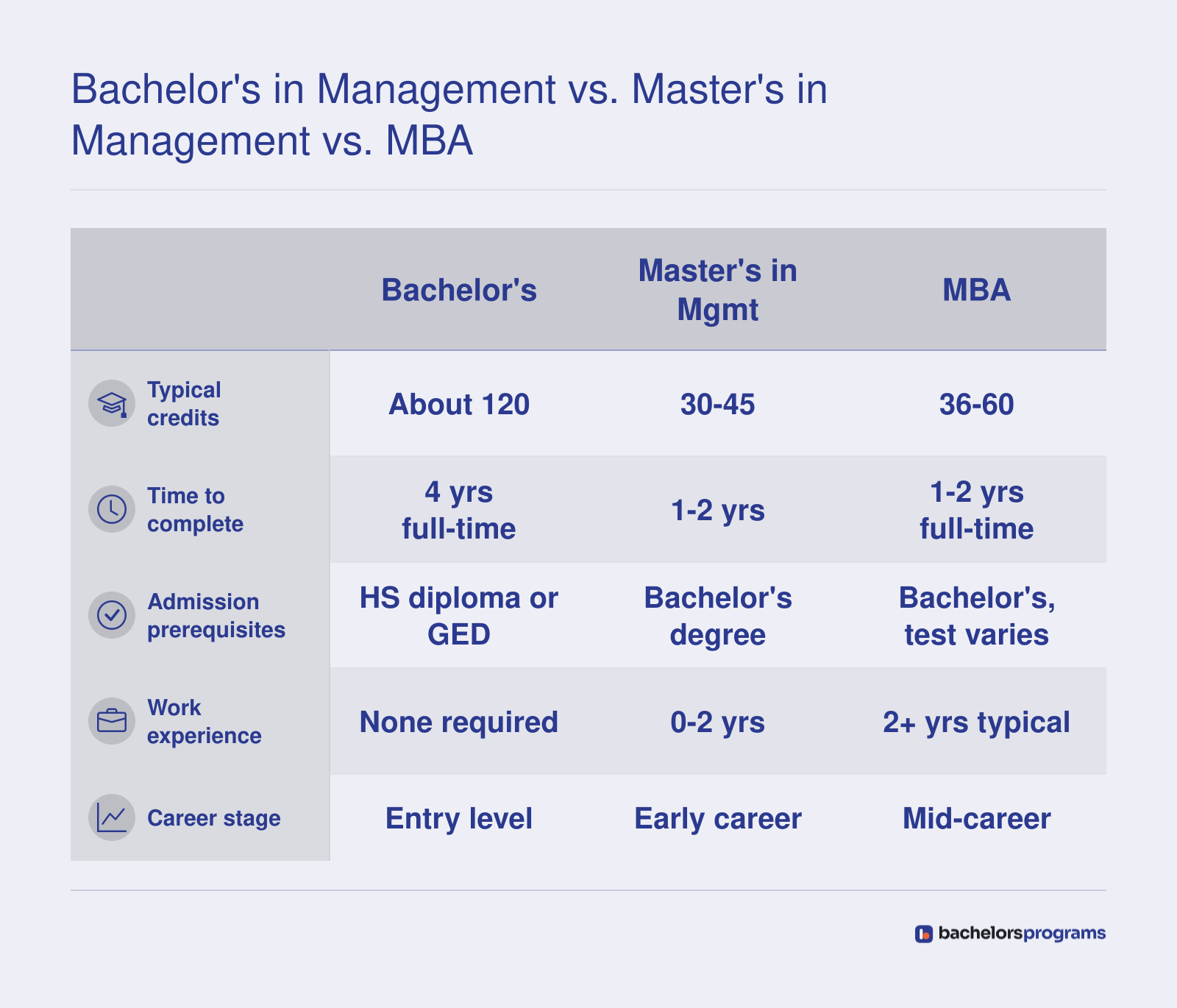
Bachelor's in Management vs. Master's in Management vs. MBA
A bachelor's in management is the entry point into the field and the degree most students start with. A master's in management suits recent graduates with little or no work experience. An MBA targets experienced professionals moving into senior roles. The figures below are general ranges, and individual schools set their own requirements.
Questions to Ask Yourself
Will your target employers or future MBA programs expect an AACSB-accredited business school?
Is a specialized concentration like HR or supply chain worth more to you than a general management track?
Would starting at a lower-cost community college, then transferring, cut your total cost without hurting your outcomes?
Management programs by state
Compare Management programs on the data that matters
Explore more Business & Management majors or browse every field of study.
All Business & Management programs Browse every field of study