Best Sports Management Degree Programs
Compare 710+ accredited Sports Management programs, with net price after aid, graduation rates, earnings and debt from IPEDS and the U.S. College Scorecard.

Dozens of sports management programs advertise the same internships and "industry connections," yet their costs differ more than fourfold. Average net price among the top-ranked schools runs from $4,815 at the University of Florida to $21,315 at Texas A&M University-College Station. Most "best of" lists never show that gap, or what graduates earn afterward.
The rankings below put cost beside outcomes, then cover online and campus options, COSMA accreditation, salary, and how to choose.
Hiring in sports runs on relationships, so where you intern often counts for as much as the diploma.
Key Points
- Southern New Hampshire University accepts up to 90 transfer credits online.
- Ranked tuition starts at $3,876 in-state at University of Florida (2024 IPEDS).
- Even online students complete internships in person, so plan for fieldwork.
Top 10 Sports Management Degree Programs for 2027
These ten schools earn their place on a mix of outcomes that matter to future sport business professionals: strong graduation rates, a net price that leaves room for an internship-heavy schedule, and program graduates who report solid earnings within a few years of finishing. Every entry below is a bachelor's degree, and every figure comes from federal data on the 2024 collection year.
University of North Carolina at Chapel Hill
#1Chapel Hill, NC · ~$12,000/yr (est.)
Best for: Future collegiate athletic administrators
UNC-Chapel Hill pairs the reach of a flagship public university with a sport administration concentration housed inside the exercise and sport science major. The school graduates 91% of its students, and average net price after aid comes to about $11,655, a combination that anchors its place at the top of this list. Coursework runs through marketing, finance, sport law, and analytics, and graduates report median earnings of roughly $63,286 four years after completing the program.
- Sport Administration concentration within the Exercise and Sport Science major
- Coursework spans sport marketing, finance, law, sales, and analytics
- Field experience in sport administration for real-world practice
- Optional two-semester honors research project
- Summer study abroad and Carolina sport business clubs
- 2.0 GPA minimum; scholarships available
- Covers sponsorship, event and facility management, and leadership
University of Michigan
#2Ann Arbor, MI · $18,000 – $61,000/yr (est.)
Best for: Students chasing big-brand sport internships
Michigan pairs a dedicated undergraduate sport management major with the athletic culture of one of the country's most visible programs. Graduates report median earnings of $79,411 four years after finishing, the strongest program-level figure on this list, and the school graduates 93% of its students. Average net price after aid is about $13,138, and an advisory board of industry executives sits behind the internship and consulting pipeline.
- Advisory board of industry executives shapes the curriculum
- Dynamic internships and consulting projects with sport organizations
- Employers include ESPN, NCAA, and Under Armour
- Faculty research covers marketing, sponsorship, and new media
- Coursework on sport's social, economic, and operational impact
- Graduates continue to business, law, accounting, and urban planning
California Polytechnic State University-San Luis Obispo
#3San Luis Obispo, CA · ~$17,000/yr (est.)
Best for: Hands-on learners drawn to event operations
Cal Poly's Learn by Doing ethos shows up in the sport and recreation management concentration, where a 400-hour internship and a strategic senior project sit at the center of the degree. The school graduates 86% of students, and average net price after aid runs about $16,665. Four years after completion, program graduates report median earnings near $64,579.
- Sport and Recreation Management concentration in Experience and Event Management
- 400-hour internship with real sport and recreation organizations
- Senior project applying strategic management skills
- Career tracks in pro sport, outdoor recreation, or community recreation
- Coursework in sport marketing, promotions, and special event planning
- 120 credit hours with a capstone requirement
- Study sport and environmental ethics, leadership, and community relations
Rice University
#4Houston, TX · ~$13,000/yr (est.)
Rice wraps sport management in an interdisciplinary major that draws on business, law, and communication, with concentrations in Sport Law and Sport Leadership. A 100-hour practicum places students inside Houston sports organizations, and a signature course puts them in the room with professional franchise executives. The school graduates 95% of students, and despite a $64,144 tuition, average net price after aid comes to about $13,370. Program graduates report median earnings of $87,404 four years out.
- Concentrations in Sport Law and Sport Leadership
- 100-hour practicum with Houston sports organizations
- Interdisciplinary blend of business, management, law, and communication
- Signature course taught with professional franchise executives
- Access to the university's Sport Analytics program
- Covers marketing, finance, ethics, analytics, and venue management
- Pathway to law school or business school
Florida State University
#5Tallahassee, FL · ~$11,000/yr (est.)
Florida State's sport management bachelor's runs on a 30-credit core plus electives across business and recreation, with an optional practicum placing students with professional teams, college athletic departments, and leagues. A fall 2026 course, SPM 4931, runs an NIL agency model in which student teams build athlete brands and pitch potential partners. Average net price after aid is about $11,297, the school graduates 86% of students, and program graduates report median earnings of $60,909 four years out.
- Ten core classes totaling 30 credits
- Optional practicum with pro teams and college athletic departments
- Combined B.S./M.S. pathway for advanced training
- Study abroad in the United Kingdom
- Fall-only entry with prerequisite coursework
- Electives across business and recreation
- Over $1 million in scholarships available
University of Illinois Urbana-Champaign
#6Champaign, IL · ~$14,000/yr (est.)
The University of Illinois Urbana-Champaign houses sport management as a concentration inside its recreation, sport and tourism degree, backed by a 12-credit internship. Average net price after aid is roughly $14,355 and the school graduates 85% of students. Program graduates report median earnings of $67,782 four years after completion, and the curriculum is designed to carry students into graduate study as well.
- Sport Management concentration within Recreation, Sport & Tourism
- 128 credit hours with a broad general education
- 12-credit internship for hands-on experience
- Coursework in sport law, finance, and facility management
- Covers marketing, event management, and strategic leadership
- Prepares students for graduate study in sport fields
University of Georgia
#7Athens, GA · ~$14,000/yr (est.)
Georgia requires experiential learning for graduation, and its sport management majors land internships with professional teams, agencies, and brands including the NBA, NFL, MLB, ESPN, and Nike. An alumni council supplies mentoring, networking, and placement help on top of the coursework in marketing, finance, economics, and analytics. The school graduates 90% of students, average net price after aid is about $13,936, and program graduates report median earnings of $67,275 four years out.
- Experiential learning required for graduation
- Internships with pro teams, agencies, and brands such as ESPN and Nike
- Alumni council offers mentoring, networking, and job placement
- Coursework in marketing, finance, economics, and analytics
- Tailor your course of study to career goals
- Studies sport's sociological, philosophical, and legal dimensions
- Graduates continue to law, business, or kinesiology study
University of Florida
#8Gainesville, FL · ~$4,800/yr (est.)
Florida's on-campus sport management bachelor's blends a business core with sport operations, revenue generation, and risk management, and lets students choose between a 12-week, 12-credit internship and a non-internship track. Average net price after aid is about $4,815, the lowest on this list, and the school graduates 85% of students. Program graduates report median earnings of $60,497 four years after completion.
- 120 credit hours blending a business core with the sport industry
- Choose a 12-week, 12-credit internship or a non-internship track
- Critical tracking courses in economics, statistics, and accounting
- Covers operations, revenue generation, and risk management
- Emphasis on data-informed decision making
- 2.2 GPA minimum with prerequisite coursework
Florida International University
#9Miami, FL · ~$9,000/yr (est.)
FIU runs a sport and recreation management bachelor's with two tracks, one aimed at sport management and one at parks and recreation, out of its College of Arts, Sciences, and Education. Average net price after aid is roughly $9,288 and the school graduates 74% of students, a completion rate that reflects a large, access-focused enrollment. The Miami setting puts students within reach of a dense market of professional teams, agencies, and event venues.
Texas A&M University-College Station
#10College Station, TX · ~$21,000/yr (est.)
Texas A&M's 120-credit sport management degree lets students close out with an internship, an entrepreneurial capstone, an international experience, or undergraduate research. Coursework covers sport marketing and promotions, sales, analytics, fan behavior, and facility and event management, with minors available in business, journalism, or speech communications. Average net price after aid is about $21,315, the school graduates 84% of students, and program graduates report median earnings of $62,888 four years after completing.
- Four culminating experience options, including internship or capstone
- Entrepreneurial and business project capstone tracks
- Coursework in sport marketing, sales, analytics, and fan behavior
- Covers facility and event management plus financial management
- Minors in business, journalism, or speech communications
- 120 credit hours with study abroad and faculty-led field trips
Cost & outcomes by school
Federal data for the highest-earning Sports Management programs, independent of the ranking above. Earnings are this field's bachelor's graduates four years after completing where the Scorecard reports them, else the school's undergraduate median.
| School | Net price / yr | Grad rate | Earnings | Debt | Grads/yr | Format |
|---|---|---|---|---|---|---|
| George Washington University DC | $36,586 | 84% | $90,873 | $20,449 | — | Campus |
| Bryant University RI | $41,219 | 80% | $90,008 | $26,849 | 1 | Campus |
| Fairfield University CT | $48,095 | 84% | $88,794 | $26,000 | 8 | Campus |
| Rice University TX | $13,370 | 95% | $87,404 | $10,000 | 48 | Campus |
| University of Portland OR | $28,210 | 80% | $82,804 | $21,370 | — | Campus |
| University of Michigan MI | $13,138 | 93% | $79,411 | $18,924 | 348 | Campus |
| San Jose State University CA | $13,760 | 69% | $78,988 | $15,000 | 241 | Campus |
| Gonzaga University WA | $35,119 | 86% | $78,892 | $24,454 | 42 | Campus |
| Carroll University WI | $15,193 | 71% | $77,095 | $27,000 | 111 | Campus |
| Saint Louis University MO | $24,398 | 80% | $77,066 | $26,316 | 100 | Campus |
| University of Delaware DE | $17,799 | 81% | $76,478 | $25,000 | 233 | Campus |
| University of Mississippi MS | $13,314 | 72% | $73,870 | $21,516 | 124 | Hybrid |
Sources: U.S. Department of Education. Net price, graduation rate, earnings and debt: College Scorecard (earnings and debt for this field's bachelor's graduates where reported, else school-wide); graduates: IPEDS. A dash means no figure is reported.
Cost, debt & payoff
Median earnings of this field's bachelor's graduates (4 yrs after completing, else the school's undergraduate median) vs. their median federal loan debt · U.S. College Scorecard
Across these programs the median graduate earns about $52,567 and finishes with roughly $24,424 in debt — a ratio that clears a common rule of thumb (keep debt below first-year salary). Net price and debt vary widely school to school, so check the per-school figures in the table above before you shortlist.
How We Ranked Sports Management Schools
What Goes Into the Score
Each program is weighed on four plain inputs. Program-level earnings and typical debt come from the federal College Scorecard, which reports what graduates of a specific field of study actually earned and borrowed. Average net price after grant aid shows what a typical student really pays rather than the sticker tuition. Institution-wide graduation and retention rates signal whether students finish what they start. Format availability, online, on campus, or both, is tracked so the ranking reflects how students actually study.
Where the Numbers Have Limits
Graduation rates and net price are school-wide figures, not program-specific, so they describe the institution a student enrolls in rather than the sports management major alone. Earnings are reported in windows of one, two, four, or five years after completion, and the window varies by school because the Scorecard publishes whatever each institution reports. A one-year figure and a five-year figure are not directly comparable, and the ranking treats them accordingly.
Accreditation Is Checked Separately
COSMA accreditation, the Commission on Sport Management Accreditation standard that signals a program meets the field's own quality benchmarks, was verified school by school and is reported in its own section rather than folded into the score. Accreditation status is a fact readers can weigh for themselves.
How Current the Data Is
Figures come from the most recent College Scorecard release available for this 2026 edition, so earnings and debt reflect recent graduating classes rather than decade-old outcomes.
Plenty of competitor lists publish a verdict with no criteria behind it. This one shows its inputs.
Best Online Sports Management Degree Programs
You can earn a sports management degree online, and Southern New Hampshire University accepts up to 90 transfer credits toward its online B.S. in Sport Management.1 The trade-off is fieldwork: internships and practicums still happen in person, often at a team, facility, or athletics department near you.
Terms and Start Dates
SNHU runs 8-week terms and offers six undergraduate start dates a year.1 Liberty University's online sports management program generally uses 8-week courses, though some courses follow full-semester schedules or sit in term-specific subterms. American Public University System lists 8-week sessions, including a Fall 2026 Session I from Nov. 2 to Dec. 27, 2026.2 Arkansas State University uses accelerated coursework with multiple starts a year and 5-week summer sessions.3 William Paterson University runs 7-week terms.4 Ask each school whether classes are asynchronous or include scheduled live sessions before you commit.
Transfer Credits and Associate Pathways
Transfer policy matters most for career changers and students arriving with an associate degree.
- Southern New Hampshire University: up to 90 credits.1
- Liberty University: up to 75% of the degree, which implies about 90 credits in a 120-credit program, subject to evaluation.
- Methodist University: up to 93 credits, generally from regionally accredited institutions for courses with a C or higher.5
- University of West Alabama: up to 60 credits from a two-year college and 90 from a four-year college, with matching coursework required.6
- Concordia University, St. Paul: up to 67 credits in its 90-credit fast-track and 90 in its 120-credit traditional option.7
The One Check to Make First
Confirm the internship or practicum requirement and how remote students complete it. Ask whether a local supervisor can oversee the placement or whether the school assigns one, and get the approval process in writing. Then compare net price after your transfer credits are evaluated, not sticker tuition alone.
Best On-Campus Sports Management Programs for Internships and Industry Access
Sports employers expect entry-level applicants to arrive with real event and front-office experience, and campus programs remain the most direct way to build it. The schools ranked here are campus-based, so students can work events in their own athletic departments, staff local venues, and build industry contacts while still enrolled.
Where Ranked Programs Connect Students to the Industry
- Rice University: Students complete a 100-hour practicum with Houston sports organizations and can take an immersive course built around a professional sports franchise.
- University of Michigan: An advisory board links students with industry contacts, and the program lists ESPN, the NCAA, and Under Armour among graduate employers.
- Florida State University: The practicum places students with professional sports teams, and the alumni network adds further professional experience.
- University of Georgia: Experiential learning is required for graduation, and the program reports graduates hired by the NBA, NFL, and MLB.
Why Required Hours Matter
A required internship guarantees that every graduate leaves with documented, supervised work, which is exactly what hiring managers look for on a first résumé. Hour requirements vary widely. Cal Poly's sport and recreation concentration includes 400 clinical hours, while Rice's practicum runs 100 hours. Beyond this ranking, Elon University requires a full-time, 320-hour internship once students finish 90 semester hours1, and Seton Hall University requires two for-credit internships totaling six credits2. If a program offers an optional internship track, as the University of Florida does, choose it unless you already have strong industry experience.
Location Expands Your Options
Proximity to pro franchises and major event markets multiplies the part-time jobs, game-day shifts, and internships you can take on while still enrolled. Seton Hall's placements with the New Jersey Devils, Brooklyn Nets, New York Yankees, and New York Mets show what a big-league market makes possible.2 Rice's Houston location and FIU's Miami campus offer similar advantages. If you prefer a college town, ask how the program arranges placements with teams in other cities and whether it helps with summer housing or travel.
Related Articles
Sports Management Degree Cost: The Most Affordable Ranked Programs
How much does a sports management degree cost? According to 2024 IPEDS and College Scorecard data from the U.S. Department of Education, published tuition and fees at the lowest-cost ranked programs range from $3,876 in-state at University of Florida to $22,320 at College of the Ozarks, and out-of-state students at the two Florida public universities face $16,579 or $18,964. After grants and scholarships, the average net price falls to between $4,815 and $9,288 a year. Treat net price as an average across aided students, not a personal quote, and note that University of Florida sport management graduates finished with a median of $15,000 in federal debt (about $159 a month on a 10-year plan), while Pell Grant shares of 66.7% at University of Florida and 81.3% at FIU show these schools enroll many lower-income students.
| School | Location | Degree | Average net price | Published tuition (in-state / out-of-state) | Median federal debt at completion | Est. 10-year monthly payment | Pell Grant share |
|---|---|---|---|---|---|---|---|
| University of Florida | Gainesville, FL | Bachelor's in Sport Management | $4,815 | $3,876 / $16,579 | $15,000 | $159 | 66.7% |
| College of the Ozarks | Point Lookout, MO | Recreation and Sports Management Major, B.S. | $6,100 | $22,320 / $22,320 | N/A | N/A | N/A |
| Florida International University | Miami, FL | Sport and Recreation Management (Sport Management concentration) | $9,288 | $6,565 / $18,964 | N/A | N/A | 81.3% |
What Do Common Sports Management Careers Pay?
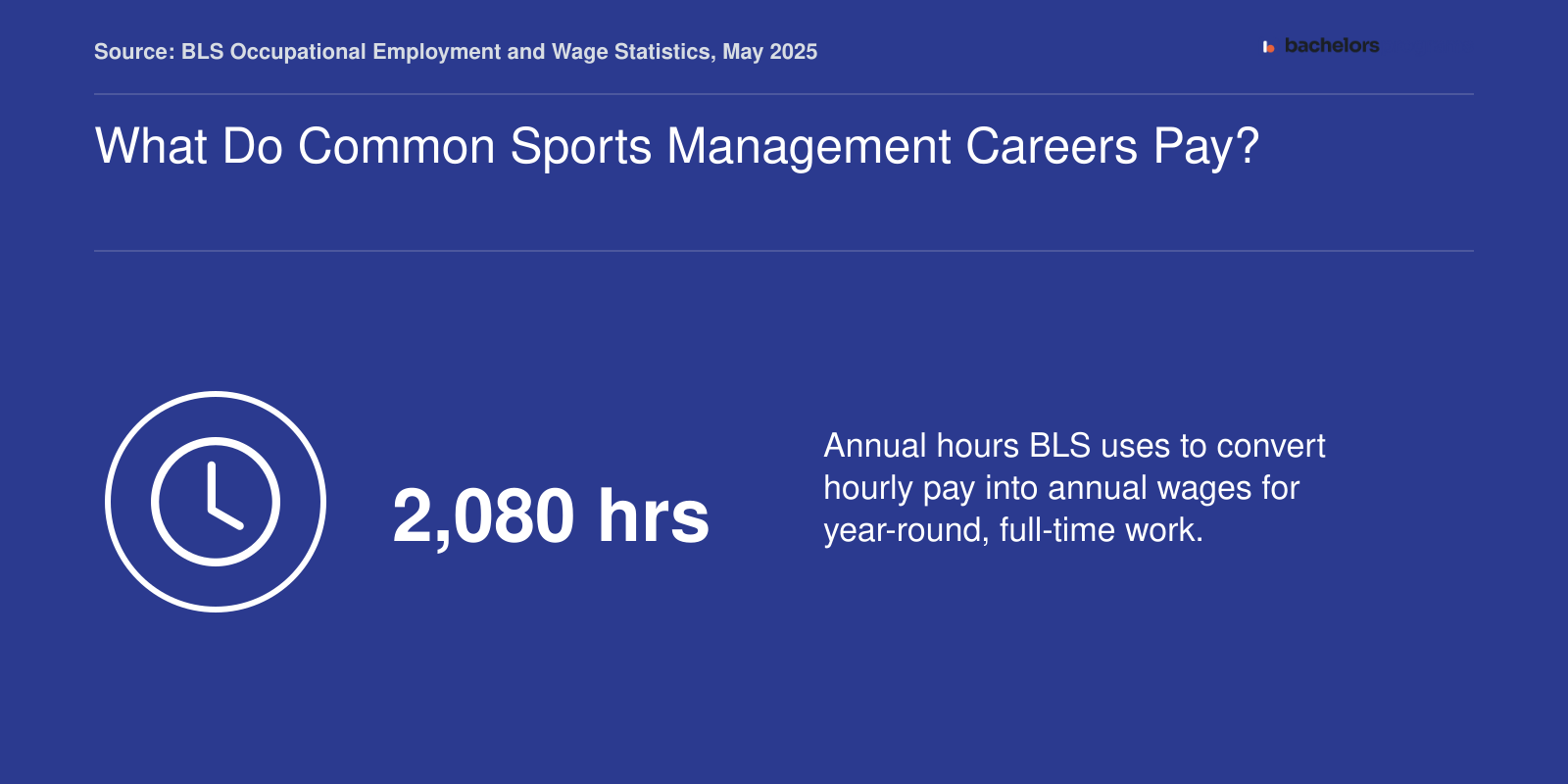
Sports management graduates often move into roles the Bureau of Labor Statistics tracks as agents and business managers of artists, performers, and athletes; meeting, convention, and event planners; marketing managers; and coaches and scouts. BLS publishes occupation-wide wages for these fields, most recently in its May 2025 national estimates released in May 2026, and those figures cover everyone working in the occupation, not graduates of any specific program. Annual wages assume full-time, year-round work and leave out self-employed workers, an important gap for independent agents and freelance event planners.
Weigh net price and what you will actually borrow against realistic first-year sports pay. The lowest sticker price is not automatically the best value, but heavy debt rarely is.
Questions to Ask Yourself
Do you want the team side or the business side of sports?
Can you relocate for an unpaid or low-paid internship?
Does full COSMA accreditation matter to you, or is candidacy status enough?
Would a business degree with a sports concentration keep more doors open?
Sports Management programs by state
Sports Management Degree FAQs
These answers cover the questions prospective students ask most often when comparing a sports management degree with other paths. Requirements vary by school, so confirm details with each admissions office before you apply.
What is the best degree for sports management?
Can you get a sports management degree online?
Is a master's in sports management worth it, or should you get an MBA?
Can you transfer community college credits into a sports management bachelor's?
Compare Sports Management programs on the data that matters
Explore more Business & Management majors or browse every field of study.
All Business & Management programs Browse every field of study