Best Economics Degree Programs
Compare 830+ accredited Economics programs, with net price after aid, graduation rates, earnings and debt from IPEDS and the U.S. College Scorecard.

Which economics programs lead to strong earnings without leaving you with crushing debt, whether you study online or on campus? The answer is not always the famous name. Economics graduates from selective private schools and large public flagships can land in very different financial positions, because net price and early pay vary widely even among programs with similar admission odds.
The programs here are ranked on College Scorecard program-level earnings and debt for economics majors, not on reputation alone.
A low sticker price can still hide a thin payoff, and a high one can be offset by aid. The gap between those outcomes is what separates a good choice from an expensive one.
Key Points
- Harvard economics graduates earn a $161,251 median five years out.
- UF, Florida State and UNC Chapel Hill post the lowest net prices.
- A BS in economics typically adds more calculus, statistics, and econometrics.
Top 10 Economics Degree Programs: School-by-School Profiles
This list draws from the all-format pool, so a campus-based program competes on the same footing as one built for remote study. These ten programs rose on what students actually pay after aid, what graduates earn, and how many finish the degree. Each profile names the kind of student the program suits best.
Massachusetts Institute of Technology
#1Cambridge, MA · ~$20,000/yr (est.)
Best for: Quantitative thinkers aiming at doctoral study
MIT's economics degree is a technical, math-forward program at one of the most selective universities anywhere, and it can be added as a second major or paired with computer science and data science pathways. Admission is extraordinarily competitive at about 5%, and the university graduates 96% of students. Net price after aid averages $20,111 for this campus-based program, which encourages independent research and leaves ample elective room for behavioral, development, environmental, or health economics.
- Course 14-1 combines microeconomic theory, macroeconomics, and econometrics
- Ample elective slots let students design the degree around applied fields
- Can be added as a second major, with transfers into the major in year one or two
- Independent research encouraged in behavioral, development, or health economics
- Prepares students for business, finance, consulting, law, and public policy
- Electives reach into political science and history
Georgia Institute of Technology
#2Atlanta, GA · ~$12,000/yr (est.)
Best for: Engineers adding an economics second degree
Georgia Tech pairs its economics degree with a STEM-certified, data-driven curriculum and five concentration options spanning development, environmental, health, and international economics. It is a popular dual-degree route for engineering and science students, and the International Plan adds two semesters of language study. About 14% of applicants are admitted, the university graduates 94% of students, and net price after aid averages $12,116 for this campus-based program.
- STEM-certified curriculum in economic theory, mathematics, and statistics
- 5 concentration options, including development, environmental, and health economics
- Coursework in econometrics, forecasting, game theory, and energy markets
- International Plan adds two semesters of language study
- Dual-degree option for engineering and science students
- Recent graduates have earned PhD offers from leading universities
University of Florida
#3Gainesville, FL · ~$7,000/yr (est.)
Best for: In-state students prioritizing low net cost
The University of Florida runs one of the largest economics programs on this list, awarding 277 bachelor's degrees in a recent year through a 120-credit curriculum that includes an ETS field test and an optional honors thesis. Roughly 24% of applicants are admitted and the university graduates 91% of students. Net price after aid averages $6,541 for this campus-based program, and graduates earned a median $89,075 four years after finishing, with median debt of $15,851.
- 120 total credit hours, typically completed in eight semesters
- Electives include game theory, international trade, and law and economics
- ETS Economics Field Test required for the degree
- Honors thesis option available for high distinction
- Internships and study abroad encouraged
- Close faculty interaction in courses
University of Michigan
#4Ann Arbor, MI · $18,000 – $61,000/yr (est.)
Michigan's economics major sits in the College of Literature, Science, and the Arts and awards more than 600 degrees a year, making it one of the biggest programs here. The 30-credit major requires calculus plus a statistics and econometrics sequence, and an honors subplan adds a senior thesis. About 16% of applicants are admitted and the university graduates 93% of students. Net price after aid averages $13,138 for this campus-based program; graduates earned a median $110,552 four years after finishing, with median debt of $19,690.
- 30-credit major with a 2.0 GPA minimum
- Prerequisites: ECON 101, ECON 102, and MATH 115
- Core theory sequence plus statistics and econometrics
- Honors subplan requires a senior thesis
- No AP credit accepted for ECON 101 or ECON 102
- Walk-in advising on Mondays and Thursdays
- 600-level economics courses count as electives
University of North Carolina at Chapel Hill
#5Chapel Hill, NC · ~$12,000/yr (est.)
Carolina's economics degree is STEM-designated and leans hard on quantitative work, mixing theory with calculus, statistics, computer science, and econometrics across 51 credit hours. It is built to finish in eight semesters and pairs well as a double major with other STEM fields. About 15% of applicants are admitted and the university graduates 91% of students. Net price after aid averages $11,655 for this campus-based program; graduates earned a median $103,846 four years after finishing, with median debt of $15,843.
- STEM-designated major totaling 51 credit hours
- Eight-semester sample plan available
- Interdisciplinary work in math, statistics, and computer science
- Honors versions of many courses available
- FY-Launch class sections for first-year students
- Built to double major with other STEM fields
- 2.0 GPA minimum
Yale University
#6New Haven, CT · ~$24,000/yr (est.)
Yale treats economics as a liberal art, with a 12-course major, small discussion sections attached to introductory lectures, senior seminars built around writing, and an optional senior essay that can earn distinction. There are no prerequisites to declare, and each residential college assigns a faculty adviser. About 4% of applicants are admitted and the university graduates 96% of students. Net price after aid averages $23,777 for this campus-based program; graduates earned a median $142,936 four years after finishing, with median debt of $13,250.
- 12 term courses, with no prerequisites to declare
- Requires one mathematics course and a senior requirement
- No thesis required; an optional senior essay earns distinction
- Introductory lectures paired with small discussion sections
- Senior seminars emphasize writing and journal articles
- Faculty adviser assigned to each residential college
University of Washington-Seattle Campus
#7Seattle, WA · ~$14,000/yr (est.)
UW's economics degree is a 180-credit STEM program built for students who like math, requiring prior calculus and statistics coursework and a 2.5 GPA to enter the major. Theory and Methods electives let students push toward data work, finance, or graduate study. About 39% of applicants are admitted and the university graduates 85% of students. Net price after aid averages $14,091 for this campus-based program; graduates earned a median $87,239 four years after finishing, with median debt of $14,166.
- 180 total credit hours; 45 prior college credits required
- STEM-designated major with a quantitative emphasis
- 2.5 GPA minimum and prerequisite courses required
- Theory and Methods electives for a custom focus
- Strong mathematics and statistics focus
- Prepares for technical and scientific roles and graduate study
Florida State University
#8Tallahassee, FL · ~$11,000/yr (est.)
Florida State's economics degree is an in-person program covering labor economics, commercial banking, government finance, and international trade, with required econometrics and data analysis plus a minor alongside the major. An internship program adds applied experience. About 24% of applicants are admitted and the university graduates 86% of students. Net price after aid averages $11,297 for this campus-based program; graduates earned a median $73,527 four years after finishing, with median debt of $17,625.
- 120 total credit hours with calculus required for graduation
- 2.5 GPA minimum and prerequisite courses required
- Required intermediate micro, macro, econometrics, and data analysis
- Covers labor economics, commercial banking, government finance, trade
- A minor is required alongside the major
- In-person instruction only at the main Tallahassee campus
- Internship program available
Pomona College
#9Claremont, CA · ~$19,000/yr (est.)
Pomona is a small liberal arts college where economics takes 11 courses, six of them core, and closes with a senior exercise that pairs a seminar with independent research. Classes are small, advising is close, and interdisciplinary options include public policy analysis and philosophy, politics, and economics. About 7% of applicants are admitted and the college graduates 93% of students. Net price after aid averages $19,285 for this campus-based program; graduates earned a median $96,702 four years after finishing.
- 11 courses: six required core courses plus five upper-division electives
- Calculus required for the major
- Capstone senior exercise combines a seminar and independent work
- One accounting course may count as an elective
- C- or better required in core courses
- Interdisciplinary options in public policy analysis and PPE
University of Virginia
#10Charlottesville, VA · $22,000/yr (est. net price)
UVA's economics major is competitive to enter: students need three prerequisites plus a 2.3 economics GPA to declare, then five required courses including econometrics and four electives with at least two at the 4000 level. A financial economics concentration is available. About 17% of applicants are admitted and the university graduates 96% of students. Net price after aid averages $21,565 for this campus-based program; graduates earned a median $110,773 four years after finishing, with median debt of $19,000.
- Declare with a 2.3 economics GPA and three prerequisites
- Prerequisites: Calculus I, intermediate microeconomics, and statistics
- Five required courses, including econometrics by the sixth semester
- Four electives required, at least two at the 4000 level
- 2.0 economics GPA needed to graduate
- Financial Economics concentration uses MATH 1310 instead of MATH 1210
Cost & outcomes by school
Federal data for the highest-earning Economics programs, independent of the ranking above. Earnings are this field's bachelor's graduates four years after completing where the Scorecard reports them, else the school's undergraduate median.
| School | Net price / yr | Grad rate | Earnings | Debt | Grads/yr | Format |
|---|---|---|---|---|---|---|
| Williams College MA | $17,716 | 94% | $166,678 | $12,925 | 115 | Campus |
| Duke University NC | $29,612 | 97% | $161,149 | $13,187 | 213 | Campus |
| University of Chicago IL | $14,860 | 96% | $159,578 | $13,395 | 828 | Campus |
| Harvard University MA | $19,066 | 98% | $155,592 | $6,617 | 326 | Campus |
| Dartmouth College NH | $29,519 | 96% | $152,929 | $18,132 | 186 | Campus |
| Claremont McKenna College CA | $28,849 | 91% | $146,524 | $12,000 | 136 | Campus |
| Carnegie Mellon University PA | $31,944 | 94% | $144,886 | $22,020 | 51 | Campus |
| Massachusetts Institute of Technology MA | $20,111 | 96% | $143,372 | $14,768 | 11 | Campus |
| Yale University CT | $23,777 | 96% | $142,936 | $12,562 | 257 | Campus |
| Amherst College MA | $23,367 | 94% | $141,730 | $16,662 | 89 | Campus |
| Vanderbilt University TN | $15,846 | 94% | $140,337 | $12,000 | 239 | Campus |
| Cornell University NY | $28,690 | 95% | $137,935 | $15,000 | 195 | Campus |
Sources: U.S. Department of Education. Net price, graduation rate, earnings and debt: College Scorecard (earnings and debt for this field's bachelor's graduates where reported, else school-wide); graduates: IPEDS. A dash means no figure is reported.
Cost, debt & payoff
Median earnings of this field's bachelor's graduates (4 yrs after completing, else the school's undergraduate median) vs. their median federal loan debt · U.S. College Scorecard
Across these programs the median graduate earns about $62,909 and finishes with roughly $22,750 in debt — a ratio that clears a common rule of thumb (keep debt below first-year salary). Net price and debt vary widely school to school, so check the per-school figures in the table above before you shortlist.
How We Ranked These Economics Programs
Economics graduates from the programs ranked here report median earnings of $73,527 to $143,372 four years after finishing, a spread no reputation score explains away.
Four Inputs, in Plain Terms
- Cost: Net price after grant and scholarship aid, so a high sticker price does not automatically sink a school.
- Outcomes: Median earnings for economics graduates plus the typical debt they carry, both drawn from federal Scorecard data.
- Completions: How many students actually finish the economics degree, the difference between a substantial major and one that exists mostly on paper.
- Graduation and retention: Whether students return for a second year and cross the finish line at all.
Program Figures vs. School Figures
Program-level numbers describe economics graduates only, and they are measured after the degree is completed. Institution-wide graduation and retention cover every student at the university, tracked from first entry and often across six years or more. The two stay separate here because a strong economics department can sit inside a university with a middling overall completion rate, and the reverse happens just as often.
What We Leave Out
Reputation surveys and research output dominate most published economics rankings. They tell you where faculty publish, not what an undergraduate pays, borrows, or earns afterward.
One Snapshot, One Year
Every figure comes from the latest federal Scorecard release, with no blending of older years. Net price is a sector average, so your individual aid package will differ from the number shown.
Most Affordable Economics Degrees: Net Price and Debt Compared
The University of Florida, Florida State University and the University of North Carolina at Chapel Hill post the lowest average net prices after aid among the programs ranked here. All are public, so net price reflects in-state students and can sit far below published out-of-state tuition: UNC's out-of-state rate of $41,203 is more than three times its $11,655 average net price. According to 2024 IPEDS and College Scorecard data, median debt at completion runs from $14,135 to $16,750, roughly $150 to $178 a month on a standard 10-year plan. A low sticker price matters less than low debt paired with solid early earnings, which is why UNC's $65,344 median first-year earnings make its slightly higher net price easy to justify.
| School | Sector | Average Net Price After Aid (In-State) | In-State Tuition | Out-of-State Tuition | Median Debt at Completion | Median Monthly Payment (10-Year Plan) | Median Earnings 1 Year After Graduation |
|---|---|---|---|---|---|---|---|
| University of Florida (Gainesville, FL) | Public | $6,541 | $6,381 | $28,659 | $15,000 | $159 | $42,349 |
| Florida State University (Tallahassee, FL) | Public | $11,297 | $6,517 | $21,683 | $16,750 | $178 | $47,304 |
| University of North Carolina at Chapel Hill (Chapel Hill, NC) | Public | $11,655 | $8,994 | $41,203 | $14,135 | $150 | $65,344 |
Economics Degree Salary by School: Where Graduates Earn the Most
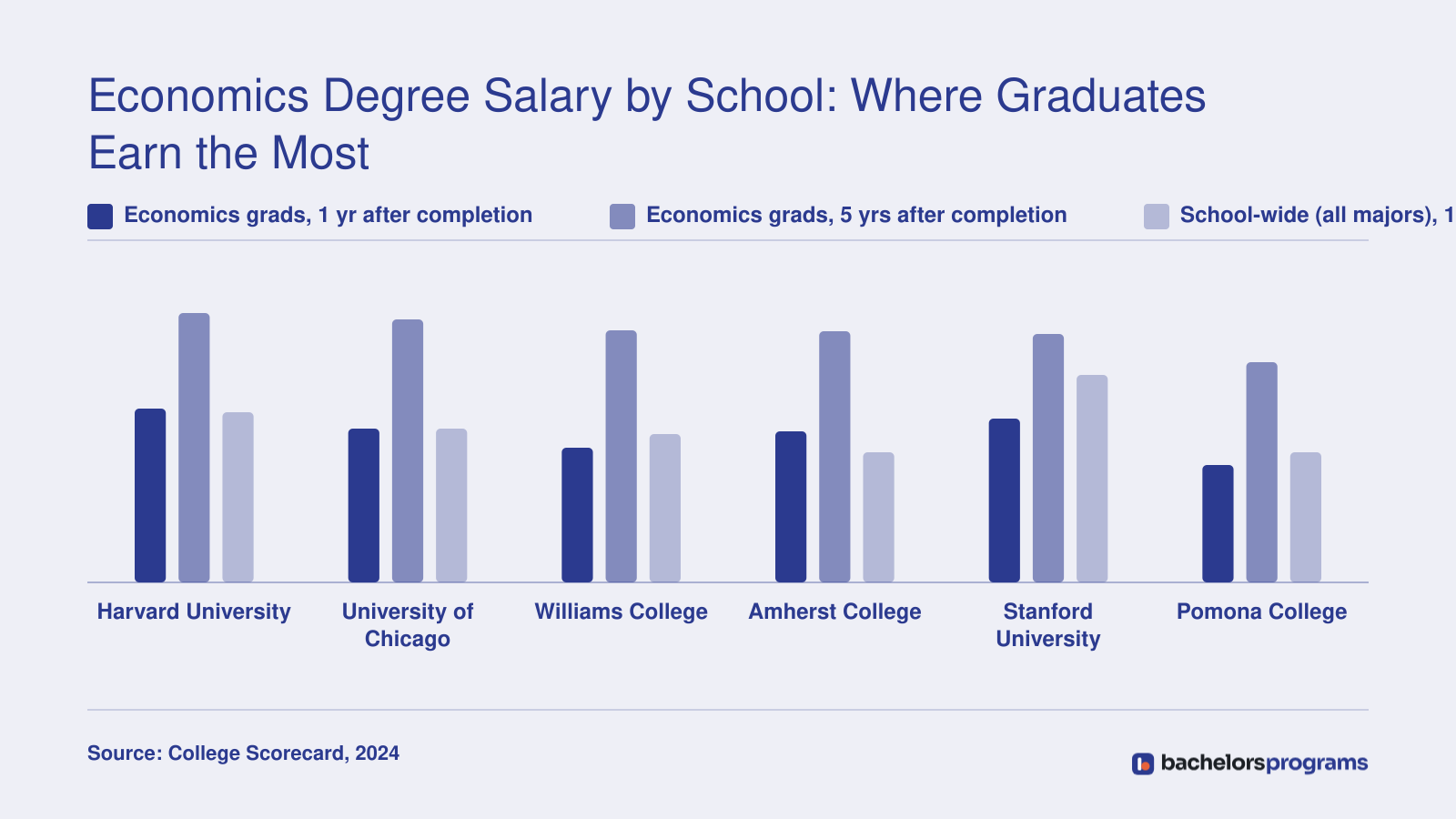
Harvard economics graduates post the highest median earnings five years after completion, at $161,251, with the University of Chicago ($157,181) close behind. The first two bars for each school track economics graduates only, while the third bar covers all majors at that school 10 years after entry, so it blends economics with lower-paying fields and is not a like-for-like comparison. On a rough earnings-to-cost ratio, used here only as a value proxy, Stanford leads at about 10.3, while Amherst sits lowest at about 5.7 despite strong economics pay.
Best Online Economics Degree Programs: Formats, Transfer Credit, and Time to Finish
Online economics degrees have moved from a niche option to a mainstream route into analytics, policy, and finance work, and the real differentiator now is how a program is built, not whether it is online. Arizona State, Oregon State, and the University of Florida all deliver economics bachelor's degrees largely online, but their rules on scheduling, transfer credit, and exams diverge in ways that change how fast you finish.
Fully Online, Hybrid, and Campus-Only
The economics degrees ranked here are campus programs, though several of those universities run separate online divisions. Fully online means remote instruction with no routine in-person attendance. Hybrid mixes online coursework with required campus visits, labs, or exams. Campus-only expects you on site. Confirm which category the economics major actually falls into, because a university can offer the same major in more than one format.
Asynchronous vs Synchronous Delivery
Most online economics programs are primarily asynchronous: you complete readings, problem sets, and exams within weekly deadlines, without a fixed class hour. That suits working adults, caregivers, and anyone in a different time zone. Synchronous courses meet live on a schedule, which suits students who want discussion and immediate feedback. ASU Online is generally asynchronous, but some courses require scheduled work.1 UF Online is primarily asynchronous, though some courses include synchronous components, including exams at the instructor's discretion.2
Transfer Credit and Time to Finish
Transfer credit is where online economics degrees differ most. ASU generally accepts up to 64 undergraduate transfer credits3; transfers can finish in under four years, while first-time students taking 12 or more credits per semester typically need about four years.4 Oregon State requires 45 of your last 75 credits there5, online or on campus, and reviews prior work course by course.6 UF sets no maximum transfer-credit limit, but upper-division applicants generally arrive with an A.A. or 60 or more transferable credits.2 UF does not publish a single completion time; full- or part-time enrollment changes the math.
What to Verify Before You Enroll
Ask two questions that brochures rarely answer. First, can you complete calculus, statistics, and econometrics online, or do those courses require a campus visit or proctor? Oregon State says some Ecampus courses require proctored exams and others do not, with the instructor deciding.7 UF Online uses Honorlock proctoring as general practice.2 Second, does the diploma or transcript differ from the campus version? Get that in writing.
An online economics degree fits working adults, career changers, military personnel, and students who need schedule flexibility. It fits less well if you want live seminar discussion or easy access to faculty office hours.
Related Articles
A prestigious name matters less than what you keep after graduation. Low debt paired with strong early earnings beats a famous diploma that leaves you owing more than you can comfortably repay.
BA vs BS in Economics: How Much Math and Econometrics You'll Take
The BA and BS in economics usually share the same core theory. They differ in how much calculus, statistics, and econometrics the department requires. Published requirements at UC San Diego and Ohio State show the pattern. At research universities, larger classes are common, but you get more track options and lab-style research access. At liberal arts colleges, small seminars and close faculty contact are typical, and the major is often a single track, so check each department's current catalog.
| Feature | BA in Economics | BS in Economics |
|---|---|---|
| Calculus level | UC San Diego's BA transfer preparation calls for a full three-course calculus sequence. Ohio State's BA intermediate microeconomics and macroeconomics are algebra-based. | UC San Diego's BS requires the three-course calculus sequence in its MATH 10 series (the MATH 20 series is recommended). Ohio State's BS uses calculus-based intermediate micro and macro. |
| Linear algebra | Not required in UC San Diego's Economics major. | Varies by school. UC San Diego's more quantitative QEDS major requires it, while its Economics major does not. |
| Statistics prerequisite | Ohio State BA econometrics requires Statistics 1450 or Economics 3400. | Ohio State BS econometrics requires Statistics 2450. |
| Econometrics | Ohio State BA students take one elementary econometrics course. | Ohio State BS students take a two-course econometrics sequence. UC San Diego's BS requires a three-part ECON 120 sequence. |
| Programming (R, Python, Stata) | UC San Diego's published BA requirements list no dedicated programming course. | UC San Diego's published BS requirements also list no dedicated programming course. Ask each department where R, Python, or Stata is taught. |
| Elective flexibility | Generally more room for electives, minors, or a double major, since fewer quantitative courses are required. | Generally less room, because more required courses are quantitative. |
| Best career and grad school fit | Policy, law, public service, and general business paths. Also suits students who want to pair economics with another field. | Finance, data analysis, and quantitative roles. Also the stronger preparation for PhD or master's study in economics. |
Questions to Ask Yourself
Are you comfortable with multivariable calculus and econometrics, or would a BA track with more elective room fit better?
Do you want direct recruiting access to finance and consulting firms, or are you aiming for a policy master's or PhD?
Will you transfer community college credits, and does your target program apply them to major requirements rather than electives alone?
Is low monthly debt more important to you than a school's name recognition?
Getting Into an Economics Major: Requirements Checklist
Getting into a university and getting into its economics major are often two separate steps. Use this checklist to plan for both.
- Strong high school mathCalculus is a core early prerequisite at schools like UC Berkeley and UCLA, so arrive ready to start it in your first year.
- Admission vs. declarationBerkeley treats the major as admission-based. UCLA requires you to finish pre-major courses before you can declare.
- Gateway coursesBerkeley requires intro economics, Calculus I and II, and statistics, with at least one math or stats course taken at Berkeley. UCLA's 2026 catalog lists Math 31A/31AL and 31B.
- Minimum gradesBoth schools require a C or better in each prerequisite. At Berkeley, a C- does not count.
- GPA thresholdsUCLA's 2026 catalog sets a 2.5 GPA in economics and math preparation. Its math department cites 2.7 for pre-major GPAs, so confirm which applies to your entry year.
- Deadlines and transfer timingAt Berkeley, first-year students apply by the fifth semester or before 80 units. Transfers apply in their first semester. At UCLA, non-transfers declare by the 8th regular quarter and transfers by the third regular term.
- Testing policyTest-optional and test-required rules have shifted at selective universities in recent years. Check each school's admissions page for the current policy.
Economics programs by state
Economics Degree FAQs
These answers cover the questions prospective economics majors ask most often, from California options to transfer rules, degree comparisons, and early pay.
What are the best economics degree programs in California?
Can I transfer community college credits into an online economics bachelor's degree?
Is an economics degree worth it compared with a finance or business degree?
How much do economics majors make in their first few years?
Compare Economics programs on the data that matters
Explore more Business & Management majors or browse every field of study.
All Business & Management programs Browse every field of study