Best Business Communication Degree Programs
Compare 930+ accredited Communication programs, with net price after aid, graduation rates, earnings and debt from IPEDS and the U.S. College Scorecard.

Business communication degrees cost anywhere from about $3,000 to more than $46,000 a year in net price, and the gap between schools rarely tracks what graduates earn. Among the programs here, Baruch College averages $3,033 a year after aid, while Chapman University averages $46,555.
The ranking draws on College Scorecard net price, graduation rate, and program-level earnings. Most of these programs sit under communication studies rather than a degree titled "business communication," so the curriculum and concentration options matter as much as the name.
Employers hiring for communications, marketing, and corporate roles care more about internships and writing samples than the exact major label.
Key Points
- Baruch College averages just $3,033 a year in net price.
- BLS data shows several business communication roles pay over $70,000 median.
- Net price after grants, not sticker tuition, reveals what families actually pay.
The 10 Best Business Communication Schools Ranked
These ten programs pair a communication core with business-facing coursework, internships, and reported outcomes. Each card names the degree and concentration options, then gives the median earnings of communication graduates where the program reports them, with the time window stated. Net prices are averages after aid and graduation rates are institution-wide.
CUNY Bernard M Baruch College
#1New York, NY · $7,000 – $15,000/yr (est.)
Best for: Manhattan-focused students seeking corporate internships
A CUNY senior college in Manhattan with a strong business identity, Baruch offers a B.A. in Communication Studies with four concentrations, including digital communication and culture and rhetoric and public advocacy. Communication graduates earned a median of $47,880 one year after completion and $69,215 four years out.
- Four concentrations: interpersonal and group, intercultural, rhetoric, digital culture
- Curriculum built from approved elective courses
- Department guidance on Communication Studies vs. Corporate Communication
- Declare the major early to avoid graduation delays
- Department office located in NVC Room 8-240
University of Iowa
#2Iowa City, IA · $11,000 – $33,000/yr (est.)
Best for: Future managers drawn to leadership coursework
Iowa's communication studies major offers six specializations, among them business and community leadership, and requires 39 semester hours inside a 120-credit degree. A foundation, intermediate, and capstone sequence keeps the path structured, transfer credit is accepted, and a 2.00 GPA minimum applies.
- Six specializations, including Business and Community Leadership
- 39 semester hours in the major within 120 total credits
- 2.00 GPA minimum required in the major
- Capstone course required for completion
- Up to 56 COMM hours may count toward the degree
- Transfer credit accepted, up to 15 hours
University of Colorado Boulder
#3Boulder, CO · $25,000 – $30,000/yr (est.)
Best for: Double-major planners combining communication with another field
Every communication major at CU Boulder adds a secondary area of study, so students often pair communication with business, marketing, or a language. Internship and career resources begin in the first semester, and the department runs centers such as TEDxCU. Graduates move into sales, marketing, consulting, and corporate communication roles.
- Secondary area of study (minor or certificate) required
- Internship and career resources from the first semester
- Home to internationally recognized centers such as TEDxCU
- Coursework in media literacy, persuasive writing, interpersonal dynamics
- Employers include National Geographic, Microsoft, and NPR
Marquette University
#4Milwaukee, WI · ~$31,000/yr (est.)
This Jesuit campus in Milwaukee fields a 36-credit communication studies major with more than 20 electives across organizational, family, health, and intercultural communication. A senior seminar caps the degree, and internships are recommended in each emphasis. Communication graduates earned a median of $39,816 one year after completion and $71,711 four years later.
- 36 major credits within a 120-credit degree
- More than 20 electives to tailor the major
- Electives span organizational, family, health, and intercultural communication
- Senior seminar on contemporary communication issues
- Internships recommended within each emphasis area
- Room to add a minor or second major
Indiana University-Indianapolis
#5Indianapolis, IN · $11,000 – $35,000/yr (est.)
IU Indianapolis builds its communication studies degree around applied practice, with a Speaker's Lab for one-on-one public speaking coaching and an accelerated five-year path to a master's. Coursework spans interpersonal, organizational, and media communication, and internships plus student organizations supply portfolio material.
- Speaker's Lab offers one-on-one public speaking coaching
- Accelerated five-year B.A. to M.A. option
- Coursework in interpersonal, organizational, and media communication
- Internships and jobs resources for students
- Student organizations and community involvement
University of Wisconsin-Eau Claire
#6Eau Claire, WI · ~$17,000/yr (est.)
UW-Eau Claire frames communication studies as theory, research, and practice, starting with interpersonal communication, rhetoric, and research methods. Electives reach into family communication and political or environmental rhetoric, and a research seminar closes the program. A published four-year plan and an internship course make the path easy to map.
- 120-credit, four-year sample degree plan published
- Core courses in interpersonal communication, rhetoric, research methods
- Electives such as family communication and political rhetoric
- Culminating communication research seminar
- Internship course available as CJ 498
Grand Valley State University
#7Allendale, MI · $15,000 – $20,000/yr (est.)
Grand Valley's communication and media studies degree comes as a B.A. or B.S. with five concentration options and student-run media outlets, including a newspaper, a TV station, and a radio station. Internships with PBS and NPR affiliates and a London study abroad term add professional experience before graduation.
- Five concentration options, including advertising and public relations
- Student-run media: Lanthorn newspaper, GVTV, Whale Radio
- Internships with PBS and NPR affiliates
- London study abroad program
- 120 total credit hours; B.A. or B.S. available
- Scholarships available for majors
North Dakota State University
#8Fargo, ND · ~$16,000/yr (est.)
NDSU's strategic communication degree concentrates in advertising and public relations and requires a 120-hour field experience, so students graduate with client work and campaign competition results behind them. Median earnings for communication graduates were $36,513 one year after completion and $62,181 four years out.
- Concentrations in advertising and public relations
- Required 120-hour field experience
- Students consult for local clients and enter national competitions
- Student organizations include Advertising Club and PRSSA
- Coursework in copywriting, media relations, event planning, digital strategy
Chapman University
#9Orange, CA · $47,000/yr (est. net price)
Chapman requires an internship of every communication studies student, with placements across Orange County, Los Angeles, or abroad. Electives specialize in entertainment, health, marketing, politics, or sports, and a 4+1 pathway shortens the route to a master's. Communication graduates earned a median of $39,901 one year after completion and $76,412 four years later.
- Internship required for all students
- Placements in Orange County, Los Angeles, or abroad
- Electives in entertainment, health, marketing, politics, sports
- Faculty-led research and independent study available
- 4+1 accelerated master's pathway
- Dedicated career advisor for the program
Portland State University
#10Portland, OR · ~$10,000/yr (est.)
Portland State's communication major lets students customize upper-division electives toward media literacy, family communication, or environmental campaigns, and many courses run in online or hybrid formats. Community partnerships supply hands-on projects, and an accelerated bachelor's-plus-master's option is available on the downtown campus.
- Customize electives in media literacy and family communication
- Hands-on projects with community partners
- Accelerated bachelor's plus master's option
- Online and hybrid course formats available
- Local employers include Nike and OHSU
Cost & outcomes by school
Federal data for the highest-earning Communication programs, independent of the ranking above. Earnings are this field's bachelor's graduates four years after completing where the Scorecard reports them, else the school's undergraduate median.
| School | Net price / yr | Grad rate | Earnings | Debt | Grads/yr | Format |
|---|---|---|---|---|---|---|
| Carnegie Mellon University PA | $31,944 | 94% | $114,862 | $21,750 | — | Campus |
| University of Pennsylvania PA | $28,699 | 97% | $111,371 | $15,715 | — | Campus |
| Santa Clara University CA | $50,062 | 88% | $109,183 | $19,162 | — | Campus |
| Cornell University NY | $28,690 | 95% | $104,043 | $14,000 | — | Campus |
| Boston College MA | $41,704 | 91% | $103,937 | $19,000 | — | Campus |
| Rensselaer Polytechnic Institute NY | $36,228 | 84% | $102,051 | $23,750 | — | Campus |
| Villanova University PA | $43,756 | 92% | $100,423 | $25,874 | — | Campus |
| Northeastern University MA | $30,915 | 91% | $92,538 | $24,250 | — | Campus |
| University of Southern California CA | $32,740 | 92% | $92,498 | $18,000 | — | Campus |
| Vanderbilt University TN | $15,846 | 94% | $91,565 | $14,000 | — | Campus |
| George Washington University DC | $36,586 | 84% | $90,873 | $20,449 | — | Campus |
| California Polytechnic State University-San Luis Obispo CA | $16,665 | 86% | $90,768 | $18,500 | — | Campus |
Sources: U.S. Department of Education. Net price, graduation rate, earnings and debt: College Scorecard (earnings and debt for this field's bachelor's graduates where reported, else school-wide); graduates: IPEDS. A dash means no figure is reported.
Cost, debt & payoff
Median earnings of this field's bachelor's graduates (4 yrs after completing, else the school's undergraduate median) vs. their median federal loan debt · U.S. College Scorecard
Across these programs the median graduate earns about $54,947 and finishes with roughly $23,250 in debt — a ratio that clears a common rule of thumb (keep debt below first-year salary). Net price and debt vary widely school to school, so check the per-school figures in the table above before you shortlist.
How We Ranked These Business Communication Programs
A business communication degree teaches the writing, speaking, and presentation skills that organizations use to sell ideas, manage teams, and reach customers. The ranking compares bachelor's programs in that field on the cost and outcome measures that matter most to prospective students.
Where the Numbers Come From
The data comes from the U.S. Department of Education's College Scorecard and IPEDS, drawn from the latest available snapshot. Those sources supply what students actually pay after aid, graduation rates for the whole institution, and program-level earnings and debt for graduates.
What the Comparison Weighs
- Average net price: What students pay after grants and scholarships, rather than the published sticker price.
- Graduation rate: The share of full-time students who finish their degree within the school's reported timeframe.
- Earnings and debt: Median earnings for graduates of the program and typical debt at completion, where the government reports them.
- Delivery format: Online, campus, and hybrid options are compared together so readers can weigh flexibility against cost and outcomes.
Reading the Limits
Graduation rates describe the entire institution, not just the communication major. That net price averages students who receive aid, so your own offer may differ. Some smaller programs do not publish earnings or debt figures, and those entries lean on cost and completion data instead.
Ranking every format in one field keeps the comparison honest. A strong online program should not be buried simply because it does not have a residential campus, and a low-cost public option should compete directly with a private university on the same measures.
Business Communication Degree Tuition, Net Cost, and Debt
Every program here carries two prices, and they can point in opposite directions: the published tuition rate and the net price a family actually pays after grants and scholarships.
Sticker Price vs. Net Price
Published in-state tuition at the public universities ranked here runs from about $7,500 to $15,700 a year, while out-of-state rates reach roughly $44,900. Private tuition sits between about $33,000 and $65,000. All of those figures describe the price before aid, so they overstate what most families pay.
Net price is the better planning number. After federal, state, and institutional aid, the public options here land between about $3,000 and $25,300. Private net prices span roughly $16,600 to $46,600, and the least expensive private colleges undercut several publics on this measure. That crossover is why sticker price alone can send you to the wrong school.
Debt at Graduation
The lowest-debt programs in the set report median federal debt of about $11,500 at completion, which works out to roughly $123 a month on a standard 10-year repayment plan. Most others cluster in the low-to-mid $20,000s, with monthly payments from about $190 to $285.
Run the Calculator
None of these averages will match your family's aid package. Run each school's net price calculator with your own income figures before you apply, then compare the results side by side.
Which Ranked Business Communication Schools Cost the Least After Aid?
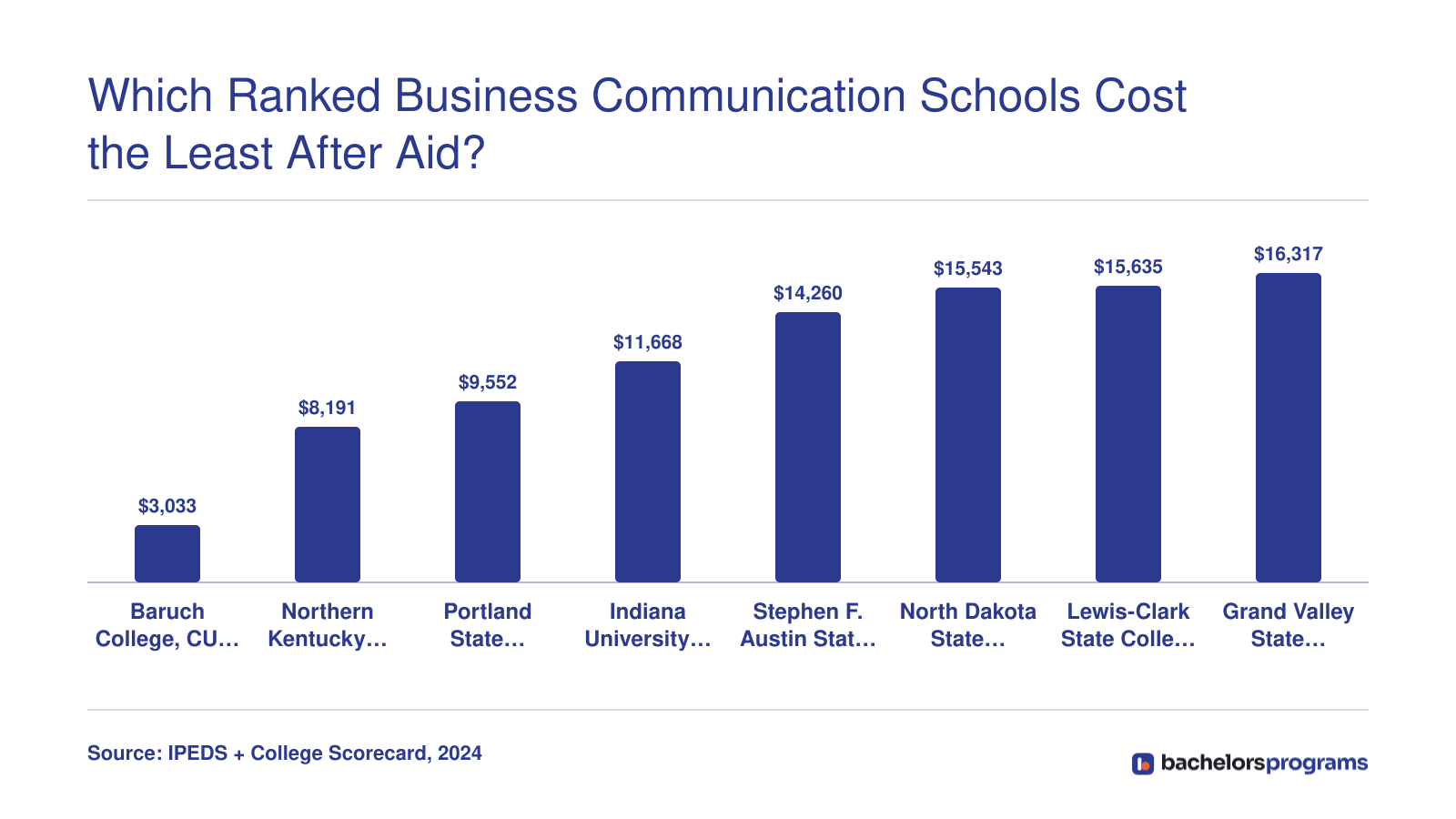
Every school in this chart is a public university. Each figure is the institution-wide average annual net price after grants and scholarships, not a price specific to the communication major. Baruch College stands out at $3,033 a year, less than half the cost at the next school, Northern Kentucky University, at $8,191. Your own cost will depend on residency, family income, and the aid package you receive.
Related Articles
Online vs. Campus Business Communication Degrees: Who Each Format Suits
Campus programs hand you internships, faculty access, and student media. Online programs hand you your schedule back. The right pick depends on where you are in life, not on which format sounds more prestigious.
Yes, a business communication degree can be earned fully online. The schools ranked here, though, are all campus-based, so an online route means looking beyond this list. Portland State is the closest to a blend, with flexible online and hybrid courses alongside its downtown program.
Who Each Format Suits
- Online: Working adults and degree completers who need to study around a job, family, or earlier college credits.
- Campus: Traditional freshmen who want internships, networking, and hands-on media work. Grand Valley State's student-run Lanthorn, GVTV, and Whale are a good example, and Chapman requires an internship of every student.
- Hybrid: Students who want some in-person contact but cannot commute every day, or who want to trim the cost of living near campus.
Check the Price Tag by Residency
At public universities, online students are sometimes billed out-of-state rates. The gap can be large. Colorado Boulder lists in-state tuition at $15,214 and out-of-state at $42,970. Iowa runs $11,283 versus $33,371. Compare both figures for any public school, then ask whether online students get a different rate.
Ask Whether the Versions Match
Before enrolling in an online option, confirm three things:
- Online and campus students are taught by the same faculty.
- Both versions follow the same curriculum and required courses.
- The diploma looks the same and does not mention the delivery format.
If a school cannot answer clearly, treat that as a warning sign.
Business Communication Major vs. Communication Studies vs. a Business Degree With a Communication Concentration
Three bachelor's degrees can look nearly identical on a major search page: a business communication major, a communication studies major, and a business degree with a communication concentration. They all teach people to write, present, and persuade, but they sit in different colleges and carry different cores.
Degree Type and Home College
Business communication is often a B.A. or B.S. housed in a communication department, though some schools place it in a business school as a BBA. Communication studies is usually a B.A. in communication.1 A business degree with a communication concentration is a BBA or B.S. in business first, with a communication emphasis added. That home college matters: it determines your advisors, internship network, and how much accounting, finance, and management you take.
What You Actually Study
A business communication major mixes writing-intensive communication courses with a practical business base. Expect business writing, corporate and organizational communication, persuasion, and rhetoric, plus some accounting, management, and economics. Communication studies leans more toward theory, rhetoric, media, and public speaking, with fewer business courses. The BBA route flips the ratio: a full business core in accounting, finance, marketing, and management, then a cluster of communication courses such as corporate communication or professional writing. Where you end up follows what you study. Business communication graduates tend to move into corporate communication, human resources, or marketing; communication studies graduates into public relations, media, or graduate study; and BBA graduates into management, sales, or operations with a communication edge.
The 120-Credit Norm
All three routes usually land at 120 semester credits for a bachelor's degree.2 That total is a useful comparison point, but the split among general education, major, and electives varies by university. When a listing says "business communication concentration," read it as a track inside a larger business or communication major, not necessarily a standalone department. Check the required course list and the number of business credits before you apply.
Which Path Fits
Choose business communication for a communication degree with business literacy, communication studies for the broadest communication foundation, and the BBA concentration for a business credential first.
Business Communication Jobs and What They Pay
A business communication degree leads to several roles that hire at the bachelor's level and pay above $70,000 at the median. The U.S. Bureau of Labor Statistics tracks a few of these occupations, and the figures below are occupation-wide medians for all workers in the role, not starting salaries for new graduates. A first job will often land below the median while experience builds.
Where Graduates Land
Business communication majors move into public relations, human resources, fundraising, market research, training and development, and internal corporate communication. Public relations specialists shape an organization's public message, draft releases, and brief journalists. Human resources specialists recruit, screen, onboard, and field employee questions. Fundraisers plan campaigns, cultivate donors, and write grant proposals. Market research analysts and training and development specialists round out the list; both rely on clear writing, audience analysis, and presentation skill.
The Numbers
- Public relations specialists: median annual pay of $74,750 in 2025, projected growth of 2% from 2025 to 2035, bachelor's degree typical.1 They write and edit communications, coordinate media interviews, and manage an organization's response to public issues.
- Human resources specialists: median annual pay of $75,940, projected growth of 6% from 2025 to 2035, bachelor's degree typical.2 They post openings, review resumes, interview candidates, and help employees navigate benefits and policies.
- Fundraisers: median annual pay of $72,550, projected growth of 6% from 2025 to 2035, bachelor's degree typical.3 They organize donor outreach, plan events, track gifts, and write appeals for nonprofits, universities, and hospitals.
Reading the Pay Gap
The distance between the median and a first salary matters. A starting offer reflects the employer, the city, and the internship record, not the degree alone. Treat the medians as a level to grow toward, not a promise at hire.
Top Early-Career Earnings Among Ranked Programs
Early pay is one way to compare how quickly graduates turn a communication degree into a paycheck.
Communication programs by state
Business Communication Degree FAQ
These answers cover the questions prospective students ask most about choosing, finishing, and using a business communication degree. Timelines and requirements vary by school, so confirm details with any program you consider.
What is the best degree for business communication?
How long does it take to get a business communication degree?
Can you get a business communication degree online?
Should I get a master's in communication after a business communication bachelor's, or go straight to work?
Compare Communication programs on the data that matters
Explore more Business & Management majors or browse every field of study.
All Business & Management programs Browse every field of study