Best Finance Schools in North Dakota
Compare 8 accredited Finance programs in North Dakota, with net price after aid, graduation rates, earnings and debt from IPEDS and the U.S. College Scorecard.

Four years after finishing a bachelor's degree in finance at North Dakota State University, graduates report median earnings of $80,522, the highest among the state's finance programs. That gap matters more than sticker price for students weighing Fargo, Grand Forks, Bismarck and the smaller regional campuses.
A Bachelor of Science in Finance is the most common credential, though some schools award a B.B.A. or place finance inside a financial services major. Campus and online routes both exist, and the differences between schools come down to cost, admissions standards and program structure.
Recruiters in commercial banking and corporate finance scan for AACSB accreditation early, so check it before anything else.
Key Points
- Bismarck State College ranks first, with the lowest published cost here.
- North Dakota State finance graduates earn a $80,522 median four years out.
- Minot State and Dickinson State charge one tuition rate regardless of residency.
Top Bachelor's in Finance Programs in North Dakota
Bismarck State College takes the first spot on this list, pairing the lowest published cost of the group with an applied finance bachelor's that accepts transfer credit and stacks business certificates. North Dakota State and the University of North Dakota follow with the strongest investment-training resources in the state. All eight entries are bachelor's-level programs offered by North Dakota institutions.
Bismarck State College
#1Bismarck, ND · $10,000 – $15,000/yr (est.)
Best for: Transfer students building on prior credit
Bismarck State College delivers its finance bachelor's in an applied format built for students who arrive with prior college credit, with stackable certificates in accounting, management, data analytics and other business fields layered into the degree. In-state tuition and fees run $5,247 and the average net price after aid is $10,270; the institution-wide graduation rate is 47%. An internship and two entry points each year keep the program tied to regional finance hiring, and qualified students can be admitted directly.
- Two start dates per year, fall and summer
- 2.0 GPA minimum for admission
- Stackable certificates in accounting, management and data analytics
- Internship applies finance theory to real-world situations
- Previous college credit accepted, including applied associate degrees
- Careers cited: financial analyst, financial planner, stockbroker, risk manager
- Direct admission available for qualified students
North Dakota State University
#2Fargo, ND · ~$16,000/yr (est.)
Best for: Future analysts seeking real-money portfolio experience
North Dakota State University runs the most hands-on finance major in the state, anchored by a student-managed Bison Fund, Bloomberg terminals in a dedicated trading lab and a CFA Institute affiliation that shapes the curriculum. In-state tuition and fees are $11,110 and net price after aid is $15,543, against an institution-wide graduation rate of 64%. A three-credit practicum and dedicated advising round out a campus program aimed at corporate finance, banking and investment roles.
- Student-run Bison Fund manages a $2.5 million portfolio
- Bloomberg terminals in the Commodities Trading Lab
- CFA Institute University Affiliation Program member
- Three-credit practicum connects coursework to business practice
- Covers corporate and international finance, investments, portfolio management
- Dedicated academic advisor; financial aid and scholarships available
University of Mary
#3Bismarck, ND · ~$18,000/yr (est.)
Best for: Bismarck students drawn to financial planning
The University of Mary houses finance in the Gary Tharaldson School of Business, where the Financial Services and Banking major leans toward planning-oriented coursework such as retirement planning, insurance and behavioral finance. Tuition and fees run $22,356, the average net price after aid is $17,770, and the institution-wide graduation rate is 67%. A required internship of at least four credits and an Investment Club mentored by professionals from major investment firms give students portfolio experience before graduation.
- Default track is a Bachelor of Science, with B.A. and B.A.S. alternatives
- Required Financial Services Capstone
- Minimum of four internship credits in the business school
- Up to four semester credits for Investment Club participation
- Investment Club mentors come from major investment firms
- Major courses require a final grade of C or higher
- Coursework spans retirement planning, insurance, investments and behavioral finance
University of North Dakota
#4Grand Forks, ND · ~$19,000/yr (est.)
The University of North Dakota awards an AACSB-accredited Bachelor of Business Administration in Finance, with a curriculum spanning investment analysis, portfolio management, real estate finance and capital market strategy. In-state tuition and fees are $10,951 and net price after aid is $18,551, with an institution-wide graduation rate of 60%. Students manage a $2.5 million investment fund and trade on eleven Bloomberg terminals at the Lanterman Investment Center.
- AACSB accredited business school program
- 120 credit hours across a four-year plan
- Students manage a $2.5 million investment fund
- Eleven Bloomberg terminals at the Lanterman Investment Center
- Starts in fall, spring and summer with synchronous and asynchronous options
- No campus visits required; free online tutoring included
- Coursework in investment analysis, portfolio management and real estate finance
Dickinson State University
#5Dickinson, ND · ~$14,000/yr (est.)
Dickinson State University offers a Bachelor of Business Administration in Finance built on a 120-credit sequence that adds financial statement analysis, income tax, investments and international finance on top of a 31-credit business core. In-state tuition and fees are $9,118 and net price after aid is $14,092, against an institution-wide graduation rate of 51%. The major is also offered at the Williston campus, and graduates need a cumulative GPA of 2.25.
- 120 credits: 41 to 42 general education, 31 business core, 23 finance core
- Finance core includes financial statement analysis, income tax and investments
- Also offered at the Williston campus and online
- Cumulative GPA of 2.25 or higher required to graduate
- Semester-by-semester degree plan published for all four years
- Housed in the School of Business and Entrepreneurship
Minot State University
#6Minot, ND · $13,000/yr (est. net price)
Minot State University's College of Business grants a Bachelor of Science in Finance with a financial trading lab, a corporate-style boardroom and internships that carry academic credit and often convert into job offers. In-state tuition and fees are $8,702 and net price after aid is $12,703; the institution-wide graduation rate is 45%. The business school holds IACBE accreditation, and the program cites a 96% job or graduate school placement rate.
- IACBE accredited College of Business program
- 120 credit hours completed over four years
- Slaaten Learning Center trading lab and corporate-style boardroom
- Internships carry university credit and often lead to job offers
- Seven student-run business clubs for networking and competition
- Program cites a 96% job or graduate school placement rate
- Coursework in banking, investments, real estate and financial planning
Valley City State University
#7Valley City, ND · $12,000/yr (est. net price)
Valley City State University does not list a standalone finance major; finance study sits inside the business administration composite major as a Managerial Accounting and Finance concentration. In-state tuition and fees are $8,514 and net price after aid is $11,890, with an institution-wide graduation rate of 53%. The 21-credit concentration pairs intermediate accounting with electives in banking, investments and taxation, and the Department of Business holds IACBE accreditation.
- 120 credits: 39 general education, 48 in the major, 21 in the concentration
- Concentration requires Managerial Accounting and Intermediate Accounting I and II
- Four electives from taxation, auditing, banking, investments and related areas
- IACBE accredited Department of Business
- Meets the IMA education requirement for the CMA credential
- Does not meet North Dakota accounting-hour rules for the CPA exam
- Bridge agreement with UND lets accepted students take two master of accountancy courses
Rasmussen University-North Dakota
#8Fargo, ND · ~$14,000/yr (est.)
Rasmussen University's Fargo location supports an online, degree-completion finance bachelor's designed for working adults who already hold an associate degree or roughly two years of college credit. Program tuition totals about $29,880 at $332 per credit across 90 credits, and coursework can be finished in as little as 18 months. The institution-wide graduation rate is 29%, and students can take one MBA course through an accelerated pathway.
- 90 credit hours across 23 courses; completion in as few as 18 months
- $332 per credit, about $29,880 total program tuition
- Prepares students for the Level I CFA exam
- Accelerated pathway allows one MBA course during the bachelor's
- Self-directed assessments at $149 let students move at their own pace
- Requires an associate degree or at least 40 semester credits with C- or better
- Transfer credit estimate returned within one day
Cost & outcomes by school
Federal data for the highest-earning Finance programs, independent of the ranking above. Earnings are this field's bachelor's graduates four years after completing where the Scorecard reports them, else the school's undergraduate median.
| School | Net price / yr | Grad rate | Earnings | Debt | Grads/yr | Format |
|---|---|---|---|---|---|---|
| North Dakota State University ND | $15,543 | 64% | $80,522 | $23,250 | 98 | Campus |
| Dickinson State University ND | $14,092 | 51% | $76,040 | $18,442 | 12 | Hybrid |
| Rasmussen University-North Dakota ND | — | 29% | $70,838 | $24,433 | — | Online |
| Minot State University ND | $12,703 | 45% | $69,738 | $19,609 | 24 | Campus |
| University of North Dakota ND | $18,551 | 61% | $65,856 | $23,250 | 68 | Online |
| University of Mary ND | $17,770 | 67% | $60,909 | $24,000 | 16 | Campus |
| Bismarck State College ND | $10,270 | 47% | $54,277 | $11,533 | 7 | Online |
| Valley City State University ND | $11,890 | 53% | $52,725 | $20,369 | — | Online or campus |
Sources: U.S. Department of Education. Net price, graduation rate, earnings and debt: College Scorecard (earnings and debt for this field's bachelor's graduates where reported, else school-wide); graduates: IPEDS. A dash means no figure is reported.
Cost, debt & payoff
Median earnings of this field's bachelor's graduates (4 yrs after completing, else the school's undergraduate median) vs. their median federal loan debt · U.S. College Scorecard
Across these programs the median graduate earns about $67,797 and finishes with roughly $21,810 in debt — a ratio that clears a common rule of thumb (keep debt below first-year salary). Net price and debt vary widely school to school, so check the per-school figures in the table above before you shortlist.
How We Ranked North Dakota Finance Schools
Four measures decide where a North Dakota finance program lands on a list like this one.
Four Inputs, in Plain Terms
- Affordability: The net price a first-year student pays after federal, state and institutional aid. A lower net price lifts a school.
- Graduation rate: The share of full-time students who finish a degree within six years.
- Graduate earnings: Median pay for former students, measured by the federal College Scorecard at set intervals after they leave.
- Program availability: Whether the school awards a full bachelor's degree in finance, and whether it is delivered on campus, online or both.
What Those Figures Describe
Neither figure is about the finance department; both are institution-wide. Read both as context for the school as a whole, not as a verdict on the finance major. A school with a modest overall completion rate can still run a demanding finance sequence, and a school with a strong rate can still strain your budget.
Earnings come from the College Scorecard and reflect graduates from earlier years, not the class entering now. Where a school does not report a figure, that measure is left out of its profile rather than estimated or borrowed from another source.
Availability Counts Too
A standalone finance major reads differently from a concentration housed inside a business administration degree, and an online route matters if you cannot relocate. Both shapes appear among the schools below, and the cost and comparison sections break down which is which.
NDSU vs UND: Bachelor's in Finance Program Comparison
North Dakota State University in Fargo and the University of North Dakota in Grand Forks both offer a bachelor's degree in finance. NDSU's catalog shows an AACSB-accredited College of Business, CFA Institute University Affiliation for its finance program, and a 120-credit minimum under the 2025-2026 Finance Major bulletin. NDSU's CFP Board-Registered coursework is a separate Financial Planning and Wealth Management minor, not the B.S. in Finance itself. The UND column points you to the details to confirm with UND's college of business and current catalog before you compare the two directly. Gaps in the UND column reflect what we could verify, not missing features. Credit totals and course lists change by catalog year, so check the bulletin for your entering year.
| Feature | North Dakota State University (Fargo) | University of North Dakota (Grand Forks) |
|---|---|---|
| Degree | B.S. in Finance | Bachelor's in Finance |
| Business school accreditation | AACSB International accredits the College of Business's undergraduate and graduate programs (2025-2026) | Confirm AACSB status on UND's college of business pages |
| CFA Institute University Affiliation | Yes, for the finance program (2025-2026) | Confirm with UND's finance faculty or catalog |
| CFP Board-Registered coursework | Offered through the Financial Planning and Wealth Management minor, which meets the CFP exam education requirement when completed with a bachelor's degree | Ask UND whether any finance or planning coursework is CFP Board-Registered |
| Total credit hours | 120-credit minimum under the 2025-2026 Finance Major bulletin | Check UND's current academic catalog |
| Finance courses named in the catalog | Includes FIN 320, FIN 410, FIN 420, FIN 430, FIN 440, FIN 460 and BUSN 489. This is a partial list, so confirm the full core in the current bulletin. | Review UND's finance degree map for required courses |
| Curriculum topics | Corporate finance, international finance, investments and portfolio management | Review UND's course descriptions for topic coverage |
| Best fit | Students targeting investment, portfolio or CFA-track careers, or adding the financial planning minor toward the CFP credential | Students who prefer Grand Forks and confirm UND's accreditation and curriculum details directly |
Admissions: Getting Into a North Dakota Finance Program
Admission to a finance program in North Dakota generally happens in two steps: you are admitted to the university, then you are admitted to the major. Both gates matter, and they do not always use the same number.
University Admission vs. Major Admission
At North Dakota State University the split is explicit. The university admits you; the finance major then requires separate admission with a 2.5 cumulative GPA. That same 2.5 governs enrollment in 300- and 400-level finance courses and applies at graduation, so it works as a keep-going standard as much as an entry one. The degree requires 120 credits and a 2.00 institutional GPA. UND, the University of Mary, Minot State, Valley City State, Dickinson State and Rasmussen each set their own thresholds, and the posted admissions page is the version that binds you.
Testing, GPA and Transfer Credit
NDSU's transfer rule is a 2.0 cumulative GPA across all postsecondary work. Applicants with fewer than 24 transferable semester credits also submit high school coursework, grades and GPA; at 24 or more, the review centers on college work attempted and completed. Credit evaluation begins after admission and typically takes one to three weeks, longer between terms. An Associate of Arts or Associate of Science from a qualifying accreditor satisfies NDSU's lower-division general education requirements, as do the NDUS GERTA and Minnesota Transfer Curriculum. Remedial coursework and work from unrecognized institutions do not transfer.
Testing policy is the item that changes most often from year to year. Confirm each school's current first-year ACT/SAT rule on its own admissions page rather than relying on a guide or an older catalog.
A Transfer Tip That Saves Semesters
If you start at Bismarck State College or another two-year school in the state, finish the associate degree before you transfer and ask for a written general-education check against GERTA. At NDSU, transfer students still need 30 resident credits, 36 at the 300 level or above, and 15 resident credits inside the major, so save upper-level finance courses for after you arrive. NDSU also publishes articulation guides, but its business administration guide ran only through the end of 2025, so ask whether a finance-specific version is current.
- Ask early: request a credit evaluation before you commit to a start date.
- Keep syllabi: the academic department, not the registrar, decides whether a course counts toward the major.
- Protect the GPA: the major standard can sit above the university's admission standard.
Cost of a Bachelor's Degree in Finance in North Dakota: Tuition, Net Price and State Aid
Sticker prices for a bachelor's degree in finance in North Dakota stay moderate: NDSU charges residents $11,110 in tuition and fees and nonresidents $15,764, while Minot State and Dickinson State charge the same rate regardless of residency. For 2026-27, total cost of attendance (housing and meals included) is $23,107 at NDSU, with a flat rate at 13 or more credits, and $25,115 at UND, where on-campus tuition and fees are capped at 12 credits per semester. Average net price runs higher than tuition alone because it adds living costs and then subtracts grant aid, and it is an institution-wide average for aided students rather than a quote for any one student. Bismarck State College ($10,270) and Valley City State ($11,890) are the cheapest options below, though Bismarck State's program is delivered online and Valley City's is a finance concentration within business administration. North Dakota's Academic Scholarship and Career and Technical Education Scholarship each pay up to $6,000 in total to students who meet their separate high school requirements. The Academic Scholarship also requires curriculum, GPA and test benchmarks plus an application through the Department of Public Instruction, and both awards pay out only while a student is enrolled full time at a qualifying North Dakota school with at least a 2.75 cumulative GPA.
| School | Finance Program | Format | In-State Tuition and Fees | Out-of-State Tuition and Fees | Average Net Price | Graduation Rate | Trade-off to Weigh |
|---|---|---|---|---|---|---|---|
| Bismarck State College | Finance | Online | $5,247 | $7,331 | $10,270 | 47.2% | Lowest net price in this table; online delivery with a 2.0 GPA minimum, and a graduation rate below NDSU's |
| Valley City State University | Business Administration, Managerial Accounting and Finance Concentration | Online and campus | $8,514 | $13,544 | $11,890 | 53.3% | IACBE accredited; finance is paired with managerial accounting rather than offered as a standalone major |
| Minot State University | Finance | Campus | $8,702 | $8,702 | $12,703 | 45.1% | Same price for residents and nonresidents; IACBE accredited, campus-based study |
| Dickinson State University | Finance, B.B.A. | Campus and online | $9,118 | $9,118 | $14,092 | 50.6% | Same price for residents and nonresidents; also offered at the Williston campus |
| North Dakota State University | Finance | Campus | $11,110 | $15,764 | $15,543 | 63.9% | Highest net price in this table, but the highest graduation rate, plus Bloomberg terminals and a student-run fund managing $2.5 million |
Related Articles
Online and Hybrid Bachelor's in Finance Options at North Dakota Schools
Several North Dakota schools let you earn a bachelor's degree in finance online, and their formats differ sharply.
Which Schools Offer What
- Online: University of North Dakota, Bismarck State College and Rasmussen University-North Dakota.
- Campus and online: Dickinson State University and Valley City State University offer both formats. Valley City's version is a business administration degree with a managerial accounting and finance concentration.
- Campus only: North Dakota State University, University of Mary and Minot State University.
UND's Bachelor of Business Administration in Finance (120 credits) can be completed fully online or in Grand Forks. Its online finance courses are delivered 100% online with no campus visit required, and UND lists both synchronous and asynchronous options.
How Online and Campus Pricing Compare
At UND, online tuition is billed per credit at one rate for residents and nonresidents alike. On-campus tuition varies by residency: published annual tuition and fees run $10,951 in-state and $15,570 out-of-state. Online tuition is not capped at 12 credits per semester, though mandatory online fees are. UND's state tuition agreements do not apply to online programs.
Rasmussen publishes $332 per credit, or $29,880 total for a 90-credit, 18-month program. That total reflects transfer-friendly pacing, so check how many of your credits it accepts.
Who Online Suits, and What You Give Up
Online works well for working adults, transfer students and out-of-state learners, since a nonresident pays the same UND online rate as a North Dakotan. What you give up is the in-person trading lab time, student-run investment funds and campus clubs that schools like UND and NDSU promote. Confirm any in-person or hybrid requirements with the school before applying.
Finance Careers in North Dakota: Jobs, Employers and Where Graduates Land
Where finance graduates from North Dakota schools actually work depends on the city, and hiring demand in your target market is worth checking before you commit.
Build the picture from two or three current sources rather than trusting a single page, including this one. Here is a repeatable checklist.
Start With the State's Own Labor Data
North Dakota Job Service publishes occupational and wage tools that let you search titles such as financial analyst, loan officer, personal financial advisor, credit analyst, and financial manager. Filter by state and by metro area (Fargo, Grand Forks, Bismarck, Minot) to see how demand and pay differ by city. Cross-check what you find against the Occupational Outlook Handbook on BLS.gov and O*NET, which describe typical duties, entry-level education, and national trend direction for each role. When a state tool and a federal source point in different directions, treat that gap as a question for a career office, not a fact to repeat.
Identify Employers City by City
Employer names change, and so do hiring plans, so verify them close to the date you apply:
- Career pages: Search job listings at banks, credit unions, insurance carriers, and investment firms with state offices. Fargo leans toward banking, insurance, agribusiness lending, and manufacturing finance; Grand Forks toward health systems, higher education, and energy; Bismarck toward state government, insurance, and energy; Minot toward energy services, agricultural lending, and health care.
- Directories: Local chamber of commerce member lists and LinkedIn company searches filtered by city surface employers you will not find on a school page.
- School lists: Career services offices keep employer lists from recent recruiting cycles, which show who actually hires on your campus.
Confirm Expectations With People
Call the career office at North Dakota State University, the University of North Dakota, or another school on your shortlist and ask for placement information for finance graduates: job titles, hiring employers, and hiring timing. Then check the North Dakota University System site and state finance and accounting associations for internship pipelines and events. Finish with informational interviews with two or three people working in the city you are targeting. One conversation with a credit analyst in Minot will tell you more about entry-level hiring than any ranking.
What Finance Graduates From North Dakota Programs Earn
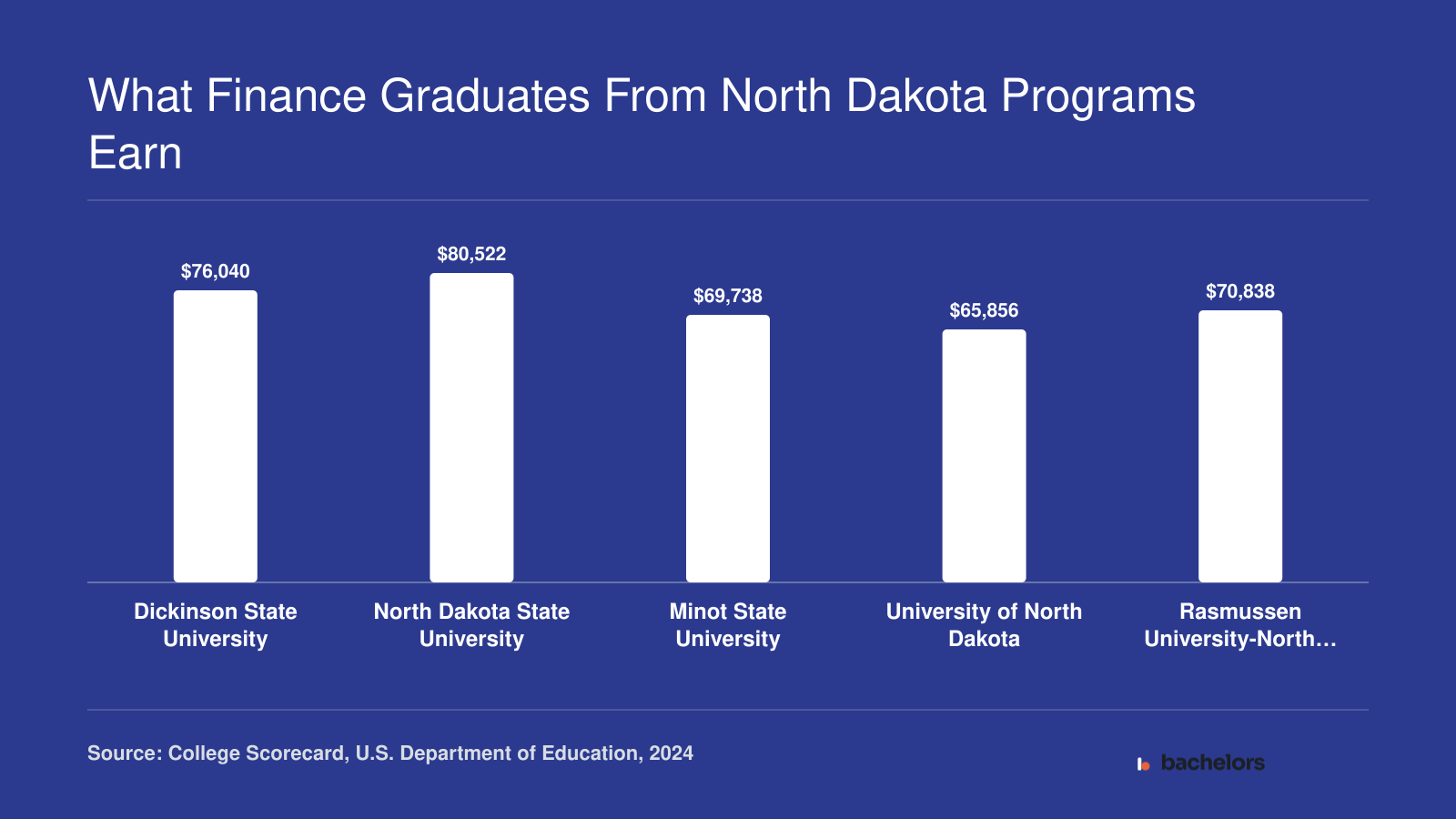
Four years after finishing a bachelor's degree in finance, graduates of North Dakota State University report the highest median earnings among these programs, at $80,522. Dickinson State University follows at $76,040, and Rasmussen University-North Dakota, Minot State University and the University of North Dakota all fall between $65,856 and $70,838. Every figure is a program-level median for finance bachelor's completers measured four years after completion, so the schools are compared on the same earnings window.
CFA, CFP and Other Certification Paths for North Dakota Finance Majors
Finance is not a licensed profession the way nursing or accounting is. Nobody hands you a state-issued finance license after graduation. What sits on the other side of your bachelor's degree is a set of credentials you earn separately, and each one points at a different job: the CFA for investments and research, the CFP for financial planning, and FINRA exams for anyone who touches securities.
Three Credentials, Three Tracks
- CFA (Chartered Financial Analyst): three exam levels, typically begun after you finish your degree, aimed at equity research, portfolio management and investment analysis.
- CFP (Certified Financial Planner): requires specific college coursework, an exam, work experience and an ethics requirement. It is the credential behind most financial planning practices.
- FINRA exams: the SIE, then the Series 7, plus a state-law exam. North Dakota broker-dealer agents are cited as needing the SIE, Series 7 and Series 63 or Series 66 unless the Commissioner requires a different exam.1
What North Dakota Schools Actually Offer
NDSU's Financial Planning and Wealth Management minor is CFP Board-Registered, so pairing it with a bachelor's degree satisfies the CFP Board education requirement to sit for the CFP exam.
The University of North Dakota's finance major sits inside an AACSB-accredited business school and runs a student investment fund of roughly $1 million, which gives you real portfolio experience even though it is not itself a credential.
Registration and Licensing
Passing exams is not the same as being authorized to work. A North Dakota broker-dealer must be FINRA-approved before the state approves its agents, and a bachelor's degree does not substitute for any required exam.1 Insurance producers need the resident producer license for the line they sell, with an application, pre-licensing education, a background check and a state exam3; an exam score stays valid for one year.2 Variable life and annuity sellers must hold a securities license first.2
One Step Before You Graduate
Sit for the SIE in your junior year. It is the entry exam North Dakota broker-dealer agents must pass first, and clearing it early tells a Fargo or Bismarck firm you are serious before you have a diploma in hand.
Compare Finance programs on the data that matters
Explore more Business & Management majors or browse every field of study.
All Business & Management programs Browse every field of study