Best Communications Degree Programs in North Dakota
Compare 10 accredited Communications programs in North Dakota at 8 colleges, with net price after aid, graduation rates, earnings and debt from IPEDS and the U.S. College Scorecard.
Every communications program in North Dakota awards the same credential, a Bachelor of Arts (B.A.) in communications, so the degree looks identical on a resume no matter which campus issues it. The price does not: a North Dakota resident at Valley City State University pays $8,514 a year in tuition and fees; an out-of-state student there pays $13,544.
That spread, plus the choice between a campus program and an asynchronous online one, is the real decision most applicants face. Employers hiring for writing, media buying, and public relations roles screen on portfolio and internship work more than on a school's name.
Key Points
- Mayville State University has the lowest average net price: $11,456 a year.
- Valley City State nonresidents pay $5,030 more yearly than North Dakota residents.
- North Dakota State University in Fargo offers a Strategic Communication major.
Best Bachelor's Degree in Communications Programs in North Dakota: Our Ranked List
North Dakota awards a bachelor's degree in communications at eight institutions, from the state's largest research university to small private colleges built around a mission. Formats run from a fully asynchronous online option to campus programs with student-run broadcast outlets and required internships. Each profile below describes what makes the school distinct and the kind of student it fits.
University of Mary
#1Bismarck, ND · ~$18,000/yr (est.)
Best for: Faith-centered students wanting ethics-heavy coursework
A private Catholic university in Bismarck guided by Benedictine values, the University of Mary builds its communication major on a 33-credit core plus 15 elective credits, with an internship that carries 8 to 11 credits. Students earn a Bachelor of Science by default or a Bachelor of Arts as the alternative, and required coursework covers media and society, communication law and ethics, and communication leadership. Ethics instruction grounded in Catholic Social Teaching shapes the program's tone more than any single production specialty does.
- Bachelor of Science by default, Bachelor of Arts as the alternative
- 33-credit communication core plus 15 elective credits
- 12 of the 15 elective credits must be upper division
- Internship carries 8 to 11 credits
- Required coursework in media and society, law and ethics, and leadership
- 1-credit seminar plus one relational, production, and theory elective
- 120 semester credits over four academic years
University of North Dakota
#2Grand Forks, ND · ~$19,000/yr (est.)
Best for: Working adults needing a fully online pathway
The University of North Dakota in Grand Forks runs the largest communication program in the state and pairs a full campus experience with a fully online bachelor's degree. Students choose a focus area and complete an internship, and the department supplies podcasting studios and VR headsets for hands-on work. An accelerated pathway lets strong undergraduates count 400-level courses toward both the bachelor's and a master's, and online courses come in self-paced and semester-based versions.
- Six focus areas including strategic communication and digital journalism
- On-campus and fully online asynchronous formats
- Internship required of all majors
- 120 credit hours over four years
- Semester-based online courses qualify for financial aid
- Accelerated bachelor's to master's pathway in as little as five years
- Podcasting studios and VR headsets for student projects
- Study abroad or international communication options
North Dakota State University
#3Fargo, ND · ~$16,000/yr (est.)
Best for: Aspiring copywriters and PR specialists
North Dakota State University in Fargo frames its communication degree as strategic communication, splitting the work between advertising and public relations rather than general theory. The 120-hour field experience sends students into local firms, nonprofits, and media companies, and coursework covers copywriting, media planning, client services, and campaign strategy. The Advertising Club and PRSSA chapter give students competition and networking exposure before graduation.
- Tracks: Advertising, Public Relations
- Required 120-hour field experience with firms, nonprofits or media companies
- Coursework in copywriting, media planning, client services, and campaign strategy
- Student organizations: Advertising Club and PRSSA
- Program reports a 95% employment or continuing education rate
- Real-world campaign projects and national competition participation
Valley City State University
#4Valley City, ND · $12,000/yr (est. net price)
Valley City State University takes a composite approach, letting students sample journalism, corporate communication, and digital media instead of locking into a single track. A Social Media Lab that monitors several feeds at once gives the major a practical anchor, and a senior capstone plus an internship or field experience close out the degree. The program can be finished on campus or at a distance, one of the few North Dakota options with a remote path outside Grand Forks.
- 37 credits of required communication coursework
- Two courses each from Journalism and Media and Corporate and Digital Media Management
- Nine communication electives plus 18 directed elective credits
- Senior capstone and internship or field experience required
- On campus or at a distance
- Social Media Lab monitors multiple social feeds at once
- 120 total credits including 39 general education credits
Dickinson State University
#5Dickinson, ND · ~$14,000/yr (est.)
Dickinson State University lists an Applied Communication Bachelor of Arts in its 2026-2027 catalog, alongside its English and History Bachelor of Arts programs. The catalog entry names the program and its level, so prospective students should ask the department directly for the credit total and course sequence. It suits readers who want a compact public university option in the state's southwest.
- Bachelor of Arts in Applied Communication
- Listed in the 2026-2027 academic catalog
- Offered alongside the English and History Bachelor of Arts programs
Minot State University
#6Minot, ND · $13,000/yr (est. net price)
Minot State University runs a Professional Communication degree built around student media: KMSU lets undergraduates produce TV shows, podcasts, and commercials, and projects with local businesses add client work. Three tracks let students lean toward strategic communication, sports media production, or media production, and field experience starts in the first semester. Students graduate with a résumé and portfolio rather than only a transcript.
- Tracks: Strategic Communication, Sports Media Production, Media Production
- Hands-on work through KMSU student-run media
- Students produce TV shows, podcasts, and commercials
- Field experience beginning in the first semester
- Program reports a 96% job placement rate
- 11:1 faculty-to-student ratio and facilities in Hartnett Hall
- 120 credit hours, four-year program
- Graduate with a résumé and portfolio
Mayville State University
#7Mayville, ND · $10,000 – $15,000/yr (est.)
Mayville State University keeps its Communication Bachelor of Arts small, with core requirements that survey the field and practicum courses or internships that push students into applied work. Radio, theater, and journalism give students places to practice, and instructors set high expectations inside small classes. A communication minor is available for students majoring in another field.
- Practicum courses and internships built into the major
- Applied work in radio, theater, and journalism
- Small class sizes with high instructor expectations
- Communication minor also offered
- Broad liberal arts foundation for a range of careers
University of Jamestown
#8Jamestown, ND · $15,000 – $20,000/yr (est.)
The University of Jamestown delivers its Communication Studies bachelor's degree entirely online through 8-week terms, aimed at working adults who need to keep their jobs while finishing a degree. Thirty-six credits cover interpersonal and organizational communication, conflict management, and diversity communication alongside digital media and team collaboration skills. Students can stack certificates in Digital Marketing & Analytics and Project Management, and each one is assigned a faculty advisor.
- 100% online with 8-week course terms
- 36 credit hours to complete
- Attend live sessions or watch replays
- Certificates in Digital Marketing & Analytics and Project Management
- Direct entry pathway to the Master of Arts in Leadership
- Faculty advisor assigned to each student
- Virtual group meetings and office hours
Cost & outcomes by school
Federal data for the highest-earning Communications programs, independent of the ranking above. Earnings are this field's bachelor's graduates four years after completing where the Scorecard reports them, else the school's undergraduate median.
| School | Net price / yr | Grad rate | Earnings | Debt | Grads/yr | Format |
|---|---|---|---|---|---|---|
| North Dakota State University ND | $15,543 | 64% | $62,203 | $23,199 | — | Campus |
| University of Jamestown ND | $19,567 | 49% | $56,621 | $27,000 | 9 | Online |
| University of North Dakota ND | $18,551 | 61% | $56,065 | $20,500 | 61 | Hybrid |
| Valley City State University ND | $11,890 | 53% | $52,725 | $20,369 | 2 | Hybrid |
| Minot State University ND | $12,703 | 45% | $51,759 | $19,609 | 15 | Campus |
| Dickinson State University ND | $14,092 | 51% | $50,720 | $18,442 | 3 | Campus |
| Mayville State University ND | $11,456 | 41% | $47,828 | $18,585 | 1 | Campus |
| University of Mary ND | $17,770 | 67% | $45,394 | $24,000 | 16 | Campus |
Sources: U.S. Department of Education. Net price, graduation rate, earnings and debt: College Scorecard (earnings and debt for this field's bachelor's graduates where reported, else school-wide); graduates: IPEDS. A dash means no figure is reported.
Cost, debt & payoff
Median earnings of this field's bachelor's graduates (4 yrs after completing, else the school's undergraduate median) vs. their median federal loan debt · U.S. College Scorecard
Across these programs the median graduate earns about $52,242 and finishes with roughly $20,435 in debt — a ratio that clears a common rule of thumb (keep debt below first-year salary). Net price and debt vary widely school to school, so check the per-school figures in the table above before you shortlist.
Cheapest Bachelor's Programs in Communications in North Dakota
Mayville State University posts the lowest average net price among the schools ranked here at $11,456 a year, with Valley City State University and Minot State University close behind. Net price is an approximate, institution-wide average after grants and scholarships for all undergraduates at each public university (IPEDS and College Scorecard, 2024), not a figure specific to the communications major. A lower price does not guarantee a lower total cost, because each extra semester adds a full term of tuition: Mayville's graduation rate is about 41 percent, compared with about 64 percent at North Dakota State University.
| School | City | Program | Format | Average Net Price After Aid (per year) | In-State Tuition and Fees (per year) | Graduation Rate |
|---|---|---|---|---|---|---|
| Mayville State University | Mayville | Communication B.A. | Campus | $11,456 | $7,979 | 41% |
| Valley City State University | Valley City | Communication Studies | Hybrid | $11,890 | $8,514 | 53% |
| Minot State University | Minot | Professional Communication | Campus | $12,703 | $8,702 | 45% |
| Dickinson State University | Dickinson | Applied Communication, B.A. | Campus | $14,092 | $9,118 | 51% |
| North Dakota State University | Fargo | Strategic Communication | Campus | $15,543 | $11,110 | 64% |
Online and Hybrid Bachelor's Degree in Communications Options at North Dakota Schools
An online communications degree and a campus-based one award the same credential, but they ask different things of you: one asks for a schedule you can bend around work, the other asks for four years of showing up in person.
Online, Hybrid, and Campus-Only Options
University of Jamestown lists its Communication Studies bachelor's as online, with 8-week terms and the choice of attending live or watching a replay. The University of North Dakota offers its B.A. in Communication in both formats and notes asynchronous online classes. Valley City State University is the hybrid entry, with a fully online option alongside on-campus study. The University of Mary, North Dakota State University, Dickinson State University, Minot State University, and Mayville State University list their programs as campus-based.
Every program named above awards a four-year bachelor's degree. Associate programs that feed into a communications bachelor's are a separate transfer question, not the four-year credential described here.
Trade-offs Worth Weighing
- Campus media: Minot State runs the student station KMSU, and Valley City State has a Social Media Lab with multiple feeds.
- Field experience: NDSU requires a 120-hour field experience, and UND requires an internship of every major.
- Networking: in-person programs put you in front of faculty and local employers weekly, which is hard to replicate through a screen.
Online suits students already working in the field or living far from campus. On-campus suits students who want the newsroom, the studio, and the local internship pipeline.
Related Articles
Admissions Requirements: GPA, Test Policy, and Transfer Credit
Applying quickly can save you a term, but acting on an outdated admission rule can cost you one. Each school sets and revises its own standards, so confirm them at the source before you build a timeline.
Check Each School's Official Pages
Start with the admissions page of every school you are considering: University of North Dakota, North Dakota State University, University of Mary, Valley City State University, Dickinson State University, Minot State University, Mayville State University, and University of Jamestown. Search each .edu site for three phrases:
- "Minimum GPA": Confirm whether the school sets a floor for first-year applicants or for the communications major itself.
- "Test-optional": Confirm whether ACT or SAT scores are required, optional, or used only for placement and scholarships.
- "Transfer equivalency": Check how prior coursework is evaluated and which courses count toward the major.
Also confirm the policy for your specific entry term, since deadlines and standards can change between fall, spring, and summer.
What UND Publishes
UND's communication page confirms the Bachelor of Arts and lists fall, spring, and summer deadlines. For transfers, UND's general standard is a 2.0 cumulative college GPA and good standing once you have 24 or more transferable credits. With fewer than 24, you must also meet freshman admission criteria. Credit is evaluated course by course from official transcripts, and the Transfer Equivalency System lets you preview how courses may apply. Ask admissions about any articulation agreement before assuming one covers communications, because UND's published 2+2 agreements are in other fields.
Use Outside Sources for Context Only
The Bureau of Labor Statistics at BLS.gov is the right place to gauge career outlook for communications roles, and professional associations in the field can help you understand career paths and credential expectations. Neither sets admission standards. Only the school does.
If a page looks dated, contradicts another page, or says nothing about your situation, ask admissions directly by phone or email and request the answer in writing. Do this before you pay an application fee or send transcripts.
Cost of a Bachelor's Degree in Communications in North Dakota: Tuition, Net Price, and Aid
Two students sit in the same communications seminar in Grand Forks, but one pays the resident rate and the other the nonresident rate, a gap of more than $4,600 a year on tuition alone.
In-State and Out-of-State Tuition
North Dakota's public universities set resident and nonresident rates separately.1 Mayville State posts the lowest resident tuition in the group at $7,979, with nonresidents paying $11,237. Minot State ($8,702) and Dickinson State ($9,118) charge the same rate either way, which makes them worth a look from out of state. UND runs $10,951 resident and $15,570 nonresident; NDSU $11,110 and $15,764. The private options, University of Mary ($22,356) and University of Jamestown ($24,990), sit higher.
Net Price After Aid
Sticker price is rarely the bill. Institution-wide net price, covering all programs after federal, state and institutional aid, runs from about $11,456 at Mayville State to $19,567 at Jamestown, with NDSU near $15,543 and UND near $18,551. These are institution-wide approximations rather than a communications-specific quote.
Reciprocity and State Aid
- Minnesota reciprocity: Minnesota residents may attend a North Dakota public at the reciprocity fee when space is available and the program is approved; an application and deadlines apply.2
- WUE and MHEC: Residents of participating WICHE states can request the WUE rate, typically 150 percent of resident tuition3, at participating campuses, and MHEC offers a similar arrangement for Midwestern states.1 Confirm campus-level participation first.
- ND Scholarship: Worth $6,000 and capped at $750 per semester, it requires a 2.75 GPA and full-time enrollment4 and can be used for up to six years after high school. Students graduating in 2025 and later receive new awards under the North Dakota Scholarship; earlier Academic and CTE recipients keep remaining eligibility.
- Need-based aid: The state need-based grant is handled through campus financial aid offices, which set current amounts and eligibility each year.
One Way to Stack Aid
File the FAFSA early, submit the state scholarship application, then ask the communications department about its own awards. Report every outside scholarship to financial aid, because total aid cannot exceed cost of attendance.
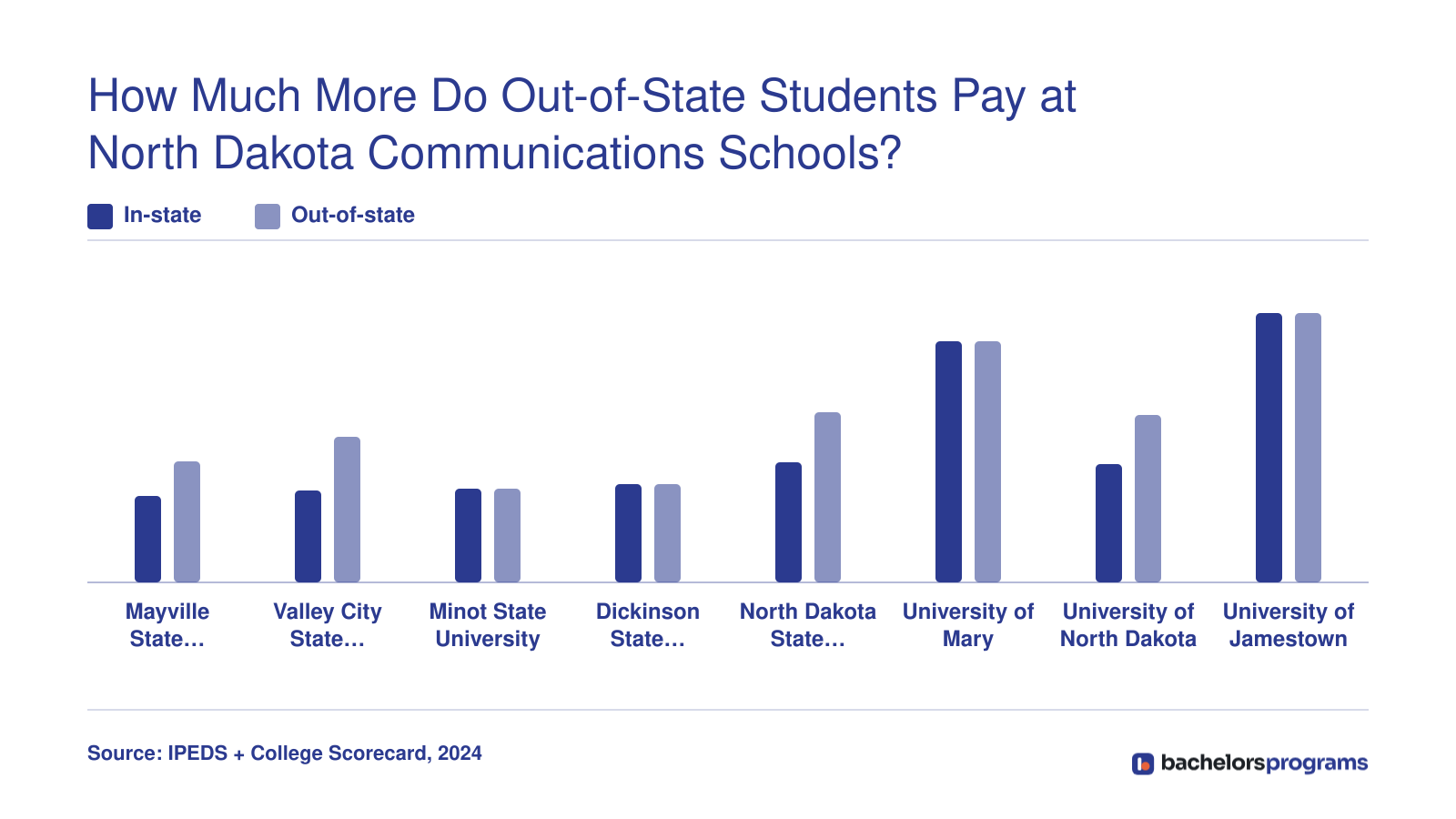
How Much More Do Out-of-State Students Pay at North Dakota Communications Schools?
Valley City State University shows the widest gap: out-of-state students pay $13,544 a year in tuition and fees versus $8,514 for North Dakota residents, a difference of $5,030. Minot State University and Dickinson State University charge every student the same rate ($8,702 and $9,118), so nonresidents pay no premium. The private University of Mary and University of Jamestown also charge one price, though it is higher. Among schools that do charge more, Mayville State University has the smallest gap at $3,258.
Communications Concentrations: Strategic Communication, Journalism, PR, and Digital Media
Three Degrees That Sound Alike
A communications degree is the broadest of the three. It mixes theory with applied skills and lets you specialize later. A journalism degree trains you to report, write, and produce for newsrooms and broadcast outlets. Media studies leans toward analysis and criticism of media rather than production. If you want flexibility, communications is usually the safer base; if you already know you want a newsroom, look hard at which programs keep reporting and broadcast work in the curriculum.
What the Programs Here Emphasize
- University of North Dakota: A B.A. in Communication with several concentration options, plus podcasting studios and virtual reality equipment for production work.
- North Dakota State University: Strategic Communication, with advertising as a named concentration and student groups in advertising and public relations.
- Valley City State University: Communication Studies with multiple concentrations and a social media lab; coursework spans corporate communication, digital marketing, and media.
- Minot State University: Professional Communication, with student-run media on campus and career paths listed as journalist, video editor, and public relations specialist.
- Mayville State University: A communication major with hands-on work in radio, theater, and journalism.
Matching a Concentration to a Career Goal
If you want public relations, advertising, or brand marketing, strategic communication and digital media tracks fit best. For broadcasting, reporting, or video production, favor programs with student media outlets you can work in from early on. Corporate communication and training roles pair well with professional or applied communication degrees, which tend to be broader. Ask each department which courses are required versus elective before you commit.
What You Can Do With a Communications Degree in North Dakota
The wages below are statewide figures for everyone working in each occupation (U.S. Bureau of Labor Statistics, May 2022), so they are separate from the graduate earnings reported for individual programs elsewhere on this page. North Dakota communications graduates typically work for health systems, colleges and universities, agriculture and energy companies, state and local government, and marketing or PR agencies, with most openings in larger cities such as Fargo, Bismarck and Grand Forks. Communications is generally not a licensed field, so there is no North Dakota license to pursue after your bachelor's degree, and employers focus on internships, writing samples and a strong portfolio instead.
| Occupation | Median Annual Wage (ND) | Employment (ND) | Projected Outlook |
|---|---|---|---|
| Marketing Managers | $126,730 | 170 | +6.9% (2025-2035) |
| Public Relations Managers | $116,480 | 70 | +5.7% (2025-2035) |
| Public Relations Specialists | $71,740 | 480 | +2% (2025-2035), slower than average |
| News Analysts, Reporters, and Journalists | $56,810 | 240 | N/A |
| Technical Writers | $50,000 | N/A | +1% (2025-2035), slower than average |
Are North Dakota Communications Programs Accredited?
More students now check accreditation before they apply, because a degree that cannot transfer or qualify for federal aid is a costly surprise. The first thing to look for is institutional accreditation from the Higher Learning Commission (HLC), the regional accreditor for North Dakota. It covers a whole college, makes a school eligible for federal financial aid, and is what most other schools look for when they review transfer credit.
What We Could Verify
HLC lists the University of North Dakota as accredited since 1913, with its latest reaffirmation in 2023-2024.1 North Dakota State University is also accredited, and HLC's January 2026 actions report that it continued and reaffirmed that status.2 For the other schools here, including University of Mary, Valley City State, Dickinson State, Minot State, Mayville State and University of Jamestown, confirm current status directly with HLC before you apply.
Program-Level Accreditation
Communications also has optional programmatic accreditation, such as ACEJMC for journalism and mass communication. It is a bonus, not a requirement.3 We could not confirm that any North Dakota communications program on this page holds it, so ask each department directly.
How to Check for Yourself
Search the school's name in the HLC institution directory. Look for a status of "Accredited" and a reaffirmation date that has not lapsed. Then check the department's website for any programmatic accreditor it names.
North Dakota Communications Degree FAQs
These answers cover the questions prospective students ask most about communications bachelor's programs in North Dakota. Confirm details with each school's admissions office before you apply.
Is communications a licensed field in North Dakota?
Can I transfer from a North Dakota community college into a communications bachelor's program?
What's the difference between a communications degree and a journalism degree?
Can out-of-state students get reduced tuition at North Dakota universities?
Compare Communications programs on the data that matters
Explore more Communications & Media majors or browse every field of study.
All Communications & Media programs Browse every field of study