Best Criminal Justice Schools in North Dakota
Compare 8 accredited Criminal Justice programs in North Dakota, with net price after aid, graduation rates, earnings and debt from IPEDS and the U.S. College Scorecard.

A bachelor's degree in criminal justice is the usual starting point for North Dakota careers in law enforcement, corrections, probation and the courts, though state peace officer standards do not require one. The degree is most often a Bachelor of Science in Criminal Justice, offered on campus, online or both.
The schools here differ sharply on price and outcomes. Published in-state tuition runs from $4,632 at United Tribes Technical College to $24,990 at the University of Jamestown, and graduation rates range from about 21% to 67%.
Some programs also tie directly to local employers, such as Minot State's tuition-covered apprenticeship with the Minot Police Department, and that kind of connection can matter as much as the price.
Key Points
- United Tribes Technical College's 2024 average net price: $3,569 a year.
- Study online at Dickinson State, University of Jamestown or Rasmussen.
- North Dakota's POST Board requires only a diploma or GED for officers.
Best Criminal Justice Schools in North Dakota: Our Ranked List
Eight North Dakota institutions award a bachelor's degree in criminal justice, and they range from large research universities to a tribal college in Bismarck to a fully online option based in Fargo. Each card below shows the format, the approximate net price after aid, the school-wide graduation rate, and the program details that matter most.
Dickinson State University
#1Dickinson, ND · ~$14,000/yr (est.)
Best for: Budget-minded online students in western ND
Dickinson State University is the most affordable route on this list by a wide margin, with an approximate net price after aid near $14,100 and in-state tuition and fees around $7,470 before aid. The criminal justice bachelor's is offered online, which suits students in western North Dakota and beyond who cannot relocate to Dickinson. The university is small, so classes are personal, and the school's graduation rate sits near 51%.
- Bachelor of Science in Criminal Justice, listed as Criminal Justice, B.S.
- Delivered fully online through the university catalog
- In-state tuition and fees around $7,470 before aid
- Approximate net price near $14,100 after aid
North Dakota State University
#2Fargo, ND · ~$16,000/yr (est.)
Best for: Students aiming at federal investigative careers
North Dakota State University runs the largest criminal justice program in the state, with roughly 44 bachelor's degrees awarded in a recent year, and it is the strongest choice for students who want a research-university setting in Fargo. The major blends social sciences, behavioral sciences and legal studies, and graduates go into law enforcement, courts, corrections and federal investigative work. Students get a dedicated advisor, an annual fall career fair, internships across North Dakota and Minnesota, and a Criminal Justice Club. The school reports that 95% of recent graduates are employed or continuing their education.
- On-campus criminal justice major in Fargo
- Coursework spans social sciences, behavioral sciences and legal studies
- Annual fall Criminal Justice Career Fair and Criminal Justice Club
- Internships with agencies across North Dakota and Minnesota
- Accelerated path to a master's degree in about five years
- Dedicated academic advisor builds a personalized plan
- Need-based and merit-based scholarships available
University of Mary
#3Bismarck, ND · ~$18,000/yr (est.)
The University of Mary in Bismarck offers unusual flexibility within a private Catholic university: both a Bachelor of Arts and a Bachelor of Science in criminal justice, plus a minor, housed in the Liffrig Family School of Education and Behavioral Sciences. Coursework covers corrections, criminological theory, law adjudication, law enforcement and research methods, with internships at federal, state, local and private agencies. Study opportunities in Arizona and Rome give the program an international dimension rare in the state. The approximate net price after aid is about $17,770.
- Both a Bachelor of Arts and a Bachelor of Science in criminal justice
- Also offered as a minor
- Housed in the Liffrig Family School of Education and Behavioral Sciences
- Coursework in corrections, criminological theory and law adjudication
- Internships with federal, state, local and private agencies
- Study opportunities in Arizona and Rome
- Program directed by Chad E. Litton, PhD
University of North Dakota
#4Grand Forks, ND · ~$19,000/yr (est.)
The University of North Dakota in Grand Forks gives students the choice of a traditional campus experience or a fully online Bachelor of Science in Criminal Justice Studies, a 120-credit, four-year major. Online classes are asynchronous but run on set deadlines, and there are three start terms a year. The department dates to 1974, hosts a chapter of the National Criminal Justice Honor Society, and offers internships locally, regionally and nationally. Students can also finish a bachelor's and master's in five years or pair the degree with a law degree in six.
- Bachelor of Science in Criminal Justice Studies, 120 credits, four years
- Available on campus in Grand Forks or fully online
- Online classes are asynchronous with set deadlines
- Three start dates per year: fall, spring and summer
- Internships placed locally, regionally and nationally
- Accelerated bachelor's and master's in five years
- Bachelor's plus law degree in six years
- National Criminal Justice Honor Society chapter
Minot State University
#5Minot, ND · $13,000/yr (est. net price)
Minot State University awards a Bachelor of Science in Criminal Justice on campus and online, and it stands out for a paid apprenticeship with the Minot Police Department: students work as part-time community service officers with tuition covered for up to two years, then serve three years as full-time officers. The department also has an agreement with the Community College of the Air Force that lets 60 semester hours beyond an associate degree complete the bachelor's, which makes it a practical pick for military students near Minot Air Force Base. The approximate net price after aid is around $12,700.
- Bachelor of Science in Criminal Justice, 120 credits, four years
- Offered on campus in Minot and fully online
- Tuition-covered police apprenticeship with the Minot Police Department
- Apprentices serve as part-time community service officers, then three years full time
- AU-ABC agreement with the Community College of the Air Force
- Coursework covers causes of crime and operation of justice agencies
- Military Resource Center on campus
University of Jamestown
#6Jamestown, ND · $15,000 – $20,000/yr (est.)
The University of Jamestown is a small private university where criminal justice students learn from practicing professionals: many local police officers, sheriff's deputies and correctional staff serve as adjunct faculty, and internships place students with local police, county sheriff's offices, correctional centers and prisons. Graduates work at local, state and federal levels in law enforcement, corrections and juvenile justice. Every full-time undergraduate receives some financial aid, with scholarship packages starting at $8,000. The approximate net price after aid is about $19,570.
- Criminal justice major covering law enforcement and the justice system
- Internships with local police, county sheriff, correctional centers and prisons
- Practicing officers serve as adjunct faculty
- Small class sizes
- Scholarship packages start at $8,000 for full-time undergraduates
- Field experience and co-curricular activities
United Tribes Technical College
#7Bismarck, ND · under $5,000/yr (est.)
United Tribes Technical College in Bismarck is the only tribal college on this list and offers both a Bachelor of Science and an Associate of Science in criminal justice, with a curriculum built around the state, federal and tribal justice systems together. That focus prepares graduates for tribal, state and federal law enforcement as well as corrections, parole and probation, victim advocacy and homeland security roles. The college is also the most affordable option here, with an approximate net price near $3,600 after aid for students who qualify. Applicants must be at least 18, hold a valid driver's license and provide a criminal background check.
- Bachelor of Science and Associate of Science in criminal justice
- Curriculum covers state, federal and tribal criminal justice systems
- Coursework in law, ethics and communication
- Prepares graduates for tribal, state and federal law enforcement roles
- Also leads to corrections, parole, probation and victim advocacy work
- Applicants must be 18 with a valid driver's license
- Criminal background check required for admission
Rasmussen University-North Dakota
#8Fargo, ND · ~$14,000/yr (est.)
Rasmussen University's North Dakota campus in Fargo delivers its criminal justice bachelor's entirely online, with live interactive sessions and eight start dates a year. The program is built for transfer students: applicants need a conferred associate degree or at least 60 quarter credits, and full-time students with no prior credits finish in about 36 months while those transferring 91 credits can finish in as few as 18 months. Tuition runs $332 per credit, roughly $29,880 in total full-time tuition. The curriculum was reviewed by FBI, DEA and Homeland Security experts, and the program does not lead to state licensure.
- Fully online criminal justice bachelor's, 180 quarter credits and 22 courses
- Full-time students with no prior credits finish in about 36 months
- Transfer 91 credits to finish in as few as 18 months
- Admission requires a conferred associate degree or 60 quarter credits
- Eight start dates per year
- $332 per credit, about $29,880 total full-time tuition
- Coursework in cultural diversity and justice, values-based leadership, mental health and substance abuse
- Reviewed by FBI, DEA and Homeland Security experts
- Does not lead to state licensure
Cost & outcomes by school
Federal data for the highest-earning Criminal Justice programs, independent of the ranking above. Earnings are this field's bachelor's graduates four years after completing where the Scorecard reports them, else the school's undergraduate median.
| School | Net price / yr | Grad rate | Earnings | Debt | Grads/yr | Format |
|---|---|---|---|---|---|---|
| Minot State University ND | $12,703 | 45% | $67,554 | $15,753 | 20 | Online or campus |
| University of Mary ND | $17,770 | 67% | $60,909 | $24,000 | 15 | Campus |
| Rasmussen University-North Dakota ND | — | 29% | $60,483 | $29,236 | — | Online |
| North Dakota State University ND | $15,543 | 64% | $58,252 | $21,125 | 50 | Campus |
| University of Jamestown ND | $19,567 | 49% | $56,621 | $27,000 | 11 | Online |
| University of North Dakota ND | $18,551 | 61% | $55,251 | $19,500 | 53 | Online or campus |
| Dickinson State University ND | $14,092 | 51% | $50,720 | $18,442 | 5 | Online |
| United Tribes Technical College ND | $3,569 | 21% | $25,292 | — | 10 | Online or campus |
Sources: U.S. Department of Education. Net price, graduation rate, earnings and debt: College Scorecard (earnings and debt for this field's bachelor's graduates where reported, else school-wide); graduates: IPEDS. A dash means no figure is reported.
Cost, debt & payoff
Median earnings of this field's bachelor's graduates (4 yrs after completing, else the school's undergraduate median) vs. their median federal loan debt · U.S. College Scorecard
Across these programs the median graduate earns about $57,437 and finishes with roughly $21,125 in debt — a ratio that clears a common rule of thumb (keep debt below first-year salary). Net price and debt vary widely school to school, so check the per-school figures in the table above before you shortlist.
Cheapest Bachelor's in Criminal Justice Programs in North Dakota
According to 2024 IPEDS and College Scorecard data, average net price (what students pay after grants and scholarships) ranges from $3,569 a year at United Tribes Technical College in Bismarck to $17,770 at the University of Mary. That $14,201 annual gap adds up to roughly $56,800 over a four-year bachelor's degree, enough to shape how much a graduate borrows. Among the public universities below, Minot State University has the lowest net price ($12,703), and its criminal justice graduates carry a median debt of $15,753, compared with $21,125 at North Dakota State University.
| School | City | Format | In-State Tuition and Fees | Average Net Price | Median Debt (Criminal Justice Bachelor's Graduates) |
|---|---|---|---|---|---|
| United Tribes Technical College | Bismarck | Campus and online | $4,632 | $3,569 | N/A |
| Minot State University | Minot | Campus and online | $8,702 | $12,703 | $15,753 |
| Dickinson State University | Dickinson | Online | $9,118 | $14,092 | N/A |
| North Dakota State University | Fargo | Campus | $11,110 | $15,543 | $21,125 |
| University of Mary | Bismarck | Campus | $22,356 | $17,770 | N/A |
Online and Hybrid Bachelor's in Criminal Justice Options at North Dakota Schools
Can you earn a bachelor's degree in criminal justice online from a North Dakota school? Yes, at several of them. By delivery format, Dickinson State, the University of Jamestown and Rasmussen University-North Dakota are listed as online. Minot State, the University of North Dakota and United Tribes Technical College offer both campus and online formats. The University of Mary and North Dakota State list campus delivery. Minot State, UND and NDSU publish the clearest residency and transfer rules, and those three get the closest look here.
Minot State and UND
Minot State offers a fully online path to its 120-credit program. Its published plan does not guarantee that every criminal justice course runs each term, electives follow a rotation, so an adviser matters. Current materials do not state a minimum number of credits taken at Minot State. An older catalog (2016-2017) required transfer students to complete 24 criminal justice credits in residence, and that count included online work.1 Treat that as a historical benchmark and confirm the current rule.
UND lists its Criminal Justice Studies B.S. as on campus or online, 120 credits, with asynchronous classes and three start dates a year. Online students pay the same tuition regardless of residency, and nothing in the published materials requires an on-campus stay.
Completion Time and Transfer Credit
None of these schools publishes a typical completion time. At 120 credits, your pace depends on how much transfers and which courses rotate. UND's transfer scholarships count credits as the registrar calculates them, but transferring more than 120 credits disqualifies you. NDSU takes coursework from regionally accredited institutions, not non-accredited or remedial work, and still requires 30 credits in residence, including 15 at the upper level and 15 in the major. NDSU's catalog does not confirm online delivery, so plan on campus attendance there. Rasmussen lists a minimum of 60 accepted transfer credits and requires a conferred associate degree for admission.
Who Benefits Most
- Working corrections and law enforcement staff: Asynchronous classes at UND and Minot State fit around shift schedules.
- Rural students: Online options remove a move to Minot or Grand Forks.
- Military-connected students: UND accepts military benefits, and Minot State has a Military Resource Center and ties to Minot Air Force Base.
What a Bachelor's Degree in Criminal Justice Costs in North Dakota
Published tuition and what you actually pay are two different numbers, and only one of them belongs in your budget. A bachelor's degree in criminal justice in North Dakota carries public in-state tuition and fees in roughly the $8,700 to $11,200 range at Minot State University, Dickinson State University, North Dakota State University and the University of North Dakota, while private campuses post higher sticker figures: about $22,356 at the University of Mary and $24,990 at the University of Jamestown. United Tribes Technical College lists the lowest tuition of the group at $4,632.
Net Price Is the Better Planning Number
Net price estimates what a typical aided student pays after grants and scholarships; because it includes living costs, it can land above the tuition line. Minot State sits near $12,703, Dickinson State near $14,092, NDSU near $15,543, Mary near $17,770, UND near $18,551 and Jamestown near $19,567. Institutional aid narrows the gap between public and private sharply, so do not rule out a private campus on sticker price alone.
Residency and the Programs That Change It
Out-of-state tuition raises the total at the research universities (NDSU and UND both move roughly $4,600 higher), while Minot State and Dickinson State charge one rate regardless of residency. Three programs can shift your bracket:
- North Dakota Scholarship: Up to $6,000 total, capped at $750 per semester, usable at accredited public, private and tribal institutions in the state, generally requiring full-time enrollment, a 2.75 GPA and credit-completion milestones, within six years of high school graduation.1 New Academic and CTE Scholarship awards ended with the 2025 class.1
- ND Scholars: Merit full tuition for qualifying North Dakota graduates who stay in state, considered at a 30 ACT composite or SAT equivalent, capped at 15 credits per semester.4
- Minnesota reciprocity and WUE: Minnesota residents can apply through a ND SAMS account for an approved program where space allows2; students from WICHE states may request 150 percent of resident tuition, though participation varies by campus and major.3
File the FAFSA the week it opens, then email each criminal justice department directly about departmental awards, which often close earlier than general aid.
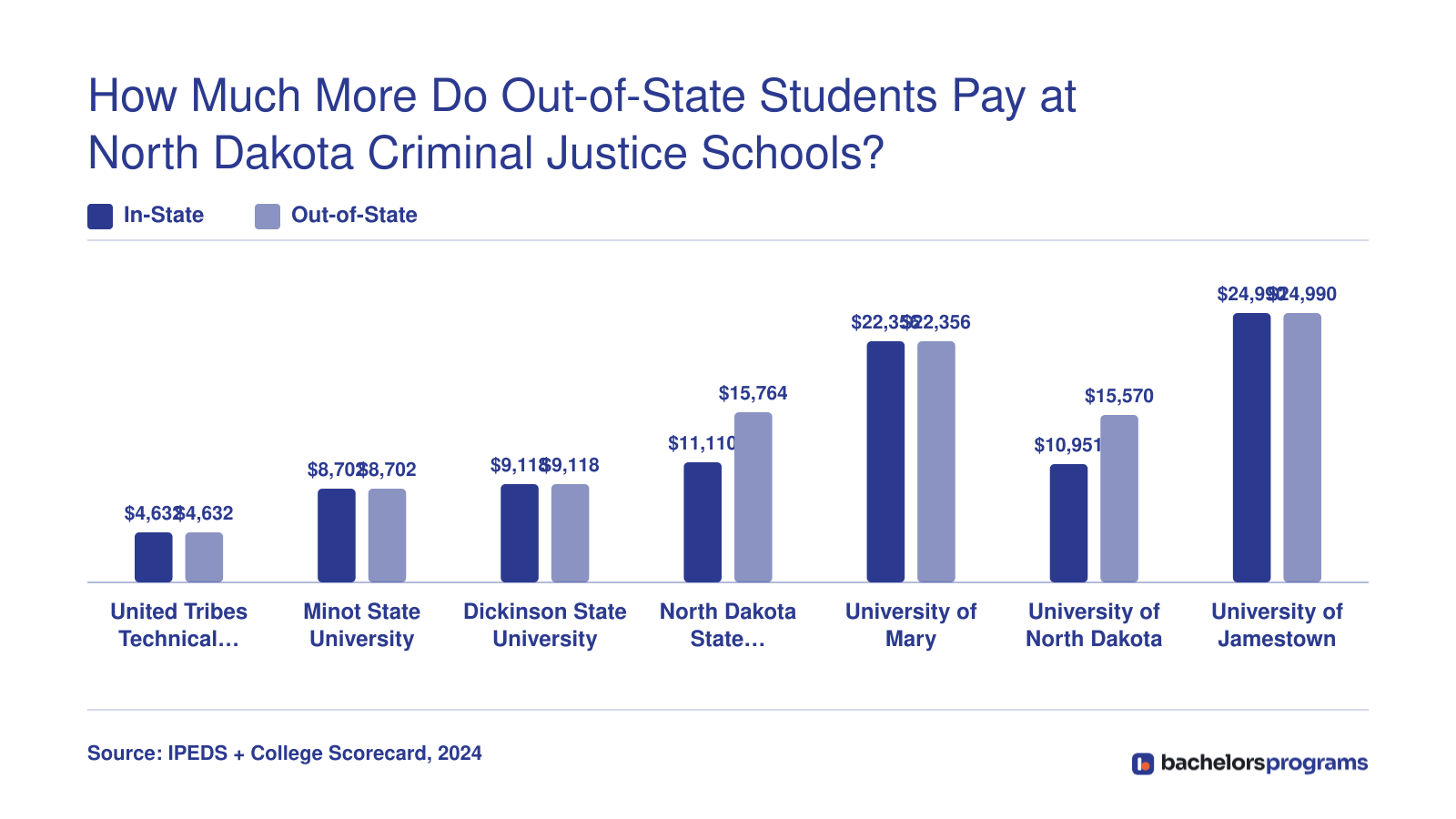
How Much More Do Out-of-State Students Pay at North Dakota Criminal Justice Schools?
North Dakota State University shows the widest in-state vs. out-of-state gap, at $11,110 for residents vs. $15,764 for nonresidents (about $4,654 more), with the University of North Dakota close behind at $10,951 vs. $15,570. United Tribes Technical College, Minot State University, Dickinson State University, the University of Mary and the University of Jamestown charge everyone the same published rate, so residency makes no difference at those schools. All figures are published annual tuition and fees before any grants, scholarships or other aid, so most students will pay less than the sticker prices shown here.
Related Articles
Criminal Justice Salaries and Job Outlook in North Dakota
These figures show what workers in each occupation earn across North Dakota, not what graduates of any school on this page earn. Wages and employment come from the U.S. Bureau of Labor Statistics Occupational Employment and Wage Statistics survey for North Dakota (May 2022), and growth figures cover the 2025 to 2035 projection window. Probation officer roles most often call for a bachelor's degree, while police and correctional officer jobs typically require a high school diploma plus academy or on-the-job training, though a bachelor's degree in criminal justice can strengthen an application.
| Occupation | North Dakota Median Annual Wage | Employment | Projected Job Growth |
|---|---|---|---|
| Police and sheriff's patrol officers | $65,730 | 1,710 | 3% (2025 to 2035) |
| Probation officers and correctional treatment specialists | $63,340 | 210 | N/A |
| Correctional officers and jailers | $48,320 | 1,070 | -7.4% (2025 to 2035) |
North Dakota Peace Officer Licensure at a Glance
Compare Criminal Justice programs on the data that matters
Explore more Criminal Justice & Law majors or browse every field of study.
All Criminal Justice & Law programs Browse every field of study