Best Early Childhood Education Schools in North Dakota
Compare 8 accredited Early Childhood Education programs in North Dakota at 6 colleges, with net price after aid, graduation rates, earnings and debt from IPEDS and the U.S. College Scorecard.

A bachelor's degree in early childhood education is a four-year undergraduate program that prepares graduates to teach and care for children from birth through about age eight. North Dakota schools title the degree a Bachelor of Science (B.S.) in Early Childhood Education, though some award a B.A. or a B.S.Ed. instead.
The real tension is licensure. Some programs lead to a North Dakota teaching license covering birth through third grade, while others, like Minot State University's non-licensure track, point toward preschool, Head Start, and administrative work.
The ranking uses College Scorecard data to compare the North Dakota schools that offer the degree, on campus and online. Program format and license eligibility often matter more than the school's name.
Key Points
- Four-year median earnings: $45,941 (Minot State) to $50,052 (NDSU).
- UND and Mayville State offer fully online early childhood bachelor's degrees.
- North Dakota's ESPB early childhood teaching license covers birth through grade three.
Best Bachelor's Degree in Early Childhood Education Programs in North Dakota
North Dakota State University leads this list for the depth of its child and adolescent development coursework, but students who want a teaching license should study the University of Mary and the University of North Dakota closely, since both prepare graduates for North Dakota's birth to grade 3 credential. Mayville State and Minot State keep tuition low and offer fully online routes, while Sitting Bull College offers the state's most affordable path into an early childhood classroom. Net price and graduation rate below are school-wide figures, not program-specific ones.
North Dakota State University
#1Fargo, ND · ~$16,000/yr (est.)
Best for: Child development and family science focus
North Dakota State University in Fargo houses its early childhood coursework inside a human development and family science major, and the Child and Adolescent Development option runs from prenatal development through the teen years. Students complete 120 credits, add a minor outside the department, and can apply to an accelerated track that counts 15 master's credits toward the bachelor's. This is a child development degree rather than a teaching licensure track, which suits readers aiming at family science, youth programs, or graduate study. School-wide, in-state tuition is $11,110, average net price after aid is $15,543, and the graduation rate is about 64%.
- Child and Adolescent Development option spans prenatal through adolescence
- Three 21-credit options including Family Science and Adult Development & Aging
- 120 credits: 67 major credits and 39 general education credits
- C or better required in all HDFS courses; 2.50 HDFS GPA
- 16-credit minor required outside the HDFS department
- Field experience required before graduation
- Accelerated bachelor's-to-master's track applies 15 credits to the master's
University of Mary
#2Bismarck, ND · ~$18,000/yr (est.)
Best for: Faith-based teacher preparation
The University of Mary, in Bismarck, is the private option on this list, and its early childhood education degree can be finished on campus or entirely online through the Liffrig Family School of Education. The program is accredited by the North Dakota Education Standards and Practices Board, meets CAEP national standards, and leads to the license required to teach children from birth through third grade. Supervised teaching starts in the sophomore year, and students can double major in elementary or special education. School-wide, tuition is $22,356, average net price after aid is $17,770, and the graduation rate is about 67%.
- B.A. or B.S., on campus or fully online
- Accredited by the North Dakota Education Standards and Practices Board
- Meets CAEP national standards
- Leads to the ND Educator's Professional License, birth through grade 3
- Supervised teaching in local schools from sophomore year through graduation
- Double major option with elementary or special education
- Coursework in developmentally appropriate practice, lesson planning, parent partnerships
- Offered as both a B.A. and a B.S.
- Interdisciplinary major built with an advisor
- Core coursework covers infancy through childhood
- Pairs with liberal arts and business majors
- Prepares for education and childcare careers
University of North Dakota
#3Grand Forks, ND · ~$19,000/yr (est.)
Best for: Working adults needing a fully online path
The University of North Dakota awards a dedicated B.S.Ed. in Early Childhood Education that students finish fully online in about four years, with no campus visits required. Field hours are built into most courses and the degree closes with ten weeks of student teaching, which makes it a practical fit for working adults. Classes run in both asynchronous and synchronous formats and are capped at 25 students, and a Para-to-Teacher tuition assistance option exists for classroom aides. School-wide, in-state tuition is $10,951, average net price after aid is $18,551, and the graduation rate is about 60%.
- 125 to 128 credits, about four years
- Fully online; no campus visits required
- Asynchronous and synchronous classes capped at 25 students
- CAEP accredited
- Field hours built into most courses, plus ten weeks of student teaching
- Three start dates per year; Aug. 15, Dec. 15, May 1 deadlines
- Accelerated path to a master's degree available
- Para-to-Teacher tuition assistance available
Mayville State University
#4Mayville, ND · $10,000 – $15,000/yr (est.)
Mayville State University delivers its B.A. in Early Childhood entirely online, pairing distance courses with field experience working alongside children. The university accepts transfer credit from regionally accredited institutions and publishes sample agreements with community and technical colleges in several states, which helps students who started elsewhere. Tuition is charged per credit and capped: North Dakota residents pay $358.72 per credit for 2026-2027, and 12 credits are charged for up to 18 enrolled. School-wide tuition is $7,979, average net price after aid is $11,456, and the graduation rate is about 41%.
- Fully online B.A. in Early Childhood
- North Dakota residents pay $358.72 per credit for 2026-2027
- Tuition capped at 12 charged credits for up to 18 enrolled
- Transfer credit accepted from regionally accredited institutions
- Sample transfer agreements with colleges in five states
- Distance courses plus field experience working with children
- Prepares teachers, administrators, and curriculum specialists
Minot State University
#5Minot, ND · $13,000/yr (est. net price)
Minot State University runs two separate early childhood tracks, which lets readers pick by goal rather than by format. The online B.S. in Early Childhood is built for preschool, Head Start, and child care leadership and does not by itself lead to a teaching license, while the on-campus B.S.Ed. is CAEP accredited and carries a North Dakota birth to grade 3 license. The university reports a 96% job or graduate school placement rate and awards about $4.7 million in scholarships and aid each year. School-wide, in-state tuition is $8,702, average net price after aid is $12,703, and the graduation rate is about 45%.
- 120-credit, four-year fully online degree
- Focus on children from birth to age eight
- Does not by itself meet state teacher licensure requirements
- Prepares for preschool, Head Start, and child care leadership
- Reports a 96% job or graduate school placement rate
- About $4.7 million awarded in scholarships and aid each year
- CAEP accredited
- Leads to a North Dakota birth to grade 3 teaching license
- On-campus, 120-credit, four-year program
- Student teaching required for majors
- Cites a $62K median salary for kindergarten teachers
Sitting Bull College
#6Fort Yates, ND · ~$4,600/yr (est.)
Sitting Bull College, a tribal college in Fort Yates, offers a B.S. in Early Childhood Education built around North Dakota's early childhood requirements, with practicum hours threaded through the coursework rather than saved for the end. Graduates sit for the Principles of Learning and Teaching exam and a content Early Childhood Praxis exam, and passing both licenses them to teach birth through grade 3 in North Dakota, though other states may ask for additional coursework. School-wide tuition is $4,010, average net price after aid is $4,605, and the graduation rate is about 22%.
- Bachelor of Science in Early Childhood Education at Fort Yates
- Courses aligned with North Dakota ESPB early childhood requirements
- Practicum embedded throughout the coursework
- Pass the PLT and Early Childhood Praxis exams for licensure
- Licensure covers birth through grade 3 in North Dakota
- Emphasis on family and cultural diversity
Cost & outcomes by school
Federal data for the highest-earning Early Childhood Education programs, independent of the ranking above. Earnings are this field's bachelor's graduates four years after completing where the Scorecard reports them, else the school's undergraduate median.
| School | Net price / yr | Grad rate | Earnings | Debt | Grads/yr | Format |
|---|---|---|---|---|---|---|
| North Dakota State University ND | $15,543 | 64% | $62,203 | $23,199 | — | Campus |
| Mayville State University ND | $11,456 | 41% | $47,852 | $24,748 | 32 | Online |
| University of Mary ND | $17,770 | 67% | $46,121 | $23,719 | 64 | Online or campus |
| University of North Dakota ND | $18,551 | 61% | $45,955 | $26,467 | 60 | Online |
| Minot State University ND | $12,703 | 45% | $45,941 | $23,375 | 34 | Online |
| Sitting Bull College ND | $4,605 | 22% | $28,488 | — | 4 | Campus |
Sources: U.S. Department of Education. Net price, graduation rate, earnings and debt: College Scorecard (earnings and debt for this field's bachelor's graduates where reported, else school-wide); graduates: IPEDS. A dash means no figure is reported.
Cost, debt & payoff
Median earnings of this field's bachelor's graduates (4 yrs after completing, else the school's undergraduate median) vs. their median federal loan debt · U.S. College Scorecard
Across these programs the median graduate earns about $46,038 and finishes with roughly $23,719 in debt — a ratio that clears a common rule of thumb (keep debt below first-year salary). Net price and debt vary widely school to school, so check the per-school figures in the table above before you shortlist.
How We Ranked North Dakota Early Childhood Education Schools
Cost and outcomes rarely point the same way: the school with the lowest net price is not always the one whose early childhood graduates earn the most, and the strongest earnings may come from a campus hours from where you intend to teach. Our ranking weighs both, plus the practical question of whether you can finish the degree online.
What We Measure
We build the ranking from federal College Scorecard data rather than from brochures, and we confirm that each school actually offers a bachelor's program in early childhood education or a closely related child development field. The measures, in the order they carry weight:
- Net price: what students pay after grant and scholarship aid, not the published sticker price.
- Graduation rate: the share of first-time, full-time students who finish.
- Earnings: median pay for graduates of the field, measured after completion.
- Debt: typical federal borrowing among graduates of the program.
- Format: whether the bachelor's can be completed online, on campus, or in a hybrid arrangement.
School-Wide Versus Program-Level
The inputs do not all describe the same thing. Net price and graduation rate are institution-wide figures, meaning they describe the whole university. Earnings and debt are reported by field of study, so they track early childhood graduates far more closely than any campus-wide average can.
Why a Stated Method Matters
Many "best" lists publish no criteria at all. Without a stated method, you cannot tell whether a school earned its place or bought it, and you cannot check whether the list weighed tuition, real graduate outcomes, or nothing more than a directory entry. A ranking you can inspect is one you can argue with, and that is the point.
Online and Hybrid Bachelor's Options at North Dakota Schools
You can earn a bachelor's degree in early childhood education from several of these North Dakota schools without moving to campus.
Formats at a Glance
- Fully online: The University of North Dakota (B.S.Ed.), Mayville State University, and Minot State University list online programs. UND says no campus visits are required, and classes may be asynchronous or synchronous.
- Online and on campus: The University of Mary offers its Bachelor of Science in Early Childhood Education online, mirroring the on-campus version. Its first online cohort began in September 2026.
- Campus-based: North Dakota State University and Sitting Bull College list campus programs.
Minot State's online degree can be completed from any location, but it is a non-licensure track. It will not qualify you for a teaching license on its own. UND and the University of Mary are licensure-eligible.
Field Experience Near Home
UND requires field experiences where students live, plus a 10-week student teaching placement. Its guidance puts the burden of finding an approved site and supervisor on the student. Working teachers may be able to use their own classroom if it meets accreditation standards. That helps rural and working students, but plan early.
The University of Mary says supervised practicums and student teaching can happen in local communities. Students in the Bismarck-Mandan area also get hands-on work at its Butler Center for Early Learning. Mayville State describes its distance courses as including field experience. Sitting Bull College embeds practicum throughout its coursework.
Not every school spells out the details. The University of Mary does not publish whether a placement near every home is guaranteed or whether the university or the student selects the site. Minot State does not describe any required practicum. Ask each admissions office directly.
Online Versus Campus Pricing
UND charges online students the same rate regardless of residency. On-campus tuition depends on residency and is capped at 12 credits per semester, while online tuition is per credit with no cap. Per-credit dollar figures for UND, the University of Mary, and Minot State were not available for comparison. Mayville State lists $358.72 per credit for North Dakota residents on its online program page. Confirm current rates with each school's billing office before you compare.
Admission Requirements: GPA, Test Policy, and Transfer Credit
Early childhood applicants in North Dakota usually face two reviews: general university admission, then a separate education program review that can set a higher GPA bar than the university itself. The North Dakota Statewide Early Childhood Education Articulation Agreement (2024-2027) lets listed courses transfer among participating campuses, generally with a C or better in courses used in the major, though UND expects a B or better in transferred education courses. Applicants to North Dakota State University and Sitting Bull College should confirm GPA, testing, and transfer rules directly with each school's admissions office.
| School | Minimum GPA | Test Policy | Transfer / Associate Pathway |
|---|---|---|---|
| University of North Dakota | 2.75 cumulative recommended (not a universal minimum) | ACT/SAT not required; scores encouraged for scholarships and placement | Statewide ECE articulation agreement (2024-2027); transferred education courses need a B or better |
| Minot State University | 2.0 cumulative for transfer applicants with 24 or more transferable semester credits | Confirm with admissions | Statewide ECE articulation agreement (2024-2027) |
| University of Mary | Confirm with admissions; education program may set a higher GPA | Confirm with admissions | Statewide ECE articulation agreement (2024-2027) |
| Mayville State University | Confirm with admissions; education program may set a higher GPA | Confirm with admissions | Statewide ECE articulation agreement (2024-2027) |
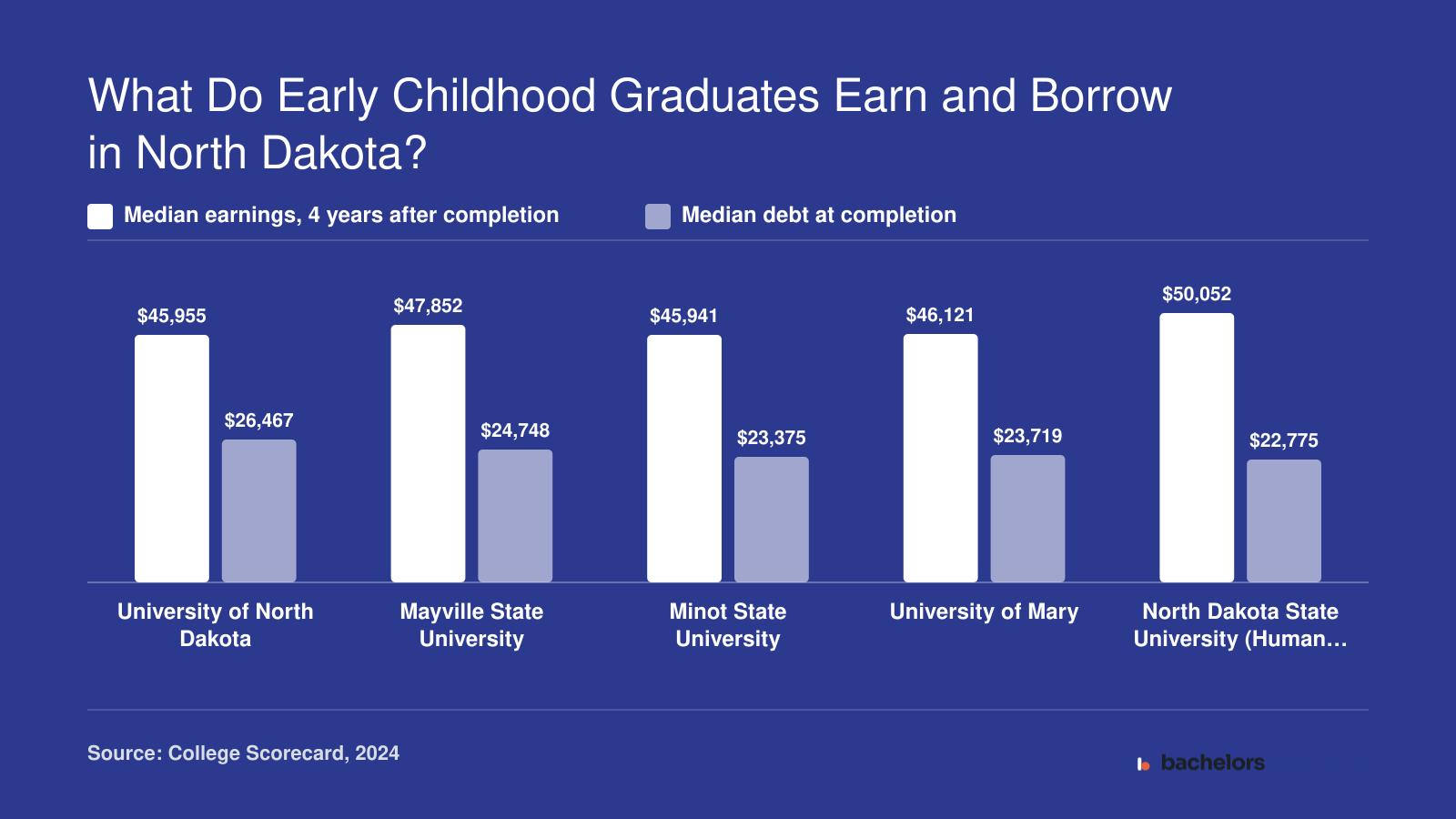
What Do Early Childhood Graduates Earn and Borrow in North Dakota?
Program-level median earnings four years after completion range from $45,941 at Minot State University to $50,052 for North Dakota State University's Human Development and Family Science graduates. Median federal loan debt at completion for the same programs runs from $22,775 to $26,467. Sitting Bull College's program earnings and debt are not reported.
North Dakota Early Childhood Licensure: Requirements and Exams
What does it take to become a licensed early childhood teacher in North Dakota? The state's Education Standards and Practices Board (ESPB) issues an Early Childhood Teaching License covering birth through grade three (age eight).1 It is a professional educator license for the school system, a different credential from what childcare or preschool staffing rules require.
The License Pathway
Initial licensure starts with a bachelor's degree from an approved teacher-preparation program. The early childhood major must cover child development from birth to age eight and early childhood methods, and the preparation has to span the full B-3 range. ESPB materials list a minimum GPA of 2.50 and 32 semester hours in the major.2
Field work is built into the degree. The endorsement form describes three supervised field experiences plus two student-teaching placements totaling at least 10 weeks.3 Applicants who already hold a license need 5 weeks. One placement must be in an accredited preK or kindergarten setting and the other in grades 1 to 3, with experience working with children who have special needs.
Exams and Application Steps
Follow the steps in this order:
- Finish the approved program: Complete the degree, field experiences and student teaching, and request your Record of Education (SFN 58417) from the teacher-education institution.
- Take the Praxis: ESPB requires passing scores on the Principles of Learning and Teaching (PLT) Praxis II.2 Check ESPB for the exact test code and cut score, and ask your program whether a separate early childhood content exam applies to you.
- Apply through NDTeach: Submit the online application with transcripts, test scores, a valid U.S. Social Security number and a criminal-history check with fingerprinting.5
- Pay the fees: First-time applicants pay a $30 nonrefundable application fee, and the initial license carries an $85 fee.5 ESPB also lists a $75 Early Childhood Endorsement form for licensed educators adding the field.3 Confirm whether it applies to your situation.
Out-of-state applicants who hold alternative certification must meet North Dakota's Praxis I and Praxis II content requirements before receiving an Other State Educator License.4 That rule does not necessarily cover traditional B-3 applicants.
License Versus Childcare and Preschool Roles
The ESPB materials reviewed do not show that childcare work requires a B-3 license, a bachelor's degree, Praxis exams or student teaching. Childcare staff qualifications are set separately, so check the state's childcare licensing rules for a specific job. A preschool classroom in a licensed school is different, since the B-3 license extends through grade three.
Schools also have a route that skips the traditional license. A district can request a teaching permit for someone it intends to hire. ESPB lists a $30 application fee, a $150 annual permit fee and 4,000 hours of work experience over five years.6 Permits are school-initiated, so you cannot apply on your own.
Not every bachelor's track leads to licensure. Minot State University, for example, offers both a licensure-track Early Childhood Education (BSEd) and an Early Childhood (BS) that is not a teacher-licensure program. Ask each program which one qualifies you for ESPB licensure.
Requirements and fees change, so confirm everything with ESPB before you apply.
Related Articles
Frequently Asked Questions About Early Childhood Education in North Dakota
These answers summarize the main sections of this page. Licensure rules are set by the North Dakota Education Standards and Practices Board (ESPB), so confirm current requirements with that agency and your school before you enroll.
What is the best school for early childhood education in North Dakota?
Can you get an early childhood education bachelor's degree online in North Dakota?
What are the North Dakota early childhood teaching license requirements?
How much does an early childhood education degree cost in North Dakota?
How do I become a preschool teacher in North Dakota?
Compare Early Childhood Education programs on the data that matters
Explore more Education & Teaching majors or browse every field of study.
All Education & Teaching programs Browse every field of study