Best Computer Science Schools in Oklahoma
Compare 16 accredited Computer Science programs in Oklahoma at 14 colleges, with net price after aid, graduation rates, earnings and debt from IPEDS and the U.S. College Scorecard.

A bachelor's degree in computer science in Oklahoma can cost anywhere from $6,863 a year in in-state tuition at Langston University to $50,061 at the University of Tulsa, and the salary gap does not always follow the price gap. Schools award it as a Bachelor of Science (B.S.) or Bachelor of Arts (B.A.) in Computer Science.
Ranking, ABET status, cost and state aid, admissions, and Oklahoma salaries all factor into the comparison, and every program here is an Oklahoma-based campus or online option.
University of Oklahoma and University of Tulsa graduates report medians of $110,853 and $109,332 four years after completion, so the research universities draw the attention. Lower-priced public programs still deserve a close look.
Key Points
- University of Oklahoma pairs ABET accreditation with seven computer science specializations.
- University of Oklahoma graduates earned a $110,853 median four years out.
- Oral Roberts University offers an online B.S. in Computer Science.
Best Computer Science Schools in Oklahoma at a Glance
The University of Oklahoma leads because it pairs the state's deepest research faculty with an ABET-accredited curriculum, seven specialization options, and the strongest early-career earnings reported by computer science graduates in this group. The University of Tulsa follows with the smallest classes on the list and dedicated artificial intelligence and cyber security tracks, while Southwestern Oklahoma State gives students a choice between a traditional computer science option and an information systems option at a regional public campus. Each profile below describes the whole institution, not only its computing department, so you can weigh overall fit alongside the program itself.
University of Oklahoma
#1Norman, OK · $15,000 – $20,000/yr (est.)
Best for: Research-minded students wanting a flagship campus
Oklahoma's flagship campus runs computer science inside its College of Engineering, with an ABET-accredited bachelor's program and seven concentration options spanning AI, cybersecurity, and data mining. Faculty collaborate with industry and government partners, and an accelerated path lets strong students begin graduate coursework early. About three in four students graduate, and the university recently named a new director for its School of Computer Science.
- ABET accredited by the Computing Accreditation Commission
- Seven concentration options within the major
- Coursework in AI, machine learning, cybersecurity, and data mining
- Accelerated B.S./M.S. pathway for strong undergraduates
- Faculty research with public and private sector partners
- Based at Devon Energy Hall in Norman
University of Tulsa
#2Tulsa, OK · $15,000/yr (est. net price)
Best for: Tulsa students preferring small private classes
A private university in Tulsa whose Tandy School of Computer Science stresses computing theory, software development, and professional and ethical practice. Undergraduates can add tracks in artificial intelligence or cyber security, and the program points to collaborations with other colleges and outside research laboratories. With roughly one faculty member for every ten students, it is the smallest-classroom option on this list.
- ABET accredited program
- Tracks: Artificial Intelligence, Cyber Security
- Housed in the Tandy School of Computer Science
- Coursework in computing theory, software development, and ethics
- Team-based projects mirroring employer expectations
- Collaborations with other colleges and outside research labs
Southwestern Oklahoma State University
#3Weatherford, OK · ~$14,000/yr (est.)
Best for: Budget-minded students in rural western Oklahoma
A regional public university in Weatherford where students pick between a traditional computer science option and an information systems option that leans into network security and business coursework. Both finish with a capstone in the final semester. Costs are moderate for a public regional campus, and the overall graduation rate sits under 40 percent.
- Two options: computer science or information systems
- Capstone course required in the final semester
- Information systems option covers network security and business
- Computer science option covers math, hardware, and programming languages
Oral Roberts University
#4Tulsa, OK · ~$25,000/yr (est.)
A private Christian university in Tulsa offering concentrations in bioinformatics and cheminformatics alongside a standard computer science core taught with a Christian worldview. Students can study on campus, through the ORU FLEX format, or online, and an active computing club plus industry internships support the degree. Nearly all full-time undergraduates receive scholarships.
- Concentrations in bioinformatics and cheminformatics
- Campus, ORU FLEX, and online study options
- Coursework in programming, software engineering, and systems analysis
- Christian worldview integrated throughout the curriculum
- Active Association for Computing Machinery chapter
- Internships across several industries
Oklahoma Christian University
#5Edmond, OK · $22,000/yr (est. net price)
A private university in Edmond where the computer science bachelor's requires 122 credit hours, 81 of them in the major, including calculus and linear algebra. Coursework runs from data structures and algorithm analysis through databases, operating systems, and programming languages, with a Christian worldview component in the core. Cohorts are small, with about a dozen graduates in a recent year.
- 122 credit hours, including 81 in the major
- Requires calculus and linear algebra
- Coursework in data structures, algorithms, databases, and operating systems
- Includes internet application development and assembly language
- Christian worldview component in the core curriculum
Northeastern State University
#6Tahlequah, OK · ~$13,000/yr (est.)
A regional public university with campuses in Tahlequah and Broken Arrow that follows ACM and IEEE curriculum guidelines. Students take software engineering, databases, game programming, networking, and security courses, and a minor is required alongside the major. Transfer agreements with Tulsa Community College smooth the path for associate degree holders, and the overall graduation rate is about 35 percent.
- Curriculum follows ACM and IEEE guidelines
- Courses in software engineering, databases, game programming, networking
- Minor required alongside the major
- Offered at Tahlequah and Broken Arrow campuses
- Transfer agreements with TCC Computer Information Systems AS
Cameron University
#7Lawton, OK · $7,000 – $17,000/yr (est.)
A public university in Lawton whose computer science program balances theory with hands-on design, algorithms, operating systems, and networking problems. Graduates move into software development, systems analysis, or network engineering, and scholarships are available to majors. Its overall graduation rate of about 31 percent is among the lower figures on this list.
- Covers hardware, software, and foundations of computation
- Hands-on work with data structures and efficient algorithms
- Operating systems and networking problem solving
- Prepares students for software developer, systems analyst, network engineer roles
- Scholarships available
University of Central Oklahoma
#8Edmond, OK · $15,000 – $20,000/yr (est.)
A large public university in Edmond offering an applied computer science bachelor's that pairs 61 major hours with an 18-hour applied area and a required minor or second major. Coursework covers C++, visual programming, data structures, algorithms, databases, and ethics in computing, with a 2.0 GPA minimum. Internships or individual study can count toward the degree.
- 124 credit hours, 61 of them in the major
- Requires an 18-hour applied area plus a minor or second major
- Coursework in C++, visual programming, data structures, algorithms, databases
- Ethics in computing and operating systems courses included
- 2.0 GPA minimum, with a C or better in major courses
- Internship or individual study can count toward the degree
Langston University
#9Langston, OK · ~$12,000/yr (est.)
Oklahoma's historically Black university, located in the small town of Langston, awards this computer science degree through its School of Business rather than a standalone computing college. Students need a 2.5 GPA and 45 credit hours to enter the major, plus at least a B in college algebra, trigonometry, and calculus I. Coursework covers hardware and software design, networking, and data communications.
- Awarded through the School of Business
- Requires 2.5 GPA and 45 credit hours for admission to the major
- B or better in college algebra, trigonometry, and calculus I
- Focus on hardware and software design, networking, data communications
- Pathway to graduate study in computer science or related fields
Oklahoma City University
#10Oklahoma City, OK · ~$23,000/yr (est.)
A private university in Oklahoma City where the computer science bachelor's blends technical training with a liberal arts core and requires an internship. Students work in Apple labs and on Raspberry Pi systems with remote access to a supercomputer, and can study cybersecurity, web development, and artificial intelligence. About 65 percent of students graduate.
- 67 to 69 credit hours in computer science, math, and electives
- Internship required
- 124 total credit hours including a liberal arts core
- Access to Apple labs, Raspberry Pi systems, and a supercomputer
- Courses in cybersecurity, web development, and artificial intelligence
Cost & outcomes by school
Federal data for the highest-earning Computer Science programs, independent of the ranking above. Earnings are this field's bachelor's graduates four years after completing where the Scorecard reports them, else the school's undergraduate median.
| School | Net price / yr | Grad rate | Earnings | Debt | Grads/yr | Format |
|---|---|---|---|---|---|---|
| University of Oklahoma OK | $15,300 | 75% | $110,853 | $23,250 | 138 | Campus |
| University of Tulsa OK | $15,000 | 72% | $109,332 | $21,500 | 32 | Campus |
| Cameron University OK | $10,912 | 31% | $83,565 | $21,500 | 17 | Campus |
| Northeastern State University OK | $12,710 | 35% | $67,854 | $19,000 | 28 | Campus |
| Oklahoma City University OK | $22,857 | 65% | $54,655 | $20,835 | — | Campus |
| Oklahoma Christian University OK | $21,872 | 56% | $49,203 | $26,000 | 20 | Campus |
| Oklahoma Baptist University OK | $20,958 | 52% | $48,434 | $24,801 | — | Campus |
| University of Central Oklahoma OK | $18,309 | 37% | $48,351 | $21,000 | — | Campus |
| Oral Roberts University OK | $25,365 | 57% | $46,885 | $27,000 | 14 | Campus |
| Southwestern Oklahoma State University OK | $14,459 | 40% | $45,744 | $15,954 | — | Campus |
| Southeastern Oklahoma State University OK | $8,039 | 32% | $45,079 | $17,000 | — | Campus |
| East Central University OK | $8,683 | 34% | $44,962 | $17,671 | — | Campus |
Sources: U.S. Department of Education. Net price, graduation rate, earnings and debt: College Scorecard (earnings and debt for this field's bachelor's graduates where reported, else school-wide); graduates: IPEDS. A dash means no figure is reported.
Cost, debt & payoff
Median earnings of this field's bachelor's graduates (4 yrs after completing, else the school's undergraduate median) vs. their median federal loan debt · U.S. College Scorecard
Across these programs the median graduate earns about $48,819 and finishes with roughly $21,500 in debt — a ratio that clears a common rule of thumb (keep debt below first-year salary). Net price and debt vary widely school to school, so check the per-school figures in the table above before you shortlist.
Most Affordable Computer Science Schools in Oklahoma at a Glance
These Oklahoma schools offer a bachelor's degree in computer science at the lowest average annual net price, meaning what students actually pay after grants and scholarships, according to 2024 IPEDS and College Scorecard data. The University of Science and Arts of Oklahoma in Chickasha reports the lowest net price, $6,624 a year. Langston University carries the lowest in-state tuition and fees at $6,863, but its net price is higher. Compare both figures when you estimate your own costs.
| School | City | Average Net Price (After Aid) | In-State Tuition and Fees | Program Format |
|---|---|---|---|---|
| University of Science and Arts of Oklahoma | Chickasha | $6,624 | $9,000 | On campus |
| Southeastern Oklahoma State University | Durant | $8,039 | $7,530 | On campus |
| East Central University | Ada | $8,683 | $8,032 | On campus and online |
| Cameron University | Lawton | $10,912 | $7,095 | On campus |
| Langston University | Langston | $11,504 | $6,863 | On campus |
How We Ranked Oklahoma Bachelor's Degree in Computer Science Programs
Two graduates of the same Oklahoma computer science program can look decades apart in the data: one earnings figure may track alumni a year after finishing, another students ten years after they first enrolled. Reading those numbers as if they cover the same span is the most common comparison error.
What the Ranking Weighs
Four things shape the order: what the degree costs a typical student after grants and scholarships, what graduates earn, whether students finish, and whether the program runs on campus, online, or both. None stands alone. A low price means little if few students complete the degree, and strong earnings mean little if the program takes six years to finish.
Two Kinds of Numbers
Some measures describe the whole institution: graduation rate, average net price, and the earnings of former students ten years after entry. Others describe the computer science program itself, and those field-level earnings windows are shorter, running one, two, four, and five years after graduation. Compare like with like. A one-year program figure set beside a ten-year institutional figure will always look worse than it is.
This Is an Undergraduate Ranking
The schools here are ranked for their bachelor's degree in computer science, awarded as a B.S. or a B.A. This is not a graduate program list, so a school's absence from a national doctoral ranking, U.S. News included, says nothing about its undergraduate teaching.
Net Price Is an Average
Net price reflects what students in a given sector pay after federal, state, and institutional aid. Your own package depends on your FAFSA results, residency, and merit awards, so treat the published figure as a starting point rather than a quote.
ABET-Accredited Computer Science Bachelor's Programs in Oklahoma
In computing, accreditation attaches to a program, not to a university's name, and that distinction explains most of the confusion in this part of the search.
What ABET Accreditation Actually Covers
ABET's Computing Accreditation Commission (CAC) accredits computing programs at the associate, bachelor's, and master's levels, and computer science falls under CAC with CSAB as the lead society.1 CSAB itself grew out of work by ACM and the IEEE Computer Society, which is why the accrediting body and the professional societies so often get blended together in conversation.2 A department that shapes its curriculum around ACM/IEEE model recommendations has not thereby earned ABET status. ABET reviews a named program against published criteria on a recurring cycle, and the stamp belongs to that program alone.3
Regional Accreditation Is a Separate Question
The schools profiled on this page hold regional accreditation, which speaks to the institution's overall standing and says nothing about any individual computing degree. A bachelor's degree in computer science can sit inside a fully accredited university and still carry no ABET seal. When an employer or a graduate committee asks whether a program is ABET-accredited, it is asking about the program.
How to Confirm Status Before You Apply
ABET maintains a public accredited-program search: enter the institution, then check that the specific degree is listed.3 Treat a department page that says "ABET-accredited curriculum" or "meets ACM/IEEE guidelines" as a prompt to verify, not as confirmation. On this page, a program is described as ABET-accredited only when the school's own materials or ABET's listing backed it up; where CAC status could not be confirmed, we have left the label off rather than guess, and readers should run the check themselves for programs such as those at the University of Oklahoma, the University of Tulsa, and Northeastern State University before committing to a deposit.
Bachelor's in Computer Science School Profiles: What Sets Each Oklahoma Program Apart
Oklahoma's computer science programs share a common core of programming, algorithms and systems, so the real differences come from what surrounds that core: research access, required internships, applied minors and delivery format.
Research Universities in Norman and Tulsa
- University of Oklahoma: OU's ABET-accredited B.S. in Computer Science, based in Devon Energy Hall in Norman, includes an embedded machine learning certificate in its 2026 program and a capstone built with government and industry partners. Students can earn 0 to 3 credits per internship through CS 3910, up to 6 credits total. The program gives undergraduates access to faculty research in AI, robotics, cybersecurity and high-performance computing.
- University of Tulsa: TU's ABET-accredited B.S. runs through the Tandy School of Computer Science, with a 10-to-1 student-faculty ratio. CaneCareers helps students secure internships and full-time roles, and the university cites more than 40 years of industry collaboration. It suits students targeting Tulsa's energy, technology and finance employers.
Programs With a Distinct Angle
- Oral Roberts University: ORU's B.S. offers concentrations in bioinformatics and cheminformatics and can be completed on campus, through ORU FLEX or online. A Christian worldview component and an Association for Computing Machinery chapter round out the program. This is the pick for students interested in computing applied to the sciences.
- Oklahoma City University: OCU's B.S. requires an internship and includes cybersecurity and artificial intelligence coursework, plus Apple labs, Raspberry Pi systems and remote supercomputer access. It suits students who want a liberal arts foundation with built-in work experience.
- Northeastern State University: NSU follows ACM and IEEE curriculum guidelines and offers courses in game programming, networking and security at its Tahlequah and Broken Arrow campuses. A minor is required. It fits northeast Oklahoma students with an interest in game development.
- University of Central Oklahoma: UCO's Computer Science - Applied, B.S. pairs the computing core with 18 hours in an applied area plus a minor or second major. An internship or individual study can count toward the degree.
Regional and Specialized Options
- Southwestern Oklahoma State University: SWOSU offers two concentration options, one aimed at traditional computer science careers and one at the business side of computing. Network security coursework and a final-semester capstone are part of the plan.
- Oklahoma Christian University: OC's Edmond B.S. totals 122 credit hours, 81 of them in the major, with calculus, linear algebra and a team-based computer science experience. It fits students headed toward software engineering roles.
- Cameron University: Cameron's Lawton program covers data structures, efficient algorithms, operating systems and networking, with scholarships available. It suits southwest Oklahoma students seeking an affordable public option.
- Langston University: At this historically Black university, computer science is a major within the School of Business leading to a Bachelor of Business Administration. Students apply in their sophomore year and need a 2.5 GPA and B grades in required math courses.
Related Articles
Online and Hybrid Computer Science Bachelor's Options at Oklahoma Schools
Yes. Oral Roberts University in Tulsa lists an online study option for its Bachelor of Science in Computer Science, so an Oklahoma-based school does offer the degree fully online. Most of these programs are campus-based, so online and flexible routes are the exception.
Online, Multi-Campus, and Traditional Formats
- Online: Oral Roberts lists three study paths for its computer science B.S.: on-campus, ORU FLEX, and online. The program includes concentrations in bioinformatics and cheminformatics. This route suits working adults and students who cannot relocate to Tulsa.
- Flexible or multi-campus: ORU FLEX is a second alternative to a standard campus schedule. Northeastern State University lists both its Tahlequah and Broken Arrow campuses for its B.S. in Computer Science. That gives Tulsa-area commuters a closer in-person site than the main campus.
- Traditional campus: The University of Central Oklahoma lists campus delivery for its Applied B.S., and Oklahoma City University describes its computer science B.S. as an on-campus program. The University of Oklahoma, University of Tulsa, Southwestern Oklahoma State, Oklahoma Christian, Cameron, and Langston also center their programs on in-person study.
What to Confirm Before You Enroll
- In-person requirements: Ask Oral Roberts whether its online track includes any on-campus orientations, labs, or proctored exams.
- Tuition: Oral Roberts charges $35,470 in annual tuition and fees, the same rate for Oklahoma residents and out-of-state students. Its average net price after aid is $25,365. We could not confirm whether online students pay a different rate.
- Northeastern State: We could not confirm a fully online or hybrid computer science B.S. at NSU. Broken Arrow is a physical campus, not an online program. In-state tuition and fees at NSU run $7,810.
- Other schools: We could not confirm an online computer science bachelor's at the remaining schools. Contact each department directly.
Who Each Format Suits
Online study works best for self-directed learners balancing jobs or family. Multi-campus access helps students who want in-person classes without moving to a main campus. Traditional campus programs fit students who want daily access to labs, faculty research, and student computing groups.
Admissions for Oklahoma Computer Science Bachelor's Programs: GPA, Tests, and Transfers
Admission to a bachelor's degree in computer science in Oklahoma usually comes in two parts: apply to the university first, then, in some cases, declare or qualify for the computer science major after you arrive. Most Oklahoma public universities review high school GPA, course rigor, and class rank; test scores increasingly sit on the optional side of that review.
GPA and test policy by selectivity
The University of Oklahoma sits at the more selective end of the schools here, and it publishes no single minimum GPA or class rank cutoff for domestic first-year applicants. Instead, OU reviews GPA, the difficulty of your coursework, rank, activities, writing, leadership, and recommendations together. Applicants submit an official transcript covering at least six completed semesters, with an unweighted 4.0-scale GPA and class rank. The 3.0 minimum you may see referenced applies to international freshmen, not domestic students.
OU is test optional and accepts the ACT, SAT, or CLT, with self-reported scores permitted and superscoring applied. Scores still matter for money: freshman scholarship consideration starts at a 24 ACT or 1160 SAT for students who submit. For Fall 2026, OU reports an average admitted ACT of 25.1 and an SAT range of roughly 1200 to 1220.
The regional and private schools on this list, including Northeastern State, Cameron, Southeastern Oklahoma State, East Central, Langston, Oral Roberts, Oklahoma Christian, Oklahoma City University, and the University of Tulsa, generally review on a less selective basis, but current published GPA and test requirements for them were not confirmed for this page. Check each school's admissions page directly rather than assuming a statewide standard.
Transfer credit and community college pathways
Oklahoma's two-year colleges feed heavily into these bachelor's programs. At OU, you become a transfer applicant once you have completed more than six semester hours after high school graduation, and you need at least seven non-remedial credits from an accredited institution. With fewer than 24 non-remedial hours, you must also meet first-year admission standards and submit an ACT or SAT score; at 24 hours or more, only the academic college's transfer GPA applies. OU publishes no maximum on transferable credit, but you need 60 hours at a four-year institution and 30 in residence. Concurrent or dual credit earned in high school does not make you a transfer applicant.
One practical tip
Calculus placement, not admission, is what delays most CS students. Take the math placement exam seriously and arrive ready for Calculus I; starting a semester behind in math pushes the entire programming sequence back a year.
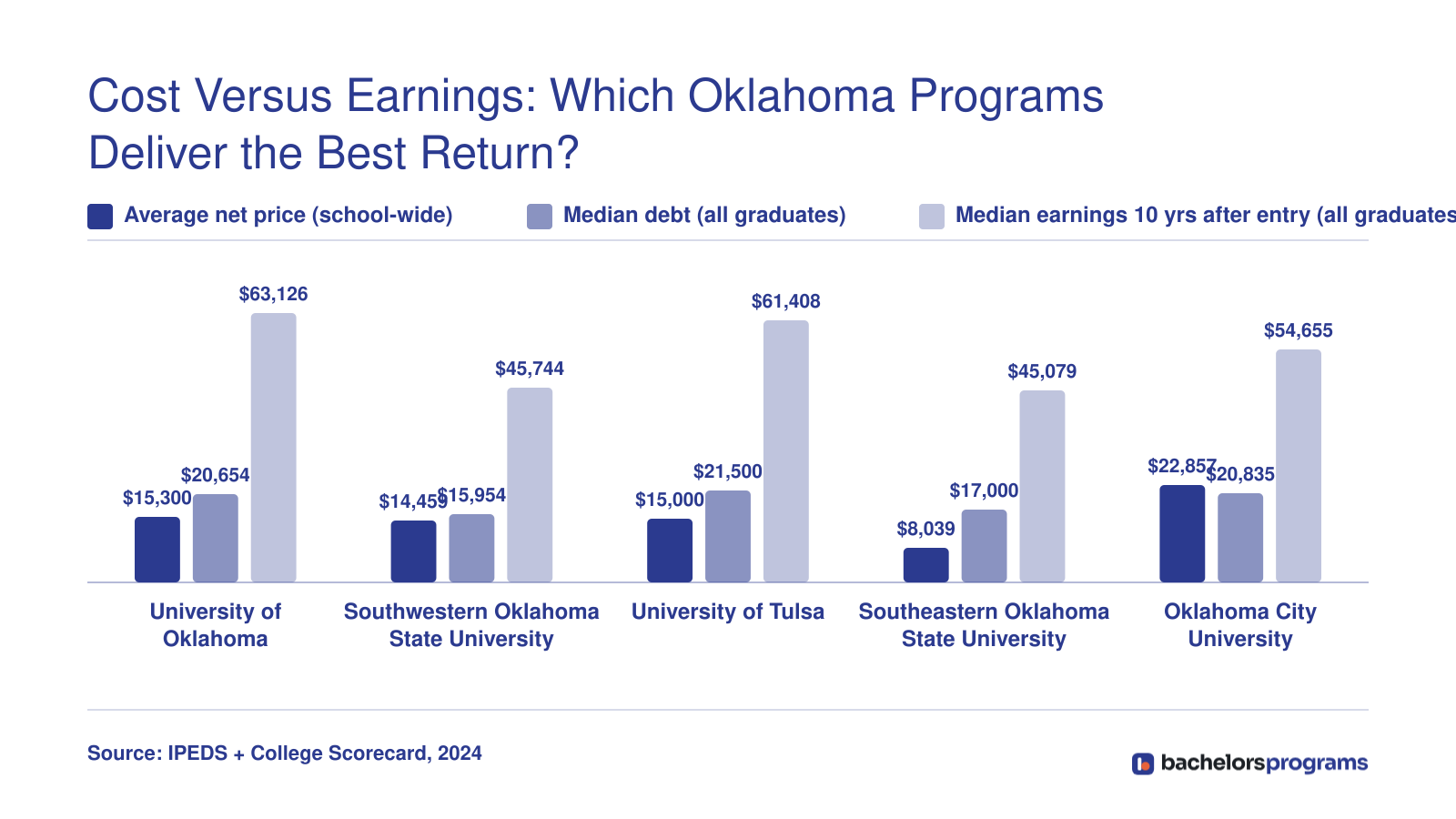
Cost Versus Earnings: Which Oklahoma Programs Deliver the Best Return?
Bachelor's graduates in computer science from the University of Oklahoma and the University of Tulsa earned medians of $110,853 and $109,332 four years after completion, against average net prices near $15,000. The bars below use school-wide figures for every graduate, not computer science majors alone: average net price, median debt and median earnings 10 years after entry. Southeastern Oklahoma State University has the lowest net price in this comparison at $8,039.
Compare Computer Science programs on the data that matters
Explore more Computers & IT majors or browse every field of study.
All Computers & IT programs Browse every field of study