Best Public Health Schools in Oklahoma
Compare 7 accredited Public Health programs in Oklahoma, with net price after aid, graduation rates, earnings and debt from IPEDS and the U.S. College Scorecard.

A bachelor's degree in public health is the entry credential for health educator, community health worker, and program coordinator roles. In Oklahoma, the common version is the Bachelor of Science (B.S.) in Public Health. The title is not uniform across the state, though: some schools award a Bachelor of Public Health, and one ranked option sits under environmental health science.
The tension is between accreditation, price, and format. A CEPH-accredited program, a regional campus, and an online schedule rarely coincide at one school. Only bachelor's programs at Oklahoma schools appear here, on campus or online; graduate study is out of scope.
Oklahoma's health outcomes keep demand for these graduates steady, and that demand is concentrated in a few metro areas.
Key Points
- University of Oklahoma ranks first, ending with a semester in Oklahoma City.
- University of Central Oklahoma alumni earn the most five years after completion.
- Oklahoma's Promise tuition aid requires signing up in grades 8 through 12.
Best Bachelor's Degree in Public Health Programs in Oklahoma, Ranked
The University of Oklahoma is the strongest overall choice for a bachelor's degree in public health in Oklahoma, pairing a science-heavy curriculum with a final semester on the state's dedicated academic health campus in Oklahoma City. Oklahoma State University follows with the broadest community health track in the state, and the University of Oklahoma Health Sciences Center lists the program that carries public health accreditation. Each card below gives tuition, net price after aid, graduation rate and format so you can compare on the numbers that matter.
University of Oklahoma
#1Norman, OK · $15,000 – $20,000/yr (est.)
Best for: Science-heavy path toward an MPH
Oklahoma's flagship public university and the undergraduate entry point to the Hudson College of Public Health. Public health majors build a science base in chemistry, biology and calculus, then spend their final spring semester on the health sciences campus in Oklahoma City, about 20 miles from Norman, completing a practicum and a capstone. It suits students who want a research-oriented, science-forward path with direct access to an academic health center, and who may be considering an MPH later.
- Spring 2027 applications close May 22, 2026
- Practicum and capstone built into the final semester
- Final spring semester at the Hudson College of Public Health in Oklahoma City
- Science foundation in chemistry, biology and calculus
- Core coursework in epidemiology, health policy and data analysis
- Graduate-level elective option for students heading to an MPH
- Career paths include environmental safety, occupational health and epidemiology
Oklahoma State University
#2Stillwater, OK · ~$17,000/yr (est.)
Best for: Community health education career starters
A large land-grant university in Stillwater with a 120-credit public health degree built around community health. The curriculum blends public health theory with epidemiology, health policy, social determinants of health, health behavior theory and program design, and adds a 12-hour internship plus a first-year seminar and career preparation course. A good fit for students aiming at health education, program coordination and policy support roles in government, nonprofits and health care organizations.
- Community Health concentration
- 120 total credit hours, structured to finish in four years
- 12-hour public health internship
- 2.8 GPA minimum
- First aid and CPR certification required
- 40 hours of upper-division coursework
- First-year seminar and career preparation course
East Central University
#3Ada, OK · $8,000 – $18,000/yr (est.)
Best for: Small-campus learners drawn to applied science
A regional public university in Ada where the public health offering sits inside a Bachelor of Science in Environmental Health Science. Students focus on disease prevention, health promotion and environmental health, with hands-on work in community settings that points toward local health departments, public health agencies and community organizations. A practical choice for students who want an applied environmental health angle on a smaller campus, and the coursework also builds a base for graduate study in public health or health administration.
- Public Health concentration within Environmental Health Science
- Focus on disease prevention and health promotion
- Hands-on learning in community health settings
- Prepares students for local health department and agency roles
- Foundation for graduate study in public health or health administration
- Offered through the College of Health and Sciences
University of Central Oklahoma
#4Edmond, OK · $15,000 – $20,000/yr (est.)
A large metropolitan university in Edmond with a public health degree rooted in social justice, scientific inquiry and evidence-based practice. Students can start graduate work early through an accelerated bachelor's-to-MPH pathway in the senior year, and the program's team has won a national case study competition in health education. Best suited to students who want an urban campus, heavy community engagement, and a fast route into graduate study.
- Accelerated bachelor's to MPH pathway
- Rolling admissions
- Scholarships available to public health students
- Team has won a national health education case study competition
- Rooted in social justice and health equity
- Careers in county health departments, tribal health organizations, hospitals and nonprofits
University of Oklahoma-Health Sciences Center
#5Oklahoma City, OK
The health sciences center in Oklahoma City and the Oklahoma program whose listing carries public health accreditation. Students complete most coursework through the Dodge Family College of Arts and Sciences in Norman, then spend their final spring semester in Oklahoma City on a practicum, a capstone and an optional graduate-level elective. Admission is rolling and requires junior standing, 60 completed hours and roughly a 3.25 GPA, which makes it a good target for students who want a two-campus experience and a close look at graduate-level work.
- Accredited by the Council on Education for Public Health
- Rolling admissions
- Junior standing and 60 completed credit hours required
- 3.25 GPA minimum for admission
- Capstone required
- Graduate-level elective available
- Final semester at the Oklahoma City health campus
- Joint program with the Dodge Family College of Arts and Sciences
Langston University
#6Langston, OK · ~$12,000/yr (est.)
Oklahoma's historically Black university, located in Langston, with a public health degree centered on minority health and health disparities. The 120-credit program sits in the School of Nursing and Health Professions and includes a six-credit fieldwork placement so students apply classroom material in real community settings before graduating. A strong fit for students who want to work on health equity in underserved communities in a smaller, close-knit campus setting.
- Minority Health and Health Disparities concentration
- 120 total credit hours
- Six-credit public health practice and fieldwork placement
- Housed in the School of Nursing and Health Professions
- Coursework in epidemiology, biostatistics, environmental health, and public health law and ethics
- Includes community health assessment and program planning
Southwestern Oklahoma State University
#7Weatherford, OK · ~$14,000/yr (est.)
A regional university in Weatherford that delivers its public health bachelor's through the distance education office, so students can complete the degree online through Canvas. Students work asynchronously but are expected to interact with the class daily, and some courses add scheduled Zoom webinars. Best suited to working adults and place-bound students who need an online route from an Oklahoma school; the department handles program-specific requirements.
- Delivered online through the distance education office
- Course materials, faculty contact and weekly discussions run in Canvas
- Students expected to interact with the class daily
- Some courses add scheduled Zoom webinars at a set weekly time
Cost & outcomes by school
Federal data for the highest-earning Public Health programs, independent of the ranking above. Earnings are this field's bachelor's graduates four years after completing where the Scorecard reports them, else the school's undergraduate median.
| School | Net price / yr | Grad rate | Earnings | Debt | Grads/yr | Format |
|---|---|---|---|---|---|---|
| University of Central Oklahoma OK | $18,309 | 37% | $67,452 | $18,000 | 44 | Campus |
| University of Oklahoma OK | $15,300 | 75% | $63,126 | $20,654 | 66 | Campus |
| University of Oklahoma-Health Sciences Center OK | — | — | $63,126 | $20,654 | — | Hybrid |
| Oklahoma State University OK | $17,447 | 68% | $52,517 | $19,700 | 28 | Campus |
| Southwestern Oklahoma State University OK | $14,459 | 40% | $45,744 | $15,954 | — | Online |
| East Central University OK | $8,683 | 34% | $44,962 | $17,671 | 4 | Campus |
| Langston University OK | $11,504 | 17% | $33,261 | $26,000 | 3 | Campus |
Sources: U.S. Department of Education. Net price, graduation rate, earnings and debt: College Scorecard (earnings and debt for this field's bachelor's graduates where reported, else school-wide); graduates: IPEDS. A dash means no figure is reported.
Cost, debt & payoff
Median earnings of this field's bachelor's graduates (4 yrs after completing, else the school's undergraduate median) vs. their median federal loan debt · U.S. College Scorecard
Across these programs the median graduate earns about $52,517 and finishes with roughly $19,700 in debt — a ratio that clears a common rule of thumb (keep debt below first-year salary). Net price and debt vary widely school to school, so check the per-school figures in the table above before you shortlist.
How We Ranked Oklahoma Public Health Bachelor's Programs
Our ranking asks one practical question: after four years and a tuition bill, what does a public health graduate actually leave with? Four kinds of evidence answer it, drawn only from bachelor's programs at Oklahoma schools, on campus or online.
- Outcomes: graduation rates and the earnings of former students, the closest thing to a report card a school has.
- Cost: published tuition, plus the average net price once grants and scholarships are applied.
- Completions: how many students finish the program each year, a rough signal of scale and stability.
- Format: whether the degree runs on campus, fully online, or hybrid, so you can compare like with like.
Two Numbers to Read Carefully
Both numbers are institution-wide averages, not figures for the public health major alone. A small program inside a large university inherits that university's numbers, for better or worse. Net price is approximate too: it reflects average aid, not your aid, and your own package can move the real figure by thousands either way.
Use the ranking to build a shortlist, then check each program's own page for admission requirements, credit transfer, and course sequence. Those details decide whether a degree actually fits your life.
CEPH Accreditation for Oklahoma Bachelor's Programs: What It Means
Program-level accreditation and institutional accreditation sound interchangeable, but they answer different questions. CEPH reviews a public health school or program; regional accreditation reviews the university as a whole.
Is the University of Oklahoma the Only CEPH-Accredited Option?
No. CEPH's directory lists the University of Oklahoma as a School of Public Health, the University of Central Oklahoma as a Public Health Program, and Oklahoma State University as a Standalone Baccalaureate Program.1 Those categories matter. OU's CEPH status covers its school of public health. UCO's covers its public health program. OSU's category is reserved for its bachelor's-level public health program, which appears here as Public Health: Community Health, BS.
Every college named here also holds regional institutional accreditation, which covers the institution overall. CEPH does not accredit the entire university and does not replace that regional status.2
Which Oklahoma Degrees Hold CEPH Status?
Among the programs on this page, the University of Oklahoma's Bachelor of Public Health, the University of Central Oklahoma's Public Health program and Oklahoma State University's Public Health: Community Health, BS sit within CEPH-accredited units. East Central University's Environmental Health Science, Langston University's Public Health program and Southwestern Oklahoma State University's BS in Public Health are public health or related degrees; the CEPH directory entries used here do not show CEPH accreditation for them. For current status, check CEPH's own Search: Who We Accredit directory, which gives each entry's start and end dates.
CEPH status tells graduate admissions committees and employers that a public health program has been reviewed against national criteria.3 It can strengthen an application or a job candidacy, but it is not a guarantee of admission or hiring.
Online and Hybrid Bachelor's in Public Health at Oklahoma Schools
The trade-off is flexibility versus campus experience. In Oklahoma, the most flexible route can also mean a slightly different credential, so check the degree name before you check the schedule.
Fully Online Paths
Southwestern Oklahoma State University lists its BS in Public Health as an online program, offered through the university's distance education office.
The University of Oklahoma's online option is the Bachelor of Arts in Community Health, not the Bachelor of Public Health. It is 100% online and asynchronous, built on 8-week courses, and totals 120 credits.1 It is a degree-completion program, so you need at least 24 college credit hours earned after high school to enroll. Working adults and transfer students with prior coursework fit this format best.
Hybrid Programs With In-Person Requirements
- OU Health Sciences Center: The Bachelor of Public Health is listed as hybrid.2 Entry requires 60 credit hours and junior standing, and the final semester takes place in Oklahoma City.
- University of Oklahoma (Norman): The Bachelor of Public Health is campus-based. It includes a final spring semester in Oklahoma City, on a health campus about 20 miles from Norman. Plan housing or a commute for that term.
Campus-Only Programs
Oklahoma State University offers its Public Health: Community Health BS at the Stillwater campus only, and the program page describes no online or hybrid option.3 East Central University in Ada, the University of Central Oklahoma in Edmond, and Langston University also list their programs as campus-based, with no fully online version published.
These programs suit traditional students who want face-to-face advising and supervised field experience, such as OSU's 12-hour internship or Langston's six-credit fieldwork. Rural students far from these campuses should look first at Southwestern's online program or OU's degree-completion option. Confirm any on-site requirements with the program before you apply.
Admission Requirements for Oklahoma Public Health Bachelor's Programs
Oklahoma public health programs split into two admission models. Some admit you to the university first and let you declare public health later, while others apply a second standard inside the department once you are enrolled. Knowing which model a school uses tells you when the GPA bar actually starts to matter.
Transfers should ask early about articulation from Oklahoma community colleges: the state's course-by-course transfer guides decide whether lower-division prerequisites arrive as equivalent credit or as generic electives. On timing, work backward from the term you want: the University of Oklahoma lists May 22, 2026, as the deadline for Spring 2027 entry, so a spring start closes well before the term begins.
What Each Program Publishes
- Oklahoma State University (Public Health, Community Health, BS): 2.75 overall GPA and 2.75 in college and departmental requirements, with a C or P floor in each course. No more than half of major requirements may come by transfer, correspondence work is capped at 8 hours, and residency rules require 60 hours at a four-year institution, 30 at OSU, and 15 of the final 30 hours on campus.
- University of Central Oklahoma (Public Health): a 2.75 GPA appears in published program guides, but the university does not state whether that figure governs freshman admission, entry to the major, or graduation.
- University of Oklahoma (Bachelor of Public Health): no published GPA or test threshold governs direct admission to the bachelor's program. Students begin in Norman and spend the final spring in Oklahoma City.
Confirm Before You Apply
Where a test policy, transfer limit, or deadline is not stated in a program's materials, treat it as open rather than as waived. Standards sit at the department level and shift with each catalog, so confirm the current GPA floor, the ACT or SAT policy, and the transfer-hour limit with an admissions counselor before you apply.
Related Articles
Oklahoma Grants and Scholarships That Lower the Price
Oklahoma's Promise rewards students who commit early, while the Oklahoma Tuition Equalization Grant helps students who choose a private college. Both are state programs, but they work very differently.
Oklahoma's Promise
Students sign up in grades 8 through 12, no later than December 31 of senior year.1 Family income at enrollment cannot exceed $60,000 for one or two dependents, $70,000 for three or four, or $80,000 for five or more. In high school, students need 15 required course units and a 2.50 GPA across grades 9 through 12.1 Parent income must also stay at or below $100,000 when benefits begin and each year after.2
The award covers resident tuition, so the dollar amount varies by school and enrollment.3 It lasts up to five years, ends once you earn a bachelor's degree, and for 2018 and later graduates is capped at 129 semester credit hours unless the degree requires more.4
OTEG and Other State Aid
OTEG is for Oklahoma residents enrolled full time (12 semester credit hours) at private nonprofit colleges.5 Family income must be $50,000 or less, with at least $2,000 in unmet need.5 The grant is up to $2,000 per academic year ($1,000 per semester) for as long as five years.6 It does not apply at public universities.
The Oklahoma Tuition Aid Grant is need-based and requires a FAFSA, Oklahoma legal residence, and full-time enrollment.7 Check the current award amount before you count on it.
Quick Tip
File the FAFSA as early as you can, since several state programs depend on it. Then look at each school's own scholarship page for institutional awards. Confirm current eligibility and amounts with the Oklahoma State Regents for Higher Education and the official Oklahoma's Promise pages.
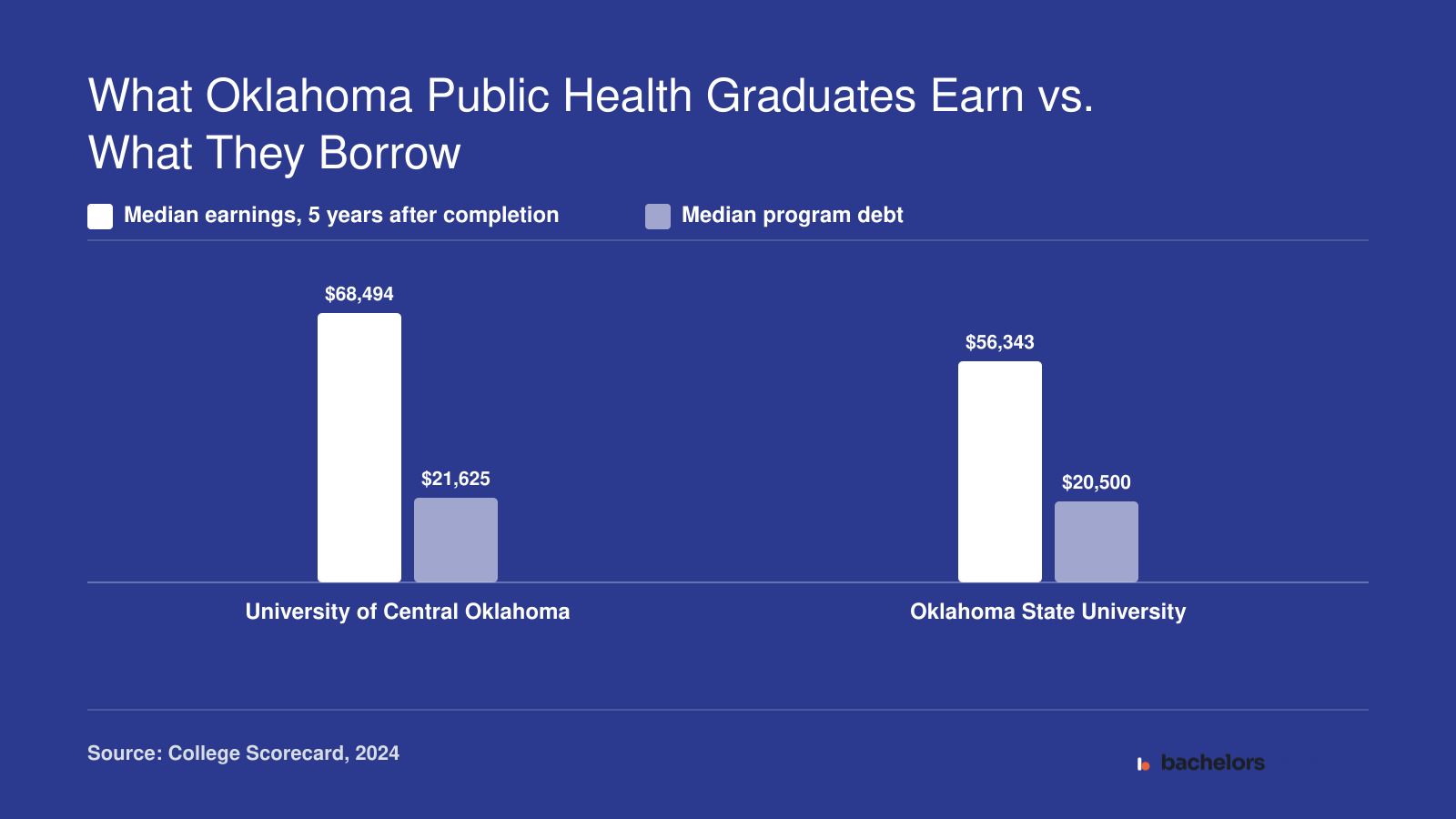
What Oklahoma Public Health Graduates Earn vs. What They Borrow
Program-level federal data pairs median earnings five years after completion with median debt for the bachelor's degree in public health at the University of Central Oklahoma and Oklahoma State University. University of Central Oklahoma shows the strongest earnings-to-debt balance: graduates earn a median $68,494 five years after completion against $21,625 in median program debt, roughly 3.2 times what they borrowed. Oklahoma State University graduates earn a median $56,343 at the same five-year mark on $20,500 in debt, about 2.7 times.
Program-Level Earnings Snapshot for Oklahoma Graduates
Among the schools ranked here, the University of Central Oklahoma's public health bachelor's program reports the highest program-level median earnings, measured five years after completion.
Oklahoma Public Health Bachelor's Degree FAQs
Which Oklahoma schools offer a bachelor's degree in public health?
Is the University of Oklahoma the only CEPH-accredited public health school in Oklahoma?
How much does a public health degree cost in Oklahoma?
Can you get a bachelor's degree in public health online in Oklahoma?
What jobs can you get with a bachelor's in public health in Oklahoma?
Compare Public Health programs on the data that matters
Explore more Healthcare majors or browse every field of study.
All Healthcare programs Browse every field of study