Best Information Technology Schools in Oklahoma
Compare 7 accredited Information Technology programs in Oklahoma at 6 colleges, with net price after aid, graduation rates, earnings and debt from IPEDS and the U.S. College Scorecard.

In-state tuition and fees for a bachelor's degree in information technology in Oklahoma run from $3,779 at Oklahoma State University-Oklahoma City to $35,470 at Oral Roberts University. The Bachelor of Science (B.S.) in Information Technology is the common credential, though Oklahoma State University Institute of Technology and OSU-Oklahoma City award a Bachelor of Technology.
The schools ranked here are compared on cost, outcomes, and accreditation across campus and online formats. The bigger choice is where you start. Cameron University and OSU-Oklahoma City build on an Associate in Applied Science, while the University of Oklahoma runs a conventional four-year degree.
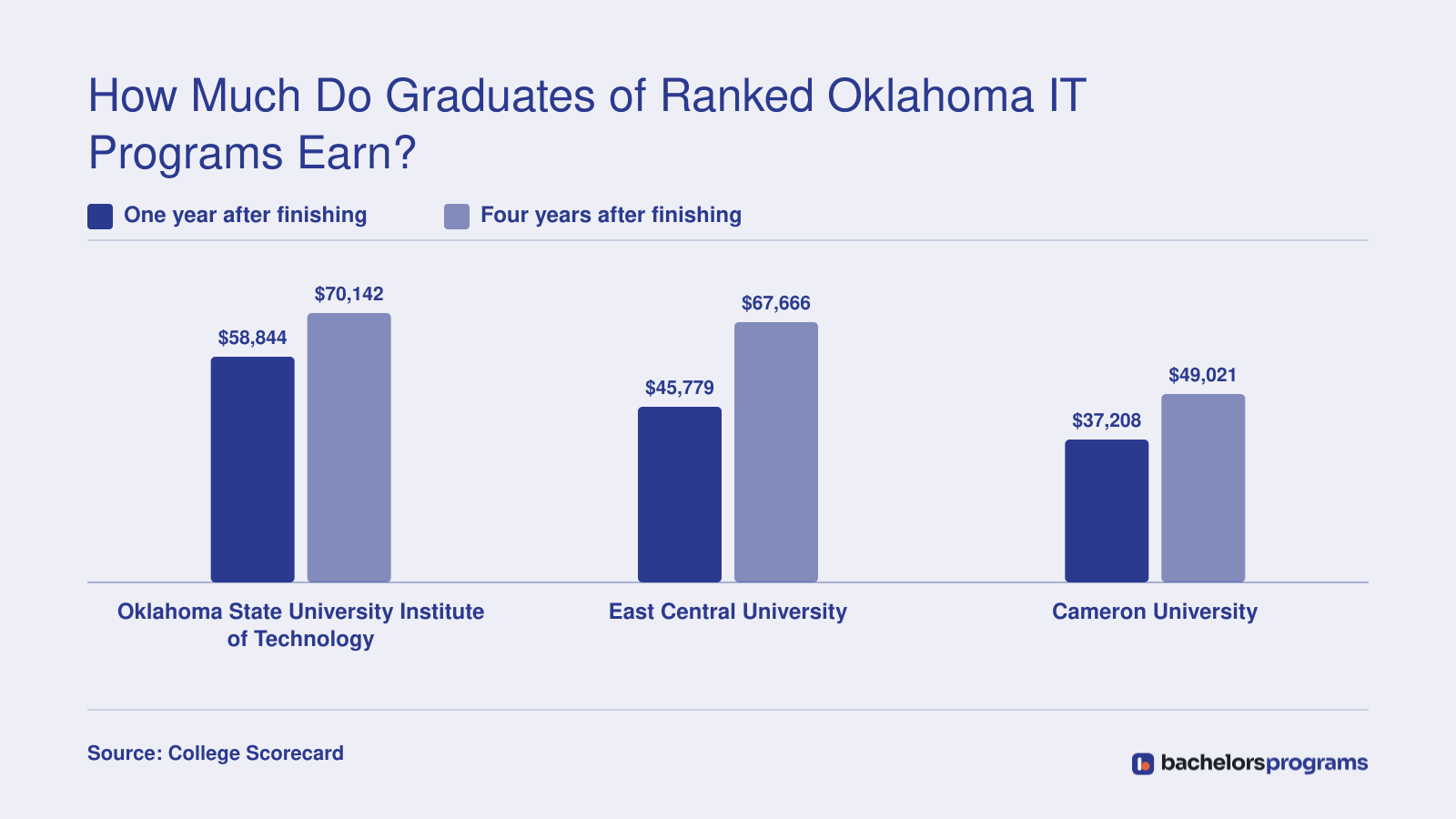
Price does not predict pay. Oklahoma State University Institute of Technology charges $5,774 in-state, and its graduates report median earnings of $70,142 four years after finishing.
Key Points
- OSU Institute of Technology graduates earn a $70,142 median four years out.
- Bachelor of Technology degrees build on an existing technical associate degree.
- Transfer credits and year-round study shape your graduation timeline most.
Best Information Technology Schools in Oklahoma: Our Ranked List
Oklahoma's information technology bachelor's programs fall into two broad families: university degrees in information science or information technology, and Bachelor of Technology degrees designed for students who already hold a technical associate degree. The six schools below cover both, from a flagship research campus in Norman to focused urban and polytechnic options. Each entry describes the concentration or track a student would actually enroll in, along with what makes that program distinct.
University of Oklahoma
#1Norman, OK · $15,000 – $20,000/yr (est.)
Best for: Data and AI focused IT majors
The University of Oklahoma awards a Bachelor of Science in Information Science and Technology through its School of Library and Information Studies. Coursework reaches into databases, data analytics, web technologies, information architecture and cybersecurity, and every student completes an internship before graduating. The Norman track blends in-person and online classes, while a fully online track serves transfer students and working professionals. Students meet an advisor each semester, which keeps a four-year plan on schedule.
- Fully online track available for transfer students and working professionals
- Internship required of every BSIST student
- Coursework uses PHP, MySQL, HTML5, JavaScript, Python, R and CSS
- Covers AI, data science, machine learning and cybersecurity
- Norman track mixes in-person and online classes
- Advising required each semester before enrolling
- Career paths include data analyst, data engineer and UX designer
Oklahoma State University Institute of Technology
#2Okmulgee, OK · ~$11,000/yr (est.)
Best for: Hands-on learners stacking IT certificates
Oklahoma State University Institute of Technology in Okmulgee takes a hands-on, technology-first approach, with three concentration options in cybersecurity, network infrastructure and software development. Stackable certificates of 18 to 21 credit hours are built into the bachelor's degree, so students leave with credentials as well as a diploma. Three start dates a year and a no-fee application make entry straightforward, and the degree runs on campus or fully online.
- Three options: cybersecurity, network infrastructure, software development
- Stackable certificates embedded in the bachelor's degree
- Digital Skills and Software Development certificates at 21 credit hours each
- Network Design, Crisis Management and Digital Forensics certificates at 18 credits
- Starts in fall, spring and summer
- No application fee
- Fully online option available
- Career paths include cloud architect, cybersecurity analyst and network administrator
East Central University
#3Ada, OK · $8,000 – $18,000/yr (est.)
Best for: Business-minded students blending IT and management
East Central University in Ada houses its IT offering inside the Stonecipher School of Business, so the degree pairs accounting, finance, marketing and management with systems analysis and digital tools. Students who want to weigh in on technology decisions alongside business strategy get a business-flavored foundation here. The degree title is a Bachelor of Science in Business Administration with an Information Systems concentration, which matters on a resume and in job searches.
- Offered through the Stonecipher School of Business
- Degree title: Bachelor of Science in Business Administration
- Concentration in Information Systems
- Core business courses in accounting, finance, marketing and management
- Training in IT, systems analysis and digital tools
- Prepares for systems management, IT consulting and business analysis roles
- Fits corporate settings or entrepreneurial ventures
Oral Roberts University
#4Tulsa, OK · ~$25,000/yr (est.)
Oral Roberts University in Tulsa delivers its Bachelor of Science in Information Technology entirely online, with 120 credit hours and a completion time as short as three and a half years. Six start dates a year on seven-week terms let students move quickly, and coursework prepares students to sit for CompTIA certifications. Success coaches guide online students from enrollment through graduation.
- 100% online Bachelor of Science in Information Technology
- 120 credit hours; finish in as little as 3.5 years
- Six start dates per year on 7-week terms
- Coursework in programming, networking, system administration and project management
- Prepares students for CompTIA certifications
- Success Coaches guide students from enrollment to graduation
- Careers: database analyst, network engineer, information security analyst
Cameron University
#5Lawton, OK · $7,000 – $17,000/yr (est.)
Cameron University in Lawton builds its Bachelor of Science in Information Technology on a 42-hour technology core and asks students to choose an option in computer information systems, management information systems, or cyber security and information assurance. The degree emphasizes communication and business skills alongside technical work and prepares students for supervisory and managerial roles. It also builds on the associate degree in information technology that Cameron awards, giving transfer students a clear path forward.
- 124-credit Bachelor of Science in Information Technology
- 42-hour core across CIS, IT, STAT and TECH courses
- Options: Computer Information Systems, MIS, Cyber Security and Information Assurance
- Option tracks run 15 to 16 credit hours
- 6 hours of guided electives
- Builds on Cameron's Associate in Applied Science in Information Technology
- Emphasizes communication and business skills for supervisory roles
Oklahoma State University-Oklahoma City
#6Oklahoma City, OK · $7,000/yr (est. net price)
Oklahoma State University-Oklahoma City offers a Bachelor of Technology in Information Technologies with two separate concentrations, cybersecurity and software development, both built for students arriving with a technical associate degree. Up to 35 technical credit hours transfer from a completed A.A.S. in information technology or a related field. Labs and internships are part of the experience, and the cybersecurity track maps to CompTIA Security+, Network+ and Certified Ethical Hacker preparation.
- Cyber Security concentration within the Bachelor of Technology
- Coursework in network security, ethical hacking and digital forensics
- Covers cryptography, cyber law and risk management
- Prepares for CompTIA Security+, Network+ and Certified Ethical Hacker
- Transfer up to 35 technical credit hours from a completed A.A.S.
- Internships and labs included
Oklahoma State University-Oklahoma City
#7Oklahoma City, OK · $7,000/yr (est. net price)
Oklahoma State University-Oklahoma City offers a Bachelor of Technology in Information Technologies with two separate concentrations, cybersecurity and software development, both built for students arriving with a technical associate degree. Up to 35 technical credit hours transfer from a completed A.A.S. in information technology or a related field. The software development track covers C#, Java, C++ and Python along with web, mobile and database work, and adds capstone and internship opportunities.
- Software Development concentration within the Bachelor of Technology
- Languages include C#, Java, C++ and Python
- Covers web, mobile, .NET and database development
- Capstone and internship opportunities
- Prepares for software engineering and systems analysis roles
- Transfer up to 35 technical credit hours from a completed A.A.S.
Cost & outcomes by school
Federal data for the highest-earning Information Technology programs, independent of the ranking above. Earnings are this field's bachelor's graduates four years after completing where the Scorecard reports them, else the school's undergraduate median.
| School | Net price / yr | Grad rate | Earnings | Debt | Grads/yr | Format |
|---|---|---|---|---|---|---|
| Oklahoma State University Institute of Technology OK | $10,999 | 42% | $70,142 | $15,336 | 58 | Online or campus |
| East Central University OK | $8,683 | 34% | $67,666 | $17,671 | 39 | Campus |
| University of Oklahoma OK | $15,300 | 75% | $63,126 | $20,654 | — | Online or campus |
| Cameron University OK | $10,912 | 31% | $49,021 | $21,500 | 25 | Online or campus |
| Oral Roberts University OK | $25,365 | 57% | $46,885 | $27,000 | 1 | Online |
| Oklahoma State University-Oklahoma City OK | $7,081 | 15% | $41,307 | $14,250 | — | Campus |
Sources: U.S. Department of Education. Net price, graduation rate, earnings and debt: College Scorecard (earnings and debt for this field's bachelor's graduates where reported, else school-wide); graduates: IPEDS. A dash means no figure is reported.
Cost, debt & payoff
Median earnings of this field's bachelor's graduates (4 yrs after completing, else the school's undergraduate median) vs. their median federal loan debt · U.S. College Scorecard
Across these programs the median graduate earns about $49,021 and finishes with roughly $17,671 in debt — a ratio that clears a common rule of thumb (keep debt below first-year salary). Net price and debt vary widely school to school, so check the per-school figures in the table above before you shortlist.
How We Ranked Oklahoma Bachelor's Programs in Information Technology
What makes one Oklahoma IT program rank above another? We looked at the factors that most shape what a student gets back from a bachelor's degree, drawing on the latest federal College Scorecard snapshot available in 2026.
What the Ranking Weighs
- Cost: Published tuition and the average net price students pay after grants and scholarships.
- Persistence: Graduation and retention rates, which show how many students stay enrolled and finish.
- Earnings and debt: Median earnings and borrowing for graduates of the IT program itself, where reported.
- Completions: How many students finish the program each year, a rough signal of program size and stability.
- Format: Whether the program runs on campus, online, or both.
What the Numbers Can and Can't Tell You
Some figures describe the whole school, not the IT department. Graduation rate, net price, and institution-wide earnings cover every student on campus, so a university with strong overall results may look different from its IT program alone. The ranking includes only bachelor's programs at Oklahoma-based schools, campus and online alike, and federal figures reflect past student cohorts rather than this fall's class.
How to Use This List
Treat the ranking as a starting shortlist. Program names and focus vary, from Oral Roberts University's B.S. in Information Technology to East Central University's Information Technology Management, so confirm curriculum, tuition, transfer rules, and online availability directly with each school before you apply.
What to Expect From a Bachelor's Degree in Information Technology in Oklahoma
Most of what determines how fast you finish an Oklahoma IT bachelor's is settled before you enroll. How many credits you arrive with, and whether you can study full time year round, shape your timeline more than the school's name does.
How Long a Bachelor's Takes
Most information technology degrees run about 120 credit hours, or roughly four years of full-time study. The University of Oklahoma's B.S. in Information Science and Technology is a 120-credit, four-year program, and students may enter the online bachelor's with as few as 24 transfer credit hours earned after high school, which shortens what remains. Oral Roberts University's online B.S. in Information Technology also totals 120 credits but can be completed in as little as 3.5 years, with six 7-week terms a year and about 6 credits per term.1 Oklahoma State University Institute of Technology's Bachelor of Technology in Information Technologies lists 122 credit hours, 30 of them satisfied by a completed associate degree.
Two Credentials, Different Shapes
The standard version, the Bachelor of Science in Information Technology, covers systems, networks, databases, and programming. The Bachelor of Technology is the applied variant used at OSU institutions, with more technical and hands-on lab work and a structure that assumes many students transfer in with an associate degree.
Specializations
OSUIT publishes four options inside its IT degree: cybersecurity, network infrastructure, software development, and applied artificial intelligence. Other programs are framed more broadly. OU's degree is in information science and technology, East Central University's is IT management, and Oklahoma State University-Oklahoma City offers an information technologies program.
What Accreditation Covers
Each school holds Higher Learning Commission accreditation, which applies to the whole institution and governs credit transfer and federal aid. ABET's Computing Accreditation Commission reviews individual programs instead, and OSUIT identifies its program as ABET CAC-accredited. Where a program is not ABET-accredited, that carries less weight in IT than in licensed fields, because employers and state boards do not require it.
Admissions Requirements: GPA, Test Policy, and Deadlines at Each School
Admissions requirements for a bachelor's degree in information technology in Oklahoma are set school by school, not by a statewide standard: each campus applies its own GPA, testing, and deadline rules. Most applicants start with the university's undergraduate application, then meet any transfer or program-level conditions.
University of Oklahoma
The B.S. in Information Science and Technology asks for a minimum 2.5 GPA and at least 24 college credit hours earned after high school. It is built for transfer students and working professionals, so official transcripts from every previous institution are required, along with good academic standing. ACT or SAT scores are not required. Applications are reviewed on a rolling basis and may remain open until two weeks before classes begin, though individual programs can set earlier dates. The application fee is $50. Applicants below the 2.5 mark may have additional admission options, but the published policy does not detail them.
Oklahoma State University Institute of Technology
For transfer applicants with at least 24 graded college credits, the benchmark is OSUIT's retention standards, the academic standing the school expects of continuing students; the published page does not give a numerical minimum GPA. With fewer than 24 credits, ACT or SAT scores are optional but requested. Every applicant submits the application, an official high school transcript, and official college transcripts. No application deadline is published.
Other Schools on Your Shortlist
East Central University, Oral Roberts University, Cameron University, and Oklahoma State University-Oklahoma City process admission through each school's undergraduate office. GPA floors, test policies, and deadlines can differ for first-year and transfer applicants, so confirm the current rules with the admissions office before you apply, particularly if you are bringing college credit.
Related Articles
How Much Do Graduates of Ranked Oklahoma IT Programs Earn?
Federal data tracks median earnings for graduates of three of the ranked IT bachelor's programs, measured one year and four years after finishing. Oklahoma State University Institute of Technology leads at $70,142 four years out, followed by East Central University at $67,666 and Cameron University at $49,021. Program-level earnings are not yet reported for the University of Oklahoma, Oral Roberts University or Oklahoma State University-Oklahoma City, so those schools are left off the chart. Read these figures against the cost data above: OSU Institute of Technology graduates reached their four-year median after paying in-state tuition and fees of $5,774 a year.
What IT Professionals Earn in Oklahoma
Network and computer systems administration is a common career path for graduates with a bachelor's degree in information technology, and it offers a useful benchmark for pay in the state.
Questions to Ask Yourself
Do you want a cybersecurity or software development concentration, and does your shortlist offer it?
Are you starting from an A.A.S. or technology center credential that needs a transfer ladder?
Do you need fully online, or can you commute to a campus in Oklahoma City, Tulsa, Stillwater, or Norman?
Frequently Asked Questions About IT Bachelor's Programs in Oklahoma
These answers show you where to confirm the details yourself, since requirements and timelines change by school and by year. Start with the program pages at the schools ranked here, then verify what matters with an advisor.
How long does an IT degree take in Oklahoma?
Can you earn a bachelor's degree in information technology online from an Oklahoma school?
Is an IT degree different from a computer science degree, and which fits cybersecurity better?
Do you need a license to work in IT in Oklahoma?
Compare Information Technology programs on the data that matters
Explore more Computers & IT majors or browse every field of study.
All Computers & IT programs Browse every field of study