Best Speech Pathology Schools in Oklahoma
Compare 5 accredited Speech Pathology programs in Oklahoma, with net price after aid, graduation rates, earnings and debt from IPEDS and the U.S. College Scorecard.
In Oklahoma, a bachelor's degree in speech pathology is a stepping stone, not a license: the state credentials SLPs at the master's level, so undergraduate years go to GPA, observation hours and references. Price separates the programs sharply.
The major appears under three names, Speech Pathology, Speech-Language Pathology, or Communication Sciences and Disorders, and the credential awarded is usually the Bachelor of Science (B.S.) in Speech Pathology. Net price after aid at the University of Science and Arts of Oklahoma is $6,624.
Programs differ in clinical hours and price, not in the title on the diploma. Since hiring turns on the master's, cost and supervised hours should outweigh prestige.
Key Points
- University of Science and Arts of Oklahoma averages $6,624 in net price.
- Median debt runs from $15,150 (Northeastern State) to $18,259 (Oklahoma State).
- Oklahoma SLP licensure requires a master's; the bachelor's is pre-professional.
Best Schools for a Bachelor's Degree in Speech Pathology in Oklahoma
Five Oklahoma universities award a bachelor's degree in speech pathology, and they differ sharply in size, price and how early you get clinical hours. Each card below shows the school's own major name, the net price students actually pay after grant aid, the institution-wide graduation rate and how selective admission is, plus program-level completion and earnings figures where the federal data reports them. Costs and completion carry the most weight here, because a pre-professional degree like this one is a stepping stone and debt taken on now follows you into graduate school.
Oklahoma State University
#1Stillwater, OK · ~$17,000/yr (est.)
Best for: Students weighing audiology as well as SLP
Oklahoma State runs its communication sciences and disorders major on both the Stillwater and Tulsa campuses, and it is by far the largest undergraduate producer of speech pathology graduates here, with about 75 bachelor's degrees completed in the latest reported year. Coursework covers anatomy and physiology of speech, acoustics, phonetics and an introduction to communication disorders, and students can join chapters of NSSLHA, ASHA and OSHA. Schools offering this program have graduation rates of 68 percent, admission is moderately selective at roughly 75 percent, and the average net price after aid is about $17,400. Graduates earn a median of about $56,500 four years after finishing.
- Also offered on the Tulsa campus, same curriculum
- Student chapters of NSSLHA, ASHA and OSHA
- Coursework in anatomy, acoustics, phonetics and disorders
- Prepares for graduate study or entry-level assistant roles
- Scholarships available to undergraduates
- Audiology assistant certificate option noted in program materials
- Biology background recommended before starting
- Advisors help plan the pre-professional sequence
University of Tulsa
#2Tulsa, OK · $15,000/yr (est. net price)
Best for: Private-college students seeking early clinical practicum
Tulsa is the private option: a small, clinically oriented major in the Oxley College of Health and Natural Sciences where undergraduates complete a supervised practicum and take phonetics, speech sound disorders, augmentative communication and audiology. About 17 bachelor's degrees were completed in the latest reported year, and learning outcomes are mapped to ASHA achievement standards. Admission is moderately selective at roughly 62 percent and net price after aid sits near $15,000, unusually low for a private university once aid is counted.
- Leads to the B.S.S.P. credential
- Supervised clinical practicum built into the major
- Major declared in the sophomore year
- Learning outcomes follow ASHA achievement standards
- Speech-language pathology minor also offered
- Research opportunities for undergraduates
- Coursework includes AAC and clinical phonetics
- Master's degree remains the entry level to the profession
University of Science and Arts of Oklahoma
#3Chickasha, OK · ~$7,000/yr (est.)
Best for: Small-campus learners wanting an on-site clinic
USAO is a small public liberal arts college in Chickasha with a compact three-year speech-language pathology degree and an on-campus clinic, the John A. Morris Speech and Language Clinic, where undergraduates earn clinical hours far earlier than most programs allow. Classes are small, students present original research, and the interdisciplinary coursework also feeds into audiology, special education and psychology pathways. Admission is comparatively open at about 66 percent and net price after aid is the lowest on this list at roughly $6,600, though the institution-wide graduation rate of 44 percent is worth asking about when you visit.
- Three-year degree plan
- 47 credit hours of specialized coursework
- Clinical practicum at the on-campus John A. Morris clinic
- Small classes with individual faculty attention
- Original research and presentation opportunities
- Interdisciplinary curriculum across related fields
- Prepares for graduate study in SLP or audiology
- Individual advisor customizes the degree plan
Northeastern State University
#4Tahlequah, OK · ~$13,000/yr (est.)
Northeastern State runs a cohort-based speech-language pathology major, so you move through the program with the same classmates, and every course is taught by a licensed and certified speech-language pathologist. Classes meet in Tahlequah and Muskogee, about 13 bachelor's degrees were completed in the latest reported year, and strong students can use an accelerated route to finish a bachelor's and master's in five years. Admission is effectively open at nearly 100 percent and net price after aid is about $12,700, while the institution-wide graduation rate of 35 percent suggests checking on advising and support before enrolling. Graduates earn a median of about $53,300 four years after finishing.
- Cohort model, same classmates throughout the program
- All courses taught by licensed and certified SLPs
- Accelerated bachelor's to master's pathway in five years
- Classes at both the Tahlequah and Muskogee campuses
- Covers fluency, voice, cognition, swallowing and hearing
- Interprofessional education opportunities
- Prepares for graduate study or SLP assistant work
- Emphasis on academic, clinical and research skills
University of Central Oklahoma
#5Edmond, OK · $15,000 – $20,000/yr (est.)
Central Oklahoma offers a 124-credit speech-language pathology major in Edmond with 25 supervised clinical hours at the campus clinic, rolling admission to the program and no application deadline. Upper-division coursework is competitive and sequential, moving from language development and acoustic phonetics into neuroscience and aural rehabilitation, and undergraduate credits can carry into the accelerated master's. Net price after aid is around $18,300 and the institution-wide graduation rate is 37 percent. Graduates earn a median of about $57,200 four years after finishing.
- 124 total credit hours including 12 in professional education
- 25 supervised clinical hours at the on-campus clinic
- Rolling admissions with no application deadline
- 2.8 GPA minimum cited in program materials
- Permission form required in the junior year
- Senior practicum limited to a select group
- Undergraduate credits count toward the master's program
- Coursework spans neuroscience, phonetics and aural rehabilitation
Cost & outcomes by school
Federal data for the highest-earning Speech Pathology programs, independent of the ranking above. Earnings are this field's bachelor's graduates four years after completing where the Scorecard reports them, else the school's undergraduate median.
| School | Net price / yr | Grad rate | Earnings | Debt | Grads/yr | Format |
|---|---|---|---|---|---|---|
| University of Tulsa OK | $15,000 | 72% | $61,408 | $21,500 | 8 | Campus |
| University of Central Oklahoma OK | $18,309 | 37% | $57,186 | $17,000 | 32 | Campus |
| Oklahoma State University OK | $17,447 | 68% | $56,543 | $18,259 | 63 | Campus |
| Northeastern State University OK | $12,710 | 35% | $53,271 | $15,150 | 29 | Campus |
| University of Science and Arts of Oklahoma OK | $6,624 | 44% | $41,913 | $21,750 | 7 | Campus |
Sources: U.S. Department of Education. Net price, graduation rate, earnings and debt: College Scorecard (earnings and debt for this field's bachelor's graduates where reported, else school-wide); graduates: IPEDS. A dash means no figure is reported.
Cost, debt & payoff
Median earnings of this field's bachelor's graduates (4 yrs after completing, else the school's undergraduate median) vs. their median federal loan debt · U.S. College Scorecard
Across these programs the median graduate earns about $56,543 and finishes with roughly $18,259 in debt — a ratio that clears a common rule of thumb (keep debt below first-year salary). Net price and debt vary widely school to school, so check the per-school figures in the table above before you shortlist.
Compare Oklahoma Speech Pathology Bachelor's Schools Side by Side
The University of Science and Arts of Oklahoma has the lowest average annual net price here at $6,624, the University of Tulsa is the most selective with a 61.5% admission rate, and Oklahoma State University graduates by far the most speech pathology majors, with 75 bachelor's completions. Among schools that report program-level earnings, University of Central Oklahoma graduates show the highest median, at $57,186 four years after completing the degree. Figures come from U.S. Department of Education IPEDS and College Scorecard data; a blank earnings cell means the figure is not published for that program, usually because the graduating group is too small to report.
| School | City | Public or Private | Format | Average Annual Net Price | Admission Rate | Bachelor's Completions | Median Program Earnings (4 Years After Completion) |
|---|---|---|---|---|---|---|---|
| Oklahoma State University | Stillwater | Public | Campus | $17,447 | 75.0% | 75 | $56,543 |
| University of Tulsa | Tulsa | Private | Campus | $15,000 | 61.5% | 17 | |
| University of Science and Arts of Oklahoma | Chickasha | Public | Campus | $6,624 | 65.8% | 6 | |
| Northeastern State University | Tahlequah | Public | Campus | $12,710 | 99.6% | 13 | $53,271 |
| University of Central Oklahoma | Edmond | Public | Campus | $18,309 | 78.1% | 17 | $57,186 |
Online and Hybrid Bachelor's Options at Oklahoma Schools
Northeastern State University teaches its speech-language pathology courses face-to-face, with the first undergraduate SLP courses in Tahlequah and the rest in Muskogee. Some general-education courses can be taken online, but the SLP coursework itself cannot. The pattern holds across every school on this list: each program is listed as campus-based, and none is listed as online or hybrid.
Delivery Mode by School
- Northeastern State University: Campus. SLP courses are face-to-face, and only general-education leveling courses are online.
- Oklahoma State University: Campus. The Communication Sciences and Disorders major is offered on the Stillwater and Tulsa campuses, and the program page does not identify an online or hybrid version.
- University of Tulsa: Campus. Its Speech-language Pathology major is listed as on-campus, with no online or hybrid track identified.
- University of Central Oklahoma: Campus. The Speech-Language Pathology program is listed as on-campus, with no online or hybrid track identified.
- University of Science and Arts of Oklahoma: Campus in our data. Neither the school's program page nor its ASHA listing describes an online or hybrid format, so plan on in-person study unless the department says otherwise.
Why These Programs Stay on Campus
Several of these programs build supervised clinical experience into the degree, and NSU runs its sequence as an in-person cohort. That structure leaves little room for a fully remote path.
No Oklahoma school in this group offers a bachelor's in the field online, so students who need flexibility should weigh campus programs that teach general education online, sit close to home, or accept transfer credit. Confirm current delivery details with each department before you apply.
Admissions: GPA, Test Policy and Transfer Credit
Test-optional admission has settled the test question at many universities, but it has not made the major's own GPA and transfer rules easier to find.
Check the University and the Major
Each Oklahoma school below sets general admission rules, and some add a second layer for the communication sciences and disorders or speech-language pathology major. Read both before you apply.
- Oklahoma State University: No published policy sets an undergraduate minimum GPA or ACT/SAT requirement for the communication sciences and disorders bachelor's. OSU does publish an associate transfer map into the CSD B.S., and an official transcript is required.1
- Northeastern State University: No published minimum GPA or ACT/SAT policy appears on the speech-language pathology program page. The same page states that "There are no Transfer Agreements at this time."
- University of Tulsa: Reports a 62% admission rate and an SAT range of 1220-1530. No published policy sets a minimum GPA or a major-specific transfer rule for speech-language pathology.
- University of Science and Arts of Oklahoma: Reports a 65% admission rate and an SAT range of 1090-1280. No published minimum GPA or transfer policy for the speech-language pathology major is listed.
- University of Central Oklahoma: Reports a 78% admission rate. The speech-language pathology program lists a 2.8 GPA minimum and a competitive admission process, a major-level standard that can sit above general admission. No published test-optional statement or transfer articulation is listed.
Transfer Credit and the SLPA Route
An associate degree does not carry uniform credit into these majors. OSU's transfer map for an Associate in Arts in Liberal Arts articulates four CDIS courses into the CSD bachelor's; the community college must send an official transcript with the associate noted.1 NSU states that it has no transfer agreements, so associate credits are not covered by a standing agreement there. For Tulsa, USAO and UCO, no associate-level articulation specific to speech-language pathology is published.
The SLPA certificate offered in Oklahoma is a post-bachelor's credential, not an associate-to-bachelor's bridge.2 Applicants must already hold a bachelor's in communication sciences and disorders or speech-language pathology, so it sits after the degree rather than before it.2
Cost of a Speech Pathology Bachelor's Degree in Oklahoma
Oklahoma's public universities make a bachelor's degree in speech pathology far cheaper than the private option, and state aid can narrow the gap further.
Tuition and Net Price
Northeastern State University has the lowest in-state tuition and fees in the data at $7,810 (out-of-state: $17,290). University of Central Oklahoma follows at $8,818 in-state ($19,704 out-of-state), then University of Science and Arts of Oklahoma at $9,000 ($20,190) and Oklahoma State University at $10,234 ($25,754). University of Tulsa charges $50,061 with no residency difference.
Net price after aid is a sector-average estimate, not a quote for a specific student. By that measure, University of Science and Arts of Oklahoma is lowest at about $6,624, then Northeastern State at $12,710, University of Tulsa at $15,000, Oklahoma State at $17,447 and Central Oklahoma at $18,309. Tulsa's sticker price is the highest by a wide margin, so check what its own aid offer says.
State Aid in Oklahoma
- Oklahoma's Promise: A tuition scholarship, not cash, covering resident tuition at eligible public colleges. Students enroll in grades 8 through 11, keep at least a 2.50 GPA, meet the program's curriculum and conduct rules, and apply by December 31 of senior year.1 The listed 2026 family income limit is $60,000.2 It ends after five years, a bachelor's degree, or 129 credits.
- Oklahoma Tuition Aid Grant (OTAG): Need-based aid for Oklahoma residents who are Pell-eligible with unmet need.3 For 2026-27 awards run up to $1,500, capped at 75% of costs, with a $100 minimum per payment period.4 One State Regents presentation cites family income of $50,000 or less, and the school makes the final award.
- Oklahoma Rising Scholars: Aimed at low-income, full-time undergraduates, with an effective income limit of $32,000.5
Access Signal and Takeaway
Pell recipients make up roughly 73% of undergraduates at Northeastern State, 70% at University of Science and Arts of Oklahoma, 67% at Central Oklahoma, 56% at Oklahoma State and 50% at Tulsa. Add the lowest sticker price, the lowest estimated net price and a strong Pell share, and Northeastern State and the University of Science and Arts of Oklahoma come out as the most affordable options. Tulsa is the priciest.
Practical Tip
File the FAFSA as early as you can. OTAG depends on Pell eligibility and unmet need, and schools award limited state aid as they process applications.
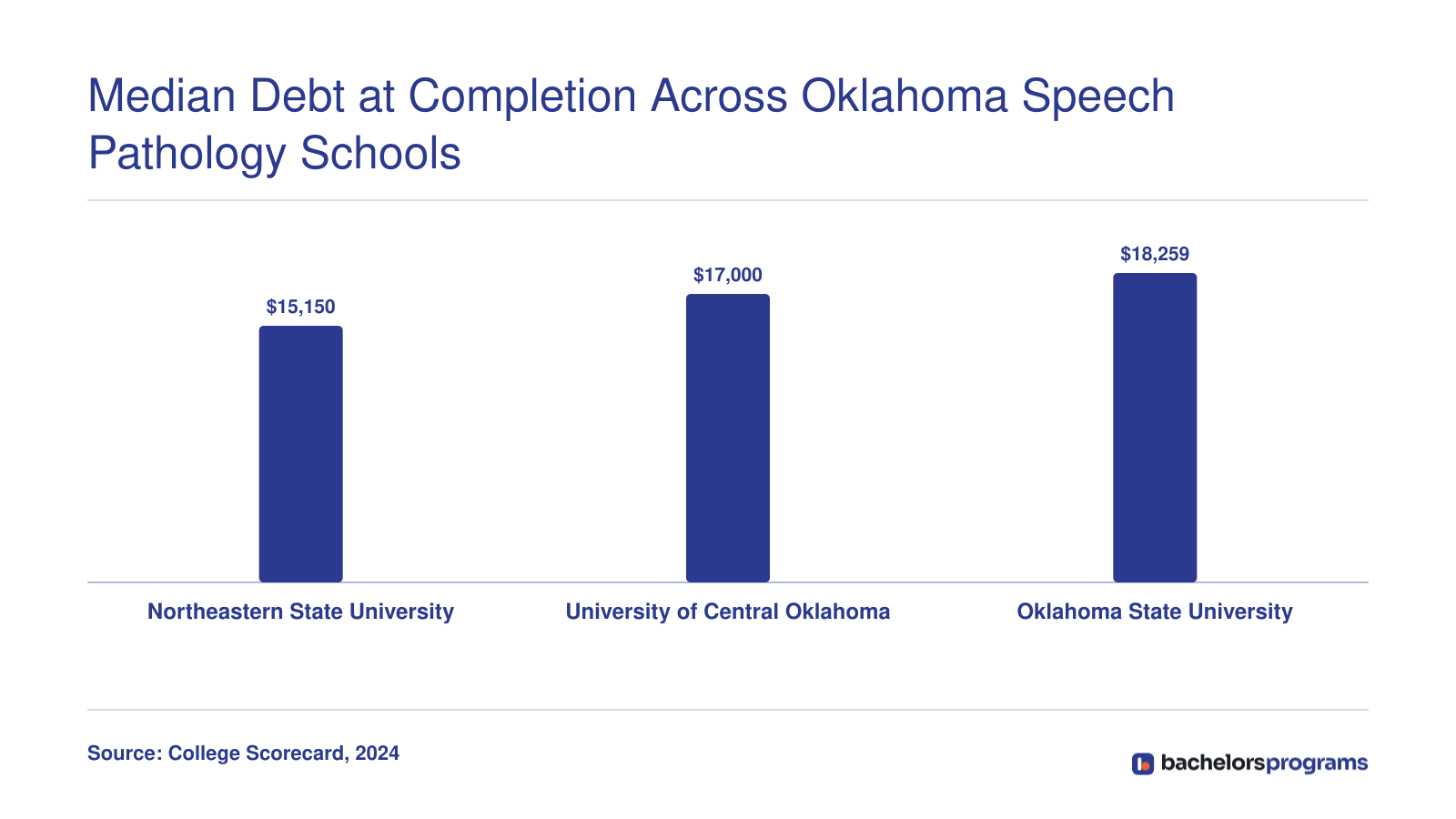
Median Debt at Completion Across Oklahoma Speech Pathology Schools
Median federal debt for speech pathology bachelor's completers runs from $15,150 at Northeastern State University to $18,259 at Oklahoma State University, a gap of about $3,100. University of Central Oklahoma falls between them at $17,000. Because the spread is modest, cost of attendance and aid will likely shape your borrowing more than the choice among these three programs.
Related Articles
How Long a Bachelor's in Speech Pathology Takes in Oklahoma
How many years does it take to finish a bachelor's degree in speech pathology in Oklahoma? Plan on four years of full-time study.1 The national standard for a bachelor's degree is at least 120 semester credit hours, and the B.S. in Speech Pathology or Communication Sciences and Disorders generally follows that pattern. Credit totals vary by program, so check the degree plan at Oklahoma State University, University of Tulsa, University of Science and Arts of Oklahoma, Northeastern State University or University of Central Oklahoma before you map out semesters.
Ways to Finish Sooner
A shorter timeline usually comes from your own credits, not from a formal fast track.
- Transfer credit: An associate degree can cover general education requirements, leaving the major's core courses for the university. Ask each school how it applies transferred credit to the major.
- Summer coursework: Extra summer terms can lighten fall and spring loads or recover lost ground.
- Credit by exam: AP, CLEP or dual-enrollment credit may count toward general education if the school accepts it.
Neither Oklahoma State University nor the University of Central Oklahoma publishes an accelerated option, a three-year bachelor's or a 3+2 bachelor's-to-graduate pathway. Confirm with an admissions advisor at the other schools here, since policies change.
Total Timeline to Licensure
The bachelor's is the pre-professional step. Oklahoma licensure as a speech-language pathologist requires a master's degree, followed by a supervised clinical fellowship. A realistic path looks like this:
- Bachelor's degree: about four years
- Graduate study: typically about two years
- Clinical fellowship: roughly nine months to a year of supervised work
That adds up to about seven years from your first college semester to full licensure, a little less if transfer credit shortens the undergraduate stretch.
Oklahoma Licensure Requirements: What Comes After the Bachelor's
A bachelor's degree gets you into the field, but it does not by itself qualify you to practice as a speech-language pathologist. Licensure as an SLP in Oklahoma requires a master's degree, so the bachelor's is the pre-professional step. The Oklahoma Board of Examiners for Speech-Language Pathology and Audiology sets the rules; check its current requirements before you plan a timeline.
The SLP Licensure Checklist
- Graduate education: At least 36 graduate-level credits in speech, language and hearing disorders, plus an Academic Preparation Practicum Form and transcripts.
- Supervised practicum: At least 400 clock hours, including 375 of direct client contact and 25 of observation. At least 325 hours must come during graduate study in a program accredited by the Council on Academic Accreditation.
- Clinical fellowship: A Clinical Fellow license comes first, with an $85 application fee, three letters of reference and a background check. Your supervisor must have held a license for two years and completed six hours of Board-approved supervision training.
- Praxis exam: The Praxis II Speech-Language Pathology exam, with scores sent to the Board.
- Full license: Submit the Report of Clinical Fellowship along with your passing scores. A temporary license is available to some applicants while paperwork is processed.
Renewal requires 20 hours of continuing education every two years, for SLPs and assistants alike.
Working as an SLP Assistant
An assistant role is the most direct way to work in the field with only a bachelor's degree. Oklahoma SLPAs must have their competency verified by the Board and pass either the Oklahoma SLPA exam or a national SLPA exam. They work under both direct and indirect supervision from a licensed SLP. That supervisor needs two years of licensure and six hours of Board-approved supervision training, three of them on supervising assistants.
The Board's published materials do not give a set number of direct-supervision hours, and the minimum education for assistants can change with rule updates. Confirm both with the Board before you commit to a degree path. Your school's CSD advisor can also tell you how its coursework lines up with these requirements.
What You Can Do With a Bachelor's Degree in Speech Pathology
A bachelor's degree in speech pathology is a pre-professional credential: it qualifies you for support roles alongside speech-language pathologists (SLPs), and the clinician title comes with the master's degree. Graduates of programs such as Northeastern State University's use the degree to move into SLPA work or into graduate study.
Entry-Level Roles and Where They Work
- Speech-language pathology assistant (SLPA): Carries out treatment plans written by an SLP, in schools, outpatient clinics and hospitals. Oklahoma sets its own SLPA credential rules, so confirm them with the state board before you plan around this role.
- Speech aide or school-based support: Helps with therapy materials, scheduling and data tracking in public school districts.
- Early-intervention support: Works with toddlers and families in home-visiting and developmental programs.
- Rehab or special-education paraprofessional: Assists in rehabilitation settings or classrooms serving students with communication needs.
Occupation Wages Versus Program Earnings
These are two different measures, so keep them apart. Occupation wages describe licensed SLPs, who hold a master's degree. The Bureau of Labor Statistics reports a May 2024 median annual wage of $84,310 for Oklahoma SLPs. The national median was $97,870 in May 2025. Federal wage data list a mean of $38.80 an hour for Oklahoma City; state data list $33.56 for Lawton.1 No reliable Oklahoma wage figure specific to SLP assistants turned up, so don't read the SLP numbers as an assistant's pay.
Program-level figures describe bachelor's completers themselves. At Oklahoma State University, median earnings were $26,921 one year after finishing, and about 83 percent of completers were employed at that point. Later windows look stronger. Median earnings four years out were $56,543 for Oklahoma State, $57,186 for the University of Central Oklahoma and $53,271 for Northeastern State University. Treat these as rough guides, since the completer groups are small, especially at Central Oklahoma and Northeastern State. One-year figures are not published for those two schools.
If you want to earn at the SLP level, plan for graduate school. If you want to work sooner, the roles above are realistic starting points.
Oklahoma Speech Pathology Bachelor's Questions, Answered
Can you earn a bachelor's degree in speech pathology in Oklahoma?
What can you do with a bachelor's degree in speech pathology?
How long does it take to become a speech-language pathologist in Oklahoma?
Compare Speech Pathology programs on the data that matters
Explore more Communications & Media majors or browse every field of study.
All Communications & Media programs Browse every field of study