Best Applied Business & Technology Degree Programs
Compare 70+ accredited Applied Business & Technology programs, with net price after aid, graduation rates, earnings and debt from IPEDS and the U.S. College Scorecard.

A technical credential does not have to be a dead end. For a working adult with an AAS, a technical certificate, or military training, the real task is finishing a bachelor's without repeating coursework already earned.
An applied business and technology degree, often a BAS or BAT, layers management, operations, and business skills onto prior technical study. Average net price among the schools ranked here runs from $4,564 at Cal State San Bernardino to $41,346 at Stevens Institute of Technology.
Transfer caps, accreditation, and earnings outcomes differ far more than degree titles do, and a strict credit limit can erase a lower price quickly.
Key Points
- Chipola College has the lowest average net price, $1,133 a year.
- Stevens Institute of Technology leads ranked schools in program-level earnings.
- Applied degrees face at most a modest employer gap versus BBAs.
Top 10 Applied Business & Technology Degree Programs for 2027
The strongest applied business and technology programs share a few traits: a net price that reflects real aid, earnings after graduation that justify the cost, debt loads graduates can carry, and formats that fit around a full-time job. The ten programs below deliver that combination, each with a different emphasis, from fully online completion degrees for working adults to campus programs built around enterprise systems and analytics.
California State University-San Bernardino
#1San Bernardino, CA · $4,600/yr (est. net price)
Best for: Working adults with transfer credits
California State University, San Bernardino built its applied business degree for adults who are already working, and the fully online, asynchronous format lets them keep their jobs while finishing. The program removes lower-division prerequisites and accepts up to 70 transfer credits, so students with community college coursework move straight into upper-division business material. Coursework is developed with the Jack H. Brown College of Business and Public Administration and leans on management, marketing, logistics, finance, and entrepreneurship.
- Fully online, asynchronous coursework
- Complete in as little as 20 months
- Accepts up to 70 transfer credits
- No lower-division prerequisites or business background required
- Built with the Jack H. Brown College of Business and Public Administration
- Coursework spans management, marketing, logistics, finance, entrepreneurship
- Designed for working adults balancing job and family
Towson University
#2Towson, MD · ~$17,000/yr (est.)
Best for: Business students targeting SAP careers
Towson University sits just outside Baltimore and pairs a traditional campus experience with a business program built around enterprise systems. Students work hands-on with SAP, customer relationship management platforms, and analytics tools, and can earn the SAP Student Recognition Award along the way. The STEM designation matters for international students who want the optional practical training extension, and assigned faculty advisers keep progress on track each term.
- 120-credit, four-year bachelor's program
- Hands-on work with SAP, CRM, and data analytics
- Earn the SAP Student Recognition Award through selected courses
- STEM-designated, supporting a two-year OPT extension
- Mentored professional experience plus capstone business exam
- Assigned faculty adviser each term
- Electives in project management, supply chain, requirements analysis
University of Miami
#3Coral Gables, FL · $37,000/yr (est. net price)
Best for: Students pairing business with a second major
The University of Miami is a private research university in Coral Gables whose business school treats technology as a core discipline rather than an add-on. Its business technology major is STEM-designated and blends the full BBA core with Python, database management, and cloud systems, plus electives in AI, fintech, cybersecurity, and health informatics. Students get an individualized plan through an assigned Cane Navigator, and the major can be added to another BBA.
- STEM-designated, 120-credit BBA
- Coursework in Python, database management, and cloud systems
- Electives in AI, fintech, cybersecurity, and health informatics
- Can be added as a second major to another BBA
- Individualized plan with an assigned Cane Navigator
- Strategic management capstone in the final semester
- Eight-semester plan with a 2.5 GPA minimum
Arizona State University
#4Tempe, AZ · ~$15,000/yr (est.)
Arizona State University runs one of the largest and most flexible applied business programs in the country, delivered through the W. P. Carey School of Business. Students can study online, at the Polytechnic or West Valley campuses, or through ASU Local, with multiple enrollment sessions each year. Applied internship courses and emphasis areas let working adults shape the degree around their current job, and an accelerated path into a master's is available.
- Offered through the W. P. Carey School of Business
- Online, Polytechnic and West Valley campuses, and ASU Local
- Emphasis areas let students tailor the degree
- Applied internship courses translate theory into practice
- Accelerated bachelor's to master's option
- Multiple enrollment sessions per year
- Core covers accounting, analytics, finance, management, marketing, ethics
George Mason University
#5Fairfax, VA · $15,000 – $20,000/yr (est.)
George Mason University designed its Bachelor of Applied Science as a completion degree for people who already hold an Associate of Applied Science. The Technology and Innovation concentration is run jointly by the Costello College of Business and the College of Engineering and Computing, and every course in it can be taken online, mostly asynchronously. A capstone and 45 upper-level credits round out a degree that assumes roughly 30 transfer credits on entry.
- Requires an Associate of Applied Science for admission
- Technology and Innovation concentration, 42 credits of core work
- All concentration courses online, most asynchronously
- At least 120 credits, including 45 upper-level credits
- Coursework includes IT project management, information security, accounting
- BAS 491 Applied Sciences Capstone required
- Option to declare a second concentration with 12 unique credits each
- Jointly run by the Costello College of Business and the College of Engineering and Computing
Mississippi State University
#6Mississippi State, MS · ~$18,000/yr (est.)
Mississippi State University offers its applied business degree both on the Starkville campus and online, aimed at working professionals who already hold an associate degree. The two-year format moves quickly through management information systems, human resources, administrative procedures, and project management. Tuition is charged per credit hour, and military benefits, scholarships, and financial aid are all accepted.
- $477 per credit hour
- Complete in two years across four semesters
- 120 total credit hours, full-time and part-time options
- On-campus and online delivery
- Builds on an associate degree from a community college
- Coursework in MIS, human resources, administrative procedures, project management
- Military benefits, scholarships, and financial aid accepted
Kansas State University
#7Manhattan, KS · $11,000 – $29,000/yr (est.)
Kansas State University's applied business and technology degree is entirely online and built to accept technical credits that other business programs often turn away. Students take a business core, then attach a concentration in nearly any skill area outside business, from aviation maintenance to health care to wind energy. Two tracks let students choose a smaller or larger concentration depending on how much technical coursework they bring.
- 121-credit program, 100% online
- Two tracks: applied business and technology management
- Add a concentration in nearly any skill area outside business
- Accepts transfer credits from community colleges and technical schools
- Skill areas include computer systems, aviation maintenance, health care, wind energy
- Taught by on-campus professors
- Online transfer equivalency tools
Grand Valley State University
#8Allendale, MI · $15,000 – $20,000/yr (est.)
Grand Valley State University runs a fully online degree completion program for students arriving with an applied associate degree. Up to 80 credits can transfer from prior learning and work experience, leaving 40 credits to finish at GVSU. The curriculum is shared between the Brooks College of Interdisciplinary Studies and the Seidman College of Business and includes stackable certificates in leadership and business fundamentals.
- Fully online with an optional in-person format
- Accepts up to 80 transfer credits for prior learning and work experience
- Final 40 credits completed at GVSU
- Offered jointly by Brooks College and the Seidman College of Business
- Stackable certificates in leadership and business fundamentals
- Three concentration options
- Designed for students with an applied associate degree
Stevens Institute of Technology
#9Hoboken, NJ · ~$41,000/yr (est.)
Stevens Institute of Technology is a private, technology-focused university in Hoboken, New Jersey, across the river from Manhattan. Its business and technology major is the largest at Stevens and requires two concentrations, one in business and one in a technical field. A practice core of business simulations, a team capstone, and a startup or live consulting project give students portfolio material before graduation.
- Two concentrations required: one business, one technology
- 12 concentration options across both areas
- Practice core built on business simulations
- Startup launch or live consulting project with New York-area executives
- Capstone showcased at the Stevens Innovation Expo
- Largest major at Stevens
- Recruiters include Goldman Sachs, Deloitte, KPMG, and Citi
Saint Louis University
#10Saint Louis, MO · $24,000/yr (est. net price)
Saint Louis University is a private Jesuit university with an AACSB-accredited business school in midtown St. Louis. Its business technology management major centers on analytics and enterprise systems, with hands-on SAP work, a required corporate practicum, and an optional six-month co-op. Students can also accelerate into a master's in supply chain management.
- AACSB-accredited business school
- Hands-on SAP enterprise systems experience
- Required practicum with a corporate client
- Six-month full-time co-op with credit and income
- Concentration covers AI, machine learning, data governance, cloud computing
- 120 total credit hours, 2.5 GPA minimum
- Accelerated route to an M.S. in Supply Chain Management
- Internships at Boeing, Edward Jones, and World Wide Technology
Cost & outcomes by school
Federal data for the highest-earning Applied Business & Technology programs, independent of the ranking above. Earnings are this field's bachelor's graduates four years after completing where the Scorecard reports them, else the school's undergraduate median.
| School | Net price / yr | Grad rate | Earnings | Debt | Grads/yr | Format |
|---|---|---|---|---|---|---|
| Stevens Institute of Technology NJ | $41,346 | 87% | $108,400 | $27,000 | — | Campus |
| Saint Louis University MO | $24,398 | 80% | $91,483 | $34,391 | 20 | Campus |
| George Mason University VA | $17,915 | 68% | $85,224 | $19,440 | 2 | Online |
| Arizona State University AZ | $14,967 | 68% | $82,535 | $20,490 | 284 | Hybrid |
| Arizona State University AZ | — | — | $82,535 | $20,490 | 516 | Hybrid |
| Quinnipiac University CT | $40,675 | 76% | $82,357 | $25,000 | 76 | Campus |
| Grand Valley State University MI | $16,317 | 67% | $79,324 | $25,000 | 109 | Online |
| Bowling Green State University OH | $24,022 | 64% | $79,291 | $23,738 | 119 | Online |
| Towson University MD | $17,413 | 70% | $78,497 | $17,250 | 437 | Campus |
| Pace University NY | $30,892 | 60% | $76,974 | $23,311 | 74 | Campus |
| Indiana Wesleyan University IN | $22,866 | 67% | $75,533 | $30,973 | 28 | Online |
| Indiana Wesleyan University IN | $16,898 | 35% | $75,533 | $30,973 | 154 | Online |
Sources: U.S. Department of Education. Net price, graduation rate, earnings and debt: College Scorecard (earnings and debt for this field's bachelor's graduates where reported, else school-wide); graduates: IPEDS. A dash means no figure is reported.
Cost, debt & payoff
Median earnings of this field's bachelor's graduates (4 yrs after completing, else the school's undergraduate median) vs. their median federal loan debt · U.S. College Scorecard
Across these programs the median graduate earns about $59,205 and finishes with roughly $22,000 in debt — a ratio that clears a common rule of thumb (keep debt below first-year salary). Net price and debt vary widely school to school, so check the per-school figures in the table above before you shortlist.
How We Ranked These Schools
This ranking is built from federal data, not editorial impressions. Every program here was scored on figures the U.S. Department of Education publishes through the College Scorecard, at two levels: the program itself and the institution behind it.
What We Measured
At the program level, we looked at what graduates of applied business and technology majors actually earn after completing, along with the median debt those graduates carried and the estimated monthly loan payment that debt implies. At the institution level, we factored in net price, graduation rate, and first-year retention, which together indicate whether students finish and what finishing costs.
Two Caveats Worth Reading
Net price is a sector-level average after grants and scholarships are subtracted. It is a comparison tool, not a quote. Your own figure will shift with family income, residency, transfer credit, and employer tuition benefits.
Program-level earnings also come from different measurement windows. Some reflect one year after completion, others two, four, or five. A longer window usually shows a higher number simply because careers advance, so each card labels its window. Compare like with like.
What We Did Not Score
We did not grade curriculum quality, faculty credentials, or how selectively a school admits transfer students. Those matter, especially for applied science completers, and they are worth asking an admissions office about directly.
Applied Business vs. Applied Management vs. Applied Technology Management
Applied Business and Applied Management programs tend to lead toward operations, administration and supervisory roles, while Applied Technology Management adds systems, IT and project work. No national classification separates the three labels, so the smartest comparison starts with the job you want, not the degree title.
Start With Job Titles, Not Program Names
List three to five target job titles, then look each one up in the Bureau of Labor Statistics Occupational Outlook Handbook and O*NET OnLine. Compare duties, typical education and median pay. No single occupation maps cleanly to any of these program labels. In May 2025, the median annual wage for management occupations was $126,520, against $50,980 for all occupations.1 Within that group, computer and information systems managers reported a median of $175,140, while administrative services and facilities managers reported $110,500.1 Those gaps describe occupations. They are not proof that one degree earns more.
Compare Curricula Side by Side
Pull each program's curriculum outline, required courses, internship list and "where graduates work" page. Line them up to see where they overlap and where each one specializes. A technology management track built around systems implementation and project coordination fits different roles than a general applied business core.
Ask for Outcome Data Directly
- Programs: Request completion, placement and salary reports from program administrators.
- Associations and accreditors: Contact groups such as AACSB, ABET and the Project Management Institute about program-level outcomes or employer surveys.
- State wages: Check BLS wage data by state and industry, since local pay can differ from national medians.2
- Employers: Hold informational interviews with local hiring managers to learn which credential they actually prefer.
Don't wait for a single comparative statistic to appear. Your own evidence will answer the question faster.
Applied Business Degree vs. Traditional Business Degree: What Employers See
Will an employer treat an applied business bachelor's differently from a BBA? The evidence points to a modest difference at most, and the research behind it is narrower than program marketing suggests.
How the Two Paths Are Built
A traditional BBA starts at freshman general education and moves into business core courses in years three and four. An applied degree works the other way around. You arrive with a completed technical associate degree, and the program stacks upper-division business courses on top of it. The technical credits count as your major foundation instead of electives.
What the Employer Research Shows
The best U.S. evidence covers community college baccalaureate graduates, a group that includes BAS holders but is not limited to them. In Washington, those graduates were employed at 75% versus 69% for regional university graduates. Fourth-quarter job-match rates were 77% versus 70%, and business graduates were about 8% more likely to be employed. Qualitative work found employers viewed these graduates' skills as immediately usable.
Earnings tell a more mixed story. By year three, community college business graduates earned $49,200 a year, against $53,200 for university business graduates. Employers and students in Washington also often struggled to tell a BAS from a BS. No national survey directly compares applied and traditional business bachelor's degrees, so treat these findings as suggestive.
The MBA Question
Most MBA programs ask for a regionally accredited bachelor's degree, and an applied management bachelor's generally meets that baseline. Admission is not automatic. Programs may add GPA, work-experience, or foundation-course requirements, so expect possible gaps in finance, accounting, or statistics. Check each school's policy before you commit.
A Simple Fit Rule
- Choose an applied degree if: you already work or hold credentials in a technical field and want to move into supervision or management.
- Choose a traditional BBA if: you are switching careers and want real depth in finance, marketing, or accounting.
Applied Business & Technology Degree Cost and Return on Investment
The cheapest program is not always the one that pays best, so the useful question is what you pay against what you can reasonably expect to earn. The schools below are sorted by an institution-wide proxy, not a program result, so treat the order as a starting point for comparison.
Net Price, Debt and Monthly Payment
The proxy compares each school's 10-year graduate earnings with median graduate debt. It describes the whole institution, so do not read it as what an applied business graduate will earn. Program-level debt and payment figures are more specific.
- Cal State San Bernardino (online BA in Applied Business): net price of $4,564, program median debt of $12,604, and a median 10-year payment of $134 a month.
- George Mason University (online-option BAS): net price of $17,915, program debt of $19,440, and $206 a month.
- Clark College (BAS in Applied Management): net price of $11,465, debt of $19,085, and $202 a month.
- Santa Fe College (online BAS in Organizational Management): net price of $11,098, debt of $18,952, and $201 a month.
The University of Miami posts the highest proxy ratio, but its $37,244 net price makes it a very different spending decision. Cal State San Bernardino is the strongest all-around value here, pairing a low net price with the smallest payment.
What the Payment Means Against Earnings
Program graduates at Cal State San Bernardino had median earnings of $40,817 one year out, and $56,361 at the four-year mark. A $134 payment is about $1,600 a year, roughly 4 percent of the first-year figure. At George Mason, first-year earnings were $55,147 against a $206 payment, about 4.5 percent. Earnings windows differ by figure, so always check which year you are comparing.
Per-Credit Tuition and Aid
Per-credit rates matter more than annual sticker prices, especially for transfer students, who pay only for the credits they still need. Mississippi State University Online's BAS in Public Management is a useful benchmark: $452 per credit plus a $25 instructional support fee, or $477, at the in-state rate for all online students.1 Across 120 credits that is $57,240, but a student arriving with 60 credits would owe about $28,620.
Three aid sources can cut that further:
- Pell Grant: up to $7,395 for 2026-27, and it is not repaid.2
- Employer assistance: up to $5,250 a year tax-free under federal rules2, paid either upfront or by reimbursement after you pass. It can also cover student loan payments.
- State completion grants: ask your school's financial aid office what is available for returning adults.
Employer aid and federal aid count together toward your cost of attendance, so confirm the combined effect with the aid office before enrolling.
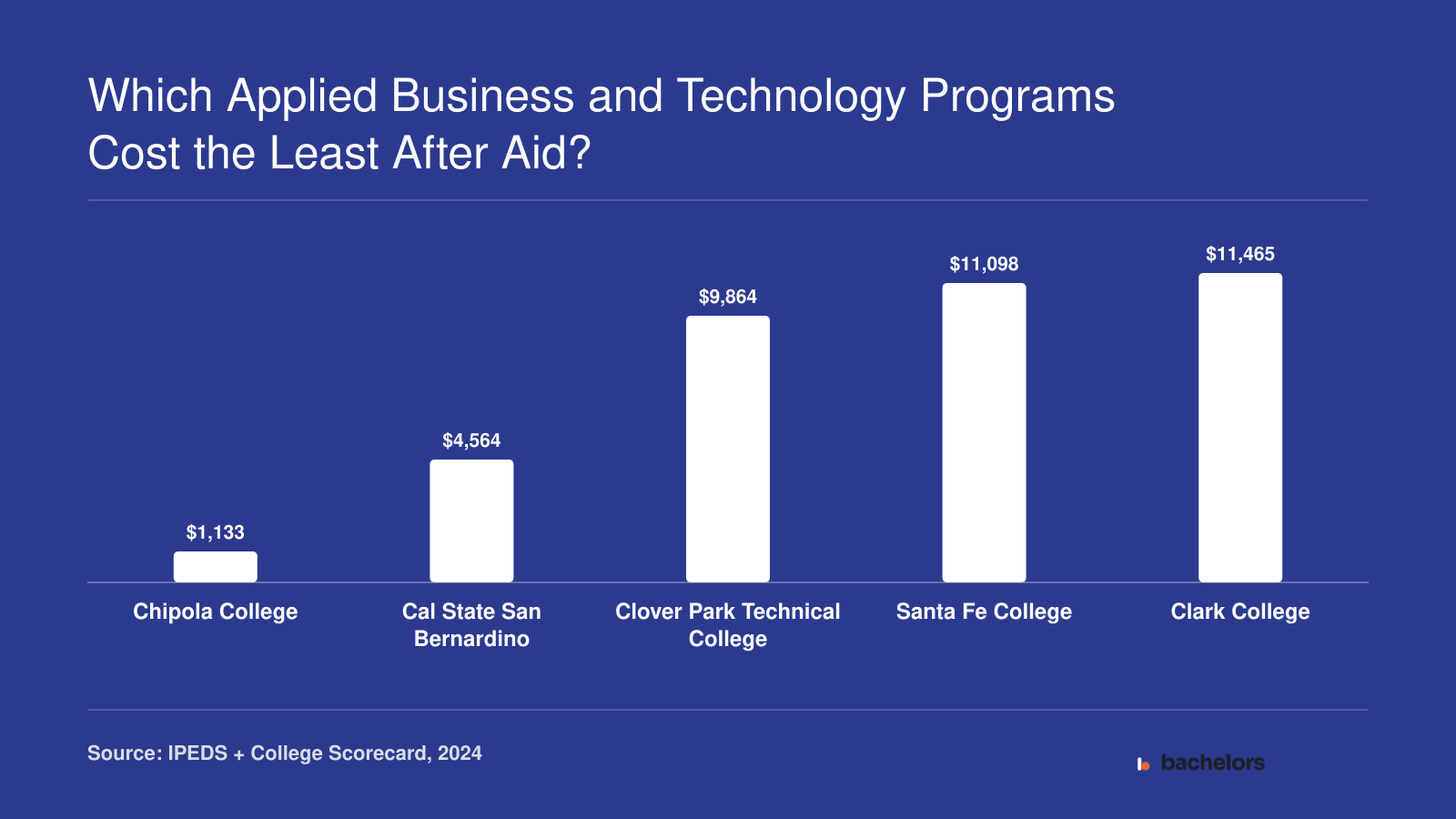
Which Applied Business and Technology Programs Cost the Least After Aid?
Net price is the average yearly cost after grants and scholarships, so what you actually pay can be higher or lower depending on your family income. Chipola College has the lowest average at $1,133 a year, and Clark College is the highest of these five at $11,465. Median debt for these specific programs is published for only three schools: $12,604 at Cal State San Bernardino, $18,952 at Santa Fe College and $19,085 at Clark College.
Questions to Ask Yourself
Will the program accept your entire AAS as a block, or evaluate technical courses one at a time?
How many credits will you actually have left after transfer, and at what per-credit rate?
Can you finish the remaining upper-division courses part-time while working, or do any require in-person sessions?
Related Articles
Highest Program-Level Earnings Among Ranked Schools
Stevens Institute of Technology posts the strongest program-level earnings among the schools ranked here.
Careers and Salaries for Applied Business & Technology Graduates
An applied business and technology degree is built for people who already have technical training and want to move into supervision, operations, or project leadership. The titles below are where graduates commonly aim. Median annual wages come from the U.S. Bureau of Labor Statistics (May 2025), and projected job growth covers 2025 to 2035 where BLS publishes it.
Roles and Typical Entry Paths
- Project management specialists: $102,320 median, 7 percent projected growth. Typical entry path: realistic right after an AAS plus an applied bachelor's, especially in the technical field you already know.
- Purchasing agents and buyers: $77,710 median, 6 percent growth. Typical entry path: open to new bachelor's graduates, particularly those with manufacturing, logistics, or trade backgrounds.
- First-line supervisors of office and administrative support workers: Typical entry path: often reached by promotion from within, so working adults who finish the degree while employed are well positioned.
- General and operations managers: $105,770 median.1 Typical entry path: a bachelor's degree plus years of experience.2 Few people start here.
- Industrial production managers: $126,060 median, 3 percent growth. Typical entry path: usually follows years in a production or technical role.
- Computer and information systems managers: $175,140 median, 16 percent growth, the fastest of the roles listed here. Typical entry path: a bachelor's plus several years in IT before moving into management.
Read These Wages in Context
BLS medians cover everyone in an occupation, from recent hires to managers with decades in the role. That is why they run well above the program-level earnings shown earlier, which track graduates of specific programs shortly after they finish. Expect your first salary after graduation to sit closer to those program figures, especially if you are changing fields.
The picture shifts if you are already working in a technical job. For many students, the applied bachelor's functions as a promotion credential rather than a fresh start, and the distance between your current pay and these occupation medians can shrink faster than it would for a traditional first-time graduate.
Applied Business & Technology programs by state
Compare Applied Business & Technology programs on the data that matters
Explore more Business & Management majors or browse every field of study.
All Business & Management programs Browse every field of study