Best Healthcare Administration Degree Programs
Compare 660+ accredited Healthcare Administration programs at 570+ colleges, with net price after aid, graduation rates, earnings and debt from IPEDS and the U.S. College Scorecard.

In-state tuition at the University of South Florida is $6,410 a year; at the private University of Pennsylvania, it is $68,686. Early earnings do not track that gap. Median pay one year after graduation runs from $39,016 at Florida International University to $74,354 at Georgetown.
Format matters too: FIU and Cambridge College of Healthcare & Technology teach online, Minnesota runs a hybrid model, and most others expect you on campus. Ranking is only the first cut; cost, AUPHA accreditation, salary outlook, and the bachelor's-versus-MHA question all shape the final choice.
Senior hospital roles often call for a master's, so a bachelor's has to pay off twice: at entry and as groundwork for graduate study.
Key Points
- Health services managers earned a $123,860 median wage (BLS, May 2025).
- In-state tuition here runs from about $6,400 to nearly $69,000 yearly.
- Georgetown, Rutgers, and UConn build health system internships into the degree.
10 Top-Rated Healthcare Administration Degree Programs for 2027
Ten programs made this list for what happens after enrollment rather than before it: what graduates earn, what they pay, and whether they finish. The spread is wide. In-state tuition runs from about $6,400 to nearly $69,000 a year, and where programs report graduate earnings, one-year medians land between roughly $39,000 and $74,000. Most of these schools teach the business and operations side of health care, but they split sharply on price, pace, and how much hands-on administrative work the degree includes.
University of Pennsylvania
#1Philadelphia, PA · $29,000/yr (est. net price)
Best for: Business-minded students eyeing health consulting
An Ivy League university where the health care management concentration lives inside the Wharton undergraduate business degree, so students pair sector coursework with a full business core. Graduates move into consulting, banking, health care technology and government roles. Tuition is $68,686 a year, and the school's overall graduation rate is 97%.
- Wharton concentration in health care management, financing and economics
- Three full course units of electives inside the concentration
- Capstone course required for the Wharton BS
- Electives span health care analytics, entrepreneurship and biotech economics
- Two semesters of a foreign language required
- Common paths: consulting, banking, health care IT and government
- Also draws students headed to medicine, nursing or dentistry
Florida International University
#2Miami, FL · ~$9,000/yr (est.)
Best for: Working adults finishing a degree part-time
A large public research university whose health services administration degree is built for students arriving with prior college credit, offered both on campus and fully online. It is one of the most affordable routes here, at $6,565 a year in state and $18,964 out of state. The school's overall graduation rate is 74%, and program graduates reported a median of about $39,000 one year after completion and $56,900 four years out.
- 60-credit upper-level program, completable in about five semesters
- Full-time and part-time options
- Face-to-face at Biscayne Bay or fully online through FIU Online
- Coursework in informatics, financial management and health services research
- Emphasizes ethical change management and interprofessional collaboration
- Prepares students for graduate study in health administration
University of South Florida
#3Tampa, FL · ~$10,000/yr (est.)
Best for: Aspiring nursing home administrators
A public research university offering a health care administration degree centered on operations, regulatory compliance and facility management rather than policy theory. It stands out for licensure alignment: graduates can sit for the state nursing home administrator exam. Tuition is $6,410 a year in state and $17,324 out of state, and the school's overall graduation rate is 77%.
- Prepares students to sit for the nursing home administrator licensure exam
- Coursework in health care management, regulatory compliance and facility administration
- Careers in assisted living communities, hospitals and other organizations
- Students can join the USF chapter of the American College of Health Care Administrators
- Scholarships and awards offered each spring
Washington University in St Louis
#4St. Louis, MO · ~$22,000/yr (est.)
A private research university where healthcare management is taught jointly by the business and medical schools, giving undergraduates faculty from both sides of the enterprise. Majors complete an independent research project, which suits students aiming at hospitals, insurers or pharmaceutical firms. Tuition is $65,790 a year, and the school's overall graduation rate is 94%.
- Joint offering between the Olin Business School and the medical school
- Open to both business and non-business students
- Core course brings clinicians and business leaders into the classroom
- Individual research project completed under faculty mentorship
- Coursework in healthcare economics, policy and management
University of Minnesota-Twin Cities
#5Minneapolis, MN · ~$17,000/yr (est.)
A large public research university with two routes into health services management: a hybrid applied bachelor's built for transfer students and a partially online management degree with many concentration choices. Flexible formats, including self-paced online coursework, let working students keep earning while enrolled. Tuition is $17,214 a year in state and $38,362 out of state; the school's overall graduation rate is 85%, and graduates reported a median of about $52,100 one year after completion.
- AUPHA-certified program totaling 120 credit hours
- Classroom, live online, self-paced online and community-based formats
- Internship and capstone built into the curriculum
- Three concentration options and 22 elective credits
- Admission requires 30 transferable credits and a 2.5 GPA
- Study abroad option in Costa Rica
- Program highlights cite AUPHA certification
- 12 concentration options across 120 credit hours
- Two start dates per year, fall and spring
- Partially online course delivery
- Annual study abroad trip to Costa Rica
- Advisory board of industry leaders
- Long-term care licensure support
Rutgers University
#6New Brunswick, NJ · $24,000/yr (est. net price)
A public research university where health administration sits inside the public policy school, so the degree leans toward systems, operations and policy rather than pure business. A required professional practice internship and an explicit welcome for transfer and adult learners make it practical for people already working in care settings. Tuition is $17,929 a year in state and $37,441 out of state; the school's overall graduation rate is 84%, and graduates reported a median of about $49,900 one year after completion.
- 51-credit major leading to a Bachelor of Science
- Required professional practice internship
- Coursework in health care finance, operations, information systems and HR
- Designed for transfer students and adult learners
- 2.5 GPA minimum plus prerequisite courses
- Blends management theory with hospital, long-term care and insurance cases
Georgetown University
#7Washington, DC · $40,000 – $45,000/yr (est.)
A private university whose health care management and policy program positions students close to federal health agencies, hospital systems and policy shops. Undergraduates choose a management or policy analysis track, then spend senior year in an internship of at least 16 hours a week plus a senior project or thesis. Tuition is $68,017 a year; the school's overall graduation rate is 95%, and graduates reported a median of about $74,400 one year after completion.
- Two tracks: Health Policy Analysis and Health Management
- Senior-year internship of at least 16 hours per week
- Internships with MedStar Georgetown University Hospital executives
- Senior project presented to the class, or an honors thesis
- Accelerated five-year BS/MS in Epidemiology available
- Honors program, pre-med advising and study abroad options
- Early Action deadline November 1, Regular Decision January 10
University of Connecticut
#8Storrs, CT · ~$25,000/yr (est.)
A public flagship where health care management is a major inside the business school and awards a B.S. in Business Administration rather than a standalone health degree. That structure suits students who want accounting, finance and marketing alongside health law and insurance, and most internships are paid. Tuition is $21,044 a year in state and $43,712 out of state, and the school's overall graduation rate is 83%.
- Leads to a B.S. in Business Administration
- Core business courses plus health law, insurance and risk management
- Internships at major insurers and hospitals, most of them paid
- Small cohort with a student-run networking organization
- Regional tuition rates for Maine, Massachusetts and Rhode Island residents
- Scholarships available after junior year
Auburn University
#9Auburn, AL · $13,000 – $35,000/yr (est.)
A public university whose health services administration program has run since 1971 and reports more than 1,100 alumni across the country. The curriculum pairs management and health information technology with research methods and patient-centered care, and the department leans on advising and internship connections. Tuition is $12,890 a year in state and $34,922 out of state; the school's overall graduation rate is 82%, and graduates reported a median of about $45,300 one year after completion.
- Running since 1971 with more than 1,100 alumni nationwide
- Program materials describe it as AUPHA-certified
- Coursework in health IT, research methods and management
- Faculty advising and internship connections
- Scholarships available to accepted students
Cambridge College of Healthcare & Technology
#10Delray Beach, FL · ~$21,000/yr (est.)
A private, career-focused college whose health care administration bachelor's is delivered entirely online and assumes students already hold an associate degree in a health or business field. The schedule is accelerated, with the degree mapped to roughly 75 weeks, and coursework covers revenue cycle management, health information management and long-term care administration. Tuition is $18,168 a year, and the school's overall graduation rate is 76%.
- 100% online, laid out to finish in about 75 weeks
- 60 semester hours of coursework
- Requires an associate degree in health care, allied health or business
- Covers revenue cycle management, health information management and long-term care
- Final term is a capstone or the Supervision and Management course
- Career examples include revenue cycle manager and health policy analyst
Cost & outcomes by school
Federal data for the highest-earning Healthcare Administration programs, independent of the ranking above. Earnings are this field's bachelor's graduates four years after completing where the Scorecard reports them, else the school's undergraduate median.
| School | Net price / yr | Grad rate | Earnings | Debt | Grads/yr | Format |
|---|---|---|---|---|---|---|
| Georgetown University DC | $40,815 | 95% | $143,686 | $17,500 | 29 | Campus |
| Massachusetts College of Pharmacy and Health Sciences MA | $39,545 | 62% | $125,557 | $25,000 | 8 | Campus |
| University of Pennsylvania PA | $28,699 | 97% | $111,371 | $15,715 | 26 | Campus |
| Washington University in St Louis MO | $21,786 | 94% | $86,182 | $17,500 | 23 | Campus |
| Western Governors University UT | $12,548 | 46% | $82,644 | $14,909 | 1,420 | Online |
| Northeastern University MA | $30,915 | 91% | $80,233 | $26,500 | 333 | Campus |
| University of St Francis IL | $13,006 | 67% | $79,421 | $20,827 | 34 | Hybrid |
| Syracuse University NY | $38,793 | 84% | $79,164 | $26,000 | — | Online |
| James Madison University VA | $23,322 | 80% | $77,393 | $19,500 | 63 | Campus |
| George Mason University VA | $17,915 | 68% | $76,343 | $19,500 | — | Online |
| Adelphi University NY | $30,783 | 67% | $75,482 | $25,000 | — | Campus |
| Rutgers University-Camden NJ | $18,745 | 67% | $74,479 | $21,500 | — | Campus |
Sources: U.S. Department of Education. Net price, graduation rate, earnings and debt: College Scorecard (earnings and debt for this field's bachelor's graduates where reported, else school-wide); graduates: IPEDS. A dash means no figure is reported.
Cost, debt & payoff
Median earnings of this field's bachelor's graduates (4 yrs after completing, else the school's undergraduate median) vs. their median federal loan debt · U.S. College Scorecard
Across these programs the median graduate earns about $54,794 and finishes with roughly $24,427 in debt — a ratio that clears a common rule of thumb (keep debt below first-year salary). Net price and debt vary widely school to school, so check the per-school figures in the table above before you shortlist.
Behind the List: The Data That Shaped Our Picks
Federal outcome data now lets students compare bachelor's programs on earnings and debt, not just brand names, though those numbers carry caveats.
The picks draw on College Scorecard program-level earnings and debt, each school's graduation and retention rates, tuition at the degree level, undergraduate net price after aid, and whether the program runs online, hybrid, or on campus.
Where the Numbers Fall Short
- Graduation rates: These cover the whole institution, not the healthcare administration major.
- Net price: It is an average after grant aid, not a quote. Your own cost depends on your aid package, residency, and transfer credits.
- Earnings: Some programs have no published Scorecard figures, so a missing number says nothing about quality.
What the List Cannot Tell You
The rankings do not measure curriculum quality, faculty experience, or internship placement. Those shape your first job as much as cost does. Ask each admissions office where recent graduates completed their practicums, who teaches the core courses, and how the program supports students in finding placements, especially if you plan to study online.
Once you have narrowed the field by cost and outcomes, accreditation is the next filter. The labels are not interchangeable, and knowing the difference tells you which ones are worth checking.
Cheapest Healthcare Administration Degrees on Our List
If cost is your top filter, these are the most affordable healthcare administration degree programs on our list, ranked by average net price after aid: what undergraduates typically pay per year once grants and scholarships are applied, according to 2024 IPEDS and College Scorecard data. Eastern Florida State College is the option here with online coursework, and Cal State San Bernardino is the only one with program-level borrowing data: its graduates carry a median debt of $16,100, or about $171 a month on a 10-year plan. The lowest sticker price isn't always the best value, so compare these costs against the earnings figures in our salary section before you decide.
| School | Location | Format | Average Net Price After Aid (per year) | Program-Level Median Debt | Monthly Payment (10-Year Plan) |
|---|---|---|---|---|---|
| California State University-Los Angeles | Los Angeles, CA | On campus | $3,967 | N/A | N/A |
| California State University-San Bernardino | San Bernardino, CA | On campus | $4,564 | $16,100 | $171 |
| Eastern Florida State College | Melbourne, FL | Hybrid (online and on campus) | $6,440 | N/A | N/A |
Related Articles
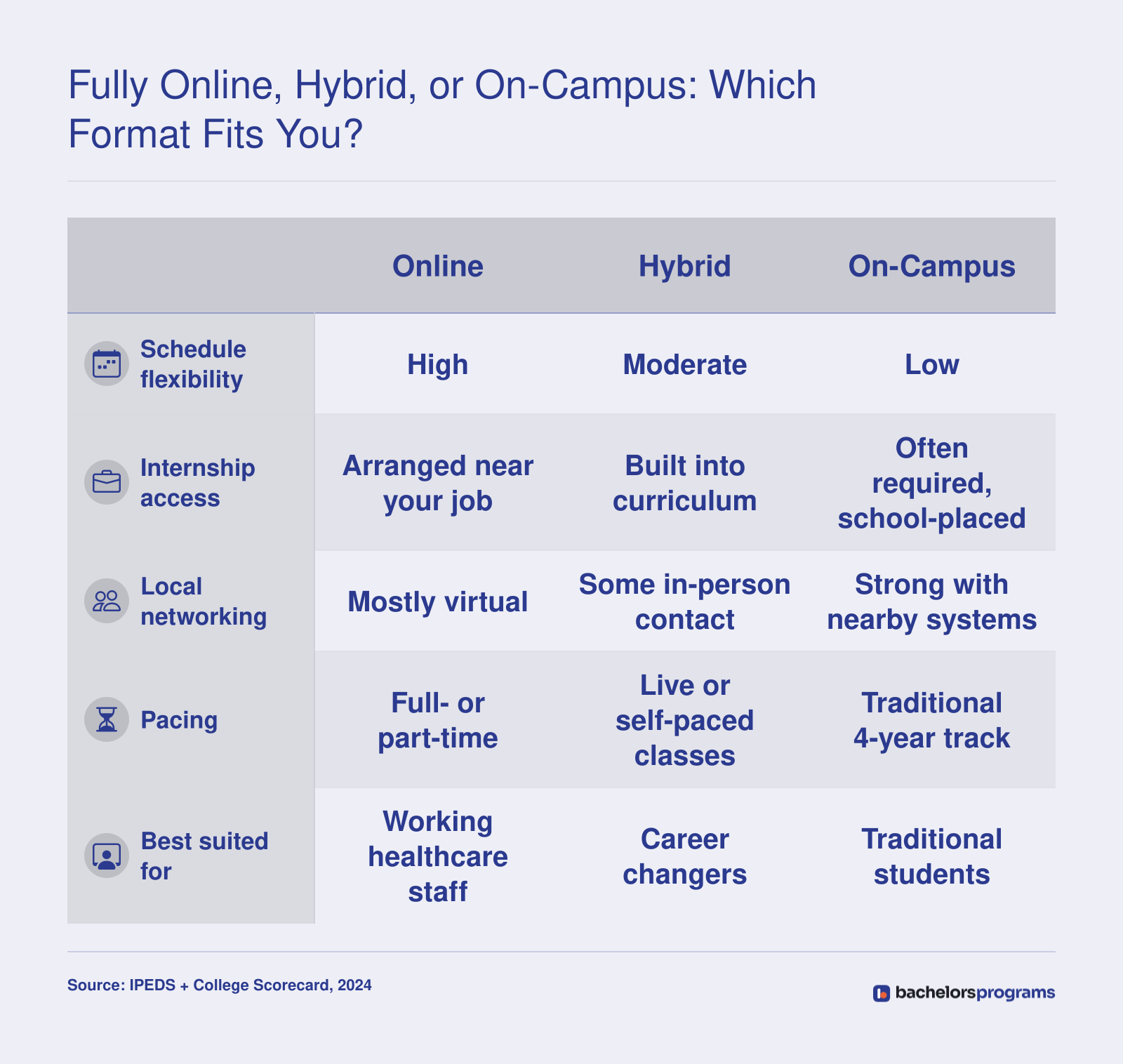
Fully Online, Hybrid, or On-Campus: Which Format Fits You?
Most of the programs ranked here are campus-based, and several, including Georgetown, Rutgers, and UConn, build internships with nearby health systems into the degree. Florida International University and Cambridge College of Healthcare & Technology deliver their degrees online, while the University of Minnesota-Twin Cities blends synchronous and asynchronous options. If you are weighing the best schools for healthcare administration online, the format works best when you already hold a job in a healthcare setting: you can apply coursework at work, and your employer can supply the practical experience that campus students get through school-arranged placements. Cambridge, for example, requires an associate degree for admission, which makes it a fit for working adults finishing a bachelor's. Career changers often do well with hybrid, and traditional students usually get the most from campus networking.
AUPHA Certified, Full Member, or Just Aligned? Decoding Accreditation Labels
Institutional accreditation is the baseline every other credential rests on, and a healthcare administration program without it is not worth your application fee.
Institutional Accreditation Comes First
Institutional (regional) accreditation from a federally recognized body is what makes federal student aid, transferable credits, and graduate-school admission possible. Confirm the university in the U.S. Department of Education's database or CHEA before you read another word on its program page.
What AUPHA Certification Adds
AUPHA undergraduate certification is a peer-review designation specific to bachelor's programs in healthcare management. The program prepares a self-study against AUPHA standards, and an outside peer panel evaluates curriculum, faculty, and outcomes. There is no site visit, so the process resembles specialty accreditation more than an institutional review. Programs that clear the panel hold Full Certified Undergraduate membership.
AUPHA's published tiers also include associate undergraduate membership, open to any bachelor's program at a regionally accredited university whether or not it has completed certification, plus a candidate status for units that commit to stand for certification within eight years. Beginning in 2026, an associate member pursuing certification must enter candidacy first. "Aligned" is not one of these designations; the verifiable AUPHA statuses are full certified, candidate, and associate, so treat an "aligned with AUPHA criteria" claim as descriptive marketing rather than a credential you can check.
CAHME is a separate seal that accredits graduate healthcare management programs. Bachelor's applicants look for AUPHA certification; CAHME matters once you are choosing a master's.
Verify It Yourself
Open the AUPHA Program Directory, scroll to AUPHA Certified Programs, and set the filter to "Yes." Then cross-check the university's institutional accreditation in CHEA or the federal database. Two lookups, five minutes.
Healthcare Administration vs. Health Information Management Degrees
Healthcare administration focuses on operations, finance, staffing, and strategy. Health information management (HIM) focuses on health data, records, coding, and compliance. The two overlap in hospitals and health systems, but they point toward different credentials and career ladders.
| Factor | Healthcare Administration | Health Information Management |
|---|---|---|
| Core focus | Running healthcare organizations: operations, budgets, staffing, and strategy | Managing health data: records, coding, privacy, and regulatory compliance |
| Typical coursework | Healthcare finance, health policy, organizational leadership, human resources, quality improvement | Medical coding, health data management, information governance, privacy and compliance, health IT systems |
| Programmatic accreditor | AUPHA certifies undergraduate healthcare management programs; CAHME accredits master's-level programs | CAHIIM accredits HIM programs at the bachelor's and master's levels |
| Credential eligibility | Program certification or accreditation does not tie to a professional exam eligibility rule | A CAHIIM-accredited program is a standard pathway to the RHIA exam through AHIMA, though accreditation alone does not guarantee eligibility |
| Common entry roles | Administrative coordinator, practice or department manager, patient services supervisor | Health information specialist, coding or compliance analyst, data quality or records coordinator |
| Advancement path | Department director, then hospital or health system executive, often with a master's degree | Health information manager or director, privacy officer, or informatics leadership, often built on the RHIA credential |
Healthcare Administration Degree Salary and Job Outlook
Few management fields are growing as fast as healthcare, and the labor data shows it. The Bureau of Labor Statistics Occupational Outlook Handbook puts the median annual wage for medical and health services managers at $123,860 as of May 2025. It projects employment growth of 24% from 2025 to 2035, with about 62,300 openings per year on average across that decade.
What the Entry Requirement Looks Like
BLS lists a bachelor's degree as the typical entry-level education for this occupation, so a healthcare administration degree meets the baseline. Many employers still prefer a master's for senior roles, such as running a hospital department or a multi-site practice. Treat the bachelor's as the way in, not necessarily the ceiling.
What Graduates Earn Early On
The occupational median describes working managers, many with years of experience. Program-level College Scorecard figures for graduates one year after completion are noticeably lower:
- Georgetown University: $74,354
- Western Governors University: $66,651
- Pima Medical Institute-Tucson: $53,773
- University of Minnesota-Twin Cities: $52,113
- Rutgers University: $49,928
These numbers are specific to each healthcare administration program, not institution-wide averages. Cohort sizes differ a lot, too. Rutgers' figure rests on a very small group of completers, so read it with caution.
Why the Gap Exists
Most new graduates do not step straight into a manager title. Early roles tend to be coordinator, analyst, or specialist positions in clinics, billing, scheduling, or quality improvement. Manager-level pay usually follows after a few years of experience and, for some, a graduate degree. The Scorecard's longer windows hint at that climb. Four years out, the same program-level medians reach $143,686 at Georgetown and $82,644 at Western Governors. Expect a starting salary well below $123,860, and a career path that builds toward it.
Entry-level graduates often start in coordinator or analyst roles, while managers with experience and added credentials earn considerably more. The degree is the starting line for that pay climb, not the finish.
Questions to Ask Yourself
Do the roles I'm targeting list an MHA as preferred?
Will my associate or prior college credits transfer?
Does the program arrange internships with local providers?
Is AUPHA certification important because I may apply to MHA programs later?
Healthcare Administration programs by state
Compare Healthcare Administration programs on the data that matters
Explore more Business & Management majors or browse every field of study.
All Business & Management programs Browse every field of study