Best Finance Schools in Kentucky
Compare 25 accredited Finance programs in Kentucky at 20 colleges, with net price after aid, graduation rates, earnings and debt from IPEDS and the U.S. College Scorecard.

A bachelor's degree in finance, usually a Bachelor of Science (B.S.) in Finance, covers corporate finance, investments, and financial markets. In Kentucky the degree is offered by flagship research universities, regional publics, and small private colleges, so cost and campus size vary widely.
We rank the top 10 bachelor's programs at Kentucky schools, on campus and online, and add quick-pick lists for the cheapest and highest-earning options, plus admissions, cost, and career details.
Kentucky's finance job market is steady rather than fast-growing, which makes program cost and local employer ties matter more.
Key Points
- KYSTATS 2026 estimates put financial analysts' median wage at $81,660.
- Kentucky's finance and insurance sector held 72,300 jobs in September 2026.
- Corporate finance and banking roles in Kentucky need no state license.
Best Finance Schools in Kentucky: Our Top 10 Ranked Bachelor's Programs
Ten Kentucky schools offer a bachelor's degree in finance worth a close look, and they differ sharply in size, setting and what the major emphasizes. The list runs from the state's flagship research universities to small private colleges where undergraduates manage real endowment money. Each entry notes what the finance program actually does so you can match the school to how you want to learn.
University of Kentucky
#1Lexington, KY · $19,000/yr (est. net price)
Best for: Students wanting a flagship research campus
The state's flagship public university, UK runs its finance major through the Gatton College of Business and Economics, which has held AACSB International accreditation since 1926. Students enter as pre-finance majors, clear the pre-major sequence, then move into investment analysis, corporate finance, portfolio management and international finance. A KCTCS transfer pathway gives community college students a defined route in, and graduates move into financial analyst, investment banking and risk analyst roles.
- AACSB International accredited since 1926 through the Gatton College of Business
- 120 credit hours; students enter as pre-finance majors and apply for full admission
- Coursework in investment analysis, corporate finance and portfolio management
- KCTCS transfer degree pathway available
- ACT or SAT scores optional for admission
- Freshman Early Action deadline of December 1
Murray State University
#2Murray, KY · $10,000 – $20,000/yr (est.)
Best for: Small-class learners wanting close faculty contact
Murray State's Arthur J. Bauernfeind College of Business offers finance as both a Bachelor of Arts and a Bachelor of Science in Business, and classes average 15 to 20 students. Students can focus on financial planning or commercial banking, join the Finance and Economics Society or the Omicron Delta Epsilon honor society, and take field trips to Nashville, Louisville and regional employers. The pitch here is faculty contact and networking rather than scale.
- Offered as both a Bachelor of Arts and a Bachelor of Science in Business
- Tracks: Financial Planning and Commercial Banking
- Average class size of 15 to 20 students
- Finance and Economics Society and Omicron Delta Epsilon honor society
- Field trips to Nashville, Louisville and regional businesses
- AACSB-accredited Arthur J. Bauernfeind College of Business
University of Louisville
#3Louisville, KY · ~$18,000/yr (est.)
Best for: Louisville-area students seeking co-op experience
Louisville's Bachelor of Science in Business Administration in Finance builds a full business core in accounting, economics, statistics and marketing before moving into corporate finance, investments, international finance and financial derivatives. A capstone seminar and an encouraged co-op program add applied experience, and the 120-credit plan of study is laid out across four years. It sits in Kentucky's largest metro, which puts banks, insurers and corporate finance departments within commuting distance.
- 120 credit hours with a required capstone seminar in finance
- Business core in accounting, economics, statistics, marketing and management
- Upper-level work in corporate finance, investments, derivatives and international finance
- Encouraged co-op program adds professional experience
- Four-year flight plan published for the degree
Western Kentucky University
#4Bowling Green, KY · $12,000 – $27,000/yr (est.)
WKU's Gordon Ford College of Business offers a Bachelor of Science in Finance with five concentration options, including a personal financial planning track registered with the CFP Board. Business finance students help manage a student-run portfolio and can add an Applied Data Analytics certificate alongside the major. It suits students who want a broad business core plus a specialization they can name on a resume.
- Five concentrations, including personal financial planning
- Personal financial planning track is CFP Board-registered
- 120 credit hours; Finish in Four plan with a 2.0 GPA minimum
- Student-run portfolio worth about $500,000
- Analyst concentration completes the Applied Data Analytics certificate
- Business core in accounting, economics, marketing, management and analytics
University of the Cumberlands
#5Williamsburg, KY · ~$14,000/yr (est.)
A private university in Williamsburg, Cumberlands offers its Bachelor of Science in Finance online, on campus or in a blended format, which makes it the most delivery-flexible option on this list. Roughly 57 finance credit hours sit inside a 120-credit degree, with required coursework in financial management, business statistics, ethics and a global business capstone. A 16-to-1 student-to-faculty ratio and low per-credit tuition make it a practical choice for working adults.
- Available online, on campus or in a blended format
- Roughly 57 finance credit hours within a 120-credit degree
- Required capstone in global business, plus ethics and business statistics
- 16-to-1 student-to-faculty ratio
- Electives tailor the major to career goals
Asbury University
#6Wilmore, KY · ~$21,000/yr (est.)
Asbury is a small Christian liberal arts university in Wilmore with a campus-based Bachelor of Arts in Finance that folds faith and ethics into the business curriculum. Students cover financial statement analysis, investments, markets, international finance and risk management, and can manage real money through the student-run Eyrie Investment Fund. Optional internships and small cohorts give it a mentorship-heavy feel rather than a large-university one.
- 124 credit hours delivered on the Wilmore campus
- Student-run Eyrie Investment Fund manages real portfolios
- Coursework in financial statement analysis, investments, risk management and international finance
- Optional internship with real clients
- Faith-integrated business curriculum with small cohorts
Eastern Kentucky University
#7Richmond, KY · $11,000/yr (est. net price)
Eastern Kentucky University's 120-credit Bachelor of Business Administration in Finance offers three 15-hour concentrations: Banking and Financial Services, Business Finance, and Financial Planning. The major core runs through corporate finance, financial institutions, principles of investments, and investment and portfolio theory, backed by a business core in accounting, economics, statistics, marketing and business law. A semester-by-semester plan of study makes the four-year path easy to map before you enroll.
- Three 15-hour concentrations: Banking and Financial Services, Business Finance, Financial Planning
- 120 credit hours, including at least 39 upper-division hours
- Major core covers corporate finance, financial institutions and portfolio theory
- Business core adds accounting, economics, statistics, marketing and business law
- Semester-by-semester plan of study provided
Morehead State University
#8Morehead, KY · ~$10,000/yr (est.)
Morehead State's finance BBA is a four-year, face-to-face program covering investments, markets, banking and insurance alongside communication, teamwork and critical thinking skills. Recent graduates have landed at Fidelity Investments, Wells Fargo and Fifth Third Bank, and the degree also prepares students who want to continue into graduate study. It is a straightforward, teaching-focused option for students who want direct access to faculty.
- Four-year, full-time program delivered face to face on the Morehead campus
- Covers investments, markets, banking and insurance
- Builds communication, teamwork and critical thinking skills
- Recent graduates hired at Fidelity Investments, Wells Fargo and Fifth Third Bank
Bellarmine University
#9Louisville, KY · ~$21,000/yr (est.)
Bellarmine's Rubel School of Business holds AACSB International accreditation and offers a 120-hour Bachelor of Arts in Finance that pairs finance theory with accounting, economics and a liberal arts core. The university is a CFA Institute University Affiliated Program, one of two in Kentucky, and students manage a $100,000 endowment. About two-thirds of finance majors intern at local businesses, and graduates have been hired by J.P. Morgan Chase, General Electric and Deloitte.
- AACSB International accredited Rubel School of Business
- 120 credit hours with a 2.0 GPA minimum in business and finance courses
- CFA Institute University Affiliated Program, one of two in Kentucky
- Students manage a $100,000 endowment
- About two-thirds of finance majors complete internships
- Graduates hired by J.P. Morgan Chase, General Electric and Deloitte
Georgetown College
#10Georgetown, KY · ~$14,000/yr (est.)
Georgetown College's finance major is a 51-hour program inside a business department that connects seven related majors, covering the time value of money, stock and bond pricing, investment decisions and risk management. The student investment team has grown a real-money portfolio from $50,000 to more than $550,000, which gives majors hands-on portfolio experience. Small classes and a liberal arts setting suit students who want close professor relationships.
- 51-hour major inside a business program of seven connected majors
- Student investment team grew a real portfolio from $50,000 to more than $550,000
- Coursework in time value of money, stock and bond pricing and risk management
- Small classes with close faculty relationships
Cost & outcomes by school
Federal data for the highest-earning Finance programs, independent of the ranking above. Earnings are this field's bachelor's graduates four years after completing where the Scorecard reports them, else the school's undergraduate median.
| School | Net price / yr | Grad rate | Earnings | Debt | Grads/yr | Format |
|---|---|---|---|---|---|---|
| Bellarmine University KY | $21,499 | 64% | $84,262 | $25,000 | 21 | Campus |
| University of Kentucky KY | $18,851 | 71% | $84,087 | $20,750 | 343 | Campus |
| University of Louisville KY | $17,988 | 61% | $75,089 | $20,884 | 79 | Campus |
| Western Kentucky University KY | $10,990 | 56% | $70,313 | $19,500 | 61 | Campus |
| Northern Kentucky University KY | $8,191 | 52% | $68,409 | $21,237 | — | Campus |
| Centre College KY | $20,781 | 81% | $66,240 | $27,000 | — | Campus |
| Eastern Kentucky University KY | $11,040 | 50% | $63,685 | $15,500 | 51 | Campus |
| Thomas More University KY | $21,835 | 41% | $59,384 | $26,236 | 3 | Campus |
| Murray State University KY | $9,096 | 61% | $56,263 | $20,500 | 65 | Campus |
| Transylvania University KY | $21,913 | 72% | $54,705 | $27,000 | — | Campus |
| Georgetown College KY | $14,095 | 49% | $52,074 | $25,200 | 8 | Campus |
| Spalding University KY | $25,491 | 52% | $49,438 | $25,250 | — | Hybrid |
Sources: U.S. Department of Education. Net price, graduation rate, earnings and debt: College Scorecard (earnings and debt for this field's bachelor's graduates where reported, else school-wide); graduates: IPEDS. A dash means no figure is reported.
Cost, debt & payoff
Median earnings of this field's bachelor's graduates (4 yrs after completing, else the school's undergraduate median) vs. their median federal loan debt · U.S. College Scorecard
Across these programs the median graduate earns about $56,263 and finishes with roughly $20,884 in debt — a ratio that clears a common rule of thumb (keep debt below first-year salary). Net price and debt vary widely school to school, so check the per-school figures in the table above before you shortlist.
Cheapest Bachelor's in Finance Programs in Kentucky
Net price is the average amount a first-year, full-time student pays after grants and scholarships, as reported for public and private schools in 2024 U.S. Department of Education data. Treat it as an approximate sector-based average rather than a quote, because your actual cost depends on family income, residency, and the aid you receive. Berea College posts the lowest average net price despite a high sticker price, while the public options (Kentucky State University, Northern Kentucky University, and our ranked pick Murray State University) pair low net prices with in-state tuition and fees between $9,387 and $11,088, which suits budget-focused Kentucky residents who can commute or live near campus.
| School | Program | Location | Sector | Format | Average Net Price After Aid | In-State Tuition and Fees |
|---|---|---|---|---|---|---|
| Berea College | Business Administration (Finance concentration) | Berea, KY | Private nonprofit | Campus | $6,106 | $51,658 |
| Kentucky State University | Business Administration (Finance concentration) | Frankfort, KY | Public | Campus | $8,040 | $9,387 |
| Northern Kentucky University | Finance, B.S.B.A. | Highland Heights, KY | Public | Campus | $8,191 | $11,088 |
| Brescia University | Business with an Emphasis in Finance and Economics | Owensboro, KY | Private nonprofit | Campus | $8,709 | $31,550 |
| Murray State University | Finance | Murray, KY | Public | Campus | $9,096 | $9,900 |
Online and Hybrid Bachelor's in Finance Options at Kentucky Schools
Online study is routine at Kentucky's regional universities, yet most finance bachelor's programs still center on the classroom. Formats and pricing differ enough from school to school that it pays to read each program page closely before applying.
Online and Hybrid Programs
- University of the Cumberlands: The B.S. in Finance can be completed online, on campus, or in a blended format. Online undergraduate tuition is $220 per credit. A 120-credit degree taken entirely at that rate comes to about $26,400 in base tuition, before aid, fees, or future rate changes.
- Eastern Kentucky University: EKU's catalog lists its finance B.B.A. as a campus program, but the university also offers an online version. EKU counts synchronous, asynchronous, and blended courses as online delivery. Its 2026-2027 online rate for bachelor's programs is $472 per credit. A lower $462 figure also appears on EKU pages without a clear explanation, so confirm which rate applies to your start term.
- Western Kentucky University: WKU describes its B.S. in Finance as hybrid. More than half of coursework can be taken online, but at least one in-person campus commitment is required. Ask WKU directly for the per-credit rate that applies.
Campus-Based Programs
The finance programs at the University of Kentucky, Murray State University, the University of Louisville, Asbury University, Morehead State University, Bellarmine University, and Georgetown College are delivered on campus. Do not assume online access at these schools without confirming with the business department.
How Online Students Are Charged
Residency rules vary by school. The University of Kentucky bills students in fully online programs a single UK Online rate regardless of residency, although its finance B.B.A. is campus-based. Cumberlands, a private school, posts one $220 online rate. At EKU and WKU, ask whether online pricing replaces in-state tuition or adds separate distance fees before you enroll.
Related Articles
Admission Requirements for a Bachelor's Degree in Finance in Kentucky
Getting into a Kentucky finance program usually takes two steps: apply to the university, then declare or qualify for the finance major inside the business school. Requirements vary by campus, and only some schools publish their numbers plainly.
GPA and Test Policy
The University of Kentucky does not post a minimum freshman GPA on its finance program page. A university regulation does set a floor: applicants with a high school GPA below 2.0 are automatically denied unless they come in through an exception process.1 UK also treats the ACT and SAT as optional for admission and for scholarship consideration through the 2028-29 academic year2, so test scores are a choice rather than a hurdle. New finance students at UK enter as Pre-Finance majors before advancing into the program itself.
Several other programs publish a 2.0 GPA minimum tied to the major rather than to the university, including Western Kentucky University and Bellarmine University. We could not confirm a current published minimum GPA or testing rule for the University of Louisville, Northern Kentucky University, Murray State University, or the smaller private colleges, so check with each admissions office directly.
How Selective Are These Schools?
Federal figures suggest most Kentucky finance programs are broadly accessible rather than competitive. The University of the Cumberlands admits nearly all applicants, and Western Kentucky University, the University of Kentucky and Georgetown College all report admission rates above 90 percent. Asbury University is the most selective of the group, admitting roughly 63 percent. A solid college-prep transcript matters more here than a dramatic test score.
Transfer Credit Advice
UK's transfer path asks for 24 earned college credit hours and a 2.0 GPA for most programs, though selective majors can require more3; the specific threshold for finance is not published. UK's admissions office reviews your transcript and decides which courses apply to the degree after faculty review, and it maintains a KCTCS transfer pathway. Finish your community college math, economics, and accounting sequence before you transfer; those are the courses finance programs most often use as prerequisites.
Finance Careers in Kentucky: Jobs, Employers, and Outlook
Kentucky's finance payroll has gone flat rather than surging. State estimates put finance and insurance at 72,300 jobs in September 2026, about 0.1 percent below the prior comparison2, so graduates are entering a steady market where openings come from turnover and specialization more than rapid expansion.3
Where the Demand Sits
Financial activities overall accounts for roughly 95,100 jobs statewide.2 Loan officers make up the largest of the three core entry occupations at 3,940 positions, ahead of financial and investment analysts at 2,460 and personal financial advisors at 2,040.1 Hiring concentrates in Louisville, Lexington, and the Northern Kentucky corridor outside Cincinnati, where banks, insurers, and corporate finance departments cluster. Confirm current openings with employers directly, since monthly estimates shift with each report.
What the Work Pays
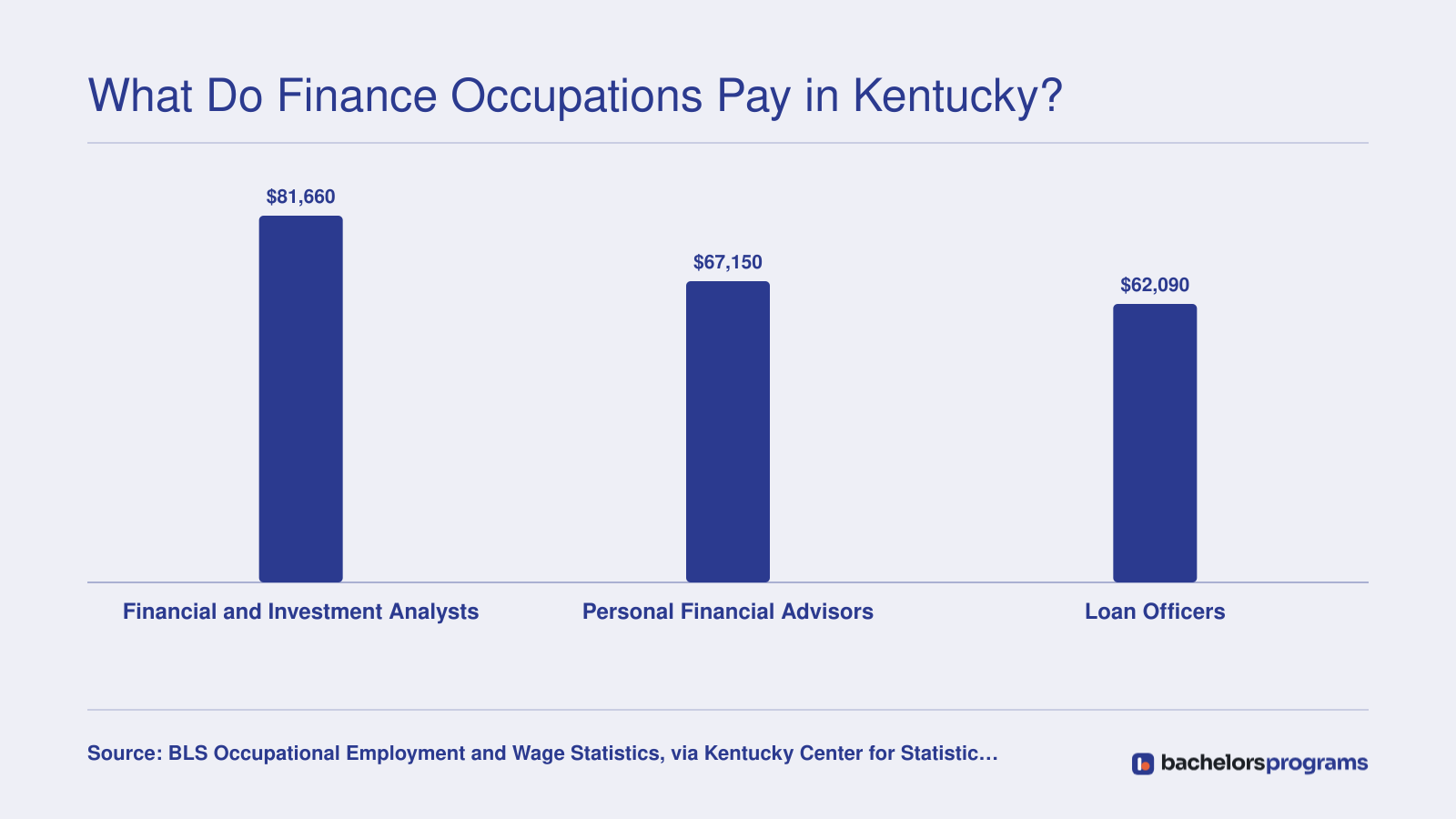
Kentucky's 2026 occupational wage estimates cover all experience levels, not starting salaries. Financial and investment analysts show a median of $81,660 (mean $90,010), and loan officers a median of $62,090 (mean $74,870).1 Personal financial advisors carry the widest spread: a median of $67,150 against a mean of $124,320, which reflects commission-driven pay.1
First-Year Earnings by Program
Federal graduate outcomes data offers a different measure: median earnings one year after graduation. University of Kentucky graduates report the strongest early figure at $58,422, followed by University of Louisville at $52,167, Western Kentucky University at $44,355, and Murray State University at $43,320. Two years out, those figures rise to $84,087 at Kentucky and $75,089 at Louisville, then settle near $80,396 and $73,986 at the four-year mark. Read them as outcomes to compare, not as promises.
What Do Finance Occupations Pay in Kentucky?
Kentucky's 2026 Occupational Employment and Wage Statistics estimates, produced by KYSTATS in cooperation with BLS, put the median annual wage for financial and investment analysts at $81,660, ahead of personal financial advisors at $67,150 and loan officers at $62,090. Loan officers are the largest of the three groups, with 3,940 jobs statewide. These are occupational wages for everyone working in each role across Kentucky, not earnings of recent finance graduates. Because medians blend new hires with experienced workers, expect a first salary after a bachelor's degree to fall below these figures, with analyst roles offering the highest ceiling.
Licensing, Credentials, and Accreditation for Kentucky Finance Majors
Do you need a license to work in finance in Kentucky? For most finance jobs, no. Corporate finance, credit analysis, bank management, and financial planning roles generally carry no state license requirement. Two exceptions matter.
Where a License Is Required
Securities work: the Series 7 is a FINRA exam you cannot sit for on your own. A FINRA member firm must sponsor you, and registration runs through that firm and FINRA, not the state. The Series 66 covers state securities law for investment adviser representatives and is usually taken with or just after the Series 7. Kentucky issues neither credential.
Insurance: selling life, annuity, or other insurance products requires a Kentucky producer license from the Kentucky Department of Insurance, covering the right line of authority, prelicensing education, an exam, and fees. Confirm current rules with the department before you pay for coursework.
Certification Paths: CFP and CFA
The CFP route starts with CFP Board-approved coursework, then the CFP exam, then qualifying experience and an ethics declaration.
On accreditation, the University of Kentucky1, University of Louisville, Murray State, Western Kentucky2, Eastern Kentucky, Morehead State3, Northern Kentucky4, and Bellarmine all hold AACSB accreditation at the business-school level, which covers their finance offerings. AACSB accredits the school rather than each individual major.
When to Start
If the CFA is the goal, plan on Level I during senior year, when registration opens to students close to graduation. CFP coursework can run alongside your finance major so the education requirement is done before exam day.
How We Ranked Kentucky Finance Schools
A ranking is a tradeoff in disguise: weight cost heavily and prestige fades, weight earnings heavily and affordability fades. What matters is knowing which lever you are pulling.
Where the Numbers Come From
We build each profile from federal College Scorecard and IPEDS data plus our own rankings dataset of Kentucky institutions and their bachelor's programs in finance.
What Counts, and How Much
- Cost and outcomes: Net price after aid and graduation rate carry the most weight.
- Graduate results: Earnings and typical debt for former students follow.
- Selectivity and program features: Admission difficulty, business school accreditation, and coursework aligned with CFP certification break ties.
What These Figures Cannot Tell You
Both graduation rate and net price describe the whole institution, not the finance major alone, and net price is an approximate average that shifts with each student's aid package. Treat them as a starting comparison, not a verdict.
Scope and Refresh
The ranking covers bachelor's programs only, campus and online, at Kentucky-based schools. Figures refresh each fall, and this 2026 edition reflects the latest federal release.
Kentucky Finance Degree FAQs
Can you get a bachelor's degree in finance online from a Kentucky school?
Which Kentucky colleges are AACSB-accredited for finance?
Do you need a license to work in finance in Kentucky?
Is a finance degree worth it in Kentucky given typical debt and starting pay?
Compare Finance programs on the data that matters
Explore more Business & Management majors or browse every field of study.
All Business & Management programs Browse every field of study