Best Finance Schools in Mississippi
Compare 12 accredited Finance programs in Mississippi at 10 colleges, with net price after aid, graduation rates, earnings and debt from IPEDS and the U.S. College Scorecard.

Mississippi finance programs are increasingly judged by graduate earnings rather than research output. Median earnings one year after a bachelor's degree in finance run from $33,932 at Jackson State University to $42,857 at the University of Mississippi. A Bachelor of Science (B.S.) in Finance is the usual credential, though several schools here award a B.B.A.
The ranking rests on undergraduate outcomes: cost, completions, and earnings. AACSB accreditation, online formats, admissions rules, and career paths vary as much as price does.
Sticker tuition runs from $8,605 at Delta State University to $30,250 at Belhaven University. Aid cuts Belhaven's average net price to $15,676, below Mississippi State University's $17,595.
Key Points
- Financial and investment analysts in Mississippi: $102,863 median pay (May 2025).
- Sticker prices run from roughly $8,600 to over $30,000 a year.
- Ole Miss offers both a B.B.A. in Finance and Banking and Finance.
Best Bachelor's in Finance Schools in Mississippi: Ranked
Finance programs in Mississippi range from a flagship business school with a simulated trading floor to small private colleges where undergraduates manage real portfolios. The strongest entries pair a lower net price after aid with a higher share of students who finish, while schools near the bottom of the list cost more or graduate fewer students on time. Every entry below awards a bachelor's degree and enrolls students in Mississippi or online through a Mississippi-based campus.
University of Mississippi
#1University, MS · $10,000 – $15,000/yr (est.)
Best for: Future investment analysts and portfolio managers
Ole Miss teaches finance inside its School of Business in Oxford, with coursework in corporate finance, asset management, investment banking, and financial planning built on case studies and current market data. Students choose a general finance path or a banking and finance path focused on lending and risk. Net price after aid is about $13,314, and the university's graduation rate is 72%. All classes run on the Oxford campus.
- 120 credit hours over four years on the Oxford campus
- Coursework in corporate finance, asset management and investment banking
- Students build corporate balance sheets and investment portfolios
- Covers futures, options and swaps using current market data
- Finance Club, TVA Investment Challenge and Banking and Finance Symposium
- Internships and study abroad options
- Prepares students for the Chartered Financial Analyst designation
- Commercial and consumer lending instruction
- Financial statement analysis and auditing coursework
- Risk management focus
- Prepares for roles as lender, credit analyst or compliance officer
- Shares the Finance Club and Banking and Finance Symposium with finance majors
Mississippi State University
#2Mississippi State, MS · ~$18,000/yr (est.)
Best for: Hands-on learners wanting a trading floor
Mississippi State runs its finance degree through the Department of Finance and Economics and a Strategic Finance Laboratory, a simulated trading floor with 21 terminals, a 24-foot stock ticker, and live market coverage. Students can add a risk management and insurance concentration, which carries its own career fair. Net price after aid is about $17,595 and the graduation rate is 67%. Classes meet on the Starkville campus.
- Simulated trading floor in the Strategic Finance Laboratory
- Bloomberg Terminal, Wharton Research Data Services and Trading Technologies access
- 21 student terminals and a 24-foot stock ticker
- Live market coverage on six 51-inch televisions
- Bloomberg Aptitude Test offered to students
- Tracks: Risk Management and Insurance
- Risk Management and Insurance career fair
Delta State University
#3Cleveland, MS · ~$14,000/yr (est.)
Best for: Cost-conscious students in the Delta region
Delta State treats finance as a major inside its Bachelor of Business Administration and posts curriculum check sheets by academic year so students can see what each term requires. It is the least expensive public option on this list at about $13,540 net of aid, with a graduation rate of 48%. Classes run on the Cleveland campus.
- Finance major inside the Bachelor of Business Administration
- Curriculum check sheets posted for each academic year
- Check sheets for 2018-19 through 2025-26 available online
- Degree audits run through the Banner system
Mississippi Christian University
#4Clinton, MS · $28,000/yr (est. net price)
This private university in Clinton awards a B.S. in Business Administration with a finance emphasis that runs 130 credit hours, including a full business core. Undergraduates manage a real $500,000 investment fund, intern with regional employers such as Trustmark, KPMG, and Raytheon, and each finance student is paired with a faculty advisor. Net price after aid is about $27,712 and the graduation rate is 59%. Classes are on campus.
- 130 total credit hours, including the business core
- Students manage a $500,000 investment fund
- Coursework in investments, corporate finance and financial modeling
- Internships with Trustmark, KPMG and Raytheon
- Each student is paired with a finance faculty advisor
- Financial aid and scholarships available
University of Southern Mississippi
#5Hattiesburg, MS · ~$22,000/yr (est.)
Southern Miss offers a 120-credit BSBA in finance on the Hattiesburg campus, with an optional real estate emphasis that points toward agent and broker licensing and mortgage finance work. The catalog describes the program as AACSB International accredited, and students can build Bloomberg certifications in the financial services lab. Net price after aid is about $21,708 and the graduation rate is 49%.
- Catalog describes the program as AACSB International accredited
- 120 credit hours at the Hattiesburg campus
- Real estate emphasis available
- C or better required in FIN 300
- Principles of Accounting Competency Examination required for ACC 325
- Bloomberg terminals in the financial services lab
- Internships with Trustmark, Sanderson Farms and Enterprise
- Banker Leadership Scholars and Financial Management Association
Belhaven University
#6Jackson, MS · $15,000 – $20,000/yr (est.)
Belhaven pairs a broad business core with required finance courses in advanced financial management, investments, and money and banking, plus an option in risk management and insurance. An internship or site observation completes the finance concentration. The Jackson campus is the only format, net price after aid is about $15,676, and the graduation rate is 49%.
- Business core plus required finance courses
- Advanced financial management, investments and money and banking
- Risk management and insurance option
- Internship or site observation in business administration
- Covers financial analysis, investment management and financial markets
Jackson State University
#7Jackson, MS · $24,000/yr (est. net price)
Jackson State offers a finance major inside its BBA, with coursework in financial analysis, investments, banking, and corporate finance, plus work in budgeting, risk assessment, and capital management. As a historically Black university in Jackson, it pairs an urban campus with a business college accredited by SACSCOC. Net price after aid is about $23,836 and the graduation rate is 51%.
- Finance major inside the BBA at the Jackson campus
- Coursework in financial analysis, investments, banking and corporate finance
- Builds skills in budgeting, risk assessment and capital management
- Regionally accredited by SACSCOC
- Prepares for entry-level banking, financial planning and treasury roles
William Carey University
#8Hattiesburg, MS · ~$14,000/yr (est.)
William Carey's School of Business lets students choose among three bachelor's options (B.S.B., B.S., or B.A.) and six concentrations, one of them finance, taught on the Hattiesburg campus. The business programs hold specialized accreditation from IACBE. Net price after aid is about $14,258 and the graduation rate is 60%, among the higher figures on this list.
- Three degree options: B.S.B., B.S. or B.A.
- Six concentrations, including finance
- Finance concentration taught on the Hattiesburg campus
- Specialized accreditation from IACBE
- Accounting concentration meets Mississippi CPA exam requirements
Alcorn State University
#9Alcorn State, MS · ~$13,000/yr (est.)
Alcorn State delivers a 120-credit business administration degree with a finance concentration entirely face to face on its Lorman campus, with fall and spring entry points and courses spanning management, marketing, finance, and accounting. It is a historically Black university and one of the lower-priced options here. Net price after aid is about $13,265 and the graduation rate is 57%.
- 120 credit hours over four years
- Six concentrations, including finance and data analytics
- Face-to-face classes at the Lorman campus
- Fall and spring start dates
- Coursework in management, marketing, finance and accounting
- Financial data analysis coursework
Strayer University-Mississippi
#10Jackson, MS · ~$14,000/yr (est.)
Strayer's finance bachelor's is built for working adults: 40 courses of 11 weeks each at $1,555 per course, available fully online or in person at select campuses including Jackson. Students can transfer up to 28 classes and take general education courses at no cost through Sophia Learning. The business programs are accredited by the Accreditation Council for Business Schools and Programs.
- 40 courses, each running 11 weeks
- $1,555 per course plus a $65 technology fee each term
- Transfer up to 28 classes
- No-cost general education courses through Sophia Learning
- Accredited by the Accreditation Council for Business Schools and Programs
- Fully online, with in-person classes at select campuses
- Military benefits and employer tuition reimbursement accepted
Cost & outcomes by school
Federal data for the highest-earning Finance programs, independent of the ranking above. Earnings are this field's bachelor's graduates four years after completing where the Scorecard reports them, else the school's undergraduate median.
| School | Net price / yr | Grad rate | Earnings | Debt | Grads/yr | Format |
|---|---|---|---|---|---|---|
| University of Mississippi MS | $13,314 | 72% | $80,488 | $24,000 | 230 | Campus |
| Mississippi State University MS | $17,595 | 67% | $70,367 | $22,000 | 95 | Campus |
| University of Southern Mississippi MS | $21,708 | 49% | $55,959 | $22,500 | 34 | Campus |
| Mississippi Christian University MS | $27,712 | 59% | $47,485 | $22,500 | 26 | Campus |
| Belhaven University MS | $15,676 | 49% | $46,440 | $26,333 | — | Campus |
| William Carey University MS | $14,258 | 60% | $43,087 | $20,832 | — | Campus |
| Delta State University MS | $13,540 | 48% | $41,991 | $20,390 | 6 | Campus |
| Strayer University-Mississippi MS | — | — | $40,092 | $40,621 | — | Online or campus |
| Jackson State University MS | $23,836 | 51% | $37,959 | $26,000 | 5 | Campus |
| Alcorn State University MS | $13,265 | 57% | $36,421 | $27,000 | — | Campus |
Sources: U.S. Department of Education. Net price, graduation rate, earnings and debt: College Scorecard (earnings and debt for this field's bachelor's graduates where reported, else school-wide); graduates: IPEDS. A dash means no figure is reported.
Cost, debt & payoff
Median earnings of this field's bachelor's graduates (4 yrs after completing, else the school's undergraduate median) vs. their median federal loan debt · U.S. College Scorecard
Across these programs the median graduate earns about $46,963 and finishes with roughly $23,250 in debt — a ratio that clears a common rule of thumb (keep debt below first-year salary). Net price and debt vary widely school to school, so check the per-school figures in the table above before you shortlist.
How We Ranked Mississippi Finance Schools
Research-output rankings such as EduRank reward faculty publications and citations. The positions here reflect something else: what an undergraduate actually gets out of a bachelor's degree in finance. That difference shapes every position on the list.
The ranking weighs four things: program earnings, student debt, completions, and cost. Earnings and debt show whether a degree pays off. Completions show how many students finish the program. Cost covers what families are asked to pay. Schools that do well across all four rise, and a strong showing on one measure does not carry a school that is weak on the others.
The figures come from the College Scorecard and IPEDS, two federal sources that report on U.S. colleges. Some of them are broader than the finance major. Graduation rate and net price describe the entire institution, not the finance major. A finance student's own experience can land above or below them, so treat them as a guide to the school rather than a promise about the program.
Only bachelor's programs at Mississippi-based schools were considered. That includes campus programs and online options, so a school based in the state can appear whether you plan to attend in person or from home.
Cheapest Bachelor's in Finance Programs in Mississippi
These Mississippi finance programs are ordered by average annual net price, the amount students pay after grants and scholarships, based on 2024 IPEDS and College Scorecard data from the U.S. Department of Education. Sticker price and net price can differ sharply: Delta State posts the lowest in-state tuition, and Belhaven's $30,250 list price falls to about $15,676 after aid. Earnings and debt figures cover each school's graduates as a whole, not finance majors alone.
| School | Location | Sector | Finance Program | In-State Tuition & Fees | Average Net Price | Graduation Rate | Median Earnings 10 Years After Entry (All Programs) | Median Graduate Debt (All Programs) |
|---|---|---|---|---|---|---|---|---|
| Alcorn State University | Lorman, MS | Public (HBCU) | Business Administration, Finance concentration | $8,785 | $13,265 | 57% | $36,421 | $27,000 |
| University of Mississippi (Ole Miss) | University, MS | Public | B.B.A. in Finance | $9,772 | $13,314 | 72% | $50,994 | $20,000 |
| Delta State University | Cleveland, MS | Public | B.B.A., Finance major | $8,605 | $13,540 | 48% | $41,991 | $20,390 |
| William Carey University | Hattiesburg, MS | Private nonprofit | Business Administration, Finance concentration | $15,480 | $14,258 | 60% | $43,087 | $20,832 |
| Belhaven University | Jackson, MS | Private nonprofit | Finance | $30,250 | $15,676 | 49% | $46,440 | $26,333 |
Cost of a Bachelor's Degree in Finance in Mississippi
The number that matters is rarely the one printed on the tuition page. In Mississippi, a finance bachelor's degree can carry a sticker price of roughly $8,600 a year at one end and more than $30,000 at the other, yet what students actually pay after grants often narrows that gap sharply.
In-state tuition versus net price after aid
At the state's public universities, in-state tuition and fees sit in a tight band, from about $8,605 a year at Delta State University to $10,202 at Mississippi State University. Alcorn State University, Jackson State University, the University of Mississippi and the University of Southern Mississippi all fall between those two. Net price, meaning what families pay on average after grant and scholarship aid, reshuffles the order: Alcorn State around $13,265, Ole Miss around $13,314, Delta State around $13,540, Mississippi State around $17,595, Southern Miss around $21,708 and Jackson State around $23,836.
Private tuition looks daunting, but aid closes much of the distance. William Carey University charges about $15,480 and shows a net price near $14,258; Belhaven University lists about $30,250 and nets near $15,676; Mississippi Christian University lists about $23,500 with a net price near $27,712. Across the programs on this list, net price ranges from roughly $13,265 to $27,712.
Why your own bill will differ
Net price is an average for the school's sector, built from students who receive federal aid and a typical mix of grants. Live at home, win a merit award, or enroll part time and your figure moves. Treat net price as a shortlisting tool, then plug your own numbers into each school's calculator.
Mississippi aid: MTAG, MESG and HELP
Mississippi runs several grant programs for in-state undergraduates. MTAG is the broad need-based tuition grant, MESG rewards high school achievement with a merit award, and HELP targets students with significant need who complete the state's college-preparatory curriculum. Award amounts and income cutoffs are reset periodically, so confirm the current figures with the Mississippi Office of Student Financial Aid before you build a budget.
One practical tip
File the FAFSA and the state aid application early in the fall, then ask each financial aid office how an institutional scholarship interacts with your state grant. Some awards fill the gap left after state aid and others displace it, and the answer changes your real cost.
Related Articles
Questions to Ask Yourself
Can you attend classes on campus, or do you need an online or evening format?
Would an AACSB-accredited business school change the employers you can target?
Are you aiming at banking, insurance, real estate or financial planning?
How much would you borrow after in-state aid, and how does that compare with a program's median debt?
What Do Finance Jobs Pay in Mississippi?
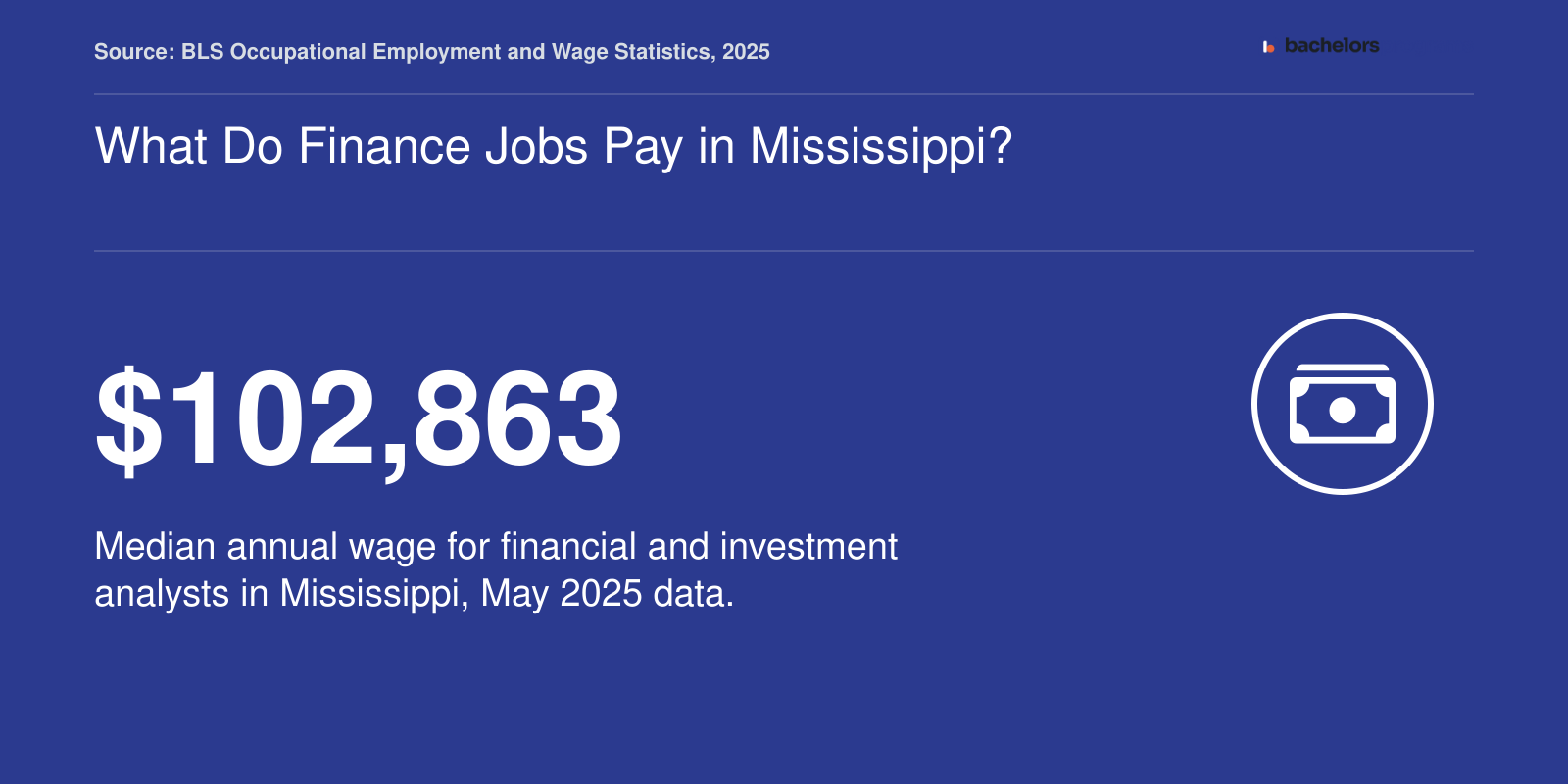
Financial and investment analysts in Mississippi earned a median annual wage of $102,863 in May 2025, well above the $77,185 median for loan officers. Personal financial advisors in the state averaged $117,880 a year, with pay running from about $46,540 at entry level to $153,020 for experienced advisors. These figures cover everyone working in each occupation, not the earnings of new bachelor's graduates, so expect a first finance job to pay less.
Common Questions About Finance Degrees in Mississippi
These answers cover the questions prospective students ask most about a bachelor's degree in finance in Mississippi. Figures come from public sources and vary by dataset and year, so treat them as guides rather than guarantees.
What is the Ole Miss acceptance rate?
What is the starting salary for a finance graduate in Mississippi?
Do you need a license to work in finance in Mississippi?
Is AACSB accreditation required to get a finance job in Mississippi?
Compare Finance programs on the data that matters
Explore more Business & Management majors or browse every field of study.
All Business & Management programs Browse every field of study