Best Finance Schools in Nebraska
Compare 14 accredited Finance programs in Nebraska at 12 colleges, with net price after aid, graduation rates, earnings and debt from IPEDS and the U.S. College Scorecard.

A bachelor's degree in finance is the standard entry credential for banking, investments, insurance and financial planning in Omaha and Lincoln, and Nebraska's schools price it very differently: in-state tuition at the public campuses runs from $8,171 to $10,434 a year, while private colleges charge more for smaller classes.
Programs here award either a Bachelor of Science in Finance or a business administration degree with a finance emphasis, built on accounting, corporate finance and investments rather than general business survey courses. AACSB accreditation separates the programs that hold it.
Omaha's concentration of banks and insurers supplies internships, and graduates who complete one tend to reach analyst work sooner.
Key Points
- Wayne State College charges $8,171 in-state tuition, the lowest here.
- Bellevue University offers an online B.S. in Finance at $459 per credit.
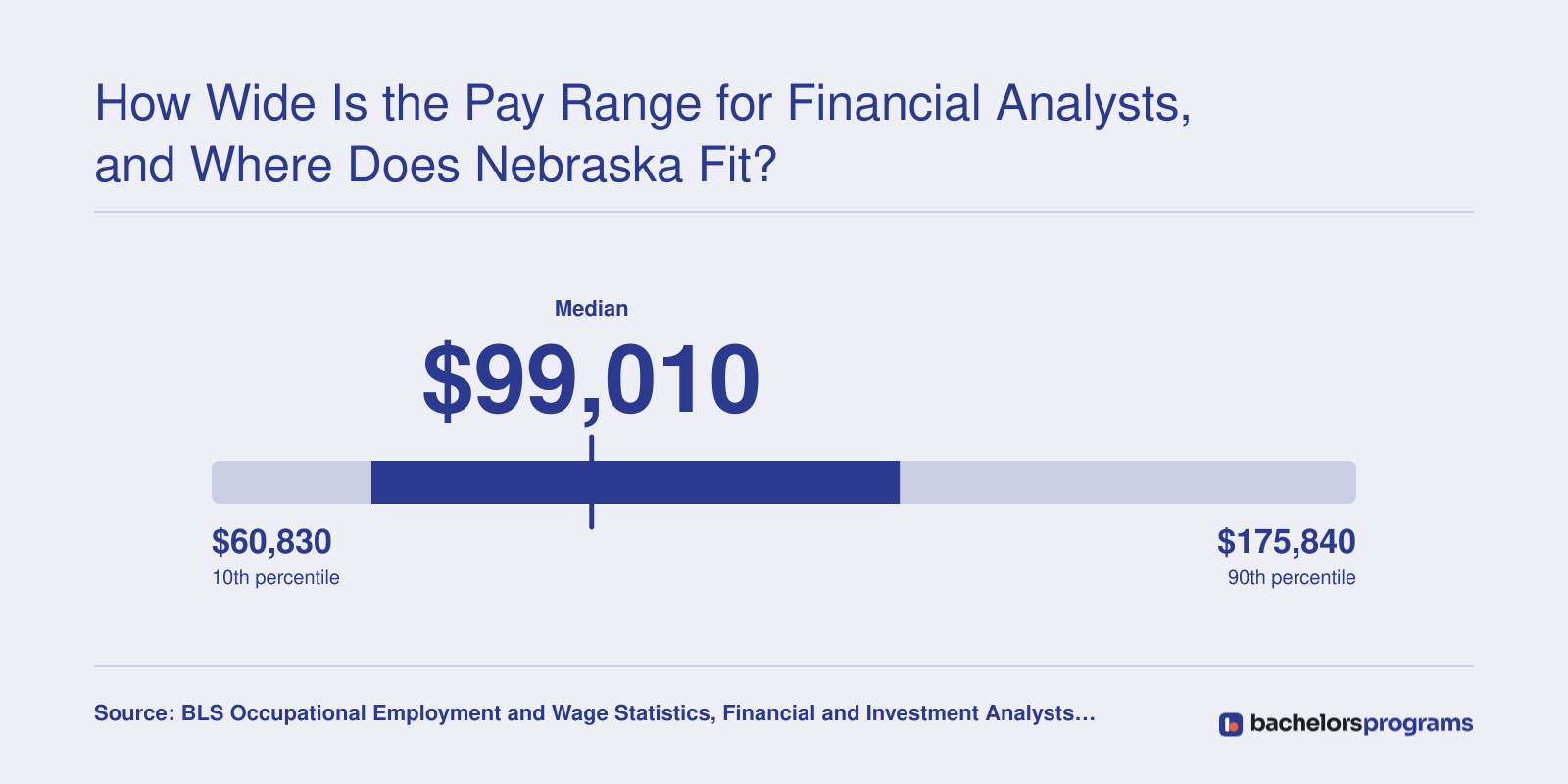
- Nationally, financial analyst pay ranged from $60,830 to $175,840 in May 2023.
Best Finance Schools in Nebraska: Our Ranked List
Nebraska's finance programs split cleanly between the large public universities in Lincoln and Omaha and a set of smaller private and regional colleges where classes stay small and internships are built into the degree. The ten schools below all award a bachelor's degree in finance or a business degree with a finance concentration, and they range from a flagship with a CFA-affiliated investment track to fully online options. Here is how they stack up for 2026.
University of Nebraska-Lincoln
#1Lincoln, NE · $15,000 – $20,000/yr (est.)
Best for: Students targeting corporate finance careers
Nebraska's flagship public university pairs a broad finance major with a shared business core and a strategic management capstone, and its Lincoln campus feeds directly into the state's banking, insurance, and corporate employers. Finance students pick among several concentrations, and the major now embeds a CFP Board-registered financial planning option that lets graduates finish the education requirement for CFP certification. A selective Investors With Purpose program adds mentorship, networking, and paid investment internships for high-achieving students.
- 120-credit, four-year curriculum with a capstone in strategic management
- Business core plus electives in real estate, international finance, insurance, and investments
- Coursework in time value of money, risk and reward, asset valuation, and market analysis
- Experiential learning requirement built into the degree
- Advising from BASE advisors and the department chair
- Examines both bank and non-bank financial institutions
- Emphasis on the decisions financial managers actually make
- Builds skill in analyzing the risk and reward relationship
- Internships supported and encouraged
- Scholarships available to finance majors
- CFA Institute University Affiliated Program
- Year-long practicum managing a real-money portfolio
- Coursework embeds roughly 70% of the CFA curriculum
- Prepares students for the CFA Level I exam
- Admission by application only
- Past internship placement with TD Ameritrade
Creighton University
#2Omaha, NE · $30,000 – $35,000/yr (est.)
Best for: Values-driven future investment analysts
A private Jesuit university in Omaha, Creighton delivers finance through its business administration degree with four focused tracks: financial analysis, financial planning, financial services, and insurance and risk management. Students can manage part of a $10 million student-run investment fund, travel to New York for Wall Street Week, and learn from a finance faculty stocked with Chartered Financial Analyst credential holders. Ethics and service run through the curriculum, and many graduates go on to the CFA, CPA, or CFP exams.
- Four tracks: financial analysis, financial planning, financial services, insurance and risk management
- 21 finance credits layered onto the business core
- Manage a portion of a $10 million student-run investment fund
- Wall Street Week trip to New York City
- Internships at firms including Bank of America and Merrill Lynch
- Accelerated bachelor's to master's option
- Test-optional admission for first-year applicants
University of Nebraska at Omaha
#3Omaha, NE · $10,000 – $15,000/yr (est.)
Best for: Omaha-area commuters balancing work and school
UNO's Business Finance concentration sits inside the Bachelor of Science in Business Administration and leans toward corporate finance: cash management, capital budgeting, sources of financing, and the wider financial system. Electives reach into entrepreneurial finance, commercial bank management, financial planning, behavioral finance, and real estate investments, and students can take an internship course or an independent study. A published four-year plan keeps the 120-credit degree on schedule.
- 120 total credit hours with a structured four-year plan
- Core focus on cash management, capital budgeting, and sources of financing
- Courses in financial reporting and analysis, financial markets, and international financial management
- Electives in entrepreneurial finance, bank management, financial planning, behavioral finance, and real estate
- Internship course and independent study options
- Prepares students for financial analyst and corporate financial officer roles
Hastings College
#4Hastings, NE · ~$24,000/yr (est.)
A private liberal arts college in Hastings, Hastings College teaches finance on a block schedule, with students taking one or two courses at a time in classes that usually stay under 20 students. Study opens with business foundations in communication, ethics, financial theory, operations, and leadership, then closes with a case-study capstone. Finance majors typically serve one or two internships, and some spend a semester abroad.
- Block schedule with one or two courses at a time
- Classes usually under 20 students
- Case-study capstone seminar
- One or two internships, plus a semester abroad option
- Academic scholarships renew based on GPA
- Plus one scholarship covers athletics, the arts, or media involvement
Bellevue University
#5Bellevue, NE · ~$18,000/yr (est.)
Bellevue University delivers its finance degree entirely online and asynchronously, with a dedicated student coach assigned from the first term. The curriculum builds on accounting, economics, and statistics, then moves into investments, international finance, cash management, and risk management, and an optional financial counseling emphasis adds depth in personal finance. Military benefits and a preferred military tuition rate make it a frequent choice for service members and working adults.
- 100% online asynchronous courses
- 127 total credit hours
- Dedicated student coach from day one
- Financial Counseling emphasis available
- Military preferred tuition rate of $250 per credit
- Transfer credits evaluated for prior coursework
- Full-time and part-time enrollment options
- Fall term starts in September
University of Nebraska at Kearney
#6Kearney, NE · $16,000/yr (est. net price)
UNK's finance emphasis sits inside the Business Administration Comprehensive degree at its Kearney campus, an AACSB-accredited program where students manage actual investments through the Bauhard Investment Program Fund. Coursework covers financial statement analysis, investments, and portfolio management, and faculty bring business-world experience into the classroom. The college reports an 80% placement rate into careers or graduate school, and an accelerated path lets students add an MBA in five years.
- AACSB-accredited business program
- 120 total credit hours
- Manage real investments through the Bauhard Investment Program Fund
- Coursework in financial statement analysis, investments, and portfolio management
- Accelerated 4+1 MBA option
- Faculty with real-world business experience
- 80% placement rate into careers or graduate school
College of Saint Mary
#7Omaha, NE · $17,000/yr (est. net price)
College of Saint Mary, a women's university in Omaha, offers a finance concentration inside its business administration degree, taught on campus with some classes available online. Students cover corporate finance, investments, financial markets, financial analysis, and risk management across 120 credits, with one-on-one advising from business faculty. Every admitted full-time undergraduate is guaranteed a merit scholarship.
- 120 total credit hours over about four years
- Starts in fall or spring under rolling admission
- Coursework in corporate finance, investments, financial markets, financial analysis, and risk management
- Select classes available online
- Guaranteed merit scholarship for admitted full-time undergraduates
- One-on-one advising with business faculty
- One of 15 concentrations offered within the business degree
Wayne State College
#8Wayne, NE · ~$15,000/yr (est.)
Wayne State College in northeast Nebraska offers a finance concentration in its business administration degree, an IACBE-accredited program built on a 21-credit business foundation, a 24-credit core, and 18 credits of finance electives. Students can intern at employers such as First National Bank of Omaha or join the Career Scholars Program, which places them in a paid senior-year job. A locked tuition rate charges the same price to in-state and out-of-state students.
- IACBE-accredited business program
- 21-credit foundation, 24-credit core, and 18 credits of finance electives
- Locked tuition rate with the same price for in- and out-of-state students
- Career Scholars Program provides a paid senior-year job
- Internships at employers such as First National Bank of Omaha
- Coursework in financial analysis and forecasting, investment strategies, monetary theory, and real estate
Chadron State College
#9Chadron, NE · ~$13,000/yr (est.)
Chadron State College offers finance as one of seven options in its Comprehensive Major in Business Administration, a list that also includes accounting, a CPA path, agribusiness, management, and marketing. Coursework runs in both online and classroom settings and stresses technical, professional, and critical-thinking skills alongside communication. A business analytics option was added for students who want data work next to their finance training.
- Finance is one of seven options in the business major
- Coursework offered in online and classroom formats
- Emphasis on theoretical, technical, and professional skills, critical thinking, and communication
- Business Analytics option also available
- Minors offered in agribusiness, business, finance, and marketing
Union Adventist University
#10Lincoln, NE · $20,000 – $25,000/yr (est.)
Union Adventist University in Lincoln offers a finance emphasis inside its business administration degree, with small classes and professors who bring business-world finance experience. Every student completes an internship, and the university's hospital system relationships open additional placement doors. Students build investment portfolios and plan financial strategy for a mock company before they graduate.
- Four-year degree with small class sizes
- Professors with finance experience in the business world
- All students complete an internship
- Hospital system relationships support internship placements
- Build an investment portfolio and plan strategy for a mock company
- Sessions with visiting finance executives
Cost & outcomes by school
Federal data for the highest-earning Finance programs, independent of the ranking above. Earnings are this field's bachelor's graduates four years after completing where the Scorecard reports them, else the school's undergraduate median.
| School | Net price / yr | Grad rate | Earnings | Debt | Grads/yr | Format |
|---|---|---|---|---|---|---|
| Creighton University NE | $31,568 | 83% | $89,079 | $26,975 | 144 | Campus |
| University of Nebraska-Lincoln NE | $17,747 | 67% | $77,504 | $19,500 | 209 | Campus |
| Bellevue University NE | $17,550 | 33% | $61,289 | $20,000 | 9 | Online |
| Union Adventist University NE | $23,716 | 52% | $55,045 | $27,000 | — | Campus |
| College of Saint Mary NE | $16,590 | 61% | $54,338 | $24,250 | — | Campus |
| University of Nebraska at Omaha NE | $13,441 | 47% | $53,909 | $19,000 | 77 | Campus |
| Doane University NE | $26,364 | 57% | $53,316 | $25,000 | — | Campus |
| Hastings College NE | $24,452 | 49% | $51,303 | $27,000 | 8 | Campus |
| University of Nebraska at Kearney NE | $16,242 | 58% | $50,105 | $19,500 | — | Campus |
| Wayne State College NE | $15,360 | 52% | $47,075 | $19,000 | — | Campus |
| Peru State College NE | $11,632 | 38% | $47,071 | $21,875 | — | Online or campus |
| Chadron State College NE | $12,549 | 50% | $47,002 | $18,875 | — | Campus |
Sources: U.S. Department of Education. Net price, graduation rate, earnings and debt: College Scorecard (earnings and debt for this field's bachelor's graduates where reported, else school-wide); graduates: IPEDS. A dash means no figure is reported.
Cost, debt & payoff
Median earnings of this field's bachelor's graduates (4 yrs after completing, else the school's undergraduate median) vs. their median federal loan debt · U.S. College Scorecard
Across these programs the median graduate earns about $54,124 and finishes with roughly $19,750 in debt — a ratio that clears a common rule of thumb (keep debt below first-year salary). Net price and debt vary widely school to school, so check the per-school figures in the table above before you shortlist.
Cost of a Bachelor's Degree in Finance in Nebraska: Tuition, Net Price and State Aid
In-state tuition at Wayne State College is $8,171, the lowest figure among the schools here, and the public campuses cluster close to it: Chadron State at $8,294, UNK at $8,564, UNO at $8,718 and UNL at $10,434. The private schools sit much higher. College of Saint Mary lists $24,510, Union Adventist University $29,334 and Hastings College $37,770.
Sticker Price vs. Net Price
Net price narrows that gap. Hastings drops to about $24,452 after aid, Union to $23,716 and College of Saint Mary to $16,590. The public schools, by contrast, run roughly $12,500 to $17,700, because their tuition is already low and net price also reflects housing and other living costs. Chadron State is about $12,549 and UNL about $17,747.
Treat net price as an average for students who receive aid, not a quote for you. Your family's income, housing choice and merit awards will move the number in either direction.
Nebraska State Aid
- Nebraska Opportunity Grant: Need-based aid for Nebraska residents attending participating in-state colleges. Awards are distributed through each school's financial aid office, so amounts vary by campus.
- Nebraska Career Scholarships: Aimed at students pursuing fields the state treats as workforce priorities at participating Nebraska colleges. Confirm with your school whether a finance or business major qualifies and how much it covers.
The Nebraska Coordinating Commission for Postsecondary Education posts current eligibility rules and award levels, and each school's aid page lists its own.
A Practical Tip
File the FAFSA early, it is what makes you eligible for federal and state grants, and ask each school what its own scholarships cover. Then stack them in order: grants first, then merit awards, then loans only for the remainder. Compare the final offer letters side by side, not the sticker prices.
Finance School Admissions in Nebraska: GPA, Test Policy and Transfer Credit
Test-optional admission has become common across Nebraska, and most finance programs here follow their university's general standards rather than setting a separate bar. That keeps first-year requirements easy to compare across schools.
GPA and Test Policy
The University of Nebraska-Lincoln, the University of Nebraska at Omaha and the University of Nebraska at Kearney share the same assured-admission route: a 3.00 high school GPA, a top-50% class rank, or an ACT score of 20 (or an SAT equivalent).1 UNL does not require test scores.2 UNO looks at GPA through the end of the sixth semester of high school. College of Saint Mary lists a 3.0 GPA minimum. Creighton University is test-optional, though it lists ACT and SAT as factors for applicants who submit them, and its finance page names no minimum GPA.3
For Hastings College, Bellevue University, Wayne State College, Chadron State College, Union Adventist University and Peru State College, the admissions information reviewed here shows no published GPA or test policy. Ask each admissions office directly.
How Selective Are They?
Admission rates vary widely from school to school. UNK (about 89%), UNL (about 87%) and UNO (about 87%) admit most applicants. Creighton sits near 80% and Hastings near 72%. College of Saint Mary is the most selective at roughly 45%. Union Adventist reports full admission.
Transfer Credit and Community College Pathways
Transfer students have workable routes, but each campus sets its own terms.
- UNL: A 2.00 cumulative GPA is the general standard.2 The College of Business directly admits transfer applicants with a 2.5 who meet university admission, and requires a C or better for courses from outside the Nebraska system. Two-year credit is capped at 60 semester hours, and 90 hours can transfer in total.
- UNO: The College of Business Administration asks for a 2.5 transfer GPA and C or better grades. Most colleges cap two-year credit at 64 semester hours, and the dean decides how credits apply.
- Others: Bellevue says it evaluates transfer credits. UNK and Creighton publish no finance-specific transfer rules in the sources reviewed.
If you plan to start at a community college, confirm the business course equivalencies with your target school before registering, since degree applicability is decided by the receiving college.
Questions to Ask Yourself
Does AACSB accreditation matter for the employers or graduate schools you are targeting?
Do you lean toward financial planning or investments?
Do you want to stay in Omaha or Lincoln after graduation?
Online and Hybrid Bachelor's in Finance Options at Nebraska Schools
Bellevue University's Bachelor of Science in Finance is delivered online through asynchronous classes, priced at $459 per credit across 127 credit hours. Bellevue is the clearest fully online route to a finance bachelor's degree in Nebraska.
Campus, Online and Hybrid Delivery
- Fully online: Bellevue University. Wayne State College also offers a fully online Applied Business Administration degree (B.A. or B.S., 90 credits, three years). It is a business administration degree with a managerial finance course, not a finance concentration, and it lists a January 2027 start.
- Online or limited hybrid: The University of Nebraska at Omaha offers its B.S. in Business Administration, Finance in both traditional and online modes. Its online concentrations include Banking, Business Finance, Financial Planning and Investment Science, available fully online or with limited hybrid requirements. Confirm with UNO whether your chosen concentration has any in-person component.
- Campus only: The University of Nebraska-Lincoln, Creighton University, Hastings College, Chadron State College and Union Adventist University deliver finance on campus. The University of Nebraska at Kearney's finance emphasis is not listed as online. College of Saint Mary teaches some classes online, but its finance program is campus-based.
Trade-Offs for Online Students
Online study gives you flexibility, but finance is a networking field. Campus programs often build in student-run investment funds, internships and employer visits, such as Kearney's Bauhard Fund and Hastings' one or two internships. Online students usually have to arrange internships and professional contacts themselves, so ask each school what career support remote students receive.
Pricing also differs by format. Online programs may charge per credit, as Bellevue does, while public campus programs set rates by residency. Compare the full cost of the credits you will actually need, not just the per-credit rate.
Related Articles
Finance Careers and Salaries in Nebraska
Nebraska's finance jobs cluster in Omaha and Lincoln, where pay varies widely enough that credentials and role choice matter as much as location. The state's banking and insurance base gives graduates several entry points into the field.
Omaha and Lincoln Hold the Finance Base
Omaha anchors the state's finance sector. Employers headquartered there include Berkshire Hathaway, Mutual of Omaha, First National Bank of Omaha and First National of Nebraska. The mix spans banking, insurance, investment firms and asset management. Lincoln adds Nelnet, Union Bank & Trust and Assurity Life, with strength in financial services operations and lending support.
What the BLS Wage Data Shows
For personal financial advisors in May 2025, the Bureau of Labor Statistics reported: - Nebraska: median $93,280; lowest 10 percent $52,370; highest 10 percent $214,280.1 - Omaha metro: median $80,550; lowest 10 percent $53,950; highest 10 percent $278,090. - Lincoln metro: median $75,590; lowest 10 percent $52,460; highest 10 percent $309,510.
National reference medians were $102,740 for financial and investment analysts2 and $166,570 for financial managers.3 Those are national figures, not Nebraska-specific, but they show the pay ceiling in analytical and management roles. The graduate earnings reported for each program show the starting side of this picture; the BLS percentiles show how far pay can stretch with experience.
Credentials Matter More Than Licensure
Finance is not a broadly licensed profession in Nebraska, so no single state license gates entry. Employers look for credentials instead. The CFP mark is the standard for financial planning, and the CFA charter carries weight in investment analysis and asset management. Both require exams and experience, and both tend to appear alongside the higher end of the pay ranges above. Securities roles may also require firm-sponsored FINRA exams.
How Wide Is the Pay Range for Financial Analysts, and Where Does Nebraska Fit?
Financial and investment analyst roles are a common destination for graduates with a bachelor's degree in finance. The range below uses national BLS figures from May 2023: pay runs from $60,830 at the 10th percentile to $175,840 at the 90th, with a median of $99,010. In the same release, BLS reported a Nebraska average of $91,370 across about 940 analyst jobs, so read the national spread as a guide to how pay climbs with experience, not as a Nebraska estimate.
Questions to Ask Yourself
Does the net price at your top Nebraska school still fit your budget after state aid?
Would you rather start in banking, financial planning or corporate finance?
Could a transfer path through a community college lower your total cost?
Nebraska Finance Degree FAQs
These quick answers pull together the rankings, costs, formats and pay figures covered above. Costs and salaries vary by residency, aid and career path, so treat each figure as a starting point.
What is the best college in Nebraska for finance?
Is UNL a good school for finance?
What is the cheapest college in Nebraska for a finance degree?
Can you get a bachelor's degree in finance online from a Nebraska school?
How much do finance majors make in Nebraska?
Compare Finance programs on the data that matters
Explore more Business & Management majors or browse every field of study.
All Business & Management programs Browse every field of study