Best Financial Technology Degree Programs
Compare 50+ accredited Financial Technology programs, with net price after aid, graduation rates, earnings and debt from IPEDS and the U.S. College Scorecard.

Average annual net price at the schools ranked here runs from $10,154 at the University of North Florida to $36,228 at Rensselaer Polytechnic Institute. That gap is the real question: which programs pay off, and what do they cost?
The ranking relies on College Scorecard outcomes such as net price, graduation rate, and debt, not reputation alone. Median debt among graduates of these schools runs from $15,531 to $24,572.
Fintech is still a young major. Many schools deliver it as a track inside a finance or business degree, so the name on the diploma varies.
Key Points
- CUNY Queens College has the lowest average net price here: $4,195.
- Check institutional accreditation, AACSB status and STEM classification separately before applying.
- Employers weigh skills and work experience far more than degree format.
The 10 Best Financial Technology Degree Programs Ranked
What separates the top tier here is a manageable net price paired with completion rates that suggest students actually finish the degree. Every program below puts a finance core next to programming, data, or analytics coursework, and most sit within reach of banks, insurers, and fintech employers that hire graduates directly.
The University of Texas at Dallas
#1Richardson, TX · $18,000/yr (est. net price)
Best for: Finance majors adding technical depth
A public research university in Richardson, Texas, UT Dallas places its fintech coursework inside a broad finance degree rather than a standalone major. Students combine corporate finance, investments, and risk management with a dedicated FinTech track and a required capstone. The Dallas-Fort Worth area is one of the country's largest financial employment markets, and the university's Professional Leadership Program connects finance students with recruiters. The school has a graduation rate of 76%.
- 24-credit FinTech concentration inside the B.S. in Finance
- Capstone in business or finance required
- Coursework covers blockchain and machine learning in finance
- Six concentration options within the finance major
- Professional Leadership Program connects students with employers
- Located in the Dallas-Fort Worth finance market
University of North Florida
#2Jacksonville, FL · $10,000 – $15,000/yr (est.)
Best for: Computing students moving into finance
The University of North Florida is a public university in Jacksonville whose fintech degree sits in the computing college rather than the business school. That structure produces a technical core in programming, data structures, and databases alongside finance fundamentals. A capstone and at least 48 upper-level credits give the degree depth. The school has a graduation rate of 69%.
- 120 total credit hours
- Computing core: programming, data structures, databases
- Finance core paired with FinTech concentration courses
- Concentration covers data analytics, AI, and computer security
- Capstone in FinTech required
- 29 prerequisite credits in accounting, calculus, economics
- Minimum 48 upper-level credits
Virginia Polytechnic Institute and State University
#3Blacksburg, VA · $25,000/yr (est. net price)
Best for: Quantitatively minded future analysts
Virginia Tech is a public research university in Blacksburg, Virginia, and its fintech major lives in the Pamplin College of Business. The program is deliberately quantitative, pairing finance with analytics, computer science, and statistics. A 17-to-1 student-faculty ratio supports the modeling-heavy coursework and hands-on projects. The school has a graduation rate of 86%.
- Major blends finance, data analytics, computer science, statistics
- Hands-on projects that mimic real financial problems
- Early graduates report starting salaries of $65,000 to $100,000
- Career tracks include algorithmic trading and risk modeling
- Offered by the Pamplin College of Business
- Open to first-year and transfer applicants
Arizona State University
#4Tempe, AZ · ~$15,000/yr (est.)
Arizona State University is a large public university in Tempe with a standalone financial technology bachelor's degree at the W. P. Carey School of Business. The program leans on practicums, applied projects, and internships, and offers an accelerated path to a master's degree. With more than 40 business clubs and global education options, the surrounding campus offers many ways to specialize. The school has a graduation rate of 68%.
- Blockchain, payment systems, and machine learning coursework
- Hands-on practicums, applied projects, and internships
- Accelerated bachelor's plus master's pathway
- More than 40 business clubs and organizations
- Global education programs available
- Taught by W. P. Carey School of Business faculty
University of North Carolina Wilmington
#5Wilmington, NC · $7,000 – $24,000/yr (est.)
UNC Wilmington is a public university on the North Carolina coast where the fintech concentration sits inside the business administration major. Students study blockchain and robo-advisors while building analytics and cybersecurity skills, and a 4+1 option shortens the path to a master's in finance. Mentoring through the Cameron Executive Network and a New York City trip add professional exposure. The school has a graduation rate of 71%.
- Concentration covers blockchain, cryptocurrency, robo-advisors
- Builds skills in financial analytics and cybersecurity
- Electives in predictive analytics and data visualization
- 4+1 pathway to a master's in finance
- Cameron Executive Network mentoring
- New York City trip and Prague consulting project
New Jersey Institute of Technology
#6Newark, NJ · $20,000 – $38,000/yr (est.)
New Jersey Institute of Technology is a public technical university in Newark with a dedicated fintech bachelor's degree. The curriculum is engineering-adjacent, with data mining, machine learning, and cloud computing built into the finance sequence. Its Newark location puts students within reach of the New York metro financial employers that recruit on campus. The school has a graduation rate of 73%.
- 120-credit on-campus program
- Covers AI, blockchain, machine learning, and cloud computing
- Adds financial data mining and regulatory compliance
- Top employers include Bank of America, JPMorgan Chase, Bloomberg
- Common roles include financial analyst and blockchain developer
- Emphasizes ethical decision-making and teamwork
University of Rhode Island
#7Kingston, RI · ~$21,000/yr (est.)
The University of Rhode Island is a public university in Kingston whose FinTech track is part of the BSBA. The program is designed to be accessible, admitting students from all majors and requiring no prior programming or legal background. Its position between Boston and New York gives students access to two major fintech corridors. The school has a graduation rate of 73%.
- FinTech track inside the BSBA
- Curriculum includes machine learning for finance and FinTech law
- No prior programming or legal knowledge required
- Open to students from all majors
- Located near the Boston and New York fintech hubs
- Regional firms include Citizens, Fidelity, Flywire, Infosys
University of Delaware
#8Newark, DE · $15,000 – $20,000/yr (est.)
The University of Delaware is a public research university in Newark, Delaware, and its fintech bachelor's is among the first undergraduate degrees of its kind at an AACSB-accredited business school. The Lerner College program pairs finance with programming, machine learning, and data science, then adds legal and regulatory coursework. A campus Fintech Innovation Hub ties coursework to industry partners. The school has a graduation rate of 81%.
- One of the first undergraduate fintech degrees in the nation
- Blends finance with programming, machine learning, data science
- Covers digital banking, mobile payments, and cryptocurrencies
- Examines ethical, legal, and regulatory frameworks
- Offered by the AACSB-accredited Lerner College
- Fintech Innovation Hub connects students to industry
Rensselaer Polytechnic Institute
#9Troy, NY · ~$36,000/yr (est.)
Rensselaer Polytechnic Institute is a private technical university in Troy, New York, with a STEM-designated finance degree aimed at markets and emerging technology. Students work with Bloomberg terminals, simulation labs, and a student-managed investment fund, and intern at firms such as Goldman Sachs and Bank of America. The STEM designation matters for international students seeking extended U.S. work authorization. The school has a graduation rate of 84%.
- 124-credit STEM-designated program
- Uses Bloomberg terminals and trading simulation labs
- James Student-Managed Investment Fund
- Internships at Goldman Sachs and Bank of America
- Coursework in algorithmic trading, blockchain, risk management
- Minors in economics, analytics, sustainability, entrepreneurship
University of Wisconsin-Whitewater
#10Whitewater, WI · $10,000 – $15,000/yr (est.)
The University of Wisconsin-Whitewater is a public university with a fintech emphasis inside its finance B.B.A. Students manage a real portfolio worth more than $1,000,000, trade on Bloomberg terminals, and meet employers at an annual Finance Day. The program holds CFA Institute University Affiliation, and the school reports that 97% of recent finance graduates were employed or in graduate school within a year. The school has a graduation rate of 59%.
- Manage a student portfolio of more than $1,000,000
- Bloomberg terminals for trading
- CFA Institute University Affiliation Program
- Fintech emphasis inside the B.B.A. in Finance
- Capstone required; six concentration options in the major
- Annual Finance Day networking event
Cost & outcomes by school
Federal data for the highest-earning Financial Technology programs, independent of the ranking above. Earnings are this field's bachelor's graduates four years after completing where the Scorecard reports them, else the school's undergraduate median.
| School | Net price / yr | Grad rate | Earnings | Debt | Grads/yr | Format |
|---|---|---|---|---|---|---|
| Bentley University MA | $37,930 | 87% | $120,959 | $25,023 | 10 | Campus |
| Worcester Polytechnic Institute MA | $43,071 | 90% | $103,470 | $27,000 | 1 | Campus |
| Rensselaer Polytechnic Institute NY | $36,228 | 84% | $102,051 | $23,750 | — | Campus |
| Northeastern University MA | $30,915 | 91% | $92,538 | $24,250 | — | Campus |
| Northeastern University MA | — | — | $92,538 | $24,250 | — | Campus |
| Fordham University NY | $44,338 | 82% | $85,569 | $24,300 | 92 | Campus |
| Drexel University PA | $38,509 | 78% | $84,648 | $25,325 | 90 | Campus |
| New Jersey Institute of Technology NJ | $16,504 | 73% | $84,276 | $21,000 | 33 | Campus |
| Quinnipiac University CT | $40,675 | 76% | $83,759 | $26,000 | 23 | Campus |
| Virginia Polytechnic Institute and State University VA | $24,953 | 86% | $81,698 | $21,500 | — | Campus |
| University of Miami FL | $37,244 | 84% | $75,328 | $17,500 | — | Campus |
| Sacred Heart University CT | $46,174 | 74% | $75,059 | $25,000 | 11 | Campus |
Sources: U.S. Department of Education. Net price, graduation rate, earnings and debt: College Scorecard (earnings and debt for this field's bachelor's graduates where reported, else school-wide); graduates: IPEDS. A dash means no figure is reported.
Cost, debt & payoff
Median earnings of this field's bachelor's graduates (4 yrs after completing, else the school's undergraduate median) vs. their median federal loan debt · U.S. College Scorecard
Across these programs the median graduate earns about $61,746 and finishes with roughly $22,250 in debt — a ratio that clears a common rule of thumb (keep debt below first-year salary). Net price and debt vary widely school to school, so check the per-school figures in the table above before you shortlist.
How We Ranked These Fintech Programs
How do you tell a genuinely strong fintech program from one with a persuasive brochure?
Measures We Compare
- Net price after aid: the average price students actually pay after grants, not sticker tuition.
- Graduation and retention rates: whether students stay enrolled and finish.
- Program-level earnings: median earnings for graduates, where federal data reports them.
- Median federal debt: what a typical graduate leaves owing.
- Delivery format: online, on-campus, or hybrid, since format shapes cost and flexibility.
Where the Numbers Come From
Every cost and outcome figure traces to the U.S. Department of Education's College Scorecard and IPEDS, using the most recent snapshot available in 2026. Both are federal datasets reported by the institutions themselves, so figures stay comparable across schools.
What the Data Cannot Show
Two limits are worth naming. Graduation rates and net price are institution-wide averages, so they describe the whole college rather than the fintech major. Some programs publish no earnings at all because their graduating cohorts are too small to report. Where that happens, the comparison rests on the measures that are reported.
Why Outcomes Outrank Prestige
Fintech employers hire for evidence: SQL, Python, payments knowledge, internship experience. A famous name on a diploma matters less than a program that graduates students into jobs at a price that does not bury them in debt.
How Much Does a Fintech Degree Cost? The Most Affordable Options
The lowest-cost fintech programs here are CUNY Queens College ($4,195), Atlanta Metropolitan State College ($5,258) and Purdue University Global ($7,770). Each is ranked by average annual net price after grants and scholarships, based on 2024 IPEDS and College Scorecard data. Published tuition appears alongside for comparison. All three are public institutions, and residency matters: out-of-state tuition at CUNY Queens College runs $15,488 versus $7,538 in-state, and Atlanta Metropolitan State College jumps from $3,248 to $10,400. Net price is an average across students who receive aid, not a personal quote, so run each school's net price calculator before you compare offers. For aid, the federal FAFSA deadline for 2026-27 is June 30, 2027, but state and college deadlines can be much earlier, so file as soon as you can. The maximum Pell Grant for 2026-27 is $7,395, with actual awards based on your Student Aid Index, cost of attendance and enrollment status. Finance-specific scholarships are often local or tied to professional exams rather than tuition. For example, the CFA Society Los Angeles offers a $1,000 award, so ask each business school about department scholarships.
| School | Location | Format | Average Net Price (Ranking Basis) | In-State Tuition | Out-of-State Tuition | Median Debt at Graduation (Schoolwide) |
|---|---|---|---|---|---|---|
| CUNY Queens College | Queens, NY | On campus | $4,195 | $7,538 | $15,488 | $10,298 |
| Atlanta Metropolitan State College | Atlanta, GA | On campus | $5,258 | $3,248 | $10,400 | $14,123 |
| Purdue University Global | West Lafayette, IN | Online | $7,770 | $10,101 | $14,412 | $26,078 |
Online vs. On-Campus Fintech Degrees
The programs below include campus, online, and mixed-format options, so confirm each school's delivery method before you apply. Employers in finance still lean slightly toward in-person degrees, but work experience and skills carry far more weight than modality. Working adults and career changers are usually best served by online or hybrid formats, while traditional-age students chasing internships tend to do better on campus.
| Factor | Online | On-Campus |
|---|---|---|
| Pacing | Flexible scheduling, often with asynchronous courses and, at some schools, accelerated terms | Fixed semester calendar with set class times, usually full-time |
| Cost drivers | No housing or commuting costs, though tuition and technology fees still apply | Housing, meal plans, campus fees, and transportation add to tuition |
| Networking and recruiting access | Virtual events, online cohorts, and alumni networks; fewer in-person career fairs | On-campus recruiting, career fairs, and easy access to internships and faculty |
| Hands-on labs and trading rooms | Virtual labs, simulated trading platforms, and cloud-based tools; quality varies by school | Physical trading rooms, data labs, and in-person project teams at schools that build them |
| Employer selection (2026 Ithaka S+R study) | 48.4% of hypothetical online-degree candidates were selected, and no penalty appeared among employers in fields with a strong online presence | 51.6% of hypothetical in-person candidates were selected, a 2.5-percentage-point edge overall |
| Recruiter perception in finance (2023 GMAC) | 36% of finance and accounting recruiters valued online and in-person degrees equally | 59% of finance recruiters thought in-person graduates build better technical skills, and 70% said the same of communication skills |
| Starting pay | Employers that track modality reported the same starting salaries as for traditional graduates (2024) | Employers that track modality reported the same starting salaries as for online graduates (2024) |
| Best suited for | Working adults, career changers, and anyone who needs location flexibility | Traditional-age students who want internships, campus recruiting, and a structured experience |
Related Articles
Fintech Major vs. Finance Degree, Concentrations, Minors, and Master's Options
The choice comes down to specialization versus flexibility. A dedicated fintech degree signals commitment to the field, while a broader degree with a fintech focus leaves more options after graduation.
What Is the Best Degree for Fintech?
If you already know you want to work on payment systems, trading platforms, or digital lending tools, a standalone fintech bachelor's degree gets you there most directly. If you're still weighing banking, software development, and data roles, a finance or computer science degree with a fintech concentration is the safer bet. Either path can work, as long as you graduate with real skills in both finance and technology.
Fintech vs. Finance Degrees
- Fintech: Adds programming, data analytics, and coursework in digital payments and blockchain on top of core finance.
- Finance: Leans on valuation, financial markets, corporate finance, and accounting.
Schools package fintech in different ways. Some offer it as a full major, while others build it into a finance, business, or computer science degree as a concentration or track. When you scan the ranked list, check the concentration shown for each school. It tells you whether fintech is the entire degree or one emphasis within a broader program, which affects how much technical coursework you'll actually take.
Minors and Master's Options
A fintech minor is a low-commitment add-on for computer science or economics majors. It gives you finance context and a credential to point to without changing your degree plan.
A master's in fintech fits two groups: career changers who need a structured route into the field, and finance professionals who want technical depth in coding, data, and automation. Build a strong undergraduate foundation first, and treat the master's as a later option once you know where you want to go.
Accreditation and What to Look for in a Fintech Program
How do you know a fintech degree will actually be respected? Start with three checks: institutional accreditation, AACSB status, and the program's STEM classification. They are separate, and one does not prove the others.
Institutional Accreditation
This covers the whole university, not the fintech program itself. It matters because federal student aid eligibility depends on it1, and it shapes credit transfer and employer credibility. It guarantees none of those outcomes, and it does not establish AACSB or STEM status.1 Confirm the school's accreditor in the U.S. Department of Education's accreditation database. Language like "approved," "licensed," or "authorized" is not enough.3 The accreditor must be recognized by the Secretary of Education.3
AACSB Accreditation
AACSB is a programmatic accreditation for business schools.2 A university can be institutionally accredited while its business school is not.4 Check AACSB's accredited-school directory, and confirm the fintech degree is housed in that school. Membership or "in progress" status is not accreditation.
STEM Designation
The DHS STEM Designated Degree Program List determines eligibility for the 24-month STEM OPT extension for international students. The determining factor is the six-digit CIP code assigned to the degree, not the word "fintech" in its title. Ask the registrar, admissions office, or international student office for the exact CIP code, in writing, and compare it with the current DHS list, last updated October 1, 2025.
Curriculum Checklist
Look for coursework and experience in:
- Programming: Python.
- Data: SQL and data analytics.
- Emerging tech: blockchain and digital payments.
- Governance: financial regulation and compliance.
- Applied experience: a required internship or capstone.
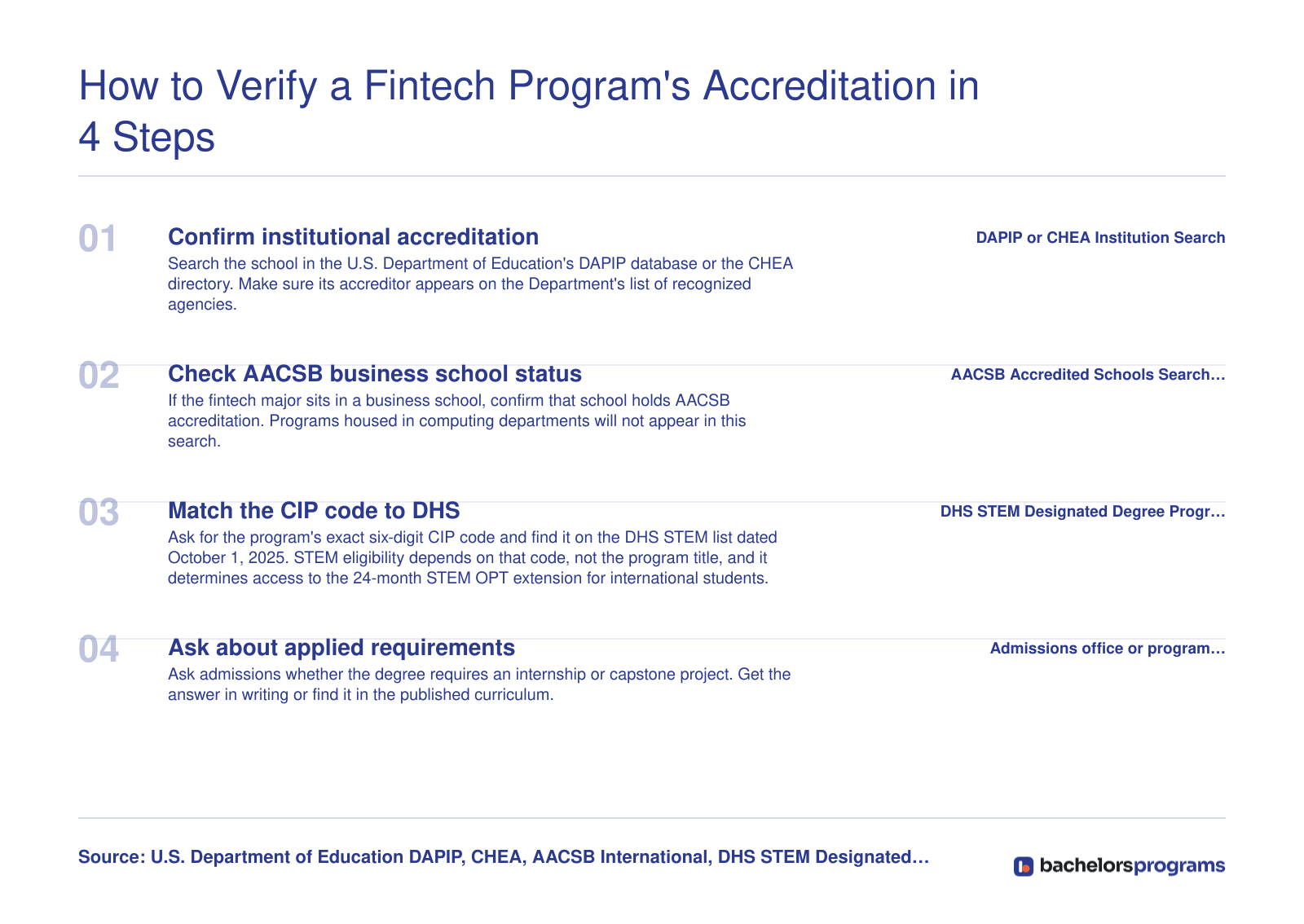
How to Verify a Fintech Program's Accreditation in 4 Steps
Accreditation affects financial aid eligibility, credit transfer, and how employers view your degree. These four checks take less than an hour and should come before you apply to any fintech program.
Entry-Level Fintech Jobs and Who's Hiring
Common Starting Roles
Entry-level fintech work means building, analyzing, or running the software and processes that move money, approve loans, and power digital banking. Bachelor's graduates commonly target roles such as:
- Software engineer or full-stack developer
- Data engineer
- Business analyst or product analyst
- Associate product manager
- Loan processor or mortgage underwriter, on the operations side
Some postings for these titles ask for prior experience, so read requirements closely. Employers include fintech companies, banks, payments and lending firms, mortgage and consumer-credit organizations, and the technology vendors that serve them.
What Hiring Looks Like in 2026
Robert Half's first-half 2026 data ranks financial services among the two strongest industries for tech hiring.1 Software engineers led financial-services hiring gains at roughly 11,700 jobs1, followed by mortgage underwriters (3,300), product managers (2,900), and loan processors (2,800)2. These figures cover financial services broadly, not fintech alone. Looking ahead, 78% of tech leaders planned to add permanent staff in the second half of 2026, and 65% said skilled talent was harder to find than a year earlier.3 The catch is that new graduates still face fewer entry-level openings and heavy application volume.
How to Stand Out
Treat internships as essential, not optional. Pair them with a GitHub or project portfolio, such as a payments dashboard or a loan-data analysis, that shows you can do the work. In a crowded applicant pool, that proof can carry as much weight as your GPA.
Financial Technology programs by state
Compare Financial Technology programs on the data that matters
Explore more Business & Management majors or browse every field of study.
All Business & Management programs Browse every field of study