Best Forensic Accounting Degree Programs
Compare 40+ accredited Forensic Accounting programs, with net price after aid, graduation rates, earnings and debt from IPEDS and the U.S. College Scorecard.

Few U.S. colleges award a true bachelor's in forensic accounting. John Jay College calls its version Fraud Examination and Financial Forensics, and Loyola University Maryland runs the state's only undergraduate major. Most other schools fold the subject into an accounting degree as a concentration or track.
Average net price among the schools here runs from $3,203 at CUNY John Jay to $40,287 at Embry-Riddle Prescott. Most programs are campus-based, while UAB and Eastern Kentucky add fully online options.
The label on the diploma matters less than the credit hours behind it. CPA licensure has long meant 150 semester hours, which is why accelerated master's paths sit beside many of these tracks, and several also add Certified Fraud Examiner prep.
Key Points
- Embry-Riddle Prescott graduates lead early earnings at $55,259 one year out.
- Most schools offer forensic accounting as a concentration, not a standalone major.
- Confirm regional accreditation first; AACSB, ACBSP or IACBE adds a quality layer.
Best Forensic Accounting Schools Ranked for 2027
These ten programs put forensic accounting front and center, whether as a dedicated fraud examination degree, a named concentration inside a broader accounting major, or a track built around Certified Fraud Examiner coursework. Each card shows what the school charges after aid, how many of its students finish, and, where it is published, what graduates of the program earn one year out.
CUNY John Jay College of Criminal Justice
#1New York, NY · ~$3,200/yr (est.)
Best for: Community college transfers targeting fraud careers
John Jay College of Criminal Justice is a CUNY senior college in Manhattan built around criminal justice and public service, and its fraud examination degree is one of the longest-running undergraduate anti-fraud programs in the country. Accounting is taught alongside law, criminal justice and the social sciences rather than in isolation. Dual-admission agreements with three CUNY community colleges give associate-degree holders a defined route into the bachelor's program, and graduates move into investigative work at accounting firms, banks, insurers and government agencies.
- Accounting integrated with law, criminal and social justice
- Formerly the Forensic Financial Analysis major
- Dual-admission pathways from three CUNY community colleges
- CUNY Justice Academy students complete 40% of major work at John Jay
- Median earnings of $44,092 one year after finishing
- Median debt of $14,475 for program graduates
- 24-credit forensic accounting certificate also available
George Washington University
#2Washington, DC · ~$37,000/yr (est.)
Best for: Washington interns aiming at federal investigations
George Washington University is a private research university set in the middle of Washington's government and business district, which gives accounting majors an unusual supply of internships, case competitions and guest practitioners. Undergraduates take a forensic accounting concentration inside the accountancy program, pairing core accounting with investigative and fraud detection coursework. Students who want a graduate credential can stay for a fifth year through the school's 4+1 pathway.
- Forensic accounting concentration inside the Accountancy program
- Coursework spans tax, auditing and forensic accounting
- Campus sits among federal agencies and major firms
- Internships and case competitions with firms and agencies
- 4+1 pathway to a master's degree in five years
University of Alabama at Birmingham
#3Birmingham, AL · $19,000/yr (est. net price)
Best for: Working adults needing a fully online path
The University of Alabama at Birmingham is an urban public research university whose Collat School of Business holds AACSB accreditation in both business and accounting. Accounting majors choose between a forensic accounting concentration and an information technology track, and the program runs on campus and fully online, with self-paced and instructor-supported online versions. Internships and an accelerated master's option let students build experience and move toward CPA eligibility on their own timeline.
- Forensic accounting concentration alongside an information technology track
- AACSB accredited in both business and accounting
- Fully online option, self-paced or instructor-supported
- Accelerated master's path toward CPA eligibility
- Internships completed before graduation
- Bridge program for students who already hold a degree
West Virginia University
#4Morgantown, WV · ~$16,000/yr (est.)
West Virginia University is a public land-grant institution in Morgantown whose accounting program carries AACSB accounting accreditation. Its forensic accounting and fraud examination concentration grew out of a federal Department of Justice grant, so the coursework leans on data analytics and investigative technique rather than theory alone. Students prepare for the Certified Fraud Examiner exam, choose among four tracks including CPA exam preparation, and many internships convert into full-time offers.
- Forensic accounting and fraud examination concentration
- Curriculum shaped by a U.S. Department of Justice grant
- Prepares students for the Certified Fraud Examiner exam
- Four concentration options, including CPA exam preparation
- Median earnings of $44,255 one year after finishing
- Median debt of $24,324 for program graduates
- AACSB accounting accreditation
- Tutoring at the Becker Academic Engagement Success Center
Loyola University Maryland
#5Baltimore, MD · ~$31,000/yr (est.)
Loyola University Maryland is a private Jesuit university in Baltimore whose Sellinger School of Business treats forensic accounting as a standalone undergraduate major rather than a track buried inside a general accounting degree, and it is the only program of its kind in the state. Faculty include practicing fraud examiners, CPAs and expert witnesses, and a capstone course turns students loose on real investigative cases. Accelerated 3+1 and 4+1 arrangements let students finish a bachelor's and master's degree in four to five years.
- Only undergraduate forensic accounting program in Maryland
- Faculty include CFEs, CPAs and expert witnesses
- Capstone course works through real investigative cases
- 3+1 and 4+1 pathways to bachelor's and master's degrees
- Recruiting relationships with PwC, RSM and CohnReznick
Boise State University
#6Boise, ID · $20,000 – $25,000/yr (est.)
Boise State University is Idaho's largest public university, and its accountancy degree is built around the practical skills employers screen for: communication, analytical reasoning, technology and technical accounting. Students who want investigative work add a forensics emphasis covering fraud examination and investigative accounting. The program also steers eligible Idaho students toward the state's LAUNCH scholarship, which can cover most of tuition and fees.
- Forensics emphasis in investigative accounting and fraud examination
- Builds analytical reasoning, technology and communication skills
- Idaho LAUNCH scholarship can cover up to $8,000 in tuition
- Graduates typically sit for the CPA exam after finishing
Eastern Kentucky University
#7Richmond, KY · $11,000/yr (est. net price)
Eastern Kentucky University is a public university in Richmond whose College of Business runs its accounting degree both on campus and online. The online version uses accelerated seven-week terms with six start dates a year, which suits working adults who want to keep earning while they finish a degree. Forensic accounting sits as a specialization inside the Public Accounting concentration, and the program is AACSB accredited and IMA-endorsed.
- Forensic accounting specialization in the Public Accounting track
- Online option uses accelerated 7-week courses, six starts a year
- Transfer up to 90 credit hours toward the degree
- AACSB accredited and IMA-endorsed
- No application fee; online tuition is $472 per credit
- 3+2 pathway to the BBA and MBA
- VITA tax service-learning project on campus
University of Scranton
#8Scranton, PA · $33,000/yr (est. net price)
The University of Scranton is a private Jesuit university in northeastern Pennsylvania whose accounting degree lets students choose among forensic accounting, accounting analytics and general accounting tracks. The forensic track mixes fraud examination, criminology and financial statement analysis, and advising is geared toward professional credentials rather than a single job title. A 125-credit, four-year structure keeps the program easy to plan around.
- Forensic accounting track inside a 125-credit BS in Accounting
- Coursework in fraud examination, criminology and statement analysis
- Prepares students for CPA, CMA, CFE and CIA credentials
- Minors available in Business Analytics or Finance
DeSales University
#9Center Valley, PA · $32,000/yr (est. net price)
DeSales University is a private Catholic university in Center Valley, Pennsylvania, with small classes and a business core shared across its accounting programs. Students who choose the forensic concentration add white collar crime and fraud examination courses to the usual auditing, taxation and financial reporting sequence. A 4+1 BS/MBA option lets qualified students continue into a master's degree, and the accounting core is structured to meet CPA education requirements.
- Forensic accounting concentration inside the BS in Accounting
- Adds white collar crime and fraud examination to the accounting core
- Prepares students for Certified Fraud Examiner certification
- Meets CPA education requirements
- 4+1 BS/MBA pathway for qualified students
Embry-Riddle Aeronautical University-Prescott
#10Prescott, AZ · ~$40,000/yr (est.)
Embry-Riddle Aeronautical University's Prescott, Arizona campus is best known for aviation, but its forensic accounting and fraud examination degree is one of the few dedicated on-campus programs of its kind in the country. The curriculum follows the four core sections of the Association of Certified Fraud Examiners, and faculty come from private, public and government practice. Coursework is aligned with federal agency hiring expectations, and students get lab time with data visualization tools.
- One of the few dedicated on-campus forensic accounting degrees
- Curriculum mirrors the four core ACFE certification sections
- Coursework aligned with FBI, CIA, DEA and IRS hiring needs
- Hands-on data visualization labs
- Median earnings of $55,259 one year after finishing
- Median debt of $19,500 for program graduates
- 120 credit hours, taught in person
Cost & outcomes by school
Federal data for the highest-earning Forensic Accounting programs, independent of the ranking above. Earnings are this field's bachelor's graduates four years after completing where the Scorecard reports them, else the school's undergraduate median.
| School | Net price / yr | Grad rate | Earnings | Debt | Grads/yr | Format |
|---|---|---|---|---|---|---|
| Embry-Riddle Aeronautical University-Prescott AZ | $40,287 | 68% | $98,996 | $19,500 | 23 | Campus |
| George Washington University DC | $36,586 | 84% | $90,873 | $20,449 | — | Campus |
| Loyola University Maryland MD | $30,574 | 79% | $82,652 | $27,000 | 36 | Campus |
| University of Scranton PA | $32,568 | 80% | $74,652 | $27,000 | 11 | Campus |
| Widener University PA | $25,759 | 68% | $70,920 | $27,000 | — | Campus |
| Pace University NY | $30,892 | 60% | $70,378 | $23,250 | 4 | Campus |
| Seton Hall University NJ | $31,446 | 70% | $70,196 | $22,750 | — | Campus |
| New York Institute of Technology NY | $22,443 | 59% | $70,080 | $23,334 | — | Campus |
| Alliant International University-San Diego CA | — | — | $66,666 | $12,878 | — | Campus |
| University of New Haven CT | $34,192 | 63% | $63,360 | $27,000 | 126 | Campus |
| West Virginia University WV | $15,634 | 65% | $62,455 | $24,121 | 103 | Campus |
| DeSales University PA | $31,643 | 72% | $61,295 | $25,788 | — | Campus |
Sources: U.S. Department of Education. Net price, graduation rate, earnings and debt: College Scorecard (earnings and debt for this field's bachelor's graduates where reported, else school-wide); graduates: IPEDS. A dash means no figure is reported.
Cost, debt & payoff
Median earnings of this field's bachelor's graduates (4 yrs after completing, else the school's undergraduate median) vs. their median federal loan debt · U.S. College Scorecard
Across these programs the median graduate earns about $54,053 and finishes with roughly $24,250 in debt — a ratio that clears a common rule of thumb (keep debt below first-year salary). Net price and debt vary widely school to school, so check the per-school figures in the table above before you shortlist.
How We Ranked These Forensic Accounting Programs
Whether a low price tag means real value or a hidden cost drives this ranking. We weigh what a degree costs a student after aid against what that program's graduates earn and owe once they leave.
The Four Measures
- Cost after aid: Net price, the average students pay once grants and scholarships reduce the sticker price.
- Program earnings and debt: Federal College Scorecard figures for people who completed the program, alongside median debt at graduation.
- Completions: How many students finish, a signal of program scale and staying power.
- Institutional outcomes: Graduation and retention rates showing whether students persist and complete.
Where the Limits Sit
Graduation and retention describe the whole institution, not the forensic accounting concentration alone. Net price is an average across students in a sector, not a personal quote; your aid package, residency, and transfer credits will shift it. Earnings come from federal tax records matched to actual completers rather than a school's own survey of its alumni, which makes those figures much harder to cherry-pick.
A Shortlist, Not a Verdict
Use the ranking to narrow the field, then verify. Confirm the program holds AACSB, ACBSP, or IACBE accreditation, and check that its accounting coursework reaches the 150 credit hours your state board requires for CPA licensure. A strong position here cannot rescue a program that leaves you short of the credits you need.
Dedicated Forensic Accounting Degree vs. Concentration, Minor or Certificate
Can you get a bachelor's degree in forensic accounting? Yes, but most schools deliver it as an accounting degree with a forensic or fraud examination concentration rather than as a standalone major.
How Common Standalone Degrees Are
Among the schools ranked here, dedicated majors are the exception. CUNY John Jay College of Criminal Justice offers a Bachelor of Science in Fraud Examination and Financial Forensics. Loyola University Maryland has a Forensic Accounting Major, and Embry-Riddle Aeronautical University-Prescott awards a Bachelor of Science in Forensic Accounting and Fraud Examination.
The rest build forensic work into an accounting major:
- Concentration or track: University of Alabama at Birmingham, West Virginia University, Eastern Kentucky University and University of Scranton
- Emphasis: Boise State University's Accountancy BBA with a Forensics Emphasis
- Combined title: DeSales University's Accounting, Forensic Accounting (BS) and George Washington University's Accountancy program, which covers tax, auditing and forensic accounting
Forensic Accounting vs. Accounting Degree
The core accounting coursework is shared: financial reporting, auditing and tax. The forensic track layers on fraud examination, litigation support and data analytics electives. Scranton's track centers on fraud examination and litigation support, while Embry-Riddle adds hands-on data visualization labs. WVU, Scranton and DeSales also prepare students for the Certified Fraud Examiner credential.
Which Path Is Safer?
Employers and state CPA boards look hardest at how many accounting credits you have completed, not the name on your diploma. A forensic concentration on an accounting major keeps those credits intact, and DeSales states that its program meets CPA education requirements. A standalone title can work if you are certain about fraud investigation, but confirm it includes enough upper-level accounting to qualify for the CPA exam in your state.
Accreditation to Look for: AACSB vs. ACBSP vs. IACBE
Regional (institutional) accreditation is the baseline. State CPA boards and federal financial aid generally require it, so confirm it before anything else. Business-school accreditation from AACSB, ACBSP or IACBE is an added quality layer on top, not a replacement. The table compares the three, and the last row explains how to verify a program.
| Factor | AACSB | ACBSP | IACBE |
|---|---|---|---|
| Primary focus | Principles-based and mission-driven, with emphasis on teaching, research, curriculum, student learning, innovation and societal impact | Generally described as teaching-centered, with a focus on continuous improvement in the classroom | Generally described as outcomes-based, centered on assessing student learning against each school's own mission |
| Typical school types | Research universities and large public and private institutions, plus many others worldwide | Often teaching-focused colleges and universities, including community colleges and mid-sized schools | Often smaller or mission-driven private and career-oriented institutions |
| Accredited institutions | 1,085 institutions worldwide (2026) | Count varies by year; confirm in ACBSP's official directory | Count varies by year; confirm through IACBE's Member Search |
| Separate accounting accreditation | Yes, 195 institutions hold AACSB accounting accreditation (2026) | Confirm with ACBSP whether a program-level accounting credential applies | Yes, IACBE offers special accounting accreditation (examples include Franklin University and the University of Arizona) |
| Employer recognition | Generally the most widely recognized among large employers and graduate programs | Recognized by many regional employers and schools; recognition varies by market | Recognized mainly within its member network; recognition varies by employer |
| Where to verify | AACSB's Accredited Schools search shows business and accounting accreditation | ACBSP's official accredited-program directory | IACBE's Member Search, filtered for accredited programs and the United States, with a link to accredited accounting programs |
| Cross-check in DAPIP | Search the school in the U.S. Department of Education's DAPIP database, then compare the listed accreditor and scope with AACSB's directory | Search the school in DAPIP, then compare the listed accreditor and scope with ACBSP's directory | Search the school in DAPIP, then compare the listed accreditor and scope with IACBE's Member Search |
Most Affordable Forensic Accounting Degree Programs
These programs post the lowest average annual net price among the schools here, measured as cost after grants and scholarships for students receiving federal aid (IPEDS and College Scorecard, 2024). Every one is a public institution, and high Pell Grant shares paired with modest median debt at completion suggest they serve many cost-conscious students. You can cut total cost further by completing lower-division accounting and general education courses at a community college first: Eastern Kentucky accepts up to 90 transfer credit hours, and Northwestern Michigan's partnership with Davenport University keeps the first three years at NMC.
| School | Location | Sector | Program | Average Annual Net Price (after aid) | In-State Tuition and Fees | Median Debt at Completion (institution-wide) | Pell Grant Recipients | Cost-Saving Notes |
|---|---|---|---|---|---|---|---|---|
| CUNY John Jay College of Criminal Justice | New York, NY | Public | BS in Fraud Examination and Financial Forensics (campus) | $3,203 | $7,470 | $11,000 | 90% | Also offered at CUNY community colleges |
| Northwestern Michigan College | Traverse City, MI | Public | BBA in Accounting Fraud Investigation with Davenport University (hybrid) | $6,231 | $5,860 | $12,500 | 71% | First three years at NMC; final year online or in Traverse City |
| Eastern Kentucky University | Richmond, KY | Public | BBA in Accounting, Forensic Accounting concentration (hybrid) | $11,040 | $10,320 | $22,500 | 65% | $472 per credit; up to 90 transfer credit hours; $0 application fee |
Related Articles
Online vs. Campus Forensic Accounting Programs
Flexibility and campus recruiting access pull in opposite directions, and forensic accounting sharpens that tension. Most of the programs here are campus-based, including John Jay, George Washington, West Virginia, Loyola Maryland, Scranton and Embry-Riddle Prescott. Only University of Alabama at Birmingham and Eastern Kentucky University are listed as hybrid, each with a fully online option. None of the schools here is listed as online-only.
Synchronous, Asynchronous and Hybrid
Synchronous online courses meet live at set times, which gives you real-time discussion with faculty and classmates. Asynchronous courses are self-paced: you watch recorded lectures and turn in assignments by set deadlines. UAB advertises a self-paced online study option, and Eastern Kentucky uses accelerated 7-week terms with six start dates a year. Hybrid formats suit working adults and career changers who want some structure without a daily commute.
Trade-Offs Specific to Forensic Accounting
On campus, you get easier access to recruiting events, faculty with investigative backgrounds and internships. Loyola Maryland, for example, highlights connections with PwC, RSM and CohnReznick. Online study fits better if you already work in accounting, auditing or law enforcement and want credentials without leaving your job. Career changers with no accounting experience may benefit more from on-campus networking.
What Stays the Same
An online degree and a campus degree from the same school carry the same accreditation. Credit hours count the same toward CPA education requirements, but your state board sets the final rules, so check them before you enroll.
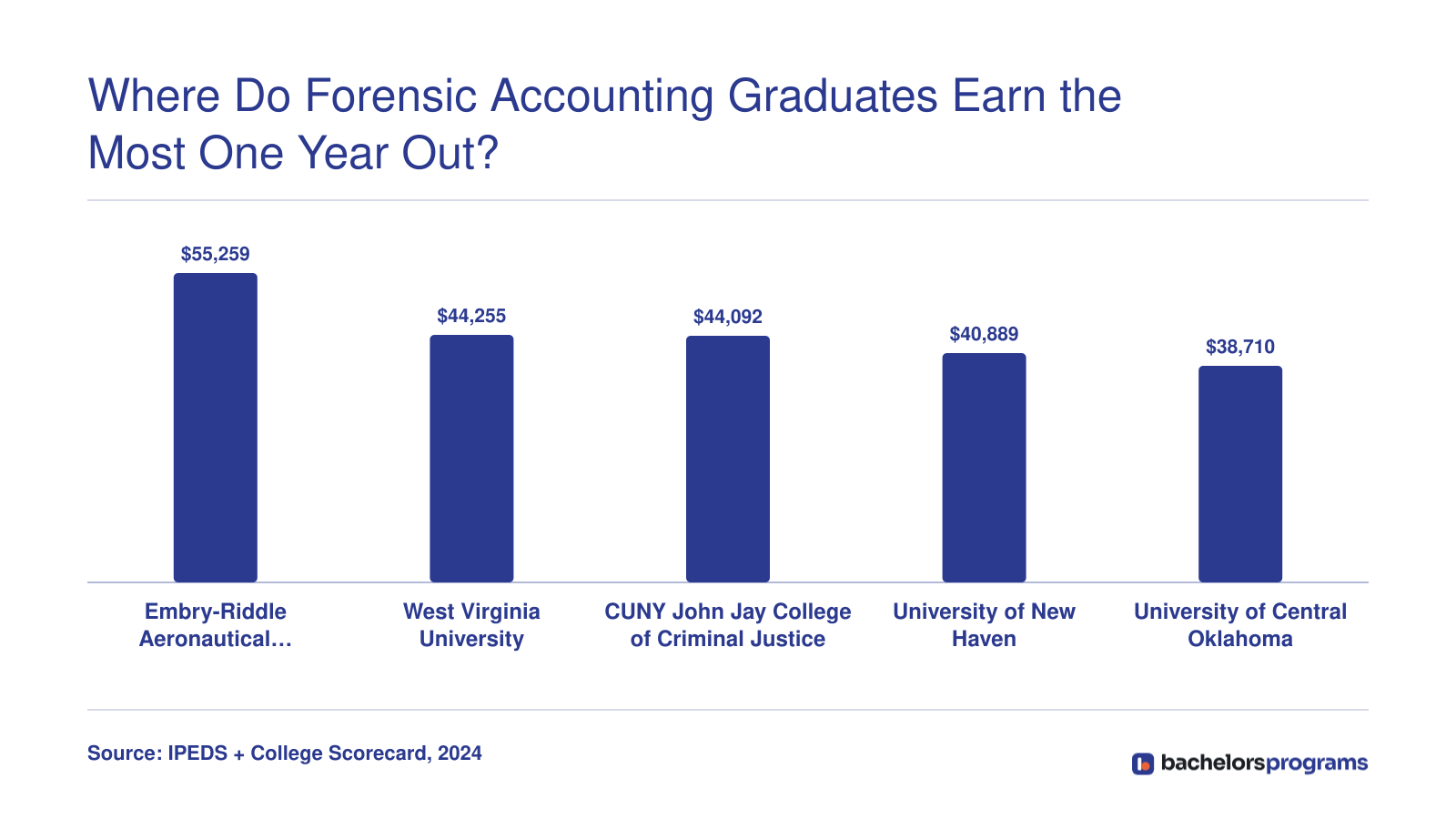
Where Do Forensic Accounting Graduates Earn the Most One Year Out?
The chart compares median earnings 1 year after completion for programs with a published program-level figure in federal College Scorecard data. Embry-Riddle Aeronautical University-Prescott leads at $55,259. West Virginia University ($44,255) and CUNY John Jay College of Criminal Justice ($44,092) are nearly tied, so early-career pay at those two is effectively a wash.
Accountants and Auditors Median Pay
Forensic accountants are counted with accountants and auditors in federal wage data, so this national occupational median is a useful benchmark for long-term earning potential.
Forensic Accounting programs by state
Forensic Accounting Degree FAQs
These answers cover the questions readers ask most when weighing a forensic accounting path. They reflect the credential rules published by the ACFE and AICPA-CIMA and federal occupational data from the Bureau of Labor Statistics.
What is the best degree for forensic accounting?
How long does it take to become a forensic accountant?
Is a forensic accounting degree worth it?
Can you switch into forensic accounting with a general accounting degree?
Compare Forensic Accounting programs on the data that matters
Explore more Business & Management majors or browse every field of study.
All Business & Management programs Browse every field of study