Best Healthcare Administration Schools in Iowa
Compare 10 accredited Healthcare Administration programs in Iowa at 8 colleges, with net price after aid, graduation rates, earnings and debt from IPEDS and the U.S. College Scorecard.

Iowa licenses nursing home administrators, and the credential hinges on a bachelor's degree from an accredited college plus a supervised administrator-in-training period. That single rule explains why so many working adults in the state choose a Bachelor of Science (B.S.) in Healthcare Administration, the standard credential for the business side of care.
The tension is cost and format, not access. Iowa's private colleges publish tuition at roughly twice what students actually pay after grants, and the online and campus versions of the same degree rarely price alike.
Employers here hire on the degree and the practicum, not the name on the transcript.
Key Points
- Mercy College, Mount Mercy and Waldorf offer this bachelor's degree online.
- Average net price after aid usually falls far below published tuition.
- Running an Iowa nursing home requires a license from a state board.
Best Bachelor's Degree in Healthcare Administration Schools in Iowa: Our Ranked List
The eight schools below all award a bachelor's degree in healthcare administration or a closely related credential, and they run from a large public research university to small private colleges built around adult learners. Each entry covers the credential, the city, the formats offered, and what the program is known for, so you can judge fit alongside price.
Iowa State University
#1Ames, IA · $19,000/yr (est. net price)
Best for: Business-minded students eyeing hospital leadership
Iowa State University's healthcare management degree sits inside the Ivy College of Business in Ames, so the training leans on finance, operations, quality improvement and analytics rather than clinical work. Experiential learning is required, and students have completed internships or co-ops with partners such as Mary Greeley Medical Center and Mayo Clinic. An accelerated three-year path and dedicated career coordinators make it a practical choice for students who want to move quickly into hospital, clinic or health plan management.
- Business-based healthcare management degree in the Ivy College of Business
- Required internship, co-op or independent study
- Partners include Mary Greeley Medical Center and Mayo Clinic
- Average internship wage of $18.38 per hour
- Accelerated three-year completion option
- Coursework in healthcare finance, law, economics and information systems
- Career coordinators support internship and job placement
Drake University
#2Des Moines, IA · $25,000 – $30,000/yr (est.)
Best for: Des Moines students wanting immersive internships
Drake University's route into the field is a Bachelor of Science in Health Sciences with a Health Care Administration track, taught on campus in Des Moines. Students pair operations, patient services, information technology and marketing coursework with biology, anatomy, psychology and ethics, then spend a full year in a senior internship inside the city's dense healthcare sector. The program reports full career or graduate placement for its most recent class, and accelerated pathways into Drake graduate programs are available.
- Health Care Administration track within the B.S. in Health Sciences
- 120 credit hours including a year-long senior internship
- Community-engaged projects across Des Moines healthcare employers
- Three concentration options in the health sciences major
- Accelerated pathways into Drake graduate programs
- Faculty mentoring and undergraduate research opportunities
Mercy College of Health Sciences
#3Des Moines, IA · ~$27,000/yr (est.)
Best for: Working adults needing fully online coursework
Mercy College of Health Sciences in Des Moines runs its healthcare administration bachelor's entirely online, with a direct-admit structure and three start dates a year. The 120-credit curriculum is built to finish in four semesters and closes with a capstone and a 45-hour practicum in a public health organization. PhD-prepared faculty and a servant leadership core give the degree a values-driven tone that is uncommon among business-adjacent online programs.
- 100% online, direct-admit program
- 120 credit hours completed across four semesters
- 45-hour practicum plus a required capstone
- Three start dates each year: fall, spring and summer
- Coursework in healthcare economics, finance, HR and biostatistics
- Servant leadership core with PhD-prepared faculty
Simpson College
#4Indianola, IA · ~$22,000/yr (est.)
Simpson College, in Indianola just south of Des Moines, treats healthcare administration as its own major and minor rather than a track buried inside a business degree. A three-week May term takes students to a dozen central Iowa healthcare organizations, where they meet executives and providers directly, and internships have landed students at UnityPoint Health Des Moines and the Iowa Hospital Association. Coursework pairs how healthcare organizations actually operate with leadership, communication and decision-making skills.
- Offered as both a major and a minor
- Three-week May tour of a dozen central Iowa healthcare organizations
- Learn directly from healthcare executives and providers
- Internship placements include UnityPoint Health Des Moines
- Internships with the Iowa Hospital Association and ChildServe
- Coursework in leadership, management, communication and decision-making
Mount Mercy University
#5Cedar Rapids, IA · $20,000 – $25,000/yr (est.)
Mount Mercy University in Cedar Rapids builds its Health Care Administration major on a business foundation, then layers on health services topics such as regulation, law, compliance, informatics and finance. Students complete an internship or practicum, and the HS 450 course can satisfy the practicum requirement for Iowa nursing home administrator licensure. Juniors and seniors can also bank up to 13 graduate credits through the university's MMU Plus option.
- Business foundation with a health services focus
- Internship or practicum required for the major
- HS 450 internship credits can support Iowa nursing home administrator licensure
- Covers regulation, law, compliance, informatics and finance
- At least a C in every major course and a 2.0 overall GPA
- 47 to 48.5 total credit hours in the major
- Up to 13 graduate credits through MMU Plus
Upper Iowa University
#6Fayette, IA · $21,000/yr (est. net price)
Upper Iowa University, based in Fayette, delivers its Bachelor of Science in Health Services Administration online and at in-person locations, using a two-courses-at-a-time schedule that fits working adults. Students pick a general leadership focus or a dental hygiene focus and work through healthcare informatics, managed care, long-term care administration, law and ethics, and financial management. The degree also feeds into the university's MBA and MPA pathways for graduates who want to keep going.
- Tracks: General Leadership and Dental Hygiene
- Two courses at a time with evening or online classes
- Available fully online or at in-person locations
- Core includes healthcare informatics, managed care and long-term care administration
- Coursework in health care law, ethics and financial management
- Pathways into Upper Iowa's MBA or MPA
- Career guidance through the Handshake platform
Waldorf University
#7Forest City, IA · ~$20,000/yr (est.)
Waldorf University in Forest City runs its healthcare management degrees fully online, aimed at busy adults and career changers who want mid-level leadership roles without a clinical background. Coursework spans medical terminology, health informatics, community health, epidemiology, reimbursement methods and strategic planning, with a steady emphasis on the efficiency and quality of patient care. Two credentials are available, a Bachelor of Arts and a Bachelor of Applied Science, both at 120 credit hours.
- 120 credit hours, typically four years of full-time study
- No clinical or in-field experience required
- Covers reimbursement methods, epidemiology and strategic planning
- 2.0 GPA minimum and a C or better in major courses
- At least 36 upper-division credit hours
- Online only, 120 credit hours over four years of full-time study
- No clinical or in-field experience required
- Focus on efficiency and quality of patient care
- 2.0 GPA minimum and a C or higher in major courses
- At least 30 upper-division credit hours
University of Dubuque
#8Dubuque, IA · ~$23,000/yr (est.)
The University of Dubuque offers a Bachelor of Science in Health Care Administration through its LIFE program, which is built for adults balancing work, family and college at the same time. The degree covers general education requirements and electives as well as the major, so students who started a degree elsewhere can finish the whole thing in one place. Hybrid classes run alongside peers facing similar obligations, which keeps the pace realistic for working professionals.
- Delivered through the LIFE program for working adults
- Includes general education requirements, electives and major courses
- Designed for students who started a degree elsewhere
- Hybrid format that balances work, family and college
- Skills for managing health services and leading teams
Cost & outcomes by school
Federal data for the highest-earning Healthcare Administration programs, independent of the ranking above. Earnings are this field's bachelor's graduates four years after completing where the Scorecard reports them, else the school's undergraduate median.
| School | Net price / yr | Grad rate | Earnings | Debt | Grads/yr | Format |
|---|---|---|---|---|---|---|
| Drake University IA | $29,127 | 74% | $71,901 | $23,000 | 4 | Campus |
| Upper Iowa University IA | $20,942 | 34% | $66,931 | $28,939 | 19 | Hybrid |
| Iowa State University IA | $18,589 | 75% | $63,386 | $22,869 | 10 | Campus |
| Mount Mercy University IA | $20,168 | 58% | $60,787 | $23,699 | 10 | Online |
| Simpson College IA | $21,936 | 63% | $59,274 | $26,000 | 1 | Campus |
| University of Dubuque IA | $23,386 | 40% | $51,190 | $25,750 | — | Hybrid |
| Waldorf University IA | $19,693 | 21% | $51,165 | $22,301 | 11 | Online |
| Mercy College of Health Sciences IA | $26,924 | 66% | $50,009 | $14,745 | 6 | Online |
Sources: U.S. Department of Education. Net price, graduation rate, earnings and debt: College Scorecard (earnings and debt for this field's bachelor's graduates where reported, else school-wide); graduates: IPEDS. A dash means no figure is reported.
Cost, debt & payoff
Median earnings of this field's bachelor's graduates (4 yrs after completing, else the school's undergraduate median) vs. their median federal loan debt · U.S. College Scorecard
Across these programs the median graduate earns about $60,031 and finishes with roughly $23,350 in debt — a ratio that clears a common rule of thumb (keep debt below first-year salary). Net price and debt vary widely school to school, so check the per-school figures in the table above before you shortlist.
Most Affordable Healthcare Administration Bachelor's Programs in Iowa
A school's published tuition (its sticker price) and its average net price are two different numbers. Net price is the average yearly cost after grants and scholarships, including housing, books and other expenses, so it is closer to what most students actually pay and can sit above tuition at a public school or far below it at a private one. The programs below are ordered by average net price, using U.S. Department of Education figures from IPEDS and the College Scorecard (2024). Median debt is the school-wide figure for graduates.
| School | City | Program | Format | In-State Tuition and Fees | Average Net Price | Median Debt at Graduation |
|---|---|---|---|---|---|---|
| Iowa State University | Ames | Healthcare Management | Campus | $10,787 | $18,589 | $22,869 |
| Waldorf University | Forest City | Bachelor of Arts in Health Care Management | Online | $25,978 | $19,693 | $18,752 |
| Mount Mercy University | Cedar Rapids | Health Care Administration | Online | $40,878 | $20,168 | $23,699 |
| Upper Iowa University | Fayette | Health Services Administration | Hybrid | $19,475 | $20,942 | $25,000 |
| Simpson College | Indianola | Healthcare Administration | Campus | $47,656 | $21,936 | $26,000 |
Online and Hybrid Healthcare Administration Bachelor's Options at Iowa Schools
You can earn a bachelor's degree in healthcare administration from an Iowa school without moving to campus. Mercy College of Health Sciences, Mount Mercy University and Waldorf University offer the degree online. Upper Iowa University and the University of Dubuque use a hybrid model. Iowa State University, Drake University and Simpson College are campus programs.
Fully Online Programs
- Mercy College of Health Sciences: Coursework is 100% online, with fall, spring and summer starts. A 45-hour practicum in the final term places you in professional or public-health settings, and the college helps you find a site through its healthcare partners. Mercy does not state whether classes are live or self-paced. Mercy College of Health Sciences participates in SARA, which governs online enrollment across state lines.
- Mount Mercy University: An internship or practicum is required. The program page does not describe how placements are arranged or how classes meet.
- Waldorf University: The degree is offered online only, and no clinical or in-field experience is required.
Hybrid Programs
Upper Iowa University offers online, in-person and evening options on a "Two-at-a-Time" schedule. Its online courses are described as self-paced, which points to mostly asynchronous study. The program page does not list start dates or explain the practicum format. The University of Dubuque's hybrid format is built for working adults who are balancing family and want to finish a degree they started elsewhere.
Campus Programs With Internships
- Iowa State University: Experiential learning is required. The internship course carries 3 credits and at least 120 contact hours, plus written and oral reports.
- Drake University: Students complete a year-long senior internship in Des Moines.
- Simpson College: Internships run through the Iowa Hospital Association, and a three-week May tour visits central Iowa healthcare organizations.
How Long Does It Take?
A full-time student usually finishes in four years. Drake, Mercy and Waldorf each list 120 total credits, and Waldorf states four years with full-time enrollment. Iowa State offers an accelerated three-year option. Mercy's major is a four-semester, 45-credit sequence, so transfer students with general education already complete can move faster. Dubuque's program is also designed for students bringing in prior credit.
Admissions for Healthcare Administration Bachelor's Programs in Iowa
Entering as a first-year student and transferring in with an associate degree are the two usual routes into a bachelor's degree in healthcare administration in Iowa. The schools here document those routes unevenly.
The Common Pattern
Admission is moderately open across the board. In the latest federal data, admit rates run from about 64 percent at Drake University to nearly 100 percent at Mercy College of Health Sciences. Iowa community college graduates with an AA or AS are the typical transfer applicants, but each school sets its own credit cap and decides how AA, AS and AAS degrees count toward the major. Do not assume automatic junior standing unless the school states it.
School by School
- Iowa State University: Admit rate near 89 percent. No GPA minimum, test policy or transfer cap is published for the Healthcare Management major.
- Drake University: Admit rate near 64 percent. No policy published for the Health Sciences program's GPA, testing or transfer credit.
- Mercy College of Health Sciences: A direct-admit, four-semester online program with three start dates a year, which suits students arriving with credits. No GPA, test or transfer-cap policy is published.
- Simpson College: Admit rate near 86 percent. No policy published.1
- Mount Mercy University: The program lists a 2.0 GPA minimum and a C or better in major courses. It is unclear whether that applies at admission or only for progression. No test or transfer policy is published.
- Upper Iowa University: Admit rate near 96 percent, with evening and online courses. No GPA, test or transfer policy is published.
- Waldorf University: The online program lists a 2.0 GPA minimum and a C or higher in major courses. It requires 120 credit hours, 36 of them upper-division. No test or transfer policy is published.
- University of Dubuque: The program is pitched at students finishing degrees started elsewhere. No GPA, test or transfer cap is published.
The Exceptions
Mount Mercy and Waldorf are the only two that state a GPA figure, and in both cases it is a program-level 2.0. Mercy College's direct-admit model and Dubuque's completion focus signal transfer friendliness, but neither amounts to a stated credit limit. Where no policy is published, do not infer one. Ask the admissions office for the current GPA expectation, whether tests are required or optional, and the maximum credits accepted from an Iowa community college degree. Get the answer in writing before you apply.
Cost of a Healthcare Administration Bachelor's Degree in Iowa
A healthcare administration bachelor's degree in Iowa usually costs far less after aid than the sticker price suggests.
Tuition vs. Net Price
Private schools discount heavily. Drake University lists in-state tuition and fees of $52,130, yet its average net price is $29,127. Simpson College goes from $47,656 to $21,936, and Mount Mercy University from $40,878 to $20,168. At the cheapest schools, net price can run higher than published tuition. Mercy College of Health Sciences lists $17,664 but averages $26,924, and Upper Iowa University lists $19,475 against $20,942, because net price also counts housing, books and living costs. Iowa State University runs $10,787 in tuition and $18,589 in net price.
Net price is an average across aided students, not a quote. Your own figure depends on income, residency and credits.
What Aid Reliance Looks Like
Pell shares show how many students lean on federal aid: 32.9% at Drake, 40.9% at Iowa State, 71.1% at Waldorf University and 69.8% at Upper Iowa. Median debt among graduates runs from $14,745 at Mercy to $26,000 at Simpson, with Drake at $23,000.
Iowa State Aid
Iowa College Aid programs generally require Iowa residency, eligible citizenship status, Title IV-eligible enrollment and a FAFSA.2 Postmarks do not count; the federal processing system must receive it by the deadline.
- Iowa Tuition Grant (nonprofit): up to $7,500 for 2026-27 at eligible Iowa nonprofit colleges, with a student aid index (SAI) from -1,500 to 16,000, at least three semester hours, and up to four years. The 2027-28 amount is not yet set.2 The FAFSA opened October 1, 2026, and the deadline is July 1, 2027.2
- All Iowa Opportunity Scholarship: $5,486, need-based, for students within two years of high school graduation; the 2026-27 deadline was April 1.1
- Future Ready Iowa Grant: $3,000 for high-demand fields, at least six hours, with a July 1 deadline.1
Confirm each school's eligibility, since programs differ by institution. Current rules and amounts are on the Iowa Scholarships and Grants page at Iowa College Aid.
How Far Does Aid Lower the Sticker Price at Iowa's Ranked Schools?
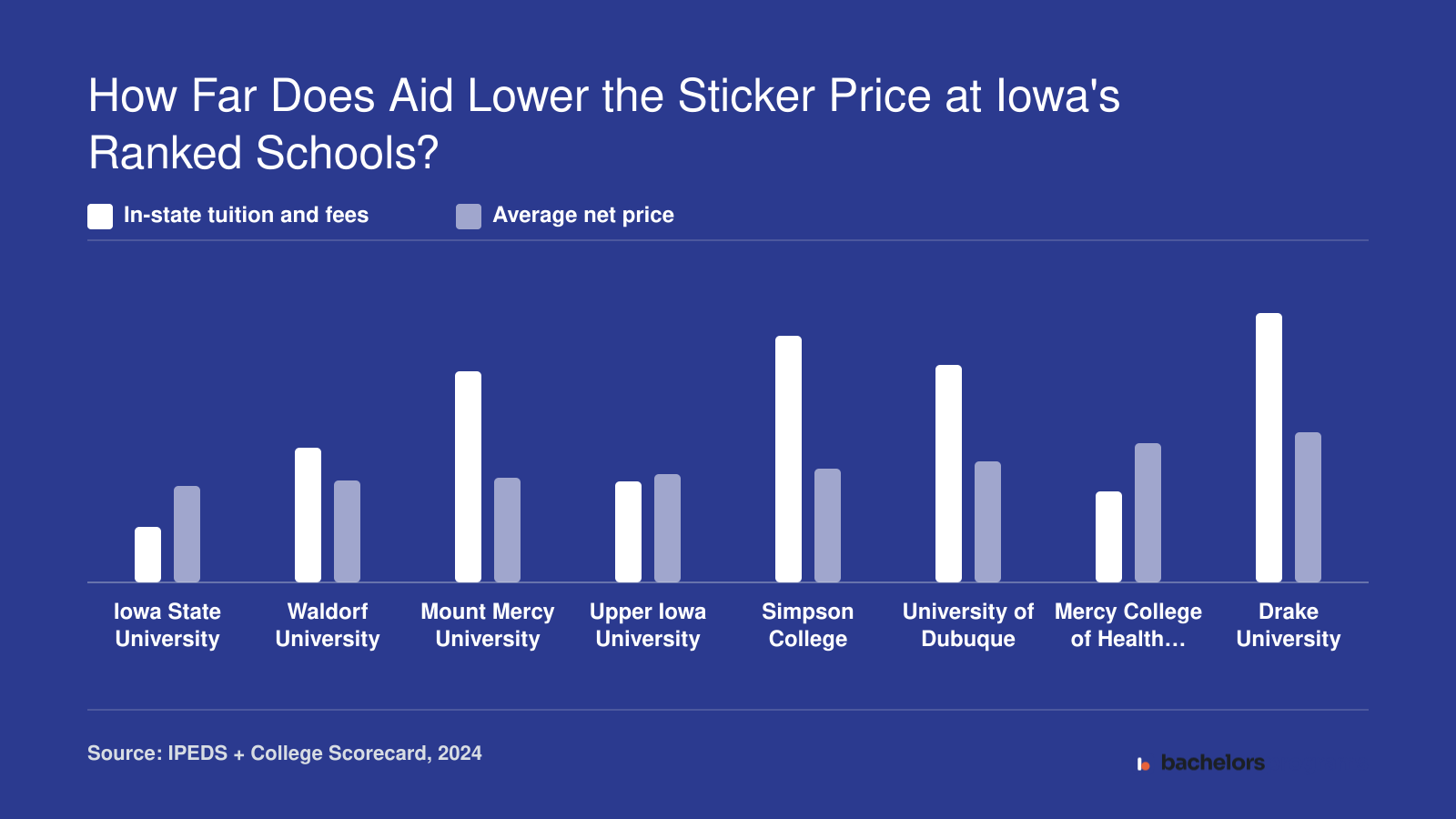
Each school below shows two bars: published in-state tuition and fees, and the average net price students paid after grants and scholarships. Net price is reported by sector, using the public-school average for Iowa State University and the private-school average for the other schools, and it covers total cost of attendance (housing, books and fees as well as tuition). Where the net price bar sits well below the tuition bar, as at Drake, Simpson, Mount Mercy and Dubuque, aid typically offsets much of the sticker price. Where net price sits above tuition, as at Iowa State, Upper Iowa and Mercy College of Health Sciences, tuition is already modest and living costs make up a larger share of the bill.
What You Can Do With a Healthcare Administration Bachelor's Degree in Iowa
Healthcare administration majors learn to manage the business side of care: budgets, staffing, scheduling, compliance, patient records and the flow of people through a facility. In Iowa, that work exists in hospitals, nursing homes, physician clinics, county public health agencies and small rural health systems, not just in large corporate offices.
Where Iowa Graduates Work
Hospitals remain the largest single setting. The Bureau of Labor Statistics projects medical and health services manager jobs in private general medical and surgical hospitals in Iowa to grow 21.8% between 2025 and 2035, from about 8,900 to 10,900.1 That figure covers one industry slice, not every Iowa employer. Long-term care companies, assisted living providers, physician group practices and community health centers also hire administrators, as do county and regional public health departments.
Entry-Level Titles vs. Manager Roles
Expect to start below the manager title. Common first jobs include patient access coordinator, practice office manager, scheduling supervisor, billing or intake lead, and assistant administrator in a long-term care setting. Department manager, clinic director and hospital administrator roles usually go to people with several years of operational experience and a track record of running a unit or service line. The degree gets you the first job; experience gets you the manager title. Titles vary by employer, and a small clinic may give you broader duties earlier than a large hospital.
Rural and Public Health Needs
Many Iowa communities rely on critical access hospitals (small rural hospitals) and rural clinics, where administrators often cover finance, staffing and compliance at once. Public health agencies and rural health networks add another path, especially for graduates who want to stay close to home. Rural employers can struggle to fill openings, so a graduate willing to work outside a metro area may find more responsibility earlier. These organizations tend to value people who can handle several functions rather than one narrow specialty.
What Iowa Medical and Health Services Managers Earn
Iowa pay for this occupation trails the national figure but remains strong.
Iowa Nursing Home Administrator Licensure and Your Bachelor's Degree
A bachelor's degree in healthcare administration can qualify you to run a nursing home in Iowa, if the degree comes from an accredited college or university and falls within a qualifying program.1 The Iowa Board of Examiners for Nursing Home Administrators issues the license, and the Iowa Administrative Code sets the rules.1
Education and Training Requirements
Iowa accepts a baccalaureate or postbaccalaureate degree in health care administration, health services administration, health care management, health services management, nursing home administration or long-term care administration.1 Healthcare administration is one accepted path, not the only one. The rules do not establish that an unrelated major automatically counts. Current code also identifies at least 10 semester hours in business management, accounting or business law, plus 6 semester hours in gerontology or aging.2 Confirm with the board how these apply to your specific degree.
Applicants then complete one of three options, subject to board approval: - An administrator training program - A long-term-care practicum through an accredited college or university - 2,080 hours of long-term care administration or healthcare-related experience in a nursing home1
Exams, Fees and Renewal
You must pass the national NAB CORE and NHA exams once the board approves you to sit for them.1 The state fee schedule lists a $120 license fee.3 Licenses renew every two years, running from January 1 of each even-numbered year through December 31 of the next odd-numbered year.1 Renewal requires a $60 fee, board-mandated continuing education and compliance with mandatory reporting rules.4 A license issued within six months before the renewal date carries over to the following cycle.4
Who Needs This License
Only nursing home administrators need it. Hospital, clinic and most other healthcare management roles in Iowa do not require this license.
Related Articles
Compare Healthcare Administration programs on the data that matters
Explore more Business & Management majors or browse every field of study.
All Business & Management programs Browse every field of study