Best Retail Management Degree Programs
Compare 60+ accredited Retail Management programs, with net price after aid, graduation rates, earnings and debt from IPEDS and the U.S. College Scorecard.

Retail programs increasingly sit inside broader business, marketing and design degrees, so "retail management" can mean very different curricula. Florida State offers a stand-alone major, Texas A&M a Strategic Retailing track inside a marketing BBA, and Minnesota a retail and consumer studies degree built on design.
The real question is which one leads to a store, buying, or merchandising career without heavy borrowing. Cost spreads widely across online and campus formats: average annual net prices among the leading programs here run from $10,411 to $28,699.
Retailers hire largely through internships and management-trainee programs, so a school's employer connections can matter as much as its price.
Key Points
- Chipola College's $1,133 average net price is the lowest here.
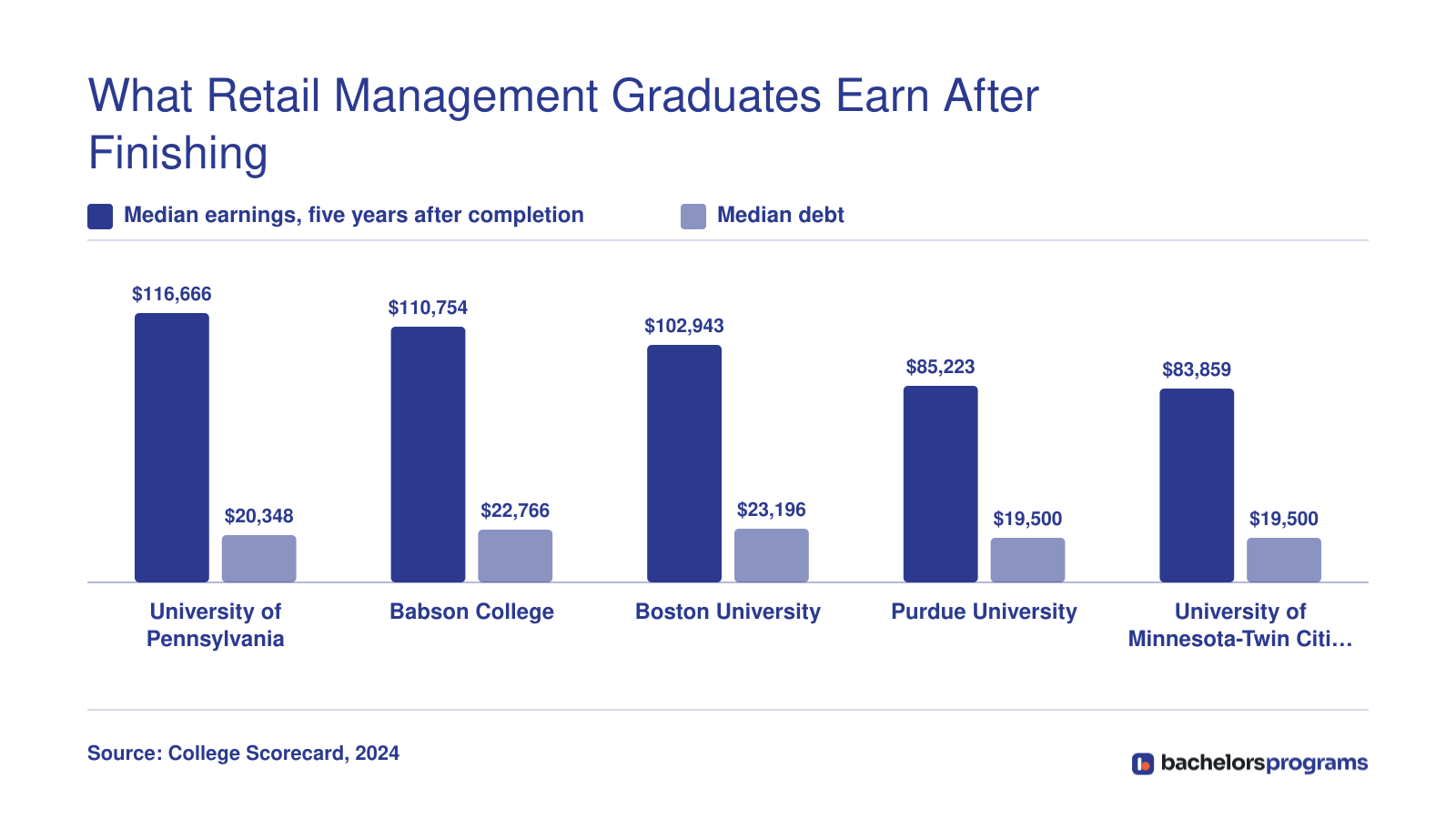
- Business management graduates earn $83,859 to $116,666 five years after finishing.
- Online options include UCF and Strayer, but internships can outweigh rank.
Best Retail Management Degree Programs at a Glance
The ten programs below balance cost against graduate earnings, student debt, and completion, so the strongest entries are not simply the cheapest ones. Each card lists the format, city and state, degree level, average net price, and any concentration, along with the details that shape day-to-day study.
Florida State University
#1Tallahassee, FL · ~$11,000/yr (est.)
Best for: Florida merchandising students wanting campus study
Florida State University runs its retail management major inside the B.S. in Marketing, pairing a full business core with coursework in consumer behavior, logistics, and supply chain management. The program is limited access, so students apply after completing 52 semester hours with at least a 2.90 GPA, which keeps the cohort focused and career-oriented. Tallahassee students also take professional selling, purchasing, and business analytics on the way to retail buyer and merchandising manager roles.
- 2.9 GPA minimum for admission
- Requires 52 completed semester hours
- Limited access program with prerequisite courses
- C- or better required in prerequisite coursework
- Professional development course required
- Cannot double major in marketing
- Covers consumer behavior, logistics, and strategic retail
- Electives in social media marketing and product innovation
University of Central Florida
#2Orlando, FL · ~$10,000/yr (est.)
Best for: Working adults needing online flexibility
The University of Central Florida delivers its retail management offering through a fully online Bachelor of Science in Lodging and Restaurant Management, aimed at service-sector operations and retail-adjacent management. Online students work with a personal success coach, can enroll part time or full time, and may finish in about two years after transferring an associate degree. The diploma does not distinguish online study from campus study, and Florida residents pay in-state online rates.
- 120 total credit hours
- Finish in as little as two years with an associate degree
- Offered fully online, part time or full time
- Personal success coach provided
- Diploma does not say online
- Taught by the same instructors as on-campus classes
- State college transfer partnerships in place
- One of more than 30 online bachelor's programs at UCF
Purdue University
#3West Lafayette, IN · ~$15,000/yr (est.)
Best for: Internship seekers targeting luxury brand retailing
Purdue University runs a dedicated retail management bachelor's that leans heavily on experiential learning, including a required internship and live business simulations. Coursework covers e-retailing, retail supply chain management, visual merchandising, and luxury brand management, with study abroad placements in Dublin, London, and Sydney. A one-year Fashion Institute of Technology option lets selected students earn an associate degree in New York City.
- 120 total credit hours
- 2.0 GPA minimum
- Internship required before graduation
- One-year Fashion Institute of Technology option in New York City
- Study abroad placements in Dublin, London, and Sydney
- Coursework in e-retailing and retail supply chain management
- Covers visual merchandising and luxury brand management
- LiveCase business simulations and hands-on projects
University of Pennsylvania
#4Philadelphia, PA · $29,000/yr (est. net price)
The University of Pennsylvania offers retailing through the Wharton School as a secondary concentration, designed to sit alongside a primary business concentration. Students combine core retailing courses with electives in product design, real estate, negotiation, and visual studies drawn from Wharton and the College of Arts and Sciences. A senior capstone and a structured plan of study round out one of the most selective business programs in the country.
- Secondary concentration only, paired with a primary concentration
- Senior capstone required
- Electives from Wharton and the College of Arts and Sciences
- Covers product design, real estate, negotiation, and visual studies
- Structured plan of study for students entering Fall 2026
- Interdisciplinary overview of the retailing industry
California State Polytechnic University-Pomona
#5Pomona, CA · $10,000 – $15,000/yr (est.)
Cal Poly Pomona teaches retail through its Fashion Design, Technology, and Management degree, whose Fashion Retailing option covers buying, digital commerce, brand marketing, and retail management. Students run Apparelscapes, the campus retail store, and can take internships with industry leaders, attend trade shows, and use advanced digital design labs. The Los Angeles County location puts students close to a major fashion and retail market.
- Fashion Retailing option includes retail management coursework
- Three concentration options within the department
- Students run Apparelscapes, the on-campus retail store
- Internships with industry leaders and trade show participation
- Coursework equivalent to two years of industry experience
- Advanced digital design labs
- Located in Los Angeles County
- Study abroad programs available
Texas A&M University-College Station
#6College Station, TX · ~$21,000/yr (est.)
Texas A&M University houses a strategic retailing track inside its marketing BBA, backed by the Center for Retailing Studies. Students study merchandising, retail financial planning, marketing analytics, and customer experience management, then test those skills in regional and national retailing competitions. Professional conferences and networking events connect students with retail employers well before graduation.
- Strategic Retailing track within the Marketing BBA
- Nationally recognized Center for Retailing Studies
- Compete in regional and national retailing campaign competitions
- Coursework in merchandising and retail financial planning
- Curriculum covers marketing analytics and customer experience
- Directed electives tailored to career goals
- Attend professional retailing conferences
University of Minnesota-Twin Cities
#7Minneapolis, MN · ~$17,000/yr (est.)
The University of Minnesota Twin Cities approaches retail from a design and business angle through its Retail and Consumer Studies BS, offered in partnership with the Carlson School. Concentrations cover visual merchandising, buying, consumer behavior, and global fashion retailing, and a required internship places students in a working retail setting. Learning abroad programs in Buenos Aires, Shanghai, and Barcelona add an international view.
- Five concentration options, including retail merchandising
- 120 total credit hours over four years
- Required retail internship
- Partnership with the Carlson School
- Annual National Retail Federation trip to New York City
- Learning abroad in Buenos Aires, Shanghai, and Barcelona
- Combines design thinking with business fundamentals
Strayer University-Florida
#8Tampa, FL · ~$16,000/yr (est.)
Strayer University offers a Bachelor of Business Administration with a retail management concentration, built for adults who need to keep working while they study. The concentration sits among 13 business options, and coursework is available online with employer tuition assistance and scholarship pathways. The university is accredited by the Middle States Commission on Higher Education.
- Retail Management concentration within the BBA
- 13 concentration options across business and finance
- Includes online coursework
- Employer tuition assistance supported
- Up to 32% tuition savings available
- Sophia general education courses can reduce cost
- Accredited by the Middle States Commission on Higher Education
University of Washington-Bothell Campus
#9Bothell, WA · ~$12,000/yr (est.)
The University of Washington Bothell offers a retail management concentration inside its Bachelor of Business Administration, layering four dedicated retail courses onto the business core. The curriculum covers merchandise acquisition, retail promotion, operations, and supply chain, with steady attention to emerging retail technologies. A business policy capstone and upper-division business coursework suit students who want a broad business degree with a retail specialty in the Seattle area.
- 90 total credit hours for the concentration
- Four specialized retail courses beyond the business core
- Business policy capstone required
- Focus on emerging retail technologies
- Prerequisites include organizational behavior and marketing management
- Minimum 1.7 grade in prerequisite courses
- 30 general elective credits
Millennia Atlantic University
#10Doral, FL · ~$27,000/yr (est.)
Millennia Atlantic University in Doral, Florida, offers a Bachelor of Science in Retail and E-Business Entrepreneurship built around launching and running retail ventures. The 120-credit degree splits into a general education core, an entrepreneurship core, and a retail concentration covering global sourcing, importing and exporting, supply chain logistics, and funding strategies. A capstone business concept pitch and at least 135 internship hours give students a portfolio before graduation.
- 120 total credit hours
- 36-credit general education core plus 54-credit entrepreneurship core
- 30-credit Retail and E-Business Entrepreneurship concentration
- Minimum 135 internship hours
- Capstone with business concept pitch
- In-person format over 48 to 60 months
- Coursework in global sourcing and import/export operations
Cost & outcomes by school
Federal data for the highest-earning Retail Management programs, independent of the ranking above. Earnings are this field's bachelor's graduates four years after completing where the Scorecard reports them, else the school's undergraduate median.
| School | Net price / yr | Grad rate | Earnings | Debt | Grads/yr | Format |
|---|---|---|---|---|---|---|
| University of Pennsylvania PA | $28,699 | 97% | $136,806 | $20,348 | 86 | Campus |
| Santa Clara University CA | $50,062 | 88% | $109,183 | $19,162 | — | Campus |
| Boston University MA | $24,402 | 89% | $108,412 | $23,196 | 812 | Campus |
| Babson College MA | $40,514 | 93% | $107,520 | $22,766 | 762 | Campus |
| Syracuse University NY | $38,793 | 84% | $91,472 | $27,000 | 123 | Campus |
| University of Minnesota-Twin Cities MN | $16,778 | 85% | $90,284 | $19,500 | 83 | Campus |
| Arizona State University AZ | $14,967 | 68% | $82,535 | $20,490 | 284 | Online |
| Arizona State University AZ | — | — | $82,535 | $20,490 | 516 | Online |
| Texas A&M University-College Station TX | $21,315 | 84% | $82,213 | $17,974 | 486 | Campus |
| The University of Tennessee-Knoxville TN | $18,976 | 74% | $82,074 | $19,500 | 681 | Campus |
| Purdue University IN | $14,600 | 83% | $81,040 | $19,500 | 213 | Campus |
| Marymount University VA | $29,137 | 54% | $80,196 | $25,000 | 53 | Campus |
Sources: U.S. Department of Education. Net price, graduation rate, earnings and debt: College Scorecard (earnings and debt for this field's bachelor's graduates where reported, else school-wide); graduates: IPEDS. A dash means no figure is reported.
Cost, debt & payoff
Median earnings of this field's bachelor's graduates (4 yrs after completing, else the school's undergraduate median) vs. their median federal loan debt · U.S. College Scorecard
Across these programs the median graduate earns about $64,131 and finishes with roughly $22,500 in debt — a ratio that clears a common rule of thumb (keep debt below first-year salary). Net price and debt vary widely school to school, so check the per-school figures in the table above before you shortlist.
How We Ranked These Retail Management Programs
A well-known name and a strong return on investment are not the same thing, and this ranking leans toward the second. Reputation alone will not move a school up the list.
What We Measured
- Net price: the average student cost remaining once grants and scholarships are applied.
- Graduate earnings: what people who finished the specific program earn.
- Median federal debt: what graduates typically owe.
- Completions: how many students earn the degree in the field.
- Graduation and retention: how many students at the institution finish and return after year one.
- Selectivity: how competitive admission is.
Data comes from the U.S. Department of Education College Scorecard and IPEDS, using the latest available snapshot.
Why Value Comes First
Earnings relative to debt carry more weight than reputation. A program that leaves graduates earning solidly with manageable loans can outrank a costlier school with a bigger brand. For retail management, where starting pay often depends on the role rather than the diploma, that balance matters.
Online, campus, and hybrid programs are judged on equal footing. Format does not raise or lower a school's position.
Limits Worth Knowing
Net price is an institution-wide average after aid, so it reflects the whole school, not only retail management students. Your own cost depends on your aid package and living situation.
Some programs graduate too few students for earnings to be published. Where that happens, we relied on the measures that were available rather than guessing. Treat the rankings as a starting point, then check each school's current numbers before you apply.
Retail Management Degree Cost: The Three Lowest-Priced Programs
According to 2024 IPEDS and College Scorecard data, Chipola College ($1,133), Cal State LA ($3,967) and UTEP ($9,403) post the lowest average net price after aid of the schools ranked here. Net price is what students typically pay once grants and scholarships are subtracted, and it falls below published in-state tuition at all three schools, most sharply at Chipola, where aid cuts the $3,120 sticker price by nearly two-thirds. Campus students moving across state lines should budget from the out-of-state column, which runs from $8,950 at Chipola to $25,502 at UTEP. Where program debt is reported, typical borrowers owe $13,000 at Cal State LA (about $138 a month over 10 years) and $16,656 at UTEP (about $177 a month).
| School | Program | Format | Average Net Price After Aid | Published In-State Tuition | Published Out-of-State Tuition | Median Program Debt | Median 10-Year Monthly Loan Payment |
|---|---|---|---|---|---|---|---|
| Chipola College (Marianna, FL) | Business Administration, Management concentration | Campus | $1,133 | $3,120 | $8,950 | N/A | N/A |
| California State University-Los Angeles (Los Angeles, CA) | Business Administration, B.S.: Option in Retailing | Campus | $3,967 | $7,160 | $19,760 | $13,000 | $138 |
| The University of Texas at El Paso (El Paso, TX) | Minor in Retailing and Sales | Campus | $9,403 | $9,744 | $25,502 | $16,656 | $177 |
What Retail Management Graduates Earn After Finishing
Graduates of the business administration and management field of study that houses each of these retail programs earned medians of $83,859 to $116,666 five years after completion, compared with typical debt of $19,500 to $23,196. Even at the lower end, early-career pay runs more than four times median debt, and the typical 10-year repayment lands around $207 to $246 a month. On those numbers, a retail management degree from these schools looks worth the borrowing, especially at Purdue and Minnesota, where in-state tuition keeps debt near the bottom of the range.
Online vs. Campus Retail Management Degrees
Can you finish a retail management bachelor's degree online and still land the store-level internship that retail employers ask about in interviews?
Most programs ranked here are campus-based, while the online options, such as UCF's and Strayer University's, teach the same coursework as their classroom counterparts. Delivery mode changes the experience more than it changes the diploma.
Credits and transfer limits
Arizona State University's online business degree with a retail management concentration and American Public University's retail management area of study both require 120 credits, the standard for a four-year bachelor's. Online business degrees with a retail or sales-management focus generally follow that same 120-credit, four-year pattern. APU accepts up to 90 transfer credits, leaving roughly a quarter of the degree to finish.1 ASU transfer applicants who bring prior college coursework need a 3.0 cumulative transfer GPA.
The campus trade-off
Online study suits people already working retail hours. Shift changes, promotions, and store transfers do not force a semester off. Campus programs make internships, retail labs, and recruiter events easier to reach. Cal Poly Pomona, for example, runs an on-campus store, Apparelscapes, where merchandising students work with real inventory.
Major or concentration?
A major and a concentration are not interchangeable. Purdue, Florida State, and the University of Minnesota offer retail as a full major. Elsewhere it is a concentration or track inside a business degree: ASU's BA in Business, UW-Bothell's business administration concentration, and Texas A&M's strategic retailing track. A concentration gives you a broader business credential with retail depth; a major goes deeper into merchandising and buying.
Credit for what you already know
APU accepts eligible prior college coursework, professional training, exams, and certifications, all counted within its 90-credit transfer limit.1 Policies vary by university, so ask an admissions counselor whether your retail work history qualifies for credit.
Related Articles
Retail Buyer Pay at a Glance
For retail management graduates who move from the sales floor into merchandising, buying roles carry one of the strongest paydays in the field.
How to Choose and Apply to a Retail Management Program
Admission rules differ widely among the programs below, so check these points before you apply.
- Confirm accreditationVerify the school's institutional accreditation first, then ask whether its business school holds separate business accreditation, such as AACSB. Both affect how employers and graduate schools view your degree.
- Know the admission requirementsArizona State University admits first-year students who meet one route: a 3.0 GPA, a top-25% class rank, or SAT (1120/1180) or ACT (22/24) cutoffs that depend on residency. ASU is not test-optional. Program-level minimums also apply elsewhere. Florida State's limited-access major lists a 2.9 GPA, and Purdue lists 2.0.
- Track start datesASU Online runs multiple sessions, and its next listed start is January 11, 2027. Confirm fall and spring deadlines directly with campus programs.
- Check transfer rules and credit limitsDirect transfers into ASU's W. P. Carey School need a 3.0 transfer GPA, minimum grades in required tracking courses and a second major outside W. P. Carey. Ask each school whether it awards credit for retail work experience. Find out how many transfer credits it accepts.
- Compare cost against debtRun each school's net price calculator. Then compare your estimate with median program debt, which ranges from $13,654 at UW Bothell to $20,348 at Penn.
- Verify internship accessPurdue and Minnesota require a retail internship, and Millennia Atlantic requires at least 135 internship hours. Confirm that your concentration offers similar access.
Retail Management programs by state
Retail Management Degree FAQs
These answers draw on federal occupational data and general guidance. Treat figures as typical ranges, since pay, credit policies and hiring requirements vary by employer and school.
Is a retail management degree worth it?
What is the best degree for retail management?
Can I become a store manager without a degree?
Can my retail work experience count toward a retail management degree?
Compare Retail Management programs on the data that matters
Explore more Business & Management majors or browse every field of study.
All Business & Management programs Browse every field of study