Best Mental Health Counseling Degree Programs
Compare 24 accredited Mental Health Counseling programs at 19 colleges, with net price after aid, graduation rates, earnings and debt from IPEDS and the U.S. College Scorecard.

A bachelor's degree in mental health counseling qualifies you for entry-level behavioral health work, but it never leads directly to a counselor's license. Every program ranked here is an undergraduate bachelor's program, not a graduate one.
Most graduates start as behavioral health technicians or human service assistants. Licensure as a counselor requires a master's degree plus supervised clinical hours.
Average annual net price ranges from $6,007 to $18,885, and programs differ as much in field placement as in curriculum.
Key Points
- Public net prices run from $6,007 (Pikes Peak) to $15,634 (WVU).
- Capella, Arizona State, and Pueblo Community College offer fully online options.
- Counselor licensure demands graduate study, supervised practice, and passing a national exam.
Best Schools for a Bachelor's Degree in Mental Health Counseling: 2027 Rankings
Each school here earned its place by balancing what students actually pay, how many finish, and where graduates land afterward. The list runs from large public universities to community colleges granting applied bachelor's degrees and fully online options, so a reader can weigh a residential campus against a program completed from home. Costs shown are average net prices after aid and will differ from household to household.
West Virginia University
#1Morgantown, WV · ~$16,000/yr (est.)
Best for: Campus-based students wanting a hands-on capstone
West Virginia University's Bachelor of Arts in Counseling and Mental Health sits in the College of Applied Human Sciences and pulls together counseling, psychology, sociology, and family studies. A capstone pairs a research paper and poster presentation with a service-learning placement, and students add minors such as addiction studies, aging, or disability studies. The university graduates about 65% of students and the average net price after aid is near $15,600, though what a given household pays varies; classes meet on campus in Morgantown.
- Capstone combines a research paper, poster session, and field placement
- Minors in addiction studies, aging, disability, wellness, cultural studies
- Ohio residents admitted to the major pay in-state tuition
- Prepares graduates for CACREP-accredited clinical mental health master's work
- Campus-based in Morgantown; first program of its kind in West Virginia
New Mexico State University
#2Las Cruces, NM · $8,000 – $25,000/yr (est.)
Best for: Working adults who need a fully online option
New Mexico State University awards a Bachelor of Science in Counseling and Community Psychology built around case management, human behavior, and multicultural practice. The degree runs on the Las Cruces campus and fully online through NMSU Global, making it one of the few programs here with a true distance pathway. About 55% of university students finish a degree and the average net price after aid is near $8,900, a figure that shifts with family income and state aid, and a capstone internship closes out the program.
- 120 credits across 40 courses, full-time or part-time
- Capstone internship in a clinical or research setting
- Double major option available
- Coursework supports New Mexico Substance Abuse Associate licensure
- Strong focus on multicultural awareness and human behavior
- 100% online, asynchronous classes through NMSU Global
- $395 per credit in the online format
- Military benefits accepted alongside federal aid and scholarships
- Internship opportunities built into the online degree
- Higher Learning Commission accredited
Thomas College
#3Waterville, ME · $19,000/yr (est. net price)
Best for: Accelerated learners aiming to finish in three years
Thomas College is a small private college in Waterville, Maine, where a Bachelor of Arts in Psychology with a mental health concentration centers on counseling theories, marriage and family work, and addiction. The 121-credit degree can be finished in three years, and internships plus leadership development are built in. The college graduates about 54% of students and the average net price after aid is roughly $18,900 depending on household, with all classes on campus.
- 121 credits, with a three-year completion option
- Core courses in counseling theories, marriage and family, helping-professional wellness
- Electives include Drugs, Addiction and Crime and Child Psychology
- Internships and leadership development built into the curriculum
- Prepares for entry-level behavioral health, child welfare, and hospice roles
Pikes Peak State College
#4Colorado Springs, CO · $5,000 – $10,000/yr (est.)
Pikes Peak State College in Colorado Springs offers an applied bachelor's in behavioral health for students who arrive with an associate degree and want to move into mental health and wellness work. Two emphasis areas point students toward mental health and social work or addiction recovery, and the format blends online coursework with campus sessions. The college graduates about 21% of students and the average net price after aid lands near $6,000, among the lowest here, with service-learning placements and prior learning assessment credit available.
- Hybrid format mixing online coursework with campus sessions
- Emphasis areas in mental health and social work or addiction recovery
- Requires an associate degree before entry to the BAS
- 5 clinical hours; no thesis or capstone required
- Service-learning placements and prior learning assessment credit
Metropolitan State University of Denver
#5Denver, CO · $15,000/yr (est. net price)
Metropolitan State University of Denver houses a human services major with a mental health counseling concentration inside a program accredited by the Council for Standards in Human Service Education. Field placements send students into group homes, domestic violence shelters, homeless programs, and behavioral health agencies while coursework covers trauma-informed care, cognitive behavior therapy, and ethics. About 32% of university students complete a degree and the average net price after aid is roughly $15,300; classes are on campus in downtown Denver.
- Accredited by the Council for Standards in Human Service Education
- Field placement and internship across shelters, group homes, agencies
- Coursework in trauma counseling, cognitive behavior therapy, psychopathology
- 120 credits with a capstone and 8 clinical hours
- Prepares students for graduate counseling programs and licensure
Pueblo Community College
#6Pueblo, CO · ~$12,000/yr (est.)
Pueblo Community College delivers its applied bachelor's in behavioral health entirely online, with a mental health and wellness pathway for students heading into clinical and community settings. Coursework covers addiction and substance abuse, counseling techniques, group dynamics, trauma, and whole person care, and a capstone internship adds supervised field time. The college graduates about 31% of students and the average net price after aid is close to $12,000, which means students across Colorado can keep working while they finish.
- Fully online applied bachelor's in behavioral health
- Capstone includes a supervised mental health internship
- Covers addiction, counseling techniques, group dynamics, and trauma
- 120 credits with 3 clinical hours
- Electives let students tailor the degree to career goals
Community College of Denver
#7Denver, CO · ~$9,000/yr (est.)
Community College of Denver offers a behavioral health bachelor's with an emphasis in mental health and social work for students who want to work directly with clients. The 120-credit program covers psychopathology, trauma and PTSD treatment, crisis intervention, motivational interviewing, and case management, and a mental health internship supplies supervised practice. The college graduates about 20% of students and the average net price after aid is roughly $9,500, with classes meeting on campus in Denver.
- Mental health internship built into the 120-credit program
- Covers psychopathology, trauma and PTSD, and crisis intervention
- Training in motivational interviewing and case management
- Maps toward Colorado addiction counseling credentials
- Emphasis combines social work foundations with counseling practice
Capella University
#8Minneapolis, MN · $15,000 – $20,000/yr (est.)
Capella University is a fully online institution, and its bachelor's in psychology with a pre-counseling and therapy focus is built for adults who intend to continue into graduate counseling study. Students add a concentration in clinical mental health counseling or school counseling and complete three master's-level courses before finishing the bachelor's. The university graduates about 20% of students and the average net price after aid is near $18,000; terms run 10 weeks and no entrance exam is required.
- Fully online with 10-week quarter terms
- Concentration in clinical mental health or school counseling
- Three master's-level courses included in the bachelor's
- 180 quarter credits; up to 135 transfer credits accepted
- No entrance exam and a $0 application fee
Arizona State University
#9Scottsdale, AZ
Arizona State University's online Bachelor of Science in Counseling and Applied Psychological Science was the first of its kind at a major research university and runs in 7.5-week terms. Students complete 40 courses plus a 135-hour supervised capstone with community behavioral health specialists, and the diploma does not note the online format. A 3.0 GPA is required for admission and no entrance exam is needed; the university's counseling training center also connects the program to supervised clinical services across Arizona.
- Fully online, 120 credits across 40 courses
- 135-hour supervised capstone with community behavioral health specialists
- 7.5-week terms; no entrance exam required
- Diploma does not say the degree was earned online
- Requires a 3.0 GPA for admission
- Focus on military psychology and counseling for veterans
- Prepares for roles inside the VA system
- Hands-on internship required
- Single spring start date each year
- 45 clinical hours focused on substance abuse treatment
- Prepares for the Licensed Addiction Counselor Technician credential
- Rolling admissions with multiple online start dates
- No capstone or thesis required for this track
Sinte Gleska University
#10Mission, SD · ~$13,000/yr (est.)
Sinte Gleska University, a tribal college in Mission, South Dakota, offers a Bachelor of Arts in human services with a mental health concentration and weaves Lakota language, culture, history, and Wolakota philosophy through the coursework. Graduates move into social services, mental health, law enforcement, courts, corrections, and substance abuse programs, and field work requires background checks and liability insurance. About 15% of university students finish a degree and the average net price after aid is roughly $12,800, with classes held on campus.
- Lakota language, culture, history, and Wolakota woven into coursework
- Seven courses with primary focus on Lakota topics
- Prepares for jobs in social services, mental health, and corrections
- Background check and liability insurance required for field work
- Human services minor available
Cost & outcomes by school
Federal data for the highest-earning Mental Health Counseling programs, independent of the ranking above. Earnings are this field's bachelor's graduates four years after completing where the Scorecard reports them, else the school's undergraduate median.
| School | Net price / yr | Grad rate | Earnings | Debt | Grads/yr | Format |
|---|---|---|---|---|---|---|
| Charles R Drew University of Medicine and Science CA | $35,558 | 30% | $83,438 | $18,750 | — | Campus |
| Arizona State University AZ | — | — | $62,668 | $19,500 | — | Online |
| Fairleigh Dickinson University NJ | $22,829 | 67% | $57,273 | $25,000 | — | Campus |
| Eastern Connecticut State University CT | $21,067 | 58% | $56,469 | $24,250 | — | Campus |
| West Virginia University WV | $15,634 | 65% | $55,939 | $22,500 | 19 | Campus |
| Avila University MO | $16,053 | 52% | $52,773 | $25,000 | — | Online |
| Metropolitan State University of Denver CO | $15,327 | 32% | $52,093 | $21,500 | — | Campus |
| Waldorf University IA | $19,693 | 21% | $51,165 | $18,752 | — | Online |
| Thomas College ME | $18,885 | 54% | $44,991 | $24,250 | 9 | Campus |
| Capella University MN | $17,956 | 20% | $42,189 | $14,968 | — | Online |
| Pikes Peak State College CO | $6,007 | 21% | $40,796 | $9,000 | — | Hybrid |
| Coker University SC | $20,286 | 40% | $40,117 | $26,000 | — | Hybrid |
Sources: U.S. Department of Education. Net price, graduation rate, earnings and debt: College Scorecard (earnings and debt for this field's bachelor's graduates where reported, else school-wide); graduates: IPEDS. A dash means no figure is reported.
Cost, debt & payoff
Median earnings of this field's bachelor's graduates (4 yrs after completing, else the school's undergraduate median) vs. their median federal loan debt · U.S. College Scorecard
Across these programs the median graduate earns about $43,590 and finishes with roughly $21,500 in debt — a ratio that clears a common rule of thumb (keep debt below first-year salary). Net price and debt vary widely school to school, so check the per-school figures in the table above before you shortlist.
Our Scoring Method: Cost, Completion, Earnings, and Format
College Scorecard publishes earnings and federal debt for individual fields of study at each school, and that program-level detail drives the comparisons that follow. We looked at five factors: average net price after aid, the school's graduation rate, program-level earnings and debt, admissions selectivity, and whether the degree is offered online, on campus, or hybrid. We did not assign percentage weights to any of them.
Program-level figures matter more than school-wide averages because a university's overall numbers blend engineering, nursing, and business graduates with everyone else. A counseling-related major can look very different from that blend. Some programs have no published earnings or debt because too few graduates were reported, so those schools are judged on the factors that are available.
Only regionally (institutionally) accredited schools with a counseling-related bachelor's appear on the list.
The method has limits. Graduation rate describes the whole institution, not the counseling major. Net price averages across all aided students, so your own cost could land higher or lower depending on your aid package. Use the list to narrow your search, then confirm figures with each school.
Related Articles
Online vs. On-Campus vs. Hybrid Mental Health Counseling Degrees: Schedules and Field Experience
Delivery format shapes your weekly schedule and your field placement far more than it shapes the value of the diploma. Most programs below are campus-based, a few are fully online (Pueblo Community College, Capella University, Arizona State University), and Pikes Peak State College blends the two.
Live Sessions vs. Self-Paced Work
Most online bachelor's programs run asynchronously, so you complete lectures and discussion posts on your own timeline. Some add live sessions. East Tennessee State University's online human services degree is mostly asynchronous with optional synchronous components. Always ask admissions how many live meetings a course requires before you enroll.
Internships and Field Experience
Hours vary widely, and many schools do not publish them. East Tennessee State lists 350 field hours spread across the curriculum, mostly in senior year.1 Arizona State's online program lists 135 clinical hours. Others, such as the University of Cincinnati and New Mexico State University Global Campus, build in a 3-credit internship without stating hours.2 Few schools state online whether they arrange your placement or expect you to find a local site, so confirm it, along with any agency approval rules in your state.
Transfer Credits as a Cost Lever
Transfer policy can cut more time and tuition than any format choice. Southern New Hampshire University and the University of Cincinnati accept up to 90 transfer credits, while Liberty University and Purdue Global allow up to 75 percent of the degree.3 Capella advertises up to 135 credits toward its 180-credit degree. Most schools still require a minimum number of credits earned in residence.
Who Each Format Suits
- Online: Working adults and career changers who need flexible scheduling and can line up a local placement.
- On-campus: Students who want faculty mentorship and strong recommendation letters for graduate school.
- Hybrid: Learners who want some in-person contact without a full commute.
How Much Does a Mental Health Counseling Degree Cost? Net Price, Debt, and Monthly Payments
Public schools here post average annual net prices from $6,007 at Pikes Peak State College to $15,634 at West Virginia University, while private options run from $16,053 at Avila University to $18,885 at Thomas College, so even the highest-priced public choice costs less per year than the lowest-priced private one. Net price is an average yearly cost after grants and scholarships, drawn from U.S. Department of Education IPEDS and College Scorecard data (2024), and what you actually pay will depend on your household income and how many transfer credits you bring in. At New Mexico State University, graduates of the program finish with a median debt of $24,421, or about $259 a month on a 10-year repayment plan.
| School | State | Sector | Format | Average Net Price (per year) | Median Program Debt at Completion | Median Monthly Payment (10-Year Plan) |
|---|---|---|---|---|---|---|
| Pikes Peak State College | CO | Public | Hybrid | $6,007 | ||
| New Mexico State University | NM | Public | On-campus | $8,889 | $24,421 | $259 |
| Community College of Denver | CO | Public | On-campus | $9,450 | ||
| Pueblo Community College | CO | Public | Online | $12,045 | ||
| Sinte Gleska University | SD | Public | On-campus | $12,768 | ||
| Metropolitan State University of Denver | CO | Public | On-campus | $15,327 | ||
| West Virginia University | WV | Public | On-campus | $15,634 | ||
| Avila University | MO | Private nonprofit | Online | $16,053 | ||
| Capella University | MN | Private for-profit | Online | $17,956 | ||
| Thomas College | ME | Private nonprofit | On-campus | $18,885 |
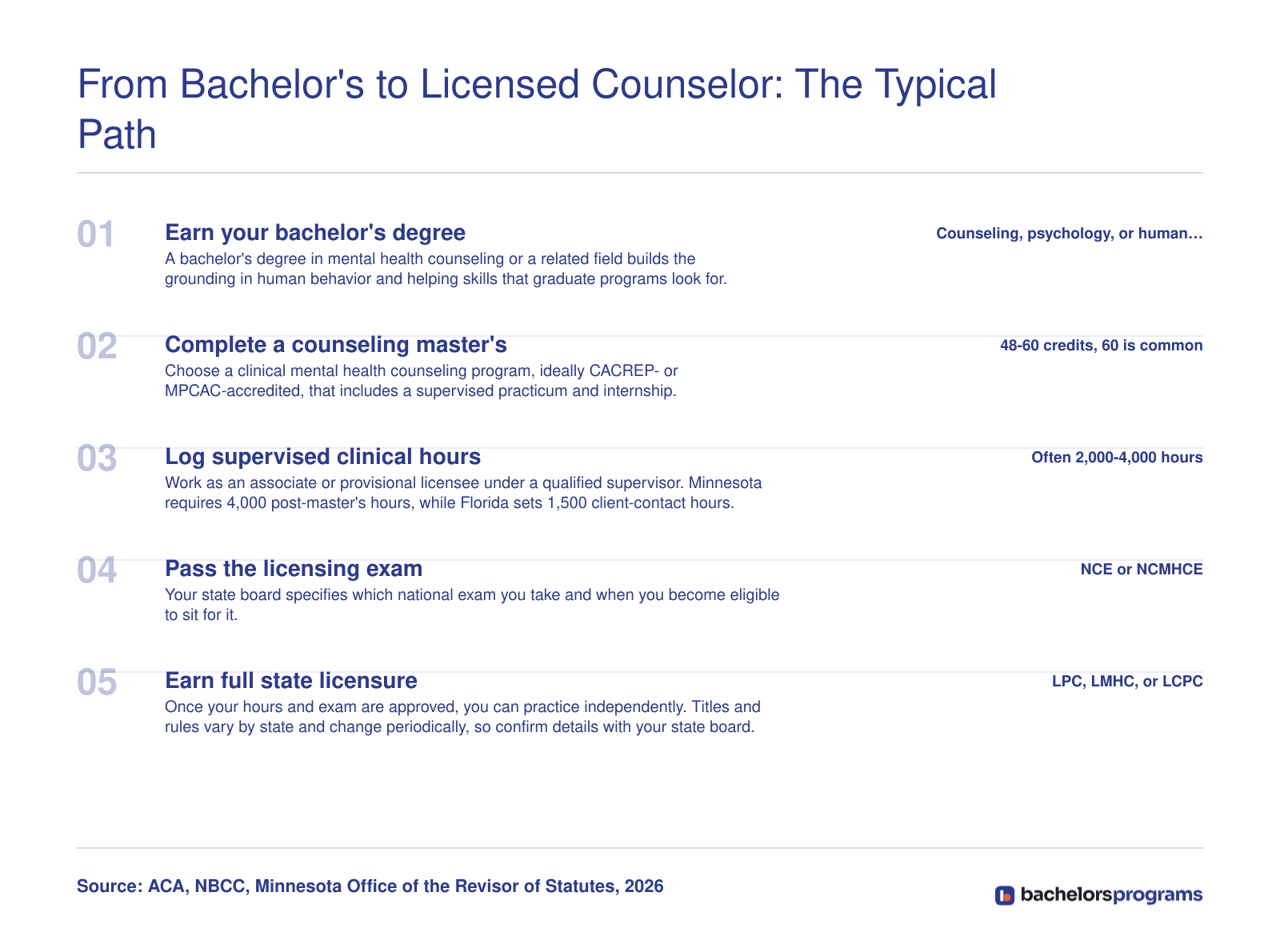
From Bachelor's to Licensed Counselor: The Typical Path
A bachelor's degree is the first step toward becoming a licensed mental health counselor, not the last. Most of the path runs through graduate study, supervised practice, and a national exam. Requirements vary by state, so check with your state counseling board before you plan.
What Licensed Mental Health Counselors Earn
Social and Human Service Assistant Pay at a Glance
Licensure as a counselor requires graduate study, so many bachelor's graduates start their careers in support roles.
Checklist for Picking Your Program: Accreditation, Credits, and a Route to Grad School
Use these checks to compare any bachelor's degree in mental health counseling before you apply.
- Institutional accreditationConfirm the school holds institutional (regional) accreditation. It affects federal financial aid eligibility and whether graduate programs will accept your degree.
- CACREP and MPCAC scopeCACREP accredits master's and doctoral counseling programs, and MPCAC accredits master's programs in counseling and psychology. Neither accredits bachelor's majors, so their absence at this level is normal. They matter when you choose a master's, which licensure requires.
- 4+1 or combined pathwaysSome schools let you start graduate coursework as an undergraduate. These tracks usually set a minimum GPA and prerequisites that vary by school. For CACREP programs, only graduate-level courses count toward the required curriculum.
- Transfer and prior learning creditAsk how many credits transfer and whether work or military experience earns credit.
- Field placement supportCheck whether the program arranges internships or leaves you to find your own site.
- Part-time and online optionsConfirm part-time enrollment and online courses fit your schedule.
- Selectivity and completionCompare admission rates and graduation rates in the rankings above to judge your odds of finishing.
Mental Health Counseling programs by state
Quick Answers Before You Compare Programs
A bachelor's degree is the starting point, not the finish line, for counseling licensure. These answers cover what comes after graduation so you can judge each program below with the full path in mind.
Can you become a mental health counselor with just a bachelor's degree?
How long does it take to go from a bachelor's degree to a licensed counselor?
Which exams do counselors take for licensure?
Compare Mental Health Counseling programs on the data that matters
Explore more Counseling majors or browse every field of study.
All Counseling programs Browse every field of study