Best Online Public Health Degree Programs
Compare 120+ accredited online Public Health programs, with net price after aid, graduation rates, earnings and debt from IPEDS and the U.S. College Scorecard.

"Online" has become one of the loosest labels in public health education, and plenty of programs marketed that way still expect campus immersions or hybrid coursework. Every program ranked here can be finished without setting foot on campus. Published tuition runs from $5,776 at the University of West Florida to $68,322 at Northwestern University.
The ranked programs are bachelor's degrees, but several feed directly into graduate study. UWF and UAB offer accelerated bachelor's-to-MPH options, and WGU has a bridge into its Master of Public Health.
Fully online still rarely means zero fieldwork. UAB requires experiential learning, and UWF builds applied practice into the community where you live.
Key Points
- Every ranked program is a bachelor's completed fully online, no campus visits.
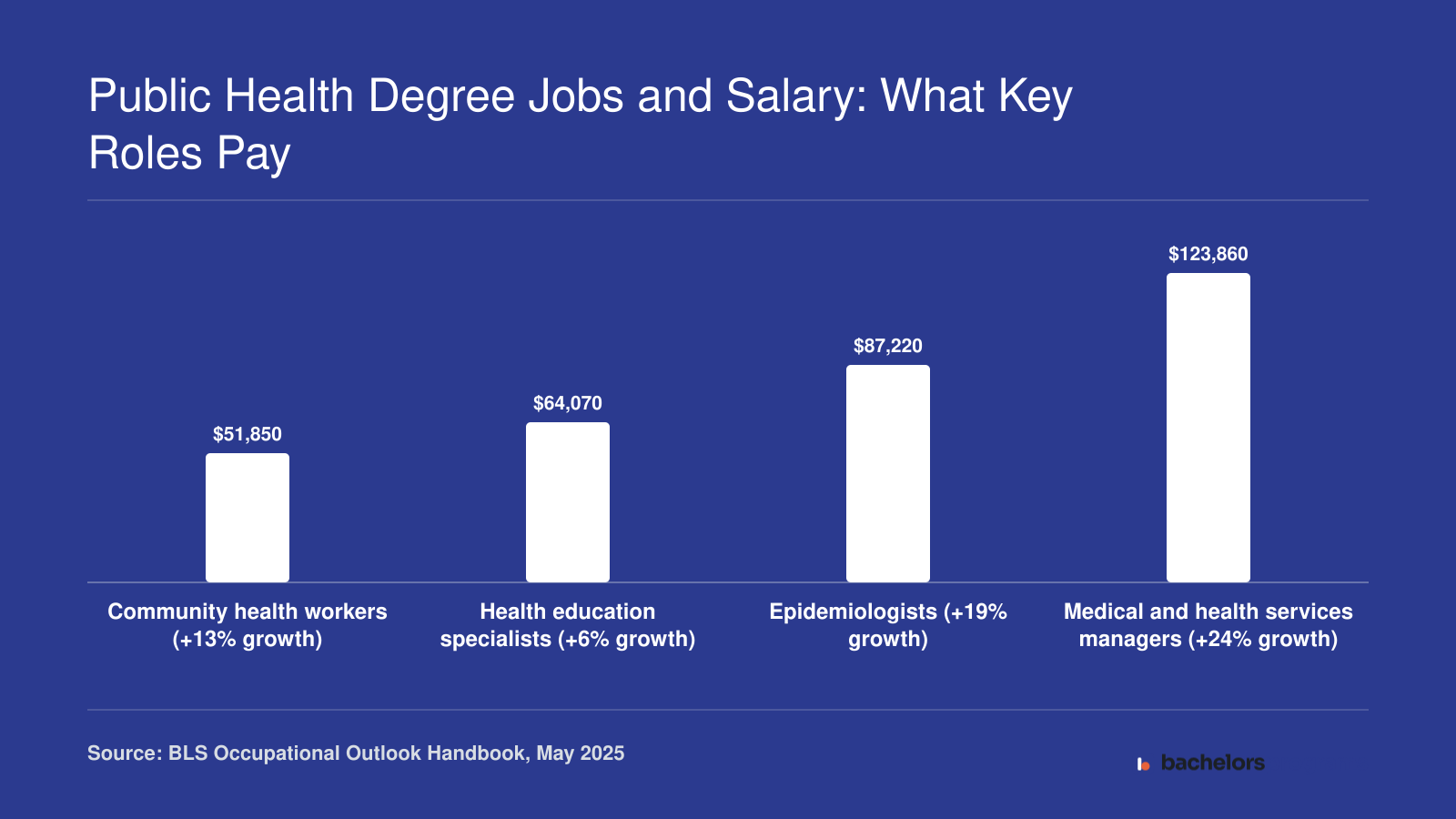
- Medical and health services managers earned a $123,860 median (BLS May 2025).
- The CPH exam accepts any bachelor's plus 5 years' public health experience.
The 10 Best 100% Online Public Health Degree Programs for 2027
Every program below is a bachelor's degree that can be completed entirely online, with no required campus visits and no hybrid coursework. Fully online delivery was the entry requirement for this list, so programs that blend in-person classes with online coursework were set aside even when they are otherwise strong. What separates the ten programs here is the mix of concentration options, transfer credit, pacing, and the accreditation standing behind the degree.
University of South Florida
#1Tampa, FL · ~$10,000/yr (est.)
Best for: Students wanting flexible concentration options
The University of South Florida houses its public health bachelor's inside a CEPH-accredited college, the first of its kind in Florida, and students can complete the entire degree online. Core coursework runs through epidemiology, biostatistics, environmental health, and global health, with major electives opening concentrations in global health, nutrition, environmental health, or infection control. Graduates move into health educator, environmental health specialist, disease intervention, and health inspector roles. The school's overall graduation rate is 77%.
- CEPH-accredited College of Public Health
- Four concentration options through major electives
- Concentrations include global health, nutrition, environmental health, infection control
- First Bachelor in Public Health in Florida
- Core covers epidemiology, biostatistics, and public health policy
- Prepares for health educator, environmental health specialist, inspector roles
San Jose State University
#2San Jose, CA · ~$14,000/yr (est.)
Best for: Transfer students with 60 completed credits
San Jose State's public health bachelor's is a fully online degree completion track for students who already hold about 60 transferable units. Courses run in eight-week terms with both synchronous and asynchronous sections, and the curriculum puts heavy emphasis on documenting and closing health disparities. Students and employers see the same faculty and coursework that anchor the campus program. The school's overall graduation rate is 69%.
- Fully online degree completion for students with 60+ transferable units
- Eight-week courses across five terms per year
- Synchronous and asynchronous sections available
- Core covers epidemiology, biostatistics, health policy, environmental health
- Curriculum emphasizes eliminating health disparities
- Capstone and leadership series required
- Same faculty and curriculum as the on-campus program
American Public University System
#3Charles Town, WV · $5,000 – $10,000/yr (est.)
Best for: Military learners needing monthly start dates
American Public University System runs public health classes on monthly starts, which suits adults who need to begin at any point in the year rather than wait for a fall term. The university accepts up to 90 transfer credits, includes textbooks at no cost, and staffs the program with working public health professionals and first responders. Four concentrations let students aim at emergency and disaster management, nutrition and wellness, public health informatics, or a general track. The school's overall graduation rate is 57%.
- Concentrations in emergency management, nutrition, informatics, general track
- Up to 90 transfer credits accepted toward the 120-credit degree
- Monthly class starts; courses run 8 to 16 weeks
- No application fee and textbooks included at no cost
- Faculty include working public health professionals and first responders
- Senior capstone seminar required after 105 credits
University of West Florida
#4Pensacola, FL · $5,000 – $10,000/yr (est.)
The University of West Florida delivers its public health bachelor's entirely online, with eight- and 16-week course options and a capstone built around a real community health problem. The curriculum is organized around the Council on Linkages competency framework, so epidemiology, health equity, occupational safety, and disaster response sit inside one applied practice structure. An accelerated path into the university's MPH lets strong students start graduate credits early. The school's overall graduation rate is 59%.
- 100% online, 120 credit hours, typically 48 months
- Eight- and 16-week course options
- Built on the Council on Linkages competency framework
- Applied practice in community settings plus a capstone
- Accelerated B.S. to MPH pathway
- Covers health equity, occupational safety, and disaster response
Western Governors University
#5Salt Lake City, UT · ~$13,000/yr (est.)
Western Governors University is self-paced and competency-based, so students move through the 33-course public health curriculum as fast as they can demonstrate mastery of each subject. Tuition is charged as a flat rate per six-month term rather than per credit, and admission is rolling with no entrance exam. A bridge pathway lets four bachelor's-level courses count toward the university's Master of Public Health. The school's overall graduation rate is 46%.
- Competency-based, self-paced, fully online
- 33 courses including a capstone
- Flat tuition per six-month term instead of per credit
- Rolling admissions; no entrance exam
- Bridge pathway into WGU's Master of Public Health (four courses)
- Associate degree holders may clear roughly 14 courses by transfer
- Curriculum built with public health industry experts
University of Alabama at Birmingham
#6Birmingham, AL · $19,000/yr (est. net price)
UAB's online public health bachelor's comes out of the only CEPH-accredited school of public health in Alabama, and online students earn the same diploma as their campus peers. The program is Quality Matters certified and requires an experiential learning component such as an internship or field placement. An accelerated bachelor's-to-MPH option lets undergraduates bank up to 12 graduate credits before finishing. The school's overall graduation rate is 64%.
- CEPH-accredited school, the only one in Alabama
- Quality Matters certified online courses
- Experiential learning component such as internship or field placement
- Accelerated bachelor's to MPH with up to 12 graduate credits
- Online students earn the same diploma as campus peers
- Public Health concentration
Northwestern University
#7Evanston, IL · $29,000/yr (est. net price)
Northwestern's School of Professional Studies offers an online Bachelor of Science in Health Sciences with a public health concentration, built for working adults who want health policy and community health credentials without pausing their careers. The 45-unit degree includes a capstone and room for an elective certificate in an area such as data science or leadership. Coursework leans on health disparities, program evaluation, and applied research skills. The school's overall graduation rate is 95%.
- 45-unit degree with a required capstone
- Concentration coursework in epidemiology, biostatistics, social determinants
- Complete an elective certificate outside the major, e.g. data science
- Conferred by the School of Professional Studies
- Designed for working adults; no minors available for BS degrees
- Three concentration options across the health sciences degree
The University of Texas at Arlington
#8Arlington, TX · ~$14,000/yr (est.)
UT Arlington offers its public health bachelor's in a fully online accelerated format alongside the campus version, with a required internship and more than 20 hours of electives for tailoring the degree. The accelerated online track is limited to Texas residents, which makes it a strong in-state option and unavailable to everyone else. Coursework spans epidemiology, biostatistics, health policy, and community education, with service and team-based learning built in. The school's overall graduation rate is 54%.
- Fully online Accelerated Online option plus a campus format
- 20+ hours of electives for tailoring the degree
- Required internship in a public health setting
- Accelerated online track limited to Texas residents
- Coursework in epidemiology, biostatistics, and community education
- Maverick Advantage Distinction available
University of North Carolina at Greensboro
#9Greensboro, NC · $11,000/yr (est. net price)
UNC Greensboro's public health education bachelor's is an online degree completion program built for adults who already hold an associate's or bachelor's degree. The Health Studies concentration covers the social and behavioral sciences, epidemiology, public health statistics, and health policy and administration. Faculty are active in research, and no campus relocation is required at any point. Graduates head into government, nonprofit, and community health organizations or continue to graduate study. The school's overall graduation rate is 56%.
- Online degree completion; prior associate's or bachelor's required
- Core includes epidemiology, public health statistics, health policy
- Health Studies concentration in the social and behavioral sciences
- No campus relocation required
- A.A.S. degrees do not satisfy the prior-degree requirement
- Prepares for government, nonprofit, and community health roles
Arkansas State University
#10Jonesboro, AR · $8,000 – $15,000/yr (est.)
Arkansas State University offers its public health bachelor's both on campus and online, with 120 credit hours spanning epidemiology, health education, and healthcare systems. Faculty have served in major U.S. health agencies, and the program feeds into roles such as biostatistician, community health worker, epidemiologist, health educator, and health administrator. Admission runs on a 3.0 GPA standard for first-year students and 2.0 for transfer students, with a single August entry each year. The school's overall graduation rate is 55%.
- 120 credit hours; offered on campus and online
- Coursework in epidemiology, health education, and healthcare systems
- Faculty have served in top U.S. health agencies
- 3.0 GPA required for first-year admission; 2.0 for transfer students
- ACT or SAT scores required; $30 application fee
- August entry each year
- Target roles: biostatistician, epidemiologist, health educator
Cost & outcomes by school
Federal data for the highest-earning Public Health programs, independent of the ranking above. Earnings are this field's bachelor's graduates four years after completing where the Scorecard reports them, else the school's undergraduate median.
| School | Net price / yr | Grad rate | Earnings | Debt | Grads/yr | Format |
|---|---|---|---|---|---|---|
| Northwestern University IL | $29,167 | 95% | $89,363 | $14,684 | 86 | Online |
| San Jose State University CA | $13,760 | 69% | $78,988 | $15,000 | 162 | Online |
| California State University-Long Beach CA | $10,440 | 69% | $57,296 | $13,200 | — | Hybrid |
Sources: U.S. Department of Education. Net price, graduation rate, earnings and debt: College Scorecard (earnings and debt for this field's bachelor's graduates where reported, else school-wide); graduates: IPEDS. A dash means no figure is reported.
Cost, debt & payoff
Median earnings of this field's bachelor's graduates (4 yrs after completing, else the school's undergraduate median) vs. their median federal loan debt · U.S. College Scorecard
Across these programs the median graduate earns about $56,469 and finishes with roughly $23,275 in debt — a ratio that clears a common rule of thumb (keep debt below first-year salary). Net price and debt vary widely school to school, so check the per-school figures in the table above before you shortlist.
Behind the List: What Earned These Programs a Spot
Two programs can teach the same epidemiology syllabus and still ask completely different things of your calendar: one wants you on campus for a summer institute, the other never asks you to leave your zip code. That single difference shaped this list more than any reputation score.
The Campus Requirement, Settled First
Any program with a required campus visit, a residency weekend, or a practicum you could only complete near the school was excluded outright, not docked points. Hybrid and low-residency formats fell out the same way. What remains are programs you can finish from anywhere, without relocating or taking leave from work.
Where the Numbers Come From
The ranking draws on federal tuition figures, published net price data, graduation and outcome rates, and a blended quality composite. Naming those inputs upfront is fairer than asking you to trust a ranking on faith.
What These Figures Cannot Tell You
Campus-wide graduation rates and net prices describe the whole institution, not the public health department. A school's overall completion rate may say little about its online bachelor's cohort, and its net price average spreads aid across every major on campus. Treat both as a starting comparison rather than a quote, then confirm program-level costs and outcomes with an admissions counselor before you commit.
Online Public Health Degree Tuition: The Lowest-Cost Fully Online Picks
These are the lowest-cost fully online bachelor's programs in our ranking, ordered by average net price after aid from U.S. Department of Education data (IPEDS and College Scorecard). Published tuition and fees are sticker prices before grants or scholarships, and out-of-state online students may pay a different rate: Tacoma Community College charges about twice as much out of state, while American Public University System charges everyone the same rate. Private and graduate programs in the main ranking generally cost more, so compare their cost details against these figures before you decide.
| School | Location | Program | Total Credits | Average Net Price After Aid | In-State Tuition and Fees | Out-of-State Tuition and Fees |
|---|---|---|---|---|---|---|
| Tacoma Community College | Tacoma, WA | Bachelor of Applied Science in Community Health | 180 | $8,376 | $5,507 | $11,646 |
| University of West Florida | Pensacola, FL | B.S. in Public Health | 120 | $9,364 | $6,360 | $19,241 |
| American Public University System | Charles Town, WV | Bachelor of Science in Public Health | 120 | $9,597 | $8,400 | $8,400 |
Transfer Credit and Financial Aid: Ways to Shrink Your Total Bill
How much of my previous college coursework will an online public health degree actually accept?
For transfer students and degree completers, that single answer decides more of your final bill than any tuition gap between programs. Texas State accepts up to 90 credits toward its 120-credit online public health bachelor's, but only 72 semester hours can come from an accredited junior or community college1, so plan the remainder with an adviser. SNHU takes up to 90 credits and requires at least 30 completed there.2 APU Global also accepts up to 90, with up to 30 available through prior learning assessment, including military training documented on a Joint Services Transcript.3
Put the Grade and Recency Rules in Writing
Ask directly whether a C-minus or a course from 2012 still counts; several programs leave those details to an adviser. Graduate study works differently. American Public University's online MPH reviews prior coursework, certifications, and exams without a published cap, while Purdue Global awards 8 to 20 credits to holders of certain professional doctorates.4
Aid That Stacks on Transfer Credit
Online students who file the FAFSA qualify for federal aid at accredited colleges on the same terms as campus students. Ask employers about tuition assistance and admissions about assistantships or partnership rates for your program. Military learners get concrete numbers: $250 per credit at SNHU, $250 per credit at American Public University, 10% off plus GI Bill and Yellow Ribbon benefits at APU Global, and 17% to 30% off at Purdue Global for current service members4, with 14% for veterans.
Request the Evaluation First
Ask for an unofficial transcript review before you submit an application. The review usually costs nothing and shows how many credits will survive before you pay an application fee.
Related Articles
Public Health Degree Jobs and Salary: What Key Roles Pay
BLS May 2025 median wages run from $51,850 for community health workers to $123,860 for medical and health services managers, and every role here is projected to grow faster than average through 2025-2035. Health education specialist and community health worker jobs are commonly open to bachelor's graduates. Epidemiologist roles usually call for an MPH or other master's degree, and many management positions favor a graduate degree plus experience. These figures are medians across all experience levels, not starting salaries.
You don't need a public health degree to sit for the Certified in Public Health exam. The National Board of Public Health Examiners accepts bachelor's holders in any field with at least 5 years of public health work experience, reviewed by a committee. The 2026 exam fee is $385.
Bachelor's or MPH Online: Matching the Degree to Where You Are Now
The right degree depends on your starting point more than on prestige. Wage data is reported by occupation, not by degree, so health education specialists earn the same $62,860 median either way, while epidemiologists earn $81,390 (bachelor's route) or $83,980 (MPH route). Rule of thumb: start with the bachelor's if you have no degree or are still finishing one, and go straight to an MPH if you already hold a bachelor's and want analytical, program management, or policy roles.
| What to compare | Online bachelor's in public health | Online MPH |
|---|---|---|
| Best fit | First-time students, plus transfer students and degree completers who can apply earlier credits | Career changers with a bachelor's in another field and working clinicians adding a population health focus |
| Typical length | 120 to 128 credits, about four years (less with transfer credit) | 42 to 48 credits, about two years; accelerated online options can shorten this |
| Typical entry roles | Community health workers, health education specialists, medical records specialists, social and community service managers | Epidemiologists, biostatisticians, program managers, policy roles |
| CPH eligibility timing | Generally in the final term or after graduating from a CEPH-accredited program; confirm with NBPHE | Generally in the final term or after graduating from a CEPH-accredited program; confirm with NBPHE |
| Cost level | More credits to pay for, though transfer credit can cut the bill | Fewer credits, but graduate per-credit rates can run higher; compare against the ranked tuition range in the table |
| Median starting salary | $48,000, with a first job in a median of 4.2 months | $65,000, with a first job in a median of 3.4 months |
| Median salary at five years | $62,000 | $82,000 |
Questions to Ask Yourself
Do you already hold a bachelor's degree, even in an unrelated field?
Does your target role, such as epidemiologist or health services manager, typically require a master's?
Could your current employer or local health department host your practicum hours?
Do the employers you are targeting specifically ask for a CEPH-accredited degree?
Public Health programs by state
Quick Answers About Earning a Public Health Degree Online
These answers cover the questions prospective students ask most about studying public health online. Deadlines and start dates come from each school's program pages and can change, so confirm them before you apply.
Which online public health programs are fully online with no campus visits?
How much does an online public health degree cost?
Are online public health degrees CEPH accredited?
Can you get a public health degree online while working full time?
What jobs can you get with a public health degree and what do they pay?
When do online public health programs start, and are classes live or self-paced?
Compare Public Health programs on the data that matters
Explore more Healthcare majors or browse every field of study.
All Healthcare programs Browse every field of study