Best Substance Abuse Counseling Degree Programs
Compare 60+ accredited Substance Abuse Counseling programs, with net price after aid, graduation rates, earnings and debt from IPEDS and the U.S. College Scorecard.

A bachelor's in addiction counseling typically leads to state certification, such as a CADC or CSAC, and supervised work in treatment programs. A master's is the usual route to independent clinical licensure and the advanced CAADC. That fork sets your cost, timeline, and supervised-hour count.
The schools ranked here mix public and private institutions across online, campus, and hybrid formats, with average annual net price running from $4,831 to $36,089. Accreditation, credential requirements, timelines, and earnings against debt matter as much as rank.
Certification rules are set state by state, so a degree that meets Ohio or Wisconsin education standards may not transfer cleanly elsewhere.
Key Points
- CACREP's 2024 standards require a 600-hour internship with 240 direct service hours.
- The bachelor's path takes 5 to 7 years, the master's 7 to 9.
- Substance abuse counselors earn a national median of about $28.53 hourly.
Best Substance Abuse Counseling Schools Ranked for 2027
Ten bachelor's programs made this year's list, ranging from fully online degrees to hybrid and campus-based options, plus a few addictions concentrations tucked inside psychology or rehabilitation majors. Each entry highlights what the program is actually built for, so you can weigh a dedicated addiction major against a concentration before you compare costs.
InterCoast Colleges-West Covina
#1West Covina, CA · ~$28,000/yr (est.)
Best for: Working adults with an associate degree in hand
A California career college whose addiction studies bachelor's is structured as an 80-week completion program for students who already hold a related associate degree. The fully online format and 2.0 GPA threshold keep it open to working adults, and the coursework emphasizes leadership and management inside substance use disorder and mental health treatment. The college graduates 97% of students.
- 80-week bachelor's completion program
- Fully online delivery
- Requires a related associate degree and 2.0 GPA
- Builds leadership and management skills
- Focus on substance use disorder and mental health treatment
Arizona State University
#2Tempe, AZ · ~$15,000/yr (est.)
Best for: Online learners wanting a research-university name
Arizona State University runs its counseling and applied psychological science degree online with a substance abuse and addictions concentration, built around 7.5-week sessions. Students complete 120 credits plus a 135-hour supervised internship, and the diploma does not indicate the online format. The university graduates 68% of students.
- 120 credit hours across 40 courses
- 7.5-week class sessions
- 135-hour internship supervised by a licensed counselor
- No entrance exam; test optional
- 3.0 GPA minimum with prerequisite courses
- Diploma does not indicate online format
- Earned Admission pathway for applicants who do not qualify
The University of Texas Rio Grande Valley
#3Edinburg, TX · under $5,000/yr (est.)
Best for: Texas residents seeking a hybrid addiction studies path
The University of Texas Rio Grande Valley offers a hybrid addiction studies bachelor's that trains students as addiction counseling specialists, with coursework in prevention, treatment, and the effect of addiction on families and communities. Hands-on training runs through the curriculum rather than being saved for the end. The university graduates 51% of students.
- Hybrid format combining online and in-person learning
- Prepares students as addiction counseling specialists
- Covers substance abuse prevention and treatment
- Trains students to address addiction's impact on families and communities
University of Cincinnati
#4Cincinnati, OH · ~$26,000/yr (est.)
The University of Cincinnati delivers a 100% online substance abuse counseling bachelor's of 120 credits covering pharmacology, assessment, ethics, and co-occurring disorders. A non-internship track and credit for work experience suit practicing professionals, and the curriculum meets Ohio CDCA certification requirements. The university graduates 75% of students.
- 120 credit hours, 100% online
- Meets Ohio CDCA certification requirements
- Non-internship track for experienced professionals
- Credit for work experience; up to 90 transfer credits
- Capstone required
- Application fee waived through Spring 2027
- Coursework covers pharmacology, assessment, ethics, co-occurring disorders
Colorado State University-Fort Collins
#5Fort Collins, CO · ~$21,000/yr (est.)
Colorado State University's psychology major with an addictions counseling concentration pairs core psychology with treatment-focused courses and a supervised internship. On-campus students get a counseling skills lab and a senior field placement, and the concentration meets coursework requirements for Colorado's Certified Addictions Technician credential. The university graduates 67% of students.
- 120 credit hours
- Meets coursework requirements for Colorado's CAT credential
- Supervised internship at an approved facility
- Hands-on counseling skills lab
- Senior-year field placement
- Courses include Psychobiology of Addictions and Foundational Addiction Counseling Skills
University of St Francis
#6Joliet, IL · ~$13,000/yr (est.)
The University of St. Francis in Joliet offers a campus-based substance abuse counseling bachelor's inside its College of Arts and Sciences, built around Illinois alcohol and drug abuse certification board requirements. Small cohorts and Franciscan values of respect, compassion, and service shape a curriculum that pairs liberal arts with professional counseling training. The university graduates 67% of students.
- Built around Illinois alcohol and drug abuse certification board requirements
- Housed in the College of Arts and Sciences
- Combines liberal arts with professional counseling training
- Pathways to certification and graduate study
Emporia State University
#7Emporia, KS · ~$16,000/yr (est.)
Emporia State University places its addiction counseling concentration inside a CACREP-accredited rehabilitation and disability studies major that finishes with a field internship. Coursework leans on motivational interviewing and the stages of change, and students pick between two concentration options. The university graduates 56% of students.
- CACREP-accredited addiction counseling program
- 44 credit hours in the concentration
- Final-semester field internship
- Emphasis on motivational interviewing and the stages of change
- Two concentration options available
- Scholarships available to all students
University of Wisconsin-Stout
#8Menomonie, WI · $17,000/yr (est. net price)
University of Wisconsin-Stout offers a vocational rehabilitation bachelor's with a substance use disorder emphasis and a substance abuse counselor concentration. The 124-credit program includes an approved field placement, prepares students for state and national exams, and counts toward Wisconsin SAC licensure hours. The university graduates 55% of students.
- 124 total credit hours
- Leads to Wisconsin substance abuse counselor licensure
- Degree counts toward required supervised licensure hours
- Includes approved field placement
- Prepares for state and national certification exams
- Coursework in psychopharmacology and treatment planning
University of Mary
#9Bismarck, ND · ~$18,000/yr (est.)
The University of Mary delivers its addiction counseling bachelor's fully online with fall, spring, and summer starts and coursework aligned to North Dakota licensure requirements. Students can finish in as few as 2.6 years with transfer credit, and prior learning credit and military benefits are both accepted. The university graduates 67% of students.
- $510 per credit
- Finish in as few as 2.6 years with transfer credits
- Fall, spring, and summer start dates
- Aligned to North Dakota licensure requirements
- Prior learning credits and military benefits accepted
- 2.0 GPA minimum
The University of Texas at Arlington
#10Arlington, TX · ~$14,000/yr (est.)
The University of Texas at Arlington offers a bachelor's in substance use and treatment that spans the biological, psychological, and social sides of addiction, with a required field internship. Core courses cover screening, assessment, treatment planning, and ethics, and graduates move into direct practice or on to social work or public health graduate study. The university graduates 54% of students.
- 120 total credit hours
- Includes field internship
- Multidisciplinary study of biological, psychological, and social aspects
- Core courses in screening, assessment, treatment planning, ethics
- Foundation for graduate study in social work or public health
Cost & outcomes by school
Federal data for the highest-earning Substance Abuse Counseling programs, independent of the ranking above. Earnings are this field's bachelor's graduates four years after completing where the Scorecard reports them, else the school's undergraduate median.
| School | Net price / yr | Grad rate | Earnings | Debt | Grads/yr | Format |
|---|---|---|---|---|---|---|
| University of St Francis IL | $13,006 | 67% | $63,926 | $21,079 | 1 | Campus |
| The University of Texas at Arlington TX | $13,951 | 54% | $63,199 | $17,527 | 3 | Hybrid |
| Arizona State University AZ | $14,967 | 68% | $62,668 | $19,500 | — | Online |
| Arizona State University AZ | — | — | $62,668 | $19,500 | — | Online or campus |
| University of Wisconsin-Platteville WI | $16,032 | 56% | $61,760 | $21,977 | — | Campus |
| University of Mary ND | $17,770 | 67% | $60,909 | $24,000 | 4 | Online |
| Metropolitan State University MN | $16,863 | 44% | $60,780 | $21,335 | 39 | Campus |
| Colorado State University-Fort Collins CO | $21,279 | 67% | $60,543 | $20,000 | — | Campus |
| The University of Alabama AL | $22,420 | 73% | $59,221 | $22,750 | — | Campus |
| University of Houston-Clear Lake TX | $15,563 | 52% | $59,004 | $17,831 | — | Campus |
| University of Wisconsin-Stout WI | $17,490 | 55% | $58,084 | $23,000 | — | Campus |
| Eastern Washington University WA | $13,886 | 44% | $57,897 | $19,500 | 11 | Campus |
Sources: U.S. Department of Education. Net price, graduation rate, earnings and debt: College Scorecard (earnings and debt for this field's bachelor's graduates where reported, else school-wide); graduates: IPEDS. A dash means no figure is reported.
Cost, debt & payoff
Median earnings of this field's bachelor's graduates (4 yrs after completing, else the school's undergraduate median) vs. their median federal loan debt · U.S. College Scorecard
Across these programs the median graduate earns about $49,129 and finishes with roughly $22,239 in debt — a ratio that clears a common rule of thumb (keep debt below first-year salary). Net price and debt vary widely school to school, so check the per-school figures in the table above before you shortlist.
Inside Our Scoring: Cost, Completion, and Graduate Outcomes
Demand for addiction treatment staff keeps growing, and so does the number of online and hybrid degrees competing for the same students, which makes hard evidence of value more useful than a polished brochure. Every school on this list earned its spot on affordability and on evidence that students finish and find work.
Five inputs drive the scoring:
- Net price: the average cost after grant aid, not the sticker rate.
- Graduation rate: the share of an institution's students who finish within six years.
- Median earnings: what graduates of the specific program make after completing it.
- Median federal debt: what borrowers typically owe when they leave.
- Completion counts: how many students finish the program, drawn from College Scorecard.
Know the limits before you lean on any of these numbers. Net price is a sector average for public or private schools, not a personal quote, so your own aid offer could land well above or below it. Graduation rates describe the entire institution, not the counseling major. Program-level earnings and debt are missing for some schools, often because small programs fall below federal reporting thresholds; a blank is not a verdict on quality.
Scorecard also cannot tell you whether a degree lines up with your state's credentials. Verify accreditation and state alignment yourself with your state certification board. The accreditation and national credential sections that follow show what to check.
Lowest-Cost Picks: What Public and Private Schools Actually Charge
Every program below is a bachelor's degree, so the headline cost is average annual net price after grants and scholarships, drawn from 2024 IPEDS and College Scorecard data, with published in-state and out-of-state tuition and fees shown for comparison. All three lowest-cost picks are public universities, and the residency gap is steep: nonresidents pay roughly double the in-state rate at UT Rio Grande Valley and UNC Pembroke and about three times as much at North Georgia, while private schools generally charge one sticker price regardless of residency. Net price also folds in housing, books, and living costs, which is why UNC Pembroke's $10,260 average sits well above its $3,648 tuition, and your own aid package can push any of these figures well above or below the averages shown.
| School | State | Sector | Program | Format | Average Net Price (after aid) | In-State Tuition & Fees | Out-of-State Tuition & Fees |
|---|---|---|---|---|---|---|---|
| The University of Texas Rio Grande Valley | TX | Public | Bachelor of Science in Addiction Studies | Online (hybrid modality) | $4,831 | $9,987 | $19,827 |
| University of North Georgia | GA | Public | Human Services Delivery & Administration with Substance Addiction Studies Concentration | Online or on campus | $9,823 | $5,285 | $16,503 |
| University of North Carolina at Pembroke | NC | Public | Public and Non-Profit Administration, Substance Abuse, B.I.S. | On campus | $10,260 | $3,648 | $7,648 |
Related Articles
CACREP, Regional Accreditation, and Online Delivery: What to Verify
CACREP's 2024 standards set the clinical floor: 100 supervised practicum hours, at least 40 of them with actual clients, plus a 600-hour internship with no fewer than 240 direct service hours for programs that prepare students in a specialized practice area such as Addiction Counseling. Those hour minimums are the most concrete guarantee accreditation gives a student.
Two Layers, Two Different Jobs
- Institutional (regional) accreditation: covers the entire college. It is what makes federal financial aid, transfer credit, and most state licensure pathways possible, and every bachelor's program ranked here depends on it.
- Programmatic (CACREP): certifies a specific program or specialty rather than a university's graduate offerings as a whole. CACREP lists Addiction Counseling as an entry-level specialized practice area, which in counseling means the master's level, so a bachelor's degree in substance abuse counseling usually is not the credential CACREP reviews. The one directory entry our research confirmed, Central Connecticut State University's Clinical Professional Counseling program, is accredited in Clinical Mental Health Counseling and Clinical Rehabilitation Counseling through March 31, 2028, and it is a graduate program that includes addictions preparation.
Online Does Not Mean Unaccredited
Accreditation attaches to the program and the institution, not to the delivery format. Fully online, hybrid, and campus-only options all appear among the schools ranked here, and an online degree can carry the same institutional accreditation as its on-campus counterpart. No online format waives the clinical requirement: practicum and internship hours are completed in person at an approved site, so ask how placement is arranged in your state before you enroll.
The Two-Step Check
- Search the CACREP directory yourself, using the exact university name, campus, degree title, specialty, and start and expiration dates. "CACREP-aligned" language, candidacy status, or a license-eligibility claim on a program page is not accreditation.
- Confirm the school's institutional accreditor in the U.S. Department of Education's database of accredited institutions and programs, and check that the accreditor covers the institution awarding your degree.
Bachelor's vs. Master's: What Each Degree Qualifies You to Do
Yes, you can become a substance abuse counselor with a bachelor's degree. It supports entry-level and certified roles in most states, though requirements vary by position. Independent clinical licensure generally requires a master's. The table below compares the two paths, and the last row explains when a standalone addiction degree fits better than a general counseling or psychology degree with an addiction concentration.
| Factor | Bachelor's in Addiction Counseling | Master's in Counseling (Addiction Focus) |
|---|---|---|
| Typical roles | Entry-level substance abuse and behavioral disorder counselor positions; requirements vary by employer and state | Mental health counselor and clinical substance use disorder counselor roles, which typically require a master's degree and an internship |
| National credential tier | NCAC II, aligned by NAADAC with Category 2, the bachelor's level of practice | MAC (Master Addiction Counselor), aligned with Category 3, the master's level of practice |
| Supervised experience | Set by your state board and the credential you pursue; confirm before enrolling | MAC requires a current credential or license plus at least three years full-time or 6,000 hours of supervised experience |
| Independent practice and supervision | NCAC II is not the credential designed for independent practice; SAMHSA's career ladder places this role below the independent clinical counselor/supervisor | MAC is designed for independent practice and for supervising NCAC I and NCAC II counselors |
| MAC degree requirement | A bachelor's degree does not satisfy it | Satisfies it when the master's is in substance use disorders/addiction or a related counseling subject |
| Best fit | A standalone addiction degree suits you if you know you want addiction work and want to start sooner. A general psychology degree with an addiction concentration keeps options open but is less focused. | A general counseling master's with an addiction focus suits you if you want clinical practice, supervisory roles, or the flexibility to work across mental health settings. |
CADC, CAADC, and NCAC: How National Credentials Map to Your Degree
Two national organizations shape nearly every addiction counseling credential in the U.S. Knowing which standard your state follows tells you how far your degree will carry you toward certification.
IC&RC: The Standard Behind CADC and CAADC
The International Certification & Reciprocity Consortium sets the Alcohol and Drug Counselor (ADC) and Advanced Alcohol and Drug Counselor (AADC) standards. State boards adopt these standards, often under their own titles such as CADC or CAADC. Every ADC candidate needs 300 hours of addiction-specific education, including 6 in ethics, and must pass the IC&RC ADC exam. The experience requirement shrinks as your education rises:
- High school diploma: 6,000 hours of work experience, 300 of them supervised
- Associate degree: 5,000 hours, 250 supervised
- Bachelor's degree: 4,000 hours, 200 supervised
- Related master's degree: 2,000 hours, 100 supervised
The AADC requires a master's degree, 180 hours of AADC-specific education, 2,000 hours of experience, 100 hours of supervision, and the IC&RC AADC exam.
NAADAC: NCAC I, NCAC II, and MAC
NAADAC, The Association for Addiction Professionals, runs a separate national track. Each level calls for roughly three years of full-time supervised work (6,000 hours) plus ethics training.
- NCAC I: A high school diploma or GED, a current state addiction credential or license, 270 education hours, and a written exam.
- NCAC II: A bachelor's degree, a current counseling credential or license, 450 education hours, and a passing score on the NCAC II, eMAC, or AADC exam. The NCAC II written exam runs 150 questions over 3 hours.
- MAC: A master's degree, 500 education hours, and an advanced exam.
Where CSAC Fits
CSAC is a state-issued title, not a national credential. The same level of practice can carry different names from one state to the next, so check your state board's terminology before you plan coursework around a specific acronym.
Why Reciprocity Matters
If you might relocate, an IC&RC credential is the more portable choice. Because member boards share a common standard, an active ADC or AADC can move with you through IC&RC reciprocity rather than forcing you to start over in a new state.
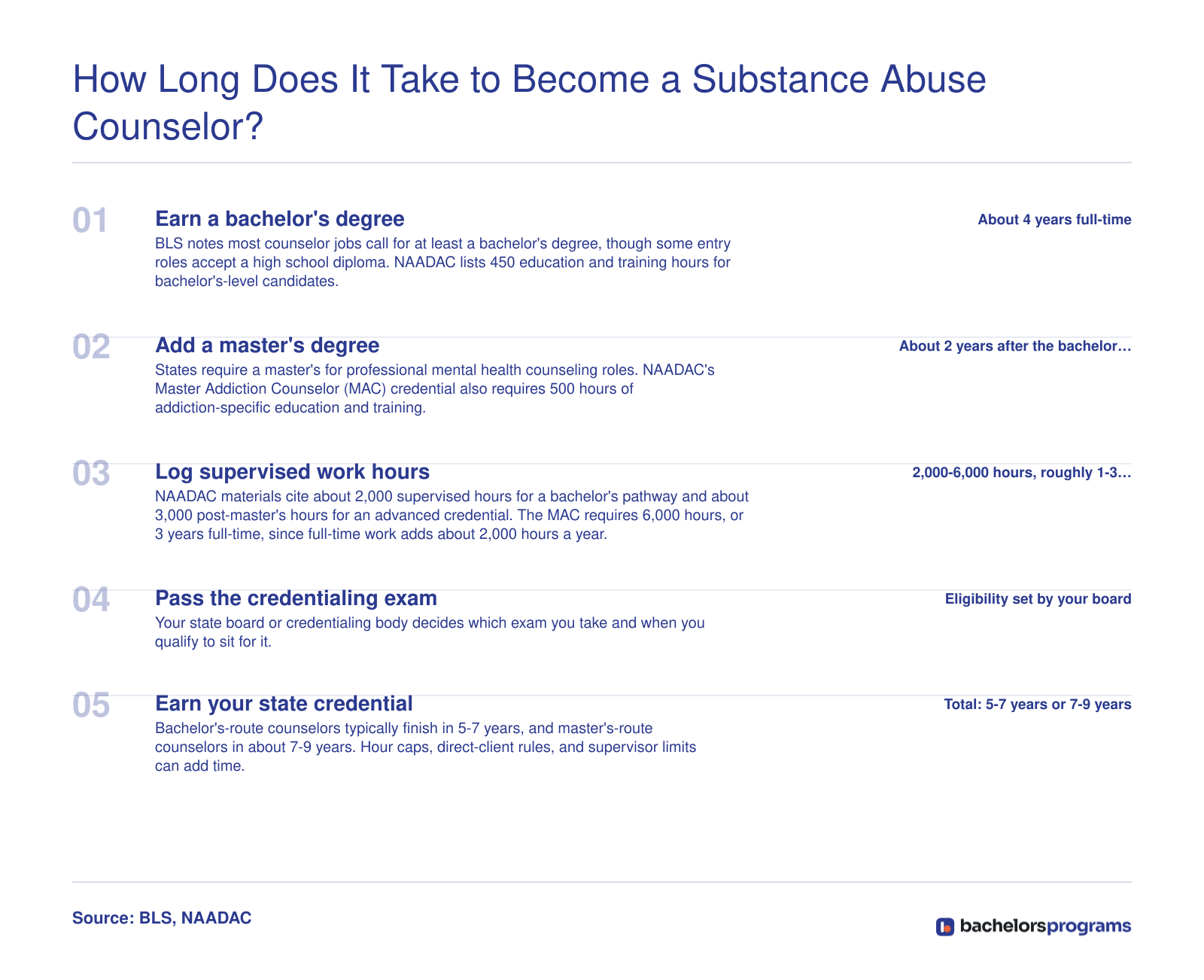
How Long Does It Take to Become a Substance Abuse Counselor?
Expect roughly 5-7 years on the bachelor's route and about 7-9 years on the master's route, assuming full-time study and full-time supervised work. Working professionals in part-time or online programs often take longer, and state rules on which hours count can stretch the timeline further. Treat these as planning estimates and confirm the exact requirements with your state board.
What Substance Abuse Counselors Earn Nationally
Half of these counselors earn more than this national median and half earn less. It works out to about $28.53 per hour.
Substance Abuse Counseling programs by state
Quick Answers for Future Substance Abuse Counselors
Requirements for this field are set by states and credentialing bodies, not by one national standard. Use these answers as a starting point, then confirm details with the credentialing authority in the state where you plan to work.
What degree do you need to be a substance abuse counselor?
Can you work as a substance abuse counselor with only a bachelor's degree?
Are online substance abuse counseling degrees accredited the same way as campus programs?
Do you need a counseling degree, or can a psychology or social work degree lead to addiction counseling credentials?
Can credits or supervised hours from one state count toward certification in another state?
Compare Substance Abuse Counseling programs on the data that matters
Explore more Counseling majors or browse every field of study.
All Counseling programs Browse every field of study