Best Behavioral Health Science Degree Programs
Compare 20+ accredited Behavioral Health Science programs at 24 colleges, with net price after aid, graduation rates, earnings and debt from IPEDS and the U.S. College Scorecard.

Behavioral health employers increasingly staff case management and care coordination with bachelor's-level graduates, while independent clinical licensure remains a graduate credential.
A bachelor's degree in behavioral health science sits at that line. The standard credential, the Bachelor of Science (B.S.) in Behavioral Health Science, blends psychology, addiction studies, and public health coursework. Annual tuition among the programs below runs from roughly $2,400 at a Maricopa County community college to $52,386 at Illinois Tech. Both campus and fully online formats appear, and a directory of additional schools follows the ranked list.
Price, not curriculum, separates these programs, and state residency rules drive most of that price gap.
Key Points
- Saint Francis University's online B.S. posts the strongest program-level earnings here.
- Independent clinical practice requires a graduate credential beyond the bachelor's degree.
- Most behavioral health science programs still run on campus, not online.
10 Best Behavioral Health Science Bachelor's Programs for 2027
The behavioral health science bachelor's degree occupies a small, distinctive corner of U.S. higher education, and the ten programs below approach it from different directions: prevention and health promotion, addiction counseling, psychology-based practice, and interdisciplinary health studies. Each earns its place for a practical reason, from how directly the coursework leads to entry-level behavioral health work to how many students actually finish. Net prices shown with each entry are approximate averages after aid rather than a quote for any one student, and graduation rates describe the whole institution, not the major.
The University of Texas at Austin
#1Austin, TX · ~$20,000/yr (est.)
Best for: Community health promotion career focus
One of the largest public research universities in the country, UT Austin folds behavioral health into its College of Education through a health promotion and behavioral science major rather than a clinical track. The degree is built for students who want to change behavior before problems start, pairing health theory and epidemiology with needs assessment, program planning, and evaluation. A required minor, certificate, or second-field concentration lets students tilt the degree toward the behavioral health career they are aiming at, and the catalog publishes a suggested four-year sequence.
- 120 total credit hours, at least 36 of them upper-division
- 36 hours in the major, from epidemiology to program planning and evaluation
- Requires a transcript-recognized minor, certificate, or second-field concentration
- 6 hours of health promotion electives
- Two years of a single foreign language expected in high school
- Careers in public health, community health promotion, and worksite wellness
- Suggested four-year plan of study published in the catalog
Illinois Institute of Technology
#2Chicago, IL · ~$18,000/yr (est.)
Best for: Chicago students seeking interdisciplinary health tracks
Illinois Tech is a private, technology-focused university in Chicago, and its behavioral health and wellness degree carries that interdisciplinary stamp: psychology, sociology, political science, and nutrition in one core. Students choose a specialty track and finish with a capstone that applies the coursework to a real-world problem. It is an on-campus program that also welcomes international students, and graduates head toward health education, behavioral health coaching, patient advocacy, and policy analysis, or on to graduate school.
- Specialty tracks in health psychology, public health, or nutrition
- Capstone project applying coursework to real-world issues
- Interdisciplinary core across psychology, sociology, political science, nutrition
- Prepares for health educator, behavioral health coach, patient advocate roles
- F-1 visa eligible for international students
- Also prepares graduates for graduate study in health fields
South Mountain Community College
#3Phoenix, AZ · $2,400 – $9,000/yr (est.)
Best for: Arizona residents entering addiction counseling
South Mountain is a Maricopa Community College campus in Phoenix, and its behavioral sciences degree is a rare community college bachelor's built specifically around behavioral health practice. The curriculum runs through human behavior, mental health, substance use, trauma, and recovery, with supervised practice and evidence-based approaches threaded throughout. Because of practicum and state authorization rules, it enrolls Arizona residents only, and it meets Arizona requirements for the Licensed Addiction Counselor Technician credential.
- 120 credits, with a C or better required in every course
- Meets Arizona requirements for the Licensed Addiction Counselor Technician credential
- Supervised practice plus coursework in trauma, recovery, and substance use disorders
- Enrollment limited to Arizona residents because of practicum and authorization rules
- Covers applied behavior analysis concepts, family systems, and cultural competence
- Full-time and part-time course sequences available
Saint Francis University
#4Loretto, PA · $24,000/yr (est. net price)
Saint Francis University is a small Catholic institution in Loretto, Pennsylvania, and its behavioral health degree is designed for adults finishing a bachelor's rather than first-time students. The fully online completion program assumes prior college credit or an associate degree, blends psychology, sociology, and social work, and lets students start at several points in the year. Tuition is charged per credit, and the university reports that more than 95% of students in its professional studies division receive a tuition discount or scholarship.
- $485 per credit, with 128 total credit hours
- Fully online degree completion for students with prior college credit
- Typically three to five years of part-time study
- Multiple start dates each year; full- or part-time enrollment
- Complimentary credit audit; military credit evaluated for transfer
- Core blends psychology, sociology, and social work
- Employer tuition reimbursement supported
University of West Georgia
#5Carrollton, GA · $13,000/yr (est. net price)
The University of West Georgia is a public regional university in Carrollton, west of Atlanta, and its social and behavioral health major sits at the intersection of sociology, public health, and health services delivery. Coursework covers health analytics, health policy, medical sociology, and the cultural side of health, and every major completes an internship. It is a face-to-face program on the Carrollton campus, though some courses run partly or fully online, and graduates move into hospitals, public health agencies, mental health agencies, and nonprofits.
- Face-to-face on the Carrollton campus, with some courses partly or fully online
- Supervised internship required in the major
- Coursework in health analytics, health policy, and medical sociology
- Electives include grant writing, medical anthropology, sociology of mental health
- Prepares graduates for hospitals, public health agencies, and mental health agencies
- One-time $40 application fee
Central Washington University
#6Ellensburg, WA · ~$18,000/yr (est.)
Central Washington University is a public university in Ellensburg with a behavioral health major housed inside its psychology department. The major builds on general psychology, research methods, statistics, and behavioral neuroscience, then adds required coursework in interventions, law and ethics, substance use, and telemental health helping skills. Two practicum courses and a capstone seminar provide supervised exposure, and the curriculum keeps a steady focus on multicultural practice and care for underserved populations.
- Housed in the Department of Psychology
- Two practicum courses plus a capstone seminar
- Required courses in interventions, law and ethics, substance abuse, telemental health
- Multicultural perspectives and care for underserved populations
- Builds on general psychology, research methods, statistics, and behavioral neuroscience
- Service learning and fieldwork experiences
University of Health Sciences and Pharmacy in St. Louis
#7Saint Louis, MO · ~$32,000/yr (est.)
The University of Health Sciences and Pharmacy in St. Louis is a health-focused private university, and its applied behavioral sciences degree takes a deliberately multidisciplinary route through psychology, sociology, and communication. Statistics, research methods, biology, and ethics anchor the coursework, and a capstone pulls the pieces together. It is an on-campus program that prepares students either for graduate study or for work in education, public health, and criminal justice settings.
- Multidisciplinary coursework across psychology, sociology, and communication
- Statistics and research methods required
- Includes a capstone project
- Foundational courses in biology and ethics
- Prepares for graduate study or roles in education, public health, criminal justice
Point Park University
#8Pittsburgh, PA · $25,000 – $30,000/yr (est.)
Point Park University is a private university in downtown Pittsburgh, and its behavioral sciences degree is built around direct practice in community health and social services rather than lab research. Juniors and seniors can take semester-long practicums with an organization of their choice, and a 4+1 arrangement lets students finish a bachelor's and a Master of Arts in Community Psychology in five years. Courses range from counseling theories to LGBTQ mental health to social welfare policy, and graduates move into case management, youth services, and mental health support roles.
- Interdisciplinary degree in the Department of Psychology
- Semester-long practicums in junior and senior years
- 4+1 option completes the bachelor's and an M.A. in Community Psychology in five years
- Coursework includes Counseling Theories, LGBTQ Mental Health, Social Welfare Policy
- Senior thesis capstone
- Prepares for case manager, mental health assistant, and child advocate roles
University of Illinois Chicago
#9Chicago, IL · ~$11,000/yr (est.)
The University of Illinois Chicago is a large public research university with a health sciences campus, and its integrated health studies degree offers a behavioral health concentration inside a broader health-science framework. Students take prerequisites in chemistry and microeconomics before moving into courses on physical and mental health, rehabilitation, and the biopsychosocial model, with an internship option and small classes. The concentration addresses substance use, mental illness, and health disparities, and it feeds into community health, behavioral health coordination, rehabilitation services, or graduate study.
- Behavioral Health concentration within the Integrated Health Studies degree
- 120 credit hours, with at least 19 completed at UIC
- Prerequisites include chemistry and microeconomics
- Coursework on physical and mental health issues in rehabilitation and human sexuality
- Internship option available
- Small classes and faculty mentorship emphasized
- Prepares for community health, behavioral health coordination, rehabilitation services
Rhode Island College
#10Providence, RI · $9,000/yr (est. net price)
Rhode Island College is a public college in Providence, and its behavioral health studies degree pairs a psychology core with professional development courses, two of them in nursing, so students learn the interaction and intervention skills clinicians use daily. It is the only undergraduate chemical dependency preparation program in New England and prepares graduates for addiction counselor licensure. The college reports that more than 90% of graduating seniors have a job offer or graduate school admission before they finish, and eligible Rhode Island students may qualify for free junior and senior year tuition through the Hope Scholarship.
- Psychology major plus five professional development courses, two in nursing
- Only undergraduate chemical dependency preparation degree in New England
- Prepares graduates for addiction counselor licensure
- Coursework in drugs and chemical dependency, social psychology, behavioral statistics
- Scientist-practitioner model with research methods and human development
Cost & outcomes by school
Federal data for the highest-earning Behavioral Health Science programs, independent of the ranking above. Earnings are this field's bachelor's graduates four years after completing where the Scorecard reports them, else the school's undergraduate median.
| School | Net price / yr | Grad rate | Earnings | Debt | Grads/yr | Format |
|---|---|---|---|---|---|---|
| University of Health Sciences and Pharmacy in St. Louis MO | $31,817 | 62% | $137,047 | $17,755 | 3 | Campus |
| Illinois Institute of Technology IL | $18,425 | 75% | $82,592 | $25,000 | 1 | Campus |
| Thomas Jefferson University PA | $28,928 | 69% | $77,449 | $14,744 | — | Online |
| The University of Texas at Austin TX | $19,857 | 89% | $75,121 | $20,500 | 132 | Campus |
| University of Illinois Chicago IL | $10,974 | 62% | $68,740 | $16,704 | — | Campus |
| Central Washington University WA | $18,476 | 54% | $61,580 | $19,500 | 4 | Campus |
| Rhode Island College RI | $9,478 | 48% | $56,318 | $20,500 | — | Campus |
| University of Colorado Colorado Springs CO | $15,788 | 47% | $54,659 | $20,000 | — | Online or campus |
| Alaska Pacific University AK | $21,616 | 47% | $54,271 | $23,500 | — | Hybrid |
| Illinois College IL | $18,298 | 64% | $52,575 | $25,565 | — | Online |
| Seton Hill University PA | $22,204 | 67% | $51,748 | $27,000 | — | Online |
| University of West Georgia GA | $12,786 | 44% | $49,587 | $23,970 | 18 | Campus |
Sources: U.S. Department of Education. Net price, graduation rate, earnings and debt: College Scorecard (earnings and debt for this field's bachelor's graduates where reported, else school-wide); graduates: IPEDS. A dash means no figure is reported.
Cost, debt & payoff
Median earnings of this field's bachelor's graduates (4 yrs after completing, else the school's undergraduate median) vs. their median federal loan debt · U.S. College Scorecard
Across these programs the median graduate earns about $50,668 and finishes with roughly $20,500 in debt — a ratio that clears a common rule of thumb (keep debt below first-year salary). Net price and debt vary widely school to school, so check the per-school figures in the table above before you shortlist.
How We Ranked These Behavioral Health Science Programs
Prestige and payoff often point to different schools, and a familiar campus can lose to a regional public on the numbers that matter after graduation. Our scoring asks one question: does this bachelor's degree in behavioral health science pay off for the student who earns it?
Affordability, Outcomes, and Student Success
We sort the evidence into three plain categories. Affordability centers on what students actually pay after grant aid, because a low sticker price means little if aid still leaves a heavy bill. Outcomes look at program-level earnings one to five years after completion, median federal debt, and the actual monthly loan payment. Student success uses graduation and retention rates for the whole institution; retention tracks whether first-year students come back, an early signal of support. Completion counts show how many students actually graduate, which gives useful context on program size. Admission rate adds selectivity context, not a quality verdict.
Where the Data Comes From
The figures come from the College Scorecard and IPEDS. A school appears only if it participates in federal student aid, which requires accreditation by a recognized accreditor. That is a baseline eligibility check, not a claim that any program holds specialized or programmatic accreditation.
Limits Worth Knowing
Graduation rate and net price are school-wide, not program-specific. Some programs do not publish earnings for their graduates, so that measure may be absent. The ranking also does not measure teaching quality, fieldwork supervision, or practicum placement, which matter enormously in behavioral health training. Those are real gaps, and they sit outside what the federal data captures.
What a Bachelor's Degree in Behavioral Health Science Covers vs. Psychology, Social Work, and Public Health
A B.S. in Behavioral Health Science is an applied undergraduate degree that prepares students to support people with mental health and substance use needs. Typical core courses include abnormal psychology, addiction studies, case management, crisis intervention, research methods, and ethics. Concentrations vary by school, and most programs finish with a practicum or internship in a clinic, agency, or community setting.
How the Four Options Compare
- Behavioral Health Science: The focus is applied prevention, behavior change, and client-facing support. A practicum is usually required, though hours vary by school. No programmatic accreditation is required. Entry jobs include case manager, behavioral health technician, and recovery support worker. The usual next step is a master's in counseling, social work, or a related field.
- Psychology (B.A./B.S.): The focus is theory, research, and the science of behavior. Core courses typically cover general and developmental psychology, statistics, and research methods. A supervised practicum is usually not a bachelor's requirement, and no accreditation is required. Entry jobs include research assistant and general human services roles. Graduates typically move on to a master's or doctorate in psychology or counseling.
- Social Work (BSW): The focus is direct practice with individuals, families, and communities. Courses cover practice methods, human behavior and the social environment, policy, research, and ethics. Supervised field education is required, and programs are accredited by CSWE. Entry jobs include caseworker and child welfare roles. The usual next step is an MSW.
- Public Health (BSPH): The focus is population-level health. Courses typically include epidemiology, biostatistics, environmental health, and health policy. A capstone or internship is common, but requirements and accreditation vary by school. Entry jobs include health educator and program coordinator. The usual next step is an MPH.
A Biology-Heavy Cousin
Biobehavioral health is a related major with a stronger science core. Penn State's B.S. in Biobehavioral Health runs 121 credits, with 97 to 99 in the major, and draws on biology, chemistry, physiology, nutrition, and research.2 It is an interdisciplinary health-science degree rather than a clinical practice degree, so it suits students headed toward health-professions or research tracks.1
Who Should Choose Which
Choose behavioral health science over psychology if you want applied, client-facing preparation rather than research-oriented theory.
Online vs. Campus Behavioral Health Science Degrees
The format choice comes down to schedule flexibility versus built-in access to faculty, peers, and supervised field placements. Most programs in this field still run on campus, so the list of online options stays short.
Where the Online Option Stands
Saint Francis University is the fully online entry in this ranking. Its Behavioral Health B.S. is designed for returning adult students. It offers multiple start dates per year and typically takes 3 to 5 years of part-time study. Every other program on this list is campus-based. The University of West Georgia does let face-to-face students mix in optional online courses.
How the Formats Compare
- Flexibility: Online study suits working adults who need to keep a job. Saint Francis also evaluates military credits for transfer and supports employer tuition reimbursement.
- Practicum logistics: Campus programs build fieldwork into the sequence. Examples include Central Washington University's two required practicum courses and Point Park University's semester-long practicums in the junior and senior years. Online students often arrange local placements themselves.
- Peer and faculty access: Campus students get clubs, capstone teams, and in-person office hours. Online learners have to be more deliberate about reaching out.
- Cost: Saint Francis charges $485 per credit across 128 credit hours, with an average net price of $23,526. Public campus options can cost less, including Rhode Island College ($9,478) and the University of Illinois Chicago ($10,974).
Check State Authorization First
Before you apply to any online program, confirm the school is authorized to enroll residents of your state. Also ask whether it can support a practicum placement where you live; a degree you cannot finish locally wastes time and money. Residency rules apply to campus programs too: South Mountain Community College's B.S. is available only to Arizona residents.
Related Articles
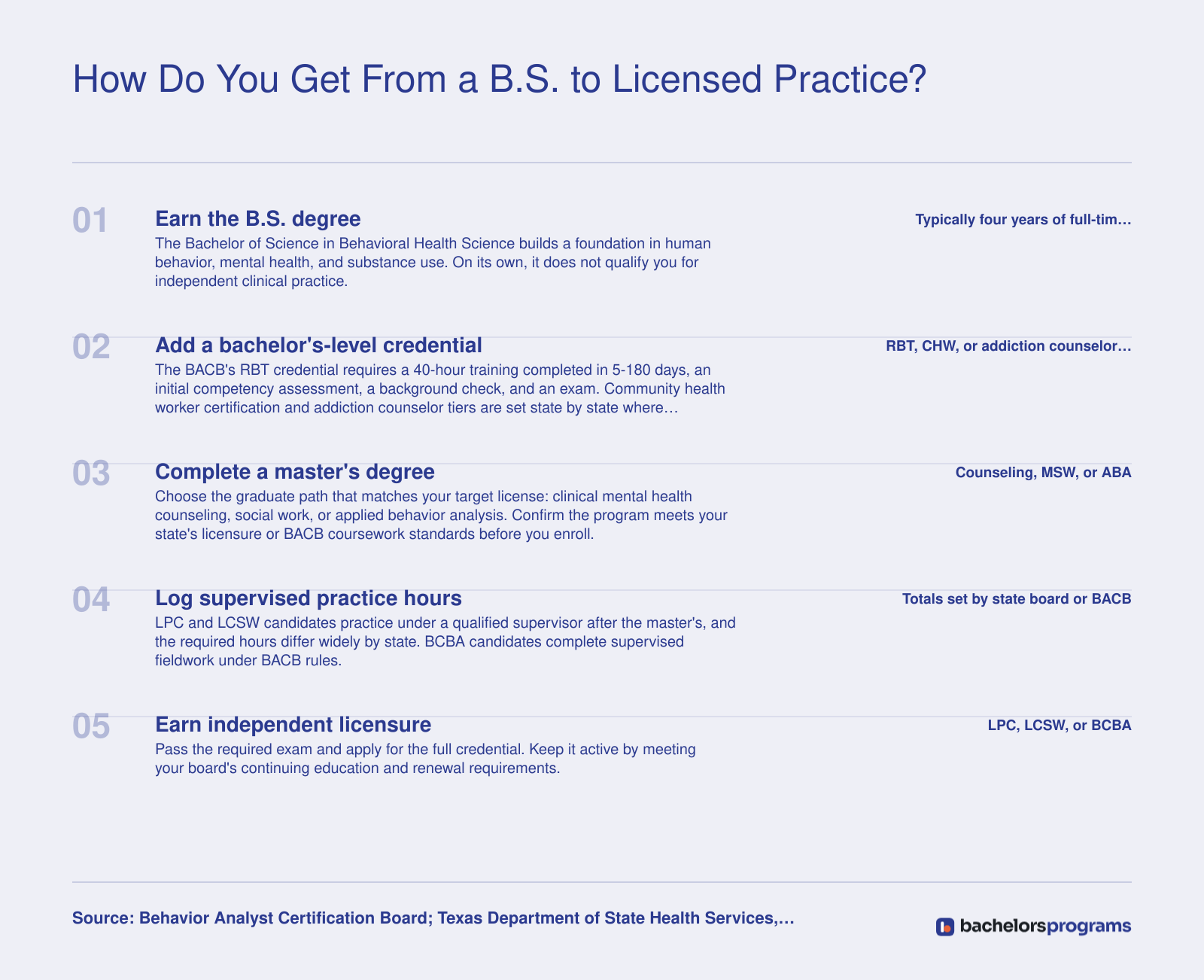
How Do You Get From a B.S. to Licensed Practice?
A bachelor's degree in behavioral health science opens entry-level roles, but independent clinical practice requires more credentials. Most graduates follow a ladder like the one below. Addiction counselor credential tiers and supervised-hour totals for licensure vary by state, so check your state board's current rules before you plan each step.
Top Program-Level Payoff
Saint Francis University's online B.S. in Behavioral Health posts the strongest program-level earnings among the schools ranked here.
Bachelor of Science in Behavioral Health Science Jobs and Salary
The table below uses Bureau of Labor Statistics figures (May 2025 median annual wages and 2025 to 2035 growth projections) for roles that behavioral health science graduates commonly pursue, so you can set realistic expectations for a behavioral health science degree salary. Health education specialists and probation officers list a bachelor's as the typical entry credential, while counselor roles list a master's, so a bachelor of science in behavioral health science salary often starts closer to assistant, community health worker, or technician pay and grows as you add graduate study and licensure. Read the counselor median with care, because it blends bachelor's-level workers with master's-level licensed practitioners and may run higher than what a new bachelor's graduate earns.
| Job Title | Typical Entry Education | BLS Median Annual Wage | Projected 10-Year Growth |
|---|---|---|---|
| Substance abuse, behavioral disorder, and mental health counselors | Master's degree | $59,350 | 18% |
| Social and human service assistants | High school diploma or equivalent | $45,930 | 7% |
| Community health workers | High school diploma or equivalent | $51,850 | 13% |
| Health education specialists | Bachelor's degree | $64,070 | 6% |
| Rehabilitation counselors | Master's degree | $46,850 | 2% |
| Probation officers and correctional treatment specialists | Bachelor's degree | $66,270 | 3% |
| Psychiatric technicians | Postsecondary certificate | $45,130 | 18% |
Behavioral Health Science programs by state
Behavioral Health Science Degree Questions, Answered
These answers cover the questions prospective students ask most often about a bachelor's degree in behavioral health science. Credential rules differ by state, so confirm details with your state board and your target school before you commit.
What jobs can I get right after graduating with a bachelor's in behavioral health science?
Should I choose behavioral health science or psychology if I eventually want to become a therapist?
How many credits does a B.S. in behavioral health science take, and can transfer credits shorten it?
Can I work as a Registered Behavior Technician while I'm still in school?
Do I need a master's degree to become a certified addiction counselor?
Do employers and graduate schools treat an online behavioral health science degree the same as a campus degree?
Compare Behavioral Health Science programs on the data that matters
Explore more Counseling majors or browse every field of study.
All Counseling programs Browse every field of study