Best Communication Disorders Degree Programs
Compare 270+ accredited Communication Disorders programs at 260+ colleges, with net price after aid, graduation rates, earnings and debt from IPEDS and the U.S. College Scorecard.

A bachelor's degree in communication disorders, most often a Bachelor of Science (B.S.) in Communication Disorders, does not qualify anyone to practice. Speech-language pathologists need a master's degree and a state license, and audiologists need a clinical doctorate (Au.D.). The undergraduate major is the prerequisite track: it supplies the anatomy, phonetics, language development, and statistics coursework that graduate programs expect.
That creates the real decision. Many of these majors are limited-access, with GPA cutoffs from 2.5 to 3.4, so admission to the department can be harder than admission to the university. Choose a program with graduate school in mind, because a bachelor's alone leads mostly to support roles.
Key Points
- Average net price after aid starts as low as $3,103 a year.
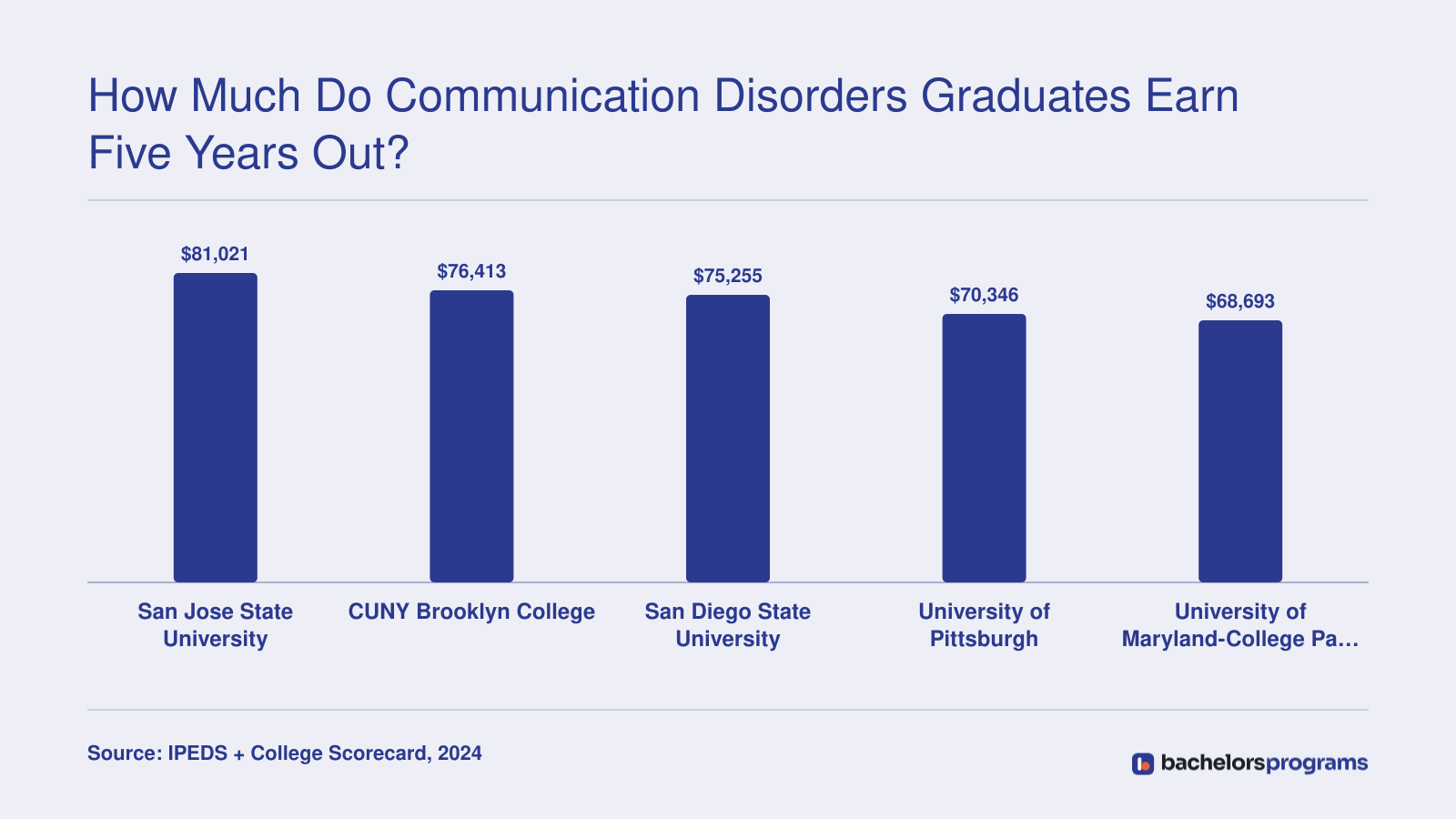
- Graduates earn medians of $68,693 to $81,021 five years after finishing.
- Speech-language pathology jobs require a master's, so plan for graduate school.
Best Schools for a Bachelor's Degree in Communication Disorders
These ten schools earned a top-10 spot by pairing a manageable net price after aid with strong institutional completion rates and a clear route into speech-language pathology or audiology graduate study. Every card names its delivery format first, so readers who need an online option can spot it at a glance. Prices shown are averages after aid, not guaranteed quotes.
Women's Institute of Torah Seminary and College
#1Baltimore, MD · $10,000 – $15,000/yr (est.)
Best for: Women seeking faith-integrated health science study
This small Baltimore institution builds a 120-credit communication sciences and disorders major around a substantial Jewish studies core, and clinical observation with practicing speech-language pathologists is part of the coursework. The school graduates 100% of its students and retains 91%, numbers that reflect a very small, closely advised cohort. The average net price after aid is about $11,670. Format: Campus.
- 120 total credit hours
- 36 credits in Jewish studies required
- Clinical observation with practicing speech-language pathologists
- Coursework aligned with ASHA certification requirements
- Prepares students for SLP and audiology graduate programs
- Double major or minor possible
University of Virginia
#2Charlottesville, VA · $22,000/yr (est. net price)
Best for: Transfer students entering a two-year major
UVA's speech communication disorders major is a two-year, upper-division program inside a large public research university in Charlottesville, and students apply after finishing prerequisites. The school graduates 96% of students and retains 98%, and the average net price after aid is about $21,570. Small classes and pre-professional field experience are the draw. Format: Campus.
- 120 total credit hours
- 2.5 GPA minimum
- Two-year program after admission to the major
- Small class sizes
- Application deadlines: Feb. 1 for UVA students, Mar. 1 for transfers
- Hands-on pre-professional learning experiences
University of Florida
#3Gainesville, FL · ~$4,800/yr (est.)
Best for: Working adults needing a fully online program
Florida's flagship delivers its communication sciences and disorders degree through UF Online, which makes it the clear pick for readers who cannot relocate to Gainesville. The school graduates 85% of students, and the average net price after aid is about $4,820, among the lowest on this list. Admission is limited-access and full-time, with a prerequisite GPA of 3.0 or better. Format: Online.
- Delivered fully online through UF Online
- Full-time, limited-access program
- Prerequisite GPA of 3.0 or higher
- Prepares students for SLP and audiology graduate study
- Research-focused faculty
Florida State University
#4Tallahassee, FL · ~$11,000/yr (est.)
Florida State runs a 42-credit communication science and disorders major in Tallahassee with limited-access admission and two entry points each year. The school graduates 86% of students, and the average net price after aid is about $11,300. Faculty work on augmentative and alternative communication, literacy access, and social participation, which gives undergraduates a current research lens on the field. Format: Campus.
- 42-credit major
- Limited-access major with a 3.0 GPA minimum
- Prerequisite coursework required
- Two start dates per year, fall and spring
- Minimum of two years after acceptance to the major
- Opportunities to observe clinical practice
Brigham Young University
#5Provo, UT · $15,000 – $20,000/yr (est.)
BYU's communication disorders major sits on a Provo campus with its own speech and language clinic, so undergraduates see clinical work early. The school graduates 81% of students, and the average net price after aid is about $15,560. The major is limited-enrollment and requires departmental acceptance, so plan the application well ahead. Format: Campus.
- On-campus speech and language clinic
- Limited-enrollment major requiring departmental acceptance
- Both bachelor's and master's degrees offered
- Research participation opportunities
- Prepares graduates for SLP or audiology graduate study
University of Illinois Urbana-Champaign
#6Champaign, IL · ~$14,000/yr (est.)
Illinois combines a dedicated speech and hearing science department with coursework in communication disorders in Champaign, preparing students for both clinical and non-clinical routes. The school graduates 85% of students, and the average net price after aid is about $14,360. A clinical master's and a research doctorate sit in the same department, which helps students line up graduate study. Format: Campus.
- Communication disorders concentration available
- Prepares students for clinical and non-clinical careers
- Graduates work in education, healthcare, academia and industry
- Clinical M.A. and research Ph.D. offered in the same department
University of Wisconsin-Madison
#7Madison, WI · ~$17,000/yr (est.)
Wisconsin's communication sciences and disorders major is a 120-credit program in Madison that students can declare without a separate application. The school graduates 90% of students, and the average net price after aid is about $17,350. A pre-clinical observation course covers the hours students need before graduate clinical training, though prospective applicants should confirm which degree route is currently open before applying. Format: Campus.
- 120 total credit hours
- No application required to declare the major
- Honors in the major available
- Pre-clinical observation course for ASHA hours
- Four-year plan and advising resources provided
University of Georgia
#8Athens, GA · ~$14,000/yr (est.)
Georgia admits communication sciences and disorders majors through a competitive cohort capped at 75 students in Athens, with 36 required hours in the major. The school graduates 90% of students, and the average net price after aid is about $13,940. A campus NSSLHA chapter and 25 guided observation hours give students early exposure to clinical work. Format: Campus.
- 36 required hours in the major
- Cohort capped at 75 students
- 3.4 GPA minimum, with 3.7 preferred
- 25 guided observation hours before clinical practicum
- Two-hour proctored admission essay
- Campus NSSLHA chapter
Purdue University
#9West Lafayette, IN · ~$15,000/yr (est.)
Purdue's speech, language and hearing sciences major in West Lafayette comes with on-site audiology and speech-language clinics plus research labs in Lyles-Porter Hall. The school graduates 83% of students, and the average net price after aid is about $14,600. The degree suits students heading to audiology or speech-language pathology graduate programs, and transfer applicants need a 2.5 GPA. Format: Campus.
- On-site audiology and speech-language clinics
- Research labs in Lyles-Porter Hall
- 2.5 GPA minimum for transfer applicants
- Prepares students for audiology or SLP graduate study
- Housed in the College of Health and Human Sciences
University of Maryland-College Park
#10College Park, MD · $16,000/yr (est. net price)
Maryland's hearing and speech sciences major in College Park puts undergraduates in faculty research labs and in the department's clinic and LEAP preschool. The school graduates 89% of students, and the average net price after aid is about $15,680. Honors students complete a thesis, and advising is mandatory each semester, which keeps four-year plans on track. Format: Campus.
- Research labs open to undergraduates
- Honors thesis under a faculty mentor
- Clinic and LEAP preschool in LeFrak Hall
- NSSLHA and Student Academy of Audiology chapters
- Mandatory advising every semester
- Endowed scholarship for juniors planning audiology graduate study
Cost & outcomes by school
Federal data for the highest-earning Communication Disorders programs, independent of the ranking above. Earnings are this field's bachelor's graduates four years after completing where the Scorecard reports them, else the school's undergraduate median.
| School | Net price / yr | Grad rate | Earnings | Debt | Grads/yr | Format |
|---|---|---|---|---|---|---|
| Northeastern University MA | — | — | $92,538 | $24,250 | — | Campus |
| Northwestern University IL | $29,167 | 95% | $89,363 | $15,000 | 17 | Campus |
| Case Western Reserve University OH | $41,190 | 87% | $87,989 | $24,000 | 15 | Campus |
| Saint Joseph's University - Philadelphia PA | $29,689 | 79% | $86,881 | $25,500 | 4 | Campus |
| San Jose State University CA | $13,760 | 69% | $78,988 | $15,000 | 33 | Campus |
| CUNY Queens College NY | $4,195 | 53% | $78,281 | $11,000 | 28 | Campus |
| University of the Pacific CA | $25,447 | 69% | $77,549 | $16,684 | 12 | Campus |
| New York University NY | $37,050 | 88% | $75,970 | $23,195 | 30 | Campus |
| Brigham Young University UT | $15,564 | 81% | $75,790 | $11,438 | 97 | Campus |
| Assumption University MA | $29,498 | 75% | $74,895 | $27,000 | — | Campus |
| University of Connecticut CT | $25,097 | 83% | $73,997 | $21,500 | 66 | Campus |
| The College of New Jersey NJ | $27,646 | 86% | $73,323 | $23,250 | 25 | Campus |
Sources: U.S. Department of Education. Net price, graduation rate, earnings and debt: College Scorecard (earnings and debt for this field's bachelor's graduates where reported, else school-wide); graduates: IPEDS. A dash means no figure is reported.
Cost, debt & payoff
Median earnings of this field's bachelor's graduates (4 yrs after completing, else the school's undergraduate median) vs. their median federal loan debt · U.S. College Scorecard
Across these programs the median graduate earns about $57,853 and finishes with roughly $21,435 in debt — a ratio that clears a common rule of thumb (keep debt below first-year salary). Net price and debt vary widely school to school, so check the per-school figures in the table above before you shortlist.
How We Ranked These Communication Disorders Schools
For communication disorders, the numbers split in two: the reliable federal data describes the whole institution, while the outcomes that matter most belong to the major. This ranking leans on both and says plainly where each one stops.
What We Measure
- Cost after aid: average net price, what a typical first-year student actually pays after grants and scholarships.
- Completion: graduation and retention rates for the whole institution, a proxy for whether students stay and finish.
- Admission selectivity: how competitive the incoming class is.
- Program outcomes: what communication disorders graduates earn and the median debt they carry, where College Scorecard publishes those figures.
- Delivery format: campus, online, or hybrid, since format often decides whether a program is workable at all.
Data Sources
The figures come from College Scorecard and IPEDS, both federal sources, using the most recent snapshot available as of November 2026. They refresh on the federal calendar, not ours, so a figure can lag the program it describes.
What This Ranking Cannot Tell You
Net price and graduation rates are school-wide, not program-specific, so they describe the institution a student joins rather than the department they study in. Bachelor's-level earnings also understate long-term value, because many graduates head to a master's program in speech-language pathology before they ever earn a clinical salary.
Nothing here measures faculty quality, access to a working clinic on campus, or how successfully a department places its students into graduate school. Treat the ranking as a starting filter, then confirm those things directly with the department.
Cost and Net Price: The Most Affordable Communication Disorders Programs
Among the most affordable schools ranked here, published in-state tuition for a communication disorders degree runs from $3,876 to $7,470 a year, out-of-state tuition from $15,402 to $20,070, and average net price after grants and scholarships from $3,103 to $6,555, according to 2024 IPEDS and College Scorecard data from the U.S. Department of Education. Net price often lands far below sticker tuition because it subtracts federal, state, and institutional grant aid; public universities like these keep in-state tuition low through state funding, while private schools tend to post much higher tuition and then discount it heavily with their own aid. Keep in mind that net price is an institution-wide average for all undergraduates, not a quote for this major, so your own aid package could come in higher or lower depending on family income, residency, and the scholarships you win.
| School | Location | Format | In-State Tuition | Out-of-State Tuition | Average Net Price |
|---|---|---|---|---|---|
| CUNY Brooklyn College | Brooklyn, NY | On campus | $7,452 | $15,402 | $3,103 |
| University of Florida | Gainesville, FL | Online | $3,876 | $16,579 | $4,815 |
| California State University-Fullerton | Fullerton, CA | On campus | $7,470 | $20,070 | $6,555 |
How Much Do Communication Disorders Graduates Earn Five Years Out?
Five years after finishing a bachelor's in communication disorders, graduates' median earnings range from $68,693 at the University of Maryland-College Park to $81,021 at San Jose State University, and median program debt stays below most of those first-year salaries: $12,721 at CUNY Brooklyn College (about $135 a month over 10 years), $14,000 at San Diego State University ($148), $21,500 at Maryland ($228) and $25,294 at the University of Pittsburgh ($268). Read these figures with the career path in mind. Speech-language pathology and audiology licensure both require a graduate degree, so the jobs open with a bachelor's alone, such as speech-language pathology assistant or audiometrist roles, typically pay less, and some graduates' five-year earnings likely reflect a master's completed after the bachelor's.
Related Articles
Can You Earn a Communication Disorders Degree Online?
Can you earn a bachelor's in communication disorders without attending class on campus? Yes, though the choices are narrower than in most majors. Of the ranked schools, the University of Florida is the one that lists an online program. Its Communication Sciences and Disorders degree is delivered as an online Bachelor of Health Science, with full-time, limited-access enrollment and a prerequisite GPA of 3.0 or higher. The other ranked schools list campus-based programs.
Other Online and Hybrid Options
- Eastern New Mexico University: The Bachelor of Science in Communicative Disorders is described as 100% online, with rolling admission and five start times a year.
- Utah State University: The online Communicative Disorders second bachelor's is built for students who already hold a bachelor's in another field. It can be finished in three semesters or taken more slowly, and the current degree map takes effect in Fall 2026.
- Western Kentucky University: The B.S. in Communication Disorders is hybrid, not fully online, because it includes some in-person requirements.
How Online Students Complete Observation Hours
ASHA expects 25 guided clinical observation hours before graduate study in speech-language pathology. The program pages for these schools do not spell out how online students complete them, so ask admissions directly. Online programs generally use recorded or video-based sessions with a certified clinician guiding the observation, and some add in-person components. WKU, for example, requires supervised clinical clock hours, up to 50, working with people who have communication disorders.1 Do not assume those hours are identical to ASHA's observation requirement, and confirm how each school counts them.
The Tradeoffs
Online study offers flexibility, often a lower total cost, and start dates that fit a working adult's calendar. The downside is fewer hands-on lab and research opportunities. Speech-language pathologists need a master's degree, and graduate admissions committees often look for undergraduate research experience and close faculty relationships. If you study online, plan how you will build those: ask a local university about volunteering in a research lab. Check that your coursework meets the prerequisites of the graduate programs you want.
B.A. vs. B.S. in Communication Disorders: Which Should You Choose?
Both degrees can lead to a speech-language pathology (SLP) graduate program, as long as you complete the science, math, and statistics coursework that ASHA requires. The real differences are in language requirements, science depth, and electives. Requirements vary by school, so treat the examples below as illustrations and confirm details in each program's current catalog.
| Factor | B.A. in Communication Disorders | B.S. in Communication Disorders |
|---|---|---|
| Foreign language | Often required. Oklahoma State's B.A. calls for 9 college-credit hours in one language, including 3 hours at the 2000 level, or equivalent proficiency. Brooklyn College's B.A. listing does not state a language requirement. | Often lighter or satisfied before college. Oklahoma State's B.S. requires 6 hours, or two years of one language in high school. UCF asks for two years of high school language, one year in college, or a proficiency exam. |
| Science depth | Typically meets ASHA's foundational science expectations without much beyond them. | Typically heavier. Elmhurst's ASHA-related science coursework includes physics or chemistry. |
| Math and statistics | Statistics is still needed for ASHA purposes. Math level varies by school. | Often spelled out. New Mexico State requires College Algebra or higher (3 credits). Sacramento State requires Introduction to Statistics (3 units). |
| General education mix | Usually weighted toward humanities, social science, and language study. | Usually weighted toward natural science and quantitative courses. |
| Typical electives | Broader liberal arts choices, such as linguistics, psychology, education, or a minor. | More biology, neuroscience, anatomy, and research methods options. |
| Fit for SLP graduate programs | Qualifies if the ASHA-required science, math, and statistics courses are completed. | Qualifies on the same condition, and the science courses are often built into the degree. |
| Fit for Au.D. or research tracks | Workable, but you may need extra science prerequisites. | Often the smoother path for audiology or research-minded students who want heavier science. |
Questions to Ask Yourself
Are you leaning toward speech-language pathology or audiology?
Does the program provide guided observation hours, or must you arrange them yourself?
Do you want undergraduate research or on-campus clinic exposure?
Will a low net price now leave room for a two-year master's or a four-year Au.D.?
What Speech-Language Pathologists Earn
This is an occupational wage for speech-language pathologists. The job requires a master's degree, so it does not reflect what graduates earn with a bachelor's degree in communication disorders alone.
Communication Disorders programs by state
Communication Disorders Degree FAQs
These answers cover the questions students ask most often when weighing a bachelor's degree in communication disorders as a first step toward speech-language pathology or audiology.
What is the best degree for communication disorders?
How long does a communication sciences and disorders degree take?
Do you need a master's degree to become a speech-language pathologist?
Can you get into an SLP graduate program without a communication disorders bachelor's degree?
Compare Communication Disorders programs on the data that matters
Explore more Communications & Media majors or browse every field of study.
All Communications & Media programs Browse every field of study