Best Human Services Degree Programs
Compare 260+ accredited Human Services programs, with net price after aid, graduation rates, earnings and debt from IPEDS and the U.S. College Scorecard.

A human services bachelor's prepares you for frontline helping work: case management, community outreach, family support, and nonprofit program coordination. Most graduates start in assistant or coordinator roles, so the degree needs to pay for itself quickly.
Cost varies widely across these programs. Average net price after aid runs from $3,203 at CUNY John Jay College of Criminal Justice to $36,586 at George Washington University. Most programs here are campus-based, though Touro University adds synchronous online classes.
Entry pay stays modest, so a lower net price and a solid internship, from 90 fieldwork hours at Boricua College to 300 at GWU, often matter more than a famous name.
Key Points
- CUNY John Jay's $7,470 in-state tuition falls to $3,203 after aid.
- CSHSE-accredited graduates skip experience verification for the HS-BCP credential.
- Most states require a CSWE-accredited BSW for bachelor's-level social work licensure.
Top 10 Human Services Bachelor's Programs for 2027
The programs below earn their place through a combination of affordability, on-time completion, and the kind of flexibility that working adults actually need. Each entry gives you the format, the concentration options, the average net price after aid, and the school's overall graduation rate, so you can compare programs on the measures that matter before you apply.
California State University-Fullerton
#1Fullerton, CA · $7,000 – $20,000/yr (est.)
Best for: Southern California students seeking public-university value
California State University, Fullerton is one of the largest campuses in the CSU system, and its human services bachelor's reflects that scale: a full public-university catalog paired with a major built around case management, counseling techniques, and supervised practice. Students select a concentration and move through fieldwork seminars and internships before graduating. It is a solid pick for readers who want a comprehensive, affordable public option in Southern California.
- Three concentrations: Addiction Studies, Mental Health, Elementary Education
- 120 units required, including a fieldwork and practicum sequence
- Coursework in case management, crisis intervention, and program evaluation
- Prepares students for mental health counseling and community organization roles
- Transfer credit accepted up to 12 units
Boricua College
#2New York, NY · ~$15,000/yr (est.)
Best for: New York City learners wanting small-cohort instruction
Boricua College is a small private institution in New York City centered on Puerto Rican and Latino culture, with an instructional model built on small group colloquia and individualized attention. Its human services bachelor's runs 132 credits and includes practicum and internship placement in social service agencies. The college suits students who want a structured, tight-knit program in the city rather than a large lecture-hall environment.
- 132 total credit hours
- Internship includes 90 hours of fieldwork
- Small group colloquia and individualized instruction
- Interdisciplinary coursework in psychology, sociology, and anthropology
- Cultural studies component affirming heritage
CUNY John Jay College of Criminal Justice
#3New York, NY · ~$3,200/yr (est.)
Best for: Justice-minded students drawn to advocacy careers
John Jay College of Criminal Justice is a CUNY senior college in Manhattan known for justice-focused degrees, and its human services and community justice major carries that identity directly into the curriculum. Advocacy, community organizing, and counseling coursework sit alongside fieldwork and peer mentoring, and many faculty are licensed clinicians. Students who want a human services degree framed around social, racial, and economic justice will find an unusually close fit here.
- 120-credit B.S. program
- Justice-centered curriculum covering advocacy, community organizing, and counseling
- Fieldwork and peer programs built into the major
- Faculty include licensed clinicians
- Offered in collaboration with the Department of Africana Studies
University of Delaware
#4Newark, DE · $15,000 – $20,000/yr (est.)
The University of Delaware is a flagship public research university in Newark, and its human services major is notable for small upper-level classes and a tightly sequenced practicum. Three concentrations, an integrated internship, and a capstone give students both breadth and supervised experience, and a 4+1 pathway lets them roll a master's in human services leadership into the same plan of study. It is a good fit for students who expect research-level resources without a huge lecture format.
- Three concentrations: Pre-Social Work/Counseling, Family and Community Services, Early Childhood Development
- Internship integrated into the curriculum
- Capstone project required
- 4+1 option leads to a master's in Human Services Leadership
- Honor society Tau Upsilon Alpha
- Study abroad eligible
Northeastern University
#5Boston, MA · ~$31,000/yr (est.)
Northeastern University is a private research university in Boston organized around experiential learning, and the human services major is a clear expression of that model. Students complete two co-op placements plus service-learning and finish with a senior seminar capstone, graduating with substantial professional experience already on a resume. The program is aimed at readers who want sustained, pre-professional work placements rather than a purely classroom degree.
- 128 semester hours across a four-year plan
- Two integrated co-op experiences
- Service-learning and internships built into the curriculum
- Senior seminar capstone course
- Coursework in nonprofit management, political advocacy, and community development
California State University-Monterey Bay
#6Seaside, CA · ~$14,000/yr (est.)
California State University, Monterey Bay is a public university on the central coast whose collaborative health and human services degree teaches health delivery and social services as one field rather than two. Students choose a public health, social work, or public administration track, then complete a 240-hour internship at a local agency and a year-long capstone. It is a natural fit for readers aiming at county agencies, community clinics, or nonprofit program management.
- Three concentrations: Public Health, Social Work, Public Administration and Nonprofit Management
- 240-hour internship at a local agency
- Year-long capstone project
- Coursework in collaborative leadership, policy analysis, and ethics
- Alumni have entered graduate programs at UC Berkeley, Duke, and NYU
University of Oregon
#7Eugene, OR · ~$22,000/yr (est.)
The University of Oregon is a public research university in Eugene whose family and human services major draws on psychology, social work, public health, and sociology. Students pick among three tracks and log internships with more than 100 community partners in case management, youth outreach, and nonprofit administration. The program leans toward prevention science and social justice, which makes it a strong choice for students planning graduate study in social work or counseling.
- Three tracks: Fundamentals, Prevention Science, Direct Service Intensive
- Internships with more than 100 community partners
- About 15,000 internship hours logged each year
- Interdisciplinary curriculum spanning psychology, social work, public health, and sociology
- BA or BS degree options
- Prepares students for graduate study in counseling, social work, and prevention science
Touro University
#8New York, NY · $30,000/yr (est. net price)
Touro University's New York School of Career and Applied Studies runs a human services major built for students who need to keep working while they study, with small classes, evening sections, and part-time enrollment. Learners choose adult and family services, child and youth services, or an honors social work track, and complete a 112-hour fieldwork internship that often leads to a job offer. Accelerated pathways into Touro master's programs make it easy to continue after the bachelor's.
- Three concentrations: Adult and Family Services, Child and Youth Services, Honors Social Work
- 112-hour fieldwork internship
- Capstone required
- Full-time and part-time enrollment with evening classes
- Three start dates per year: fall, spring, and summer
- Accelerated pathways to master's degrees in social work and behavioral sciences
George Washington University
#9Washington, DC · ~$37,000/yr (est.)
George Washington University is a private university in Washington, D.C., where the human services and social justice major combines classroom work with 300 hours of community engagement. Nonprofit management, program evaluation, and grant writing run throughout the curriculum, and the senior capstone asks students to lead a philanthropic change project of their own. The program is designed for students heading into nonprofit management, policy, health services, education, or government work.
- 300 hours of community engagement
- Senior capstone in philanthropic social change
- Coursework in nonprofit management, grant writing, and program evaluation
- Can be combined with criminal justice, law, or sociology minors
- Small class sizes
Western Washington University
#10Bellingham, WA · $10,000 – $29,000/yr (est.)
Western Washington University is a public university in Bellingham whose human services major has been embedded in the surrounding community for more than 45 years. Students complete two quarters of internship work, roughly 240 hours, with partners such as Big Brothers Big Sisters and the Bellingham Food Bank, and the curriculum is aligned with national human service education standards. It suits students who want direct service experience with veterans, children, and families before they graduate.
- 240 hours of internship across two quarters
- Curriculum aligns with Council for Standards in Human Service Education standards
- More than 45 years of community engagement
- Internship partners include Big Brothers Big Sisters and the Bellingham Food Bank
- Coursework in advocacy, grant writing, case management, and outreach
Cost & outcomes by school
Federal data for the highest-earning Human Services programs, independent of the ranking above. Earnings are this field's bachelor's graduates four years after completing where the Scorecard reports them, else the school's undergraduate median.
| School | Net price / yr | Grad rate | Earnings | Debt | Grads/yr | Format |
|---|---|---|---|---|---|---|
| University of Michigan MI | $13,138 | 93% | $83,648 | $19,500 | — | Campus |
| Merrimack College MA | $37,927 | 70% | $75,584 | $27,000 | — | Online |
| Adelphi University NY | $30,783 | 67% | $75,482 | $25,000 | — | Campus |
| Elon University NC | $41,555 | 84% | $74,545 | $20,500 | 18 | Campus |
| Wagner College NY | $28,241 | 65% | $74,360 | $25,000 | — | Campus |
| The Catholic University of America DC | $29,561 | 80% | $73,250 | $26,000 | — | Online |
| Purdue University IN | $14,600 | 83% | $72,424 | $19,500 | — | Campus |
| University of Massachusetts-Amherst MA | $22,383 | 83% | $71,631 | $22,763 | — | Online |
| Yeshiva University NY | $49,965 | 83% | $71,353 | $18,250 | — | Campus |
| University at Buffalo NY | $20,995 | 75% | $70,814 | $19,000 | — | Campus |
| University of Maryland-Baltimore County MD | $16,467 | 70% | $69,960 | $19,500 | — | Campus |
| St. John's University-New York NY | $29,999 | 66% | $69,571 | $25,000 | — | Campus |
Sources: U.S. Department of Education. Net price, graduation rate, earnings and debt: College Scorecard (earnings and debt for this field's bachelor's graduates where reported, else school-wide); graduates: IPEDS. A dash means no figure is reported.
Cost, debt & payoff
Median earnings of this field's bachelor's graduates (4 yrs after completing, else the school's undergraduate median) vs. their median federal loan debt · U.S. College Scorecard
Across these programs the median graduate earns about $51,009 and finishes with roughly $23,409 in debt — a ratio that clears a common rule of thumb (keep debt below first-year salary). Net price and debt vary widely school to school, so check the per-school figures in the table above before you shortlist.
How We Ranked These Human Services Programs
These rankings rest on federal records rather than reputation surveys or paid placement, so each position reflects a reported outcome rather than a marketing claim.
What Goes Into the Comparison
Every program is weighed on the same set of measures, drawn from the College Scorecard and the Integrated Postsecondary Education Data System:
- Average net price after aid: what students typically pay after grants and scholarships, not the sticker tuition.
- Graduation and retention rates: whether students at the institution finish what they start.
- Median earnings after completion: reported separately for human services graduates where the field is large enough to disclose.
- Median federal debt at completion: how much borrowing a typical graduate carries out the door.
- Delivery format: whether the program runs online, on campus, or in a hybrid arrangement, since working adults and career changers need that answer early.
Reading Program Figures Against School Figures
Some numbers describe human services graduates specifically. Earnings and federal debt are reported at that program level wherever the data supports it. Other numbers describe the whole institution, including graduation rates and ten-year earnings across all majors. Read those institution-wide figures as context for the school, not as a forecast of what a human services major will earn. A strong graduation rate at a large university says something real about student support, but it is not a human services statistic.
What the Numbers Leave Out
Federal data says nothing about curriculum quality, internship placement networks, or accreditation status. Those factors shape a graduate's first job more than a net price figure does, so treat the CSHSE section that follows as a required companion to the rankings.
Most Affordable Human Services Degree Programs by Net Price
Net price, the average yearly cost after grants and scholarships, is a better budget guide than sticker tuition: at CUNY John Jay College of Criminal Justice, in-state tuition of $7,470 falls to an average net price of $3,203, about $4,267 less per year, according to 2024 IPEDS and College Scorecard data from the U.S. Department of Education. Because net price also counts expenses beyond tuition, such as books and living costs, it can run higher than tuition at very low-tuition schools like Indian River State College, where in-state tuition is $2,764 and net price is $3,815. Pell Grant shares above 80 percent at each school show how many lower-income students these programs serve, and median debt is listed only where it is published for the human services program itself.
| School | Location | Average Net Price | In-State Tuition | Out-of-State Tuition | Pell Grant Share | Median Program Debt |
|---|---|---|---|---|---|---|
| CUNY John Jay College of Criminal Justice | New York, NY | $3,203 | $7,470 | $15,420 | 89.6% | N/A |
| Indian River State College | Fort Pierce, FL | $3,815 | $2,764 | $10,201 | 91.2% | $13,500 |
| California State University-Fullerton | Fullerton, CA | $6,555 | $7,470 | $20,070 | 80.1% | N/A |
Related Articles
CSHSE-Accredited vs. CSHSE-Aligned Human Services Programs
What CSHSE Accreditation Covers
The Council for Standards in Human Service Education (CSHSE) describes itself as the only national body that accredits human services degree programs. The Council for Higher Education Accreditation recognizes its scope at the associate, bachelor's, and master's levels.1 CSHSE accreditation is programmatic: it applies to one specific human services program at one degree level, not to an entire university.3
That makes it separate from a school's institutional (regional) accreditation, which should be your baseline for financial aid eligibility and credit transfer. CSHSE review adds to that baseline. It does not replace it. A regionally accredited university can offer a human services bachelor's that CSHSE has never reviewed.
At the bachelor's level, programs must meet 21 standards.2 Some cover program operations, policies, and procedures. Others cover curriculum: knowledge, theory, skills, and supervised field experience. The process includes a self-study read by three to four approved reviewers and a site visit for initial accreditation.2 Programs then complete an interim self-study every five years and host a site visit every 10 years.
"Accredited" vs. "Aligned With"
Wording matters. A program described as "aligned with," "informed by," or "based on" CSHSE standards is making a marketing claim. That claim does not show it passed a formal review. CSHSE membership is not accreditation either.4 The council keeps its member list separate from its accredited list.
Schools With Verified CSHSE Records
Research confirmed a few examples. Treat them as starting points, since status can change:
- California State University, Fullerton: The university reports CSHSE accreditation dating back to 1982.5
- University of Scranton: CSHSE records list a 2026 accreditation extension, following a decision letter issued in October 2022.
- East Tennessee State University, Baker College, and Fitchburg State University: Each school's bachelor's-level human services program appeared on a CHEA list of CSHSE-accredited programs dated February 2023.1 That list is now several years old.
Verify Before You Enroll
Look up the exact program and degree level in the official CSHSE Accredited Programs directory. The directory was last updated after the February 27, 2026 board meeting. The board approves accreditations in February, June, and October. Check the valid-through date, because accreditation ends on that date unless the program renews it.
This check also matters for certification. Graduating from an accredited program can make the path to the Human Services Board Certified Practitioner (HS-BCP) credential simpler. That pathway is covered next.
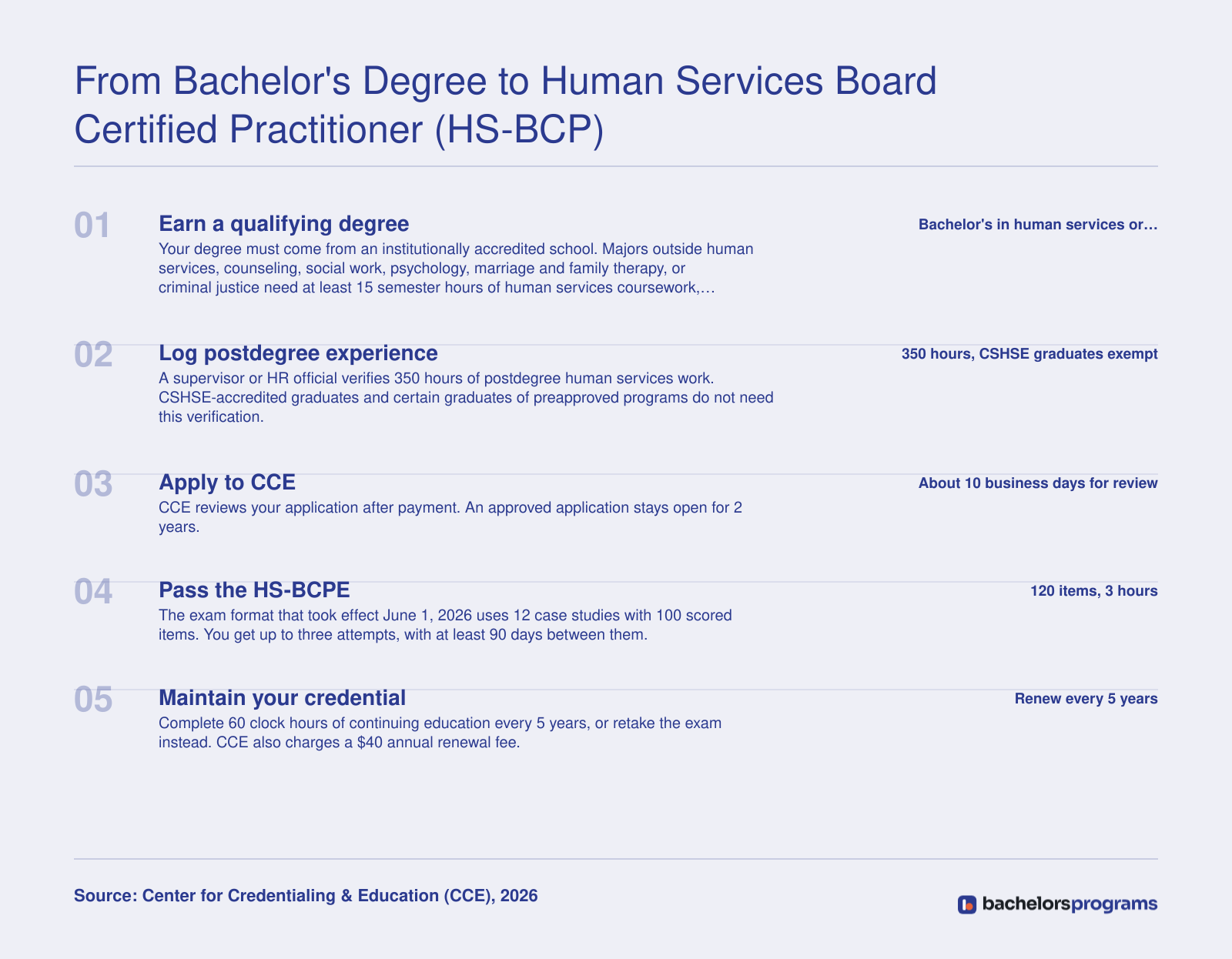
From Bachelor's Degree to Human Services Board Certified Practitioner (HS-BCP)
The HS-BCP is a national credential from the Center for Credentialing & Education (CCE). It is not a state license, but it gives employers verified proof of your training. Graduates of CSHSE-accredited programs skip the experience verification step.
Human Services Degree Salary and Career Outcomes
A human services degree leads to steady work with modest entry pay and room to advance into higher-paying management roles. The figures below come from the Bureau of Labor Statistics Occupational Outlook Handbook, using May 2025 wage data and 2025 to 2035 projections. They describe everyone working in each occupation, not just recent graduates.
How Much Do Human Services Majors Make?
BLS tracks three occupations where many bachelor's holders in this field work:
- Social and human service assistants: $45,930 median annual wage, with about 463,400 jobs nationally.
- Community health workers: $51,850 median, with about 64,700 jobs.
- Social and community service managers: $80,390 median, with about 231,000 jobs.
For context, the median wage across all U.S. occupations was $50,980.1 Entry-level roles sit near that mark, while management sits well above it.
Common Job Titles and Where They Fit
- Case manager: Entry-level case management positions typically fall under social and human service assistants, coordinating services for clients.
- Intake coordinator: Also grouped with social and human service assistants, screening clients and connecting them to programs.
- Community outreach worker: Aligns with community health workers, linking residents to health and social resources.
- Program coordinator: Often a stepping stone toward social and community service manager, where you oversee services and staff.
Job Growth Outlook
BLS rates projected growth for all three occupations as "much faster than average" from 2025 to 2035: 7 percent for assistants (about 34,200 new jobs), 13 percent for community health workers (about 8,200), and 7 percent for managers (about 16,600). Turnover adds to demand. BLS estimates roughly 48,900 openings a year for assistants and 18,500 for managers, averaged over the decade. Because those openings far exceed new job creation, most of them come from replacing workers who retire or change fields.
Is a Human Services Degree Worth It?
Assistant and community health worker jobs typically require only a high school diploma, so the degree is not a formal gate there. Its value shows up in hiring competitiveness and advancement: manager roles typically call for a bachelor's degree plus less than five years of related experience. Choosing an affordable program keeps your debt in proportion to starting pay, and the degree also positions you for graduate study, such as a master's in social work.
Keep these occupation-wide BLS wages separate from program-level completer earnings, which reflect what graduates earn shortly after finishing a degree.
Median Pay for Social and Human Service Assistants
Many bachelor's graduates start in assistant-level roles such as case management aide or family support worker, and national pay data shows what those positions typically earn.
Human Services vs. Social Work: Which Degree Fits You?
A human services bachelor's and a CSWE-accredited BSW can lead to similar-sounding jobs, but they open different doors. Most states tie bachelor's-level social work licensure to a CSWE-accredited BSW, so human services graduates generally cannot hold the title "social worker" where it is protected. Human services fits readers who want broad, flexible service careers. A BSW fits readers who want a direct path to licensed practice, including clinical work. Requirements vary by state, so confirm with your state licensing board.
| Factor | Human Services Bachelor's | CSWE-Accredited BSW |
|---|---|---|
| Focus | Broad preparation for service delivery, case support, program coordination, and nonprofit or agency work | Professional social work training built around licensure, ethics, and generalist practice |
| Accreditation body | Program accreditation is optional; CSHSE is the main human services standard | Council on Social Work Education (CSWE) accreditation |
| Bachelor's-level licensure | Generally not the qualifying degree for the bachelor's social work license category | Generally required, along with passing the bachelor's-level licensing exam |
| Use of the title "social worker" | Generally not permitted where the title is protected; check your state board | Available to licensed graduates in states that protect the title |
| Typical entry roles | Case aide, social and human service assistant, community outreach worker, program coordinator | Case manager, caseworker, and other entry-level social work roles, with licensure where required |
| Field hours | Internship or practicum is common, but hours vary by program | Supervised field education is a required part of the accredited curriculum |
| MSW advanced standing | Generally does not meet the CSWE-accredited BSW prerequisite | Typically eligible, though admission is selective and some programs expect grades of B or better in BSW courses |
| Graduate pathway | Usually enters a traditional two-year MSW; the MSW, not the bachelor's, is the qualifying degree for licensure above the bachelor's level | Can shorten the MSW through advanced standing; clinical licensure still requires an MSW, supervised experience, and an exam |
Questions to Ask Yourself
Do you want to deliver licensed clinical therapy someday?
Does your state protect the "social worker" title?
Would MSW advanced standing save you enough time and tuition?
Are you drawn to a specific population like addiction, gerontology, or youth services?
Human Services programs by state
Compare Human Services programs on the data that matters
Explore more Social Work & Social Sciences majors or browse every field of study.
All Social Work & Social Sciences programs Browse every field of study