Best Disability Studies Degree Programs
Compare 20+ accredited Disability Studies programs, with net price after aid, graduation rates, earnings and debt from IPEDS and the U.S. College Scorecard.

Average net price after aid at the schools ranked here runs from about $7,000 at California State University, Northridge to roughly $41,000 at Georgetown, a spread wide enough to reshape the decision.
A disability studies bachelor's degree is interdisciplinary, so the name on the diploma hides real differences. The University of Florida lists seven concentration options; Illinois Chicago's BS in Disability and Human Development requires a practicum in disability inclusion.
In a field this small, the differences that matter come down to what students actually pay, whether they finish, and whether the schedule fits a working life.
Key Points
- Georgetown graduates lead early earnings at $51,388 with $17,000 median debt.
- Net price after grants, not sticker tuition, reveals your real cost.
- Online formats suit working professionals; campus programs offer fieldwork and cultural centers.
Best Disability Studies Schools Ranked
Ten disability studies programs, listed in the order they earned. Each entry weighs what the degree costs after aid, whether students actually finish, and how well the program's format fits a student's life. The methodology section below explains how those pieces come together.
University of Florida
#1Gainesville, FL · ~$7,000/yr (est.)
Best for: Future advocates in education policy
The University of Florida runs its disability studies pathway through the College of Education, where Education Sciences majors choose a Disabilities in Society specialization. Students get a law and policy thread through courses such as Disabilities: Legal Aspects and Policies, plus a capstone and experiential learning. Campus ties to the Disability Resource Center give students a direct look at how a large university delivers accommodations. The school graduates 91% of its students.
- 7 concentration options within the Disabilities in Society specialization
- 120 total credit hours, including a required capstone
- Coursework in disability law and policy, research design, and social foundations
- Experiential learning through research, internships, or study abroad
- Not a teacher certification or educator preparation program
- Ties to UF's Disability Resource Center for accommodations work
- Four required courses offered asynchronously across fall, spring, and summer
University of California-Los Angeles
#2Los Angeles, CA · $13,000/yr (est. net price)
Best for: Pre-law students drawn to disability rights
UCLA launched its Disability Studies BA as the first major of its kind in the University of California and California State University systems, and it remains one of the most research-connected programs on this list. Faculty are shared with nursing, law, education, music, and the sciences, so coursework crosses medicine, culture, and policy. Students can also plug into community partnerships built around disability law and innovation. The school graduates 93% of its students.
- Offered as a bachelor's major in the UCLA General Catalog
- First disability studies major in the UC and Cal State systems
- Interdisciplinary work across nursing, law, education, music, and genetics
- Spring 2027 enrollment limited to sophomores and juniors
University of Washington-Seattle Campus
#3Seattle, WA · ~$14,000/yr (est.)
Best for: Community college transfers entering a social science major
Disability Studies at the University of Washington sits in the College of Arts and Sciences and treats disability as a social, cultural, legal, and political category rather than a medical one. It is a minimum-requirements major, so admitted students declare after finishing the introductory course, and both first-year and transfer students are welcome. The Seattle campus adds a large health sciences and policy ecosystem to the degree. The school graduates 85% of its students.
- Minimum requirements major; declare after the introductory course
- Prerequisite: DIS ST/LSJ/CHID 230 with at least a 2.0 GPA
- Rolling admissions with autumn and winter start quarters
- Open to first-year and transfer students
- Barbara Greenberg Distinguished Scholarship available to undergraduates
- Coursework on representation, marginalization, and intersecting identities
Davidson College
#4Davidson, NC · ~$17,000/yr (est.)
Davidson College is a small liberal arts college in North Carolina, and its disability studies major runs through the Center for Interdisciplinary Studies. Students build an individualized plan with faculty advisers instead of following a fixed sequence, which suits double majors and self-designed careers. Class sizes are small and mentorship is the norm. The school graduates 91% of its students.
- Individualized plans of study built with faculty advisers
- Housed in the Center for Interdisciplinary Studies
- Blends academics, activism, and career preparation
- Prepares graduates for advocacy, policy, education, or graduate study
Swarthmore College
#5Swarthmore, PA · ~$23,000/yr (est.)
Swarthmore College offers disability studies as an interdisciplinary BA inside a small, discussion-heavy liberal arts setting. The curriculum centers on disability theory, ableism, accessibility, and disability justice, with coursework spread across the humanities and social sciences. A required thesis gives students a chance to apply that theory to a real question before graduating. The school graduates 92% of its students.
- Interdisciplinary BA examining disability as a social and political identity
- Required thesis applying theory to real-world disability issues
- Coursework in disability theory, ableism, accessibility, and disability justice
- Bachelor of Arts degree awarded
University of North Florida
#6Jacksonville, FL · $10,000 – $15,000/yr (est.)
The University of North Florida offers disability studies as a concentration inside its BA in Education, so students graduate with both an education degree and a disability services focus. The curriculum pairs disability law, inclusive practice, and leadership coursework with a long practicum sequence and a senior capstone. Jacksonville's community agencies and service providers supply the field placements. The school graduates 69% of its students.
- Disability Services concentration inside the BA in Education
- 15-credit practicum sequence plus a senior capstone
- Courses include Disability Laws and Policy and Universal Design for Learning
- 120 total credit hours; Intro to Teaching Profession prerequisite
- Prepares for advocacy, community agencies, and employment services
- On-campus program with clinical placements and experienced faculty
University of Illinois Chicago
#7Chicago, IL · ~$11,000/yr (est.)
The University of Illinois Chicago grants a BS in Disability and Human Development through a department devoted entirely to the field, which is unusual and gives the major real depth. Core coursework runs from disability policy and law to activism, arts, and research methods, with electives in American Sign Language, Deaf culture, and assistive technology. A practicum and capstone keep the degree applied. The school graduates 62% of its students.
- 120 credit hours: 47 in the major, 49 in electives
- Practicum in interdisciplinary disability inclusion required
- Senior capstone required
- Electives include American Sign Language, Deaf culture, assistive technology
- Core covers disability policy, law, activism, arts, and research methods
- DHD 101 and DHD 102 satisfy two general education categories
Georgetown University
#8Washington, DC · $40,000 – $45,000/yr (est.)
Georgetown University's 31-credit Disability Studies major draws on faculty from anthropology, bioethics, English, health systems, and philosophy. Students finish with either a senior thesis or a community-based learning project. The Washington, DC location puts federal policy shops, advocacy organizations, and medical institutions within reach of internships and research. The school graduates 95% of its students.
- 31-credit major
- Senior thesis or community-based learning project
- Draws on anthropology, bioethics, English, health systems, and philosophy
- Washington, DC location near disability law, policy, and advocacy institutions
Stony Brook University
#9Stony Brook, NY · ~$19,000/yr (est.)
Stony Brook University delivers disability studies as a concentration inside the BS in Health Science, so the degree carries health sciences coursework alongside disability content. Seniors move through a learning community cohort and can add an internship. Graduates typically head into developmental disability services, independent living centers, mental health agencies, or vocational rehabilitation, or continue to graduate school. The school graduates 76% of its students.
- BS in Health Science with a Disability Studies and Human Development focus
- 2.0 GPA minimum
- Capstone or culminating project required
- Senior year learning community cohort with optional internship
- Courses on aging and disability, popular culture, and children with disability
- Prepares for developmental disability services and vocational rehabilitation
California State University-Northridge
#10Northridge, CA · ~$7,000/yr (est.)
California State University, Northridge offers disability studies as an 18-unit minor rather than a standalone bachelor's degree, so it works as a pairing with any major on campus. The coursework covers disability history, legislation, representation, and advocacy, with electives drawn from several departments. It is the shortest commitment on this list and the easiest to add to an existing degree plan. The school graduates 57% of its students.
- 18-unit minor, not a standalone bachelor's major
- Core courses include Introduction to Disability Studies
- Electives span multiple departments
- Examines disability history, legislation, representation, and advocacy
- Pairs with any major to build cultural competency
Cost & outcomes by school
Federal data for the highest-earning Disability Studies programs, independent of the ranking above. Earnings are this field's bachelor's graduates four years after completing where the Scorecard reports them, else the school's undergraduate median.
| School | Net price / yr | Grad rate | Earnings | Debt | Grads/yr | Format |
|---|---|---|---|---|---|---|
| Davidson College NC | $17,379 | 91% | $81,400 | $18,688 | 7 | Campus |
| Swarthmore College PA | $23,149 | 92% | $80,257 | $17,500 | 5 | Campus |
| Stony Brook University NY | $18,784 | 76% | $74,502 | $18,228 | 15 | Campus |
| Hobart William Smith Colleges NY | $31,563 | 77% | $68,831 | $27,000 | 2 | Campus |
| Auburn University AL | $24,323 | 82% | $65,337 | $21,000 | — | Campus |
| University of Massachusetts-Lowell MA | $17,163 | 65% | $64,874 | $23,704 | — | Online |
| University of Kentucky KY | $18,851 | 71% | $59,025 | $22,500 | 6 | Campus |
| SUNY Old Westbury NY | $11,282 | 45% | $58,526 | $14,997 | — | Campus |
| William Paterson University of New Jersey NJ | $18,745 | 44% | $57,780 | $22,334 | 8 | Campus |
| Stockton University NJ | $20,670 | 69% | $57,602 | $20,500 | 1 | Campus |
| University of Washington-Seattle Campus WA | $14,091 | 85% | $57,534 | $12,551 | 49 | Campus |
| University of North Florida FL | $10,154 | 69% | $56,343 | $15,531 | 1 | Campus |
Sources: U.S. Department of Education. Net price, graduation rate, earnings and debt: College Scorecard (earnings and debt for this field's bachelor's graduates where reported, else school-wide); graduates: IPEDS. A dash means no figure is reported.
Cost, debt & payoff
Median earnings of this field's bachelor's graduates (4 yrs after completing, else the school's undergraduate median) vs. their median federal loan debt · U.S. College Scorecard
Across these programs the median graduate earns about $55,541 and finishes with roughly $20,500 in debt — a ratio that clears a common rule of thumb (keep debt below first-year salary). Net price and debt vary widely school to school, so check the per-school figures in the table above before you shortlist.
How We Ranked These Disability Studies Programs
What separates a strong disability studies program from one that just sounds good in a brochure? We focused on outcomes and costs you can verify, then weighed them alongside how flexibly you can actually take the classes.
The Four Inputs Behind the Order
- Average net price after aid: What students typically pay after grant aid comes off the bill, a better comparison than the published sticker price.
- Graduation and retention: How many students return after their first year and how many finish, a practical signal of student support and academic fit.
- Program-level earnings and debt: Where College Scorecard publishes figures for disability studies graduates specifically, we considered early earnings against typical borrowing.
- Online or hybrid availability: Programs you can complete fully online or in a hybrid format earned credit, since many students in this field are working adults, caregivers, or people with disabilities who need flexible schedules.
What the Numbers Can and Cannot Tell You
Graduation and retention rates cover the whole institution, not the disability studies major alone. A school with a strong overall completion rate may still run a small department with its own strengths and gaps.
That figure is an average across students who receive aid. Your own cost depends on family income, state residency, and transfer credits, so get a personalized estimate from each school before comparing offers.
Smaller programs often graduate too few students for earnings and debt figures to be published. When that happens, the missing data does not count against the school. We ranked it on the measures that are available.
No Paid Placements
No school paid to appear on this list or to move up in it. The order reflects the data, and bachelorsprograms.com does not accept payment for ranking positions.
Disability Studies Degree Tuition and Costs Compared
The sticker price on a disability studies degree rarely matches what you actually pay, and the gap between them is the number that matters. Published tuition is the starting point. The figure to compare is net price, which accounts for the aid a student actually receives. Public in-state, public out-of-state, and private schools can land far apart on both, so check each school's net price in the rankings above before deciding that a private option is out of reach.
Online Per-Credit Pricing
Online programs are easier to price because they publish per-credit rates.
- CUNY School of Professional Studies: The fully online BA in Disability Studies is 120 credits at $305 per credit for 2026-27. That estimates $36,600 in tuition before mandatory fees, books, and any transfer credit.
- Walden University: The online bachelor's Disability Studies concentration charges $360 per quarter credit hour across 181 quarter credits, plus a $185 program fee each quarter. Published totals are $65,160 in tuition and $2,960 in fees, or $68,120 before aid.1
- Arizona State University Online: The BA in Disability Studies is 120 credit hours. Confirm the current per-credit rate and fees with the school.
Do not compare CUNY's and Walden's rates directly. A quarter credit carries less instruction than a semester credit, so the two per-credit prices are not equivalent.
Residency and Scholarship Fine Print
CUNY says fully online degree students qualify for in-state tuition regardless of residence. A separate notice says students who first enrolled in Winter 2023 or later pay a non-resident online rate. Ask the school which applies to you.
Walden's $20,310 Believe & Achieve Scholarship brings the published estimate down to $47,810.1 That figure assumes course-based format, minimum completion time, and no transfer credit. Tuition and fees can change.
Transfer Credits Change the Math
If you arrive with 60 credits, you pay for roughly half the degree. At CUNY's rate, that trims the remaining tuition to about $18,300. Get an official credit evaluation before you compare programs.
Three Most Affordable Disability Studies Programs After Aid
This affordability shortlist is not a second ranking. It sorts schools by the average net price students paid after grants and scholarships, using 2024 U.S. Department of Education data from IPEDS and the College Scorecard. Net price is an average across aided students, so your own cost can land well above or below it depending on household income, residency, and the aid package a school offers you. The CSUN entry is an 18-credit minor, and the UNF option is a special education degree with a disability services focus, so confirm the program structure fits your goals before comparing on price alone.
| School | Program | State | Format | Average Net Price After Aid | In-State Tuition and Fees |
|---|---|---|---|---|---|
| University of Florida | Disabilities in Society (Bachelor's) | FL | Campus | $6,541 | $6,381 |
| California State University-Northridge | Disability Studies Minor | CA | Campus | $7,021 | $7,458 |
| University of North Florida | Special Education, Disability Services (Bachelor's) | FL | Campus | $10,154 | $6,389 |
Related Articles
Online vs. Campus Disability Studies Degrees: Which Format Fits You
Coursework looks much the same in either format; what decides it is whether you can trade campus access for schedule flexibility. Online suits people already working in the field; campus suits students who want fieldwork, disability cultural centers, and faculty supervision in person.
Online: built for working adults in the field
CUNY SPS delivers its B.A. in Disability Studies fully online at 120 credits, with concentrations in intellectual and developmental disabilities, autism spectrum disorder, mental and behavioral health, and arts, culture, and design. Applicants need 24 transferable credits and a 2.5 GPA. Arizona State offers the same major fully online or through ASU Sync, with asynchronous courses in 6- to 7.5-week sessions. Sync lets students attend virtually or in person, but the disability studies courses themselves run virtually, and required courses outside the major may meet in person. Both formats suit paraprofessionals and direct support staff who need to keep earning while enrolled. Fully online majors are the exception among the programs ranked here, so choosing this route narrows your list quickly.
Campus: fieldwork, centers, and research access
Residential programs put you near disability cultural centers, faculty research, and supervised placements. UCLA, the University of Washington, Georgetown, and the University of Florida all list disability studies as a campus major; UIC requires a practicum in disability inclusion, and Florida builds in a capstone and experiential learning. Those extras matter if you want research assistant roles or a peer community between classes.
Check the credential and the practicum
UC Berkeley and Ohio State list disability studies as a minor only in 2026, so confirm you are applying to a full major and not a minor.1 Then ask where the practicum happens: an online major can still require a local placement you arrange near home.
Rehabilitation Counselor Pay at a Glance
Rehabilitation counseling is one of the most direct career paths for disability studies graduates, and federal wage data offers a useful benchmark for what the work pays.
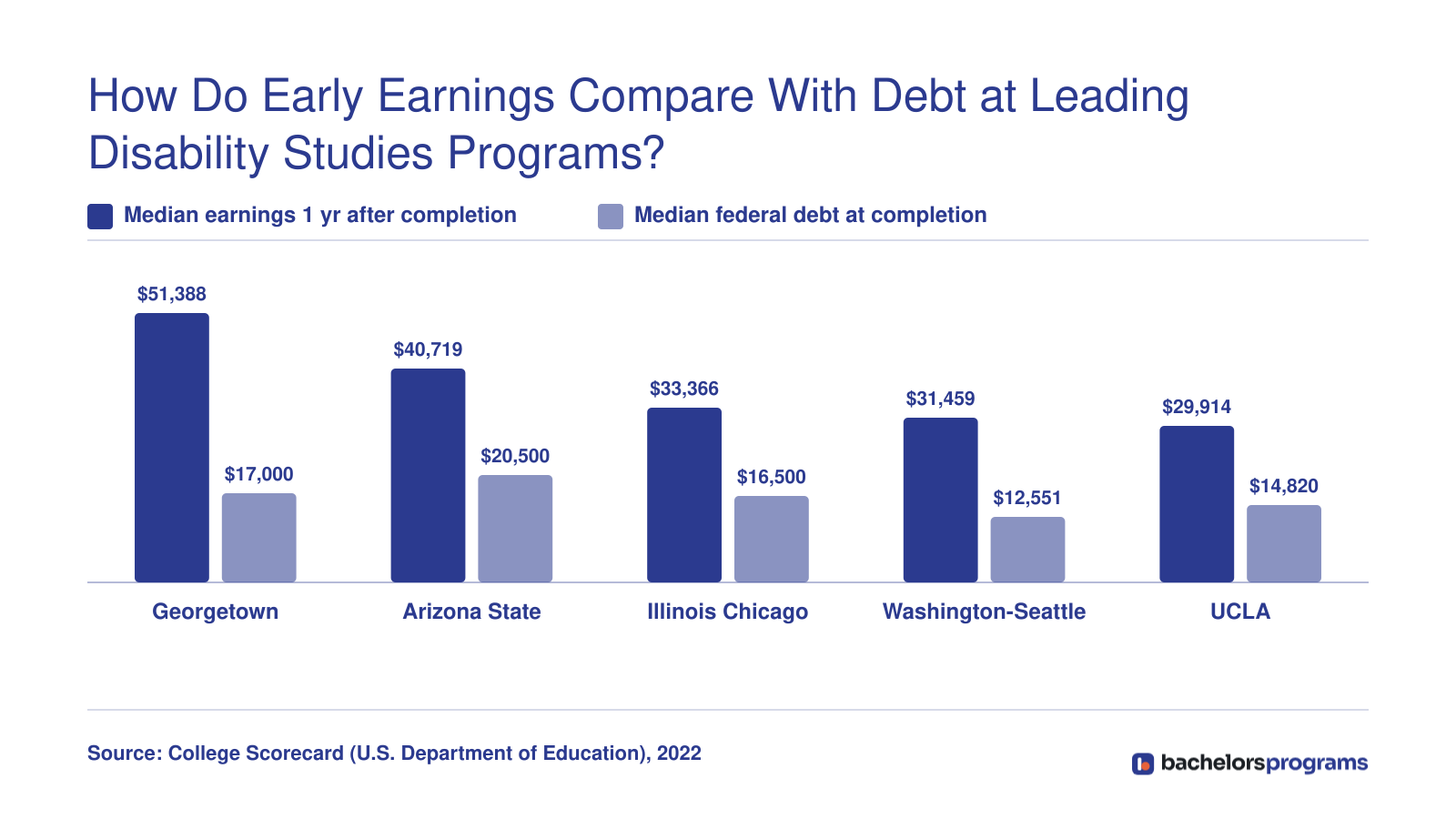
How Do Early Earnings Compare With Debt at Leading Disability Studies Programs?
Georgetown graduates lead on early pay at $51,388 against $17,000 in median debt. Arizona State, Illinois Chicago, Washington and UCLA graduates earn between $29,914 and $40,719 a year after finishing, with median debt from $12,551 to $20,500. Every figure is a program-level College Scorecard median for disability studies bachelor's completers, not a school-wide number, and the outcomes data reflect 2022 cohorts; small graduating classes can make these medians swing year to year.
Admissions, Transfer Credits, and Concentrations to Check Before You Apply
Disability studies programs differ more in their fine print than in their course titles. Confirm each of these details with the admissions office before you commit.
- GPA and testing requirementsCUNY School of Professional Studies asks transfer applicants to its online B.A. for at least 24 transferable credits, a minimum 2.5 cumulative GPA, and basic proficiency in reading, writing, and math. Testing policies vary by school and entry path, so ask directly whether SAT or ACT scores are required.
- Transfer credit capsCUNY SPS accepts up to 105 credits toward its 120-credit degree, including prior-learning credit and ACE-evaluated military training. You must still complete at least 15 credits there. Its articulation agreements cover human services associate degrees from BMCC and Hudson Valley Community College. The University of Toledo evaluates credit from regionally accredited schools after admission and offers Ohio Guaranteed Transfer Pathways for associate-degree holders.
- Completion timeA 120-credit bachelor's degree generally takes about four years of full-time study, and longer if you enroll part time. Degree-completion students who bring in large transfer blocks can finish sooner. Your actual timeline depends on your official credit evaluation and on which courses are available.
- Concentration fitTracks in autism, intellectual and developmental disabilities, policy, or disability arts lead toward different work. These range from direct support and education to advocacy, government, and cultural roles. Choose the track that matches your target career.
- Fieldwork rulesAsk whether an internship or practicum is required. If you study online, ask whether you can complete it at an approved site near home.
- Faculty perspectiveCheck whether the faculty includes disabled scholars or practitioners with lived experience, since their perspective shapes how the field is taught.
Questions to Ask Yourself
Does your target job require a master's degree anyway?
Would a minor paired with education, nursing, or psychology get you licensed faster?
Do you want a career in policy or advocacy?
Could you finish the bachelor's at a low net price?
Disability Studies programs by state
Compare Disability Studies programs on the data that matters
Explore more Social Work & Social Sciences majors or browse every field of study.
All Social Work & Social Sciences programs Browse every field of study