Best Sociology Degree Programs
Compare 1,400+ accredited Sociology programs at 910+ colleges, with net price after aid, graduation rates, earnings and debt from IPEDS and the U.S. College Scorecard.

Net price at the sociology programs ranked here runs from $6,128 to $16,109 a year after grants, a spread wide enough to change what a degree costs over four years. Every school on the list delivers the major on campus; students who need online coursework will have to look outside this group.
The tension is not reputation. What matters is whether a program's graduation rate, debt load and early-career earnings justify the price of attendance, and those numbers vary more between schools than the curricula do. Sociology departments teach similar theory and methods sequences.
What separates them is what happens after: who finishes, what they owe, what they earn early.
Key Points
- Arizona State, UCF, and Oregon State offer fully online sociology bachelor's degrees.
- Choose a BS for data and policy work, a BA for breadth.
- Baruch College and University of Florida use state funding to lower costs.
Top 10 Sociology Degree Programs for 2027
The ten programs below share a common thread: each pairs a sociology curriculum grounded in theory and research methods with a strong institutional track record. Every school on this list offers its sociology major on campus, and all ten are public or private nonprofit institutions with graduation rates above 80 percent. What separates them is concentration depth, from Berkeley's research methods track to Michigan's law and social work sub-majors, and the fact that net price after aid ranges from roughly $12,500 to over $120,000 depending on residency and aid.
University of California-Los Angeles
#1Los Angeles, CA · $13,000/yr (est. net price)
Best for: California residents wanting research depth
UCLA's sociology department sits inside one of the largest and most research-active public universities in the country, and the major reflects that scale: eleven upper-division courses, a required theory and methods core, three core area courses, and five electives. Students can pursue an honors program, undergraduate research, and study abroad, and a Pre-Sociology pathway lets incoming students declare early. The school graduates 93 percent of students.
- 11 upper division courses required for the major
- Preparatory courses must be completed with a C or higher
- 2.0 GPA average required to remain in good standing
- Theory, methods, and three core area courses required
- Five elective options, including study abroad and variable topics
- Honors program and undergraduate research opportunities available
- Pre-Sociology major option for incoming students
- Alpha Kappa Delta sociology honor society membership
Princeton University
#2Princeton, NJ · ~$6,000/yr (est.)
Best for: Future researchers wanting close faculty mentorship
Princeton's sociology program is intentionally small, with a 3:1 student-to-faculty ratio and a nine-course major that includes introduction to sociology, sociological theory, and statistics. Students can specialize in methods such as computational social science or ethnography, complete a junior paper seminar, and write a senior thesis. Coursework centers on inequality, poverty, immigration, race and ethnic relations, and religion in public life. The school graduates 98 percent of students.
- 9 courses required to complete the major
- 3:1 student-to-faculty ratio in the department
- Introduction to sociology, sociological theory, and statistics required
- Methods specializations in computational social science and ethnography
- Junior paper seminar and optional senior thesis
- Study abroad opportunities with funding available
- Coursework on inequality, poverty, immigration, and race relations
- Prepares graduates for tech, law, medicine, or academia
University of California-Berkeley
#3Berkeley, CA · ~$13,000/yr (est.)
Best for: Students targeting methods-heavy social science
Berkeley offers a sociology major with an explicit concentration in sociological research methods, training students in both methods and theory alongside faculty in one of the country's top-ranked departments. Honors opportunities, research funding, mentoring, and study abroad are built into the undergraduate experience, and students have access to a major map, dedicated advising, and student organizations. The school graduates 93 percent of students.
- Concentration in Sociological Research Methods available
- Training in both research methods and sociological theory
- Honors opportunities and potential research funding
- Mentoring, study abroad, and Berkeley Connect program
- Dedicated advising, undergraduate writing resources, and a major map
- Sociology student organizations and special enrollment procedures
- Campus-based program located in Berkeley, California
University of California-Santa Barbara
#4Santa Barbara, CA · $15,000 – $20,000/yr (est.)
UCSB runs one of the largest sociology departments in the country, with more than 1,600 undergraduate majors and a curriculum built on a strong theoretical foundation plus methodology training. Students explore gender, culture, race and ethnicity, social movements, globalization, Latinx studies, conversation analysis, and social networks. An honors program lets high-achieving students graduate with distinction, and faculty research is described as cutting-edge. The school graduates 83 percent of students.
- More than 1,600 undergraduate majors in the department
- Strong theoretical foundation plus methodology training
- Honors program available for high-achieving students
- Coursework in gender, culture, race and ethnicity, and social movements
- Topics include globalization, Latinx studies, and social networks
- Pre-major requirements and GPA thresholds apply
- Advising support provided by the department
University of California-Irvine
#5Irvine, CA · $14,000/yr (est. net price)
UC Irvine offers a Bachelor of Arts in Sociology built on twelve courses covering theory, research methods, and a capstone seminar, with an optional concentration in Public and Applied Sociology. An honors program lets eligible students write a thesis, and the curriculum emphasizes empirical sociological research on topics such as gender, family, organizations, and social networks. Honors eligibility includes a 3.2 GPA. The school graduates 87 percent of students.
- 12 courses required for the major
- Includes sociological theory, research methods, and a majors seminar
- Honors program with a required thesis project
- 3.2 GPA for honors eligibility; transfer students eligible
- Concentration in Public and Applied Sociology available
- Coursework in gender, family, organizations, and social networks
- Empirical sociological research focus throughout the curriculum
Stanford University
#6Stanford, CA · $10,000 – $15,000/yr (est.)
Stanford's sociology BA requires 60 units in the major on top of the university's 180-unit minimum, structured around a four-course core, three foundation courses, social science electives, a methods course, a Writing in the Major course, and a capstone sequence or honors thesis. Students choose between the standard BA and a Data Science, Markets, and Management subplan covering programming, big data, and network analysis. Honors admission requires a 3.5 major GPA and 3.3 overall. The school graduates 92 percent of students.
- 60 units in the major on top of the 180-unit university minimum
- Capstone spans a three-course sequence; honors thesis earns up to 12 units
- Two pathways: standard BA or Data Science, Markets, and Management subplan
- Subplan covers programming, big data, and network analysis
- Three foundation courses across five study areas
- One quantitative or qualitative methods course plus Writing in the Major
- Honors requires a 3.5 major GPA and 3.3 overall
- Up to 10 units may be taken outside Sociology
University of California-Davis
#7Davis, CA · $10,000 – $15,000/yr (est.)
UC Davis offers a sociology BA through the College of Letters and Science with four emphases: general, law and society, social services, and comparative studies. Coursework builds theory and methodological training around inequality, immigration, criminal justice, and health care politics, and students have access to internships, undergraduate research, faculty collaboration, and global learning programs. Graduates go into law, education, social work, research, and marketing. The school graduates 86 percent of students.
- Four emphases: general, law and society, social services, comparative studies
- Theory and methodological training required
- Coursework on inequality, immigration, criminal justice, and health care
- Internships, undergraduate research, and faculty collaboration
- Global learning programs and a published course roadmap
- Department advisor support and full requirements online
University of North Carolina at Chapel Hill
#8Chapel Hill, NC · ~$12,000/yr (est.)
UNC Chapel Hill's sociology major is a flexible nine-course BA with a primary specialization in quantitative analysis and roughly fourteen concentration options, including social inequality, marriage and family, work and the economy, sex and gender, social movements, and population and human ecology. Students can pursue independent studies, an honors thesis, and community internships, and interdisciplinary combinations are encouraged. The school graduates 91 percent of students.
- 9 courses required for the BA, with substantial flexibility
- 14 concentration options across inequality, family, work, gender, and more
- Primary specialization in quantitative analysis
- Honors thesis, independent study, and community internships available
- Interdisciplinary approaches and possible graduate course enrollment
- Advising through both the department and College of Arts and Sciences
University of California-San Diego
#9La Jolla, CA · $10,000 – $15,000/yr (est.)
UC San Diego's sociology BA requires four lower-division and twelve upper-division courses with a 2.0 major GPA and a C- minimum per course, and offers seven concentrations including International Studies, American Studies, Science and Medicine, Culture and Communication, Social Inequality, Law and Society, and Economy and Society. An honors program is open to students with a 3.5 GPA, study abroad is encouraged, and transfer credit is accepted. The school graduates 86 percent of students.
- Four lower-division and twelve upper-division courses required
- 2.0 GPA in the major with a C- minimum per course
- Seven concentrations, including Law and Society and Science and Medicine
- Other concentrations: International Studies, American Studies, Culture and Communication
- Honors program available with a 3.5 GPA and faculty sponsor
- Study abroad encouraged and transfer credit accepted
- A seven-course sociology minor is also offered
University of Michigan
#10Ann Arbor, MI · $18,000 – $61,000/yr (est.)
Michigan's sociology major requires 33 credits at the 200 level or above, including statistics, research methods, and sociological theory, with at least 18 credits completed on the Ann Arbor campus. Optional sub-majors cover Law, Justice, and Social Change; Sociology of Health and Medicine; and Sociology and Social Work, the last aimed at students heading toward an MSW. An honors program requires a 3.4 GPA and a thesis. The school graduates 93 percent of students.
- 33 credits at the 200 level or above, including statistics, methods, and theory
- At least 18 credits must be completed on the Ann Arbor campus
- Sub-majors in Law, Justice, and Social Change and Sociology of Health and Medicine
- Sociology and Social Work sub-major prepares students for MSW programs
- Honors program requires a 3.4 GPA and a thesis
- Pass/fail courses are not allowed in the major
- Introductory course prerequisite with a C- or better
Cost & outcomes by school
Federal data for the highest-earning Sociology programs, independent of the ranking above. Earnings are this field's bachelor's graduates four years after completing where the Scorecard reports them, else the school's undergraduate median.
| School | Net price / yr | Grad rate | Earnings | Debt | Grads/yr | Format |
|---|---|---|---|---|---|---|
| Stanford University CA | $13,807 | 92% | $124,080 | $12,000 | 36 | Campus |
| Princeton University NJ | $6,128 | 98% | $110,066 | $10,320 | 31 | Campus |
| Santa Clara University CA | $50,062 | 88% | $109,183 | $19,162 | 15 | Campus |
| Lehigh University PA | $36,931 | 88% | $105,584 | $21,960 | 23 | Campus |
| Georgetown University DC | $40,815 | 95% | $103,494 | $13,266 | 25 | Campus |
| Harvard University MA | $19,066 | 98% | $101,817 | $14,000 | — | Campus |
| Columbia University in the City of New York NY | $21,590 | 96% | $101,536 | $27,000 | 55 | Campus |
| Yale University CT | $23,777 | 96% | $100,533 | $12,975 | 20 | Campus |
| Washington and Lee University VA | $23,781 | 94% | $94,810 | $19,500 | — | Campus |
| Brown University RI | $25,184 | 96% | $93,487 | $11,428 | 33 | Campus |
| University of Chicago IL | $14,860 | 96% | $91,885 | $15,000 | 46 | Campus |
| Rice University TX | $13,370 | 95% | $89,718 | $11,000 | 29 | Campus |
Sources: U.S. Department of Education. Net price, graduation rate, earnings and debt: College Scorecard (earnings and debt for this field's bachelor's graduates where reported, else school-wide); graduates: IPEDS. A dash means no figure is reported.
Cost, debt & payoff
Median earnings of this field's bachelor's graduates (4 yrs after completing, else the school's undergraduate median) vs. their median federal loan debt · U.S. College Scorecard
Across these programs the median graduate earns about $53,484 and finishes with roughly $23,000 in debt — a ratio that clears a common rule of thumb (keep debt below first-year salary). Net price and debt vary widely school to school, so check the per-school figures in the table above before you shortlist.
How We Ranked These Sociology Programs
A famous name and a good return on your money are not always the same thing. Many sociology rankings lean on peer surveys, which measure how professors view each other's departments. This list weights what students actually pay, finish, earn and owe.
The five inputs
- Net price after aid: What a typical student pays once grants and scholarships are subtracted, not the published sticker price.
- Completion and graduation rate: The share of students who finish. A low-cost school that few students complete is not a bargain.
- Program-level earnings: What graduates of the sociology program itself earn, rather than a school-wide average that blends in engineering and nursing.
- Median debt: How much graduates typically borrow, which shapes your monthly payments after you leave.
- Admissions selectivity: How hard it is to get in, so you can judge your realistic chances before you apply.
Why not reputation alone?
Reputation can be a useful tie-breaker, but it says little about whether you will graduate on time or manage your loans. Weighting cost, completion, earnings and debt keeps the focus on outcomes you can verify and compare across online and campus options.
How to use the list
Treat the rankings as a starting point, not a final answer. Pick three schools that fit your budget, schedule and goals. Then run each school's net price calculator, which is available on its financial aid page, using your own family income and aid situation. Your own net price can differ sharply from these averages, often by enough to decide which of your three finalists makes sense.
Most Affordable Sociology Degree Programs
Net price is the average amount students actually pay after grants and scholarships, based on 2024 IPEDS and College Scorecard data from the U.S. Department of Education. Public schools like Baruch College and the University of Florida use state funding to keep in-state tuition low, while Princeton, a private school with a $62,688 sticker price, reaches a low net price only through large aid awards. The Pell share shows how many students receive federal Pell Grants, so a higher figure signals a school that enrolls and supports lower-income students; because every figure here is an average, use each school's net price calculator for a personal estimate.
| School | Location | Sector | Average Net Price (After Aid) | In-State Tuition and Fees | Pell Share | Format |
|---|---|---|---|---|---|---|
| CUNY Bernard M Baruch College | New York, NY | Public | $3,033 | $7,464 | 89.5% | Campus |
| University of Florida | Gainesville, FL | Public | $4,815 | $3,876 | 66.7% | Campus |
| Princeton University | Princeton, NJ | Private nonprofit | $6,128 | $62,688 | 81.4% | Campus |
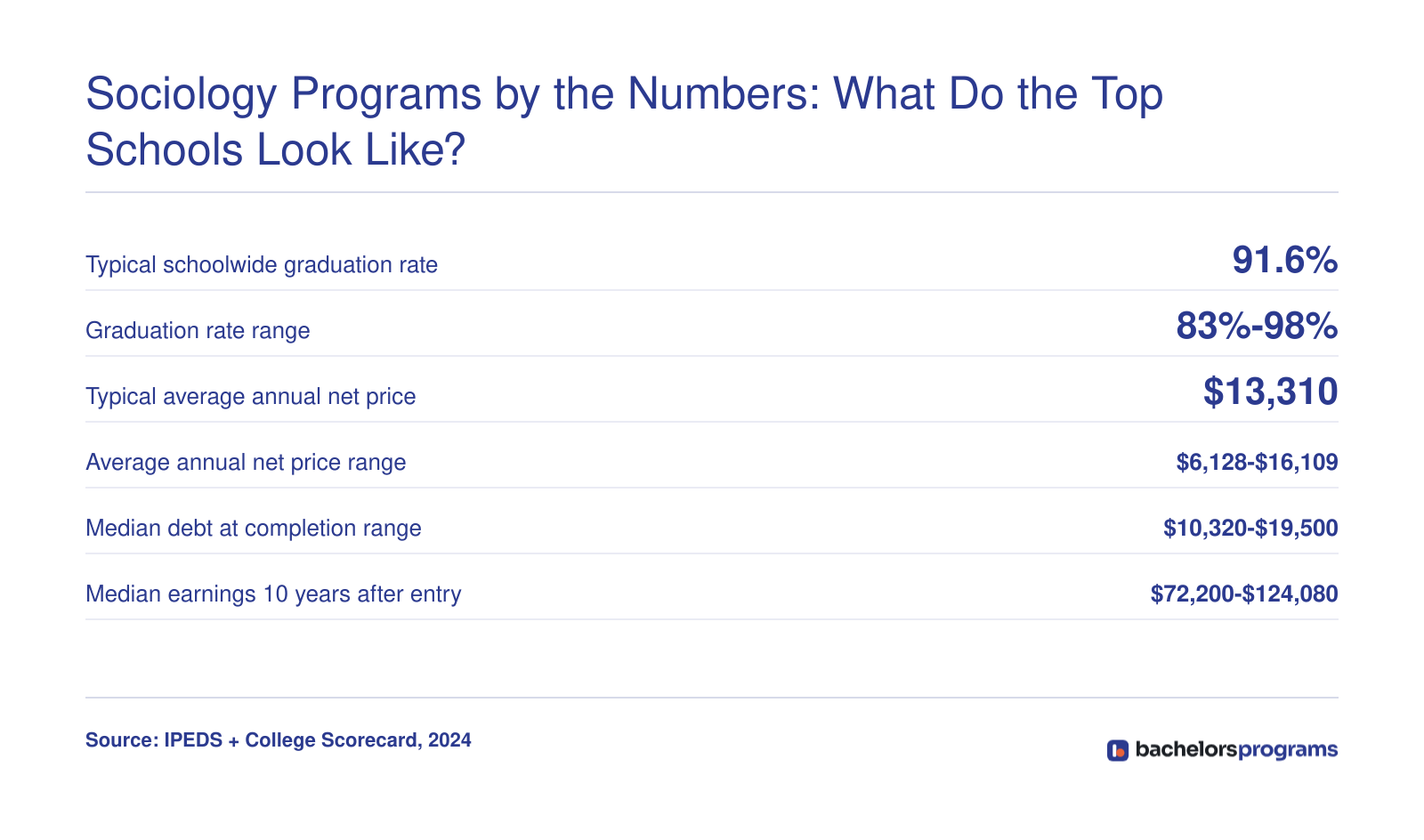
Sociology Programs by the Numbers: What Do the Top Schools Look Like?
These figures summarize the schools ranked here as a group, so they describe the whole field rather than any single program. Graduation, retention, debt and earnings figures are institution-wide, covering all students at each school and not only sociology majors. Read them as a baseline for what strong sociology departments sit inside.
Related Articles
Online vs Campus Sociology Degrees: Flexibility, Transfer Credit, and Time to Finish
Can you earn a sociology bachelor's degree completely online? Yes. Arizona State University, the University of Central Florida, and Oregon State University's Ecampus all offer fully online sociology bachelor's programs. The top-ranked programs on this page, however, are all campus-based, so choosing online usually means looking beyond the most selective research universities.
Which Format Fits You
Online programs suit working adults, parents, and transfer students who need to study around a job or family schedule. ASU Online, for example, runs its courses in 7.5-week sessions, so you can focus on fewer classes at a time.1 Campus programs make more sense if you want hands-on research, internships, and close faculty mentoring. UCLA, UC Berkeley, and UC Davis all highlight undergraduate research or internship opportunities, and the University of Michigan requires its sociology methods and theory courses to be taken on the Ann Arbor campus.
How Long It Takes
Plan on about four years of full-time study, or roughly 120 semester credits. Oregon State lists 180 quarter credits, which works out to about the same load.4 Treat four years as an estimate, not a promise: transfer credit, course availability, prerequisites, and part-time enrollment all shift your timeline.
Transfer credit is the fastest route to finishing early, but the limit usually comes from residency rules rather than a single published cap. UCF requires 30 of your last 39 credits at UCF, including at least 24 upper-level sociology credits.3 Oregon State requires 45 of your last 75 credits at OSU, online or on campus.4 ASU's program pages list no sociology-specific cap and defer to the university's general evaluation and residency rules.
Accelerated pathways vary by school. ASU offers a bachelor's-plus-master's option that can deliver both degrees in as few as five years, with approval typically during junior year.1 Oregon State's accelerated route leads to a Master of Public Policy rather than a sociology master's.4
Questions to Ask Before You Enroll
- Transfer limits: How many credits will you accept, and how many must I complete at your school?
- Scheduling: Are online courses fully asynchronous, or do some require live sessions?
- Course availability: Is every required course and elective offered online? UCF notes that not all electives or prerequisites are available online.2
- Diploma: Is the online degree identical to the campus diploma and transcript?
BA vs BS in Sociology: Which Degree Fits You?
A BS leans quantitative and suits data, research, and policy analysis paths. A BA offers more breadth and suits social services, law, and teaching. Many schools offer only a BA, so check the methods and statistics coursework in the catalog rather than relying on the degree label. The requirements below come from published 2026 curricula and vary by school.
| Factor | BA in Sociology | BS in Sociology |
|---|---|---|
| General education focus | Broader liberal arts base with more room for humanities and social science breadth | Adds more mathematics and other social-science training for students with strong quantitative interests |
| Statistics requirement | 4 semester hours of Statistical Analysis in Sociology, or an approved introductory social-science statistics course | Elementary Statistics (4 credits) plus Intermediate Social Statistics (4 credits) |
| Research methods requirement | 4 semester hours of Research Methods in Sociology, or an approved social-science methods course | Social Research Methods (5 credits, with a required lab) plus Social Research Project (4 credits) |
| Foreign language requirement | 12 semester hours of language study or demonstrated equivalent proficiency | 6 college credits in the same language, including the first-year sequence, or equivalent proficiency |
| Typical electives | Wide range of topical courses, such as family, inequality, health, and crime, plus electives outside the major | Advanced statistics, social-science computing, and research-oriented courses in an analysis and research track |
| Best-fit careers | Social services, law, teaching, and social-policy work | Data analysis, research, and policy evaluation roles |
| Graduate school fit | Prepares students for an MA or PhD in sociology; add extra statistics if aiming at data-heavy programs | Prepares students for an MA or PhD in sociology; the extra statistics suits public policy and data analysis programs |
Sociology Concentrations: Criminology, Pre-Law, Urban, and Data Tracks
A general sociology major and a concentration track lead to the same degree. The difference is how clearly your transcript signals that focus before you have to explain it in an interview.
What the ranked programs actually list
Criminology is the label prospective students ask about first, but it rarely appears as a formal concentration among the schools ranked here. Where programs do publish a track, the names cluster around research methods, law and society, and inequality. UC Berkeley lists Sociological Research Methods. UC San Diego publishes seven options, among them Law and Society, Social Inequality, Culture and Communication, Science and Medicine, and Economy and Society. UNC Chapel Hill names social inequality, marriage and family, and aging. UC Davis keeps a general track with four emphasis areas, and Stanford's program points to a computational social science path inside the major.
Who each track fits
- Criminology: for students drawn to policing, courts, and corrections. A likely next step is probation or corrections work, or a justice-focused master's.
- Pre-law or law and society: for anyone aiming at law school, legal aid, or policy analysis. Pairs well with internships in legal services.
- Urban and community studies: for readers who want local government, housing nonprofits, or community organizing.
- Environmental sociology: for students headed toward climate policy, environmental justice, or sustainability roles in agencies and advocacy groups.
- Data and social research: for the quantitatively minded. Leads toward market research, program evaluation, and analyst positions.
Do you need one?
No. You can enter probation work, policy, or research without a named concentration. The track signals focus to employers and graduate committees, and a methods-heavy sequence or an honors thesis does much the same job. Work backward from the next step rather than forward from the label that sounds best.
Questions to Ask Yourself
Do you picture yourself in a courtroom, a probation office, or a policy think tank?
Are you willing to spend semesters on statistics and software like R or SPSS?
Would a general degree plus a targeted internship serve you better than a specialized label?
Which concentration's required courses would you willingly take even if they were electives?
Top Early-Career Earnings Among Ranked Programs
Among the sociology programs ranked here, one school stands out for early-career pay.
Sociology programs by state
Compare Sociology programs on the data that matters
Explore more Social Work & Social Sciences majors or browse every field of study.
All Social Work & Social Sciences programs Browse every field of study