Best Public Policy Degree Programs
Compare 150+ accredited Public Policy programs at 120+ colleges, with net price after aid, graduation rates, earnings and debt from IPEDS and the U.S. College Scorecard.

Most public policy rankings are built for graduate schools, scoring faculty research and MPP placement while saying little about undergraduate teaching, cost or early-career pay.
Programs here span campus, online and hybrid formats, and are weighed on what students pay after aid, how many finish and what graduates earn. Average net prices among the ranked schools run from $6,128 at Princeton to $29,612 at Duke, so a famous name does not predict the bill.
The bachelor's is also often a first step rather than a final credential. Several programs here point graduates toward law school or an MPP, and Maryland folds the master's into a five-year track.
Key Points
- Private Princeton beats public FIU on net price: $6,128 versus $9,288.
- Political scientists earn a $142,080 median, but BLS projects a 2% decline.
- NASPAA accreditation covers MPP and MPA programs, not bachelor's degrees.
The 10 Best Public Policy Degree Programs for 2027
The programs below are ordered around reader outcomes rather than reputation: how many students actually finish, what families pay after aid, and what graduates earn in the first years after the degree. Every entry is a public policy, public affairs or social policy major at the bachelor's level, with campus and online formats noted on each card. Earnings shown are medians for the major itself, measured one or four years after completion, and institution-wide graduation rates describe the university, not the program.
Princeton University
#1Princeton, NJ · ~$6,000/yr (est.)
Best for: Policy researchers planning graduate study
Princeton's A.B. in the School of Public and International Affairs is a liberal arts major built around policy analysis rather than a pre-professional track. Students clear four prerequisites before declaring, work through a six-course core that includes a policy task force and an ethics seminar, then write a junior policy research paper and a yearlong senior thesis defended orally. Seven thematic concentrations, from environment and energy to national security, let students shape the degree. Medians for the major reach $73,630 one year after finishing and $107,792 four years out.
- Seven thematic concentrations, including environment and energy policy
- Four prerequisites required before declaring the major
- Six-course core includes a policy task force and ethics seminar
- Junior policy paper in SPI 397, then a yearlong senior thesis
- Senior thesis includes an oral defense
- Funding available for thesis research travel
- Cross-cultural or field experience required for graduation
University of North Carolina at Chapel Hill
#2Chapel Hill, NC · ~$12,000/yr (est.)
Best for: North Carolina residents wanting applied capstone work
UNC-Chapel Hill treats public policy as a standalone Bachelor of Arts with a 32- to 33-credit core in policy analysis, political institutions, justice and quantitative methods. The senior capstone, PLCY 698, puts teams on client-centered analysis for a government agency or nonprofit, while honors candidates write a two-semester thesis instead. An optional policy field concentration adds nine credits across eight policy fields, and MacRae fund grants support undergraduate research. Median earnings for the major are $48,252 one year after finishing and $74,403 four years out.
- 32 to 33 credit core in policy analysis and quantitative methods
- Senior capstone delivers client-centered analysis for agencies or nonprofits
- Honors option runs a two-semester thesis, PLCY 691H and 692H
- Optional nine-credit policy field concentration across eight fields
- Honors seminar held in Washington, D.C.
- MacRae fund research grants for undergraduates
- Requires a 2.0 GPA and 45 credits earned at UNC-Chapel Hill
University of California-Los Angeles
#3Los Angeles, CA · $13,000/yr (est. net price)
Best for: Urban-focused students wanting West Coast internships
UCLA's B.A. in Public Affairs sits in the Luskin School of Public Affairs and blends policy, social welfare and urban planning with data analysis and communication work. Coursework takes on poverty, housing affordability, climate change and criminal justice reform, and the program leans on internships and community partnerships in Los Angeles, Sacramento and Washington, D.C. Students can pair the major with minors in gerontology or urban studies, and graduates move into government, nonprofits and consulting or continue to law and planning school.
- Interdisciplinary major spanning policy, social welfare and urban planning
- Coursework in data analysis, critical thinking and communication
- Policy topics include poverty, housing, climate and justice reform
- Internships in Los Angeles, Sacramento and Washington, D.C.
- Gerontology and urban studies minors available
- Path to law, public policy and urban planning graduate study
University of Chicago
#4Chicago, IL · ~$15,000/yr (est.)
Chicago's Public Policy Studies major is a social science degree that requires two quarters of calculus and a methods sequence before students specialize. Five core courses, a Windows practicum and three courses in a specialization build toward a capstone thesis or project, and double majors are common. A spring study abroad option runs in Barcelona. Median earnings for the major are $60,057 one year after finishing and $94,237 four years out.
- Two quarters of calculus required alongside a methods sequence
- Five core courses, including Economics for Public Policy
- Windows practicum pairs students with real policy problems
- Three specialization courses plus a capstone thesis or project
- Honors eligibility requires a 3.5 GPA
- Spring study abroad program in Barcelona
- Double major option available
Stanford University
#5Stanford, CA · $10,000 – $15,000/yr (est.)
Stanford's Public Policy BA requires 60 units in the major and 180 overall, with preparatory work in economics, math and psychology ahead of a core spanning economics, political science, law and ethics. Students take at least 15 units in one of 13 concentrations, including health care policy and science and technology policy, or design their own. Seniors either join a practicum team serving a nonprofit or government client or write an honors thesis, which requires a 3.5 major GPA. The Bing Stanford in Washington program is a common route for applied work.
- 60 units in the major, 180 university units overall
- 13 concentrations, including health care and science and technology policy
- Students may design their own concentration
- Senior practicum teams research for nonprofit or government clients
- Honors thesis option requires a 3.5 major GPA
- Faculty advisor secured by winter quarter of junior year
- Bing Stanford in Washington program encouraged
University of Michigan
#6Ann Arbor, MI · $18,000 – $61,000/yr (est.)
Michigan's Ford School admits students to its public policy BA in sophomore year, and the degree stays deliberately interdisciplinary: microeconomics, statistics, political institutions, ethics and program evaluation, capped by a small policy seminar in both junior and senior years. Each student builds a 12-credit focus area from across the university, from energy policy to health care policy. BA students get a dedicated career counselor, and alumni work as congressional staff, think tank researchers, analysts and attorneys. Median earnings are $49,685 one year after finishing and $73,749 four years out.
- Students apply to the major during sophomore year
- Small interdisciplinary policy seminars in junior and senior year
- 12 credits in a self-designed focus area such as energy or health policy
- Dedicated career counselor for public policy BA students
- Required coursework includes microeconomics and program evaluation
- Focus-area courses can be taken across U-M and abroad
- Applied learning course taken with the whole cohort
Rice University
#7Houston, TX · ~$13,000/yr (est.)
Rice frames its undergraduate policy degree as Social Policy Analysis, a Bachelor of Arts that trains students to design, implement and evaluate policy interventions. Faculty from across the social sciences teach the theory and methods behind five policy pillars: education, health, housing, labor and income support. Students also learn to present research findings to stakeholders, and each student maps a curriculum with the major advisor every semester before registration.
- Policy pillars: education, health, housing, labor and income support
- Training in evidence-based policy design and analysis
- Students run an empirical evaluation of a policy intervention
- Presentation of findings to stakeholders required
- Advisor meeting each semester before pre-registration
Georgia Institute of Technology
#8Atlanta, GA · ~$12,000/yr (est.)
Georgia Tech's B.S. in Public Policy is a 122-credit degree that pairs policy analysis with statistics and research methods, then pushes students into two of five clusters such as environmental and energy policy or science and technology policy. A three-credit internship is required, and the two-semester senior capstone has teams working with clients like the Centers for Disease Control and the Atlanta Food Bank. Students also add a minor of 15 hours or a certificate of 12, and a BS/MS option shares six graduate credits. Median earnings one year after finishing are $48,383.
- 122 credit hours, including policy analysis and research methods
- Choose two of five clusters, from environment to science and technology
- Three-credit public policy internship required
- Two-semester capstone teams work with clients such as the CDC
- Add a 15-hour minor or a 12-hour certificate
- 15 hours of depth electives in a policy area
- BS/MS option shares six graduate credit hours
Duke University
#9Durham, NC · ~$30,000/yr (est.)
Duke's Sanford School runs a Bachelor of Arts in Public Policy with no prerequisites: five core courses in policy analysis, political analysis and microeconomic tools, two required courses, four electives and a policy internship. Undergraduates can stack certificates in child policy research or health policy, add a tech policy minor, or continue into a 4+1 accelerated master's. In July 2026 Sanford announced a $5 million gift creating the Becker Government Leadership Initiative, a six-year pilot supporting students who pursue federal public service careers. Median earnings for the major are $60,501 one year after finishing and $103,071 four years out.
- No prerequisites to declare the major
- Five core courses, two required courses, four electives and an internship
- Core covers policy analysis, political analysis and microeconomic tools
- History elective must be taken on campus at Duke
- 4+1 accelerated Master of Public Policy option
- Tech policy minor and journalism and media minor available
- Becker Government Leadership Initiative supports federal service careers
- Most courses must be taken for a letter grade
- Certificate option that stacks with the public policy major
- Certificate coursework drawn from multiple disciplines
- Certificate option that stacks with the public policy major
- Certificate coursework spans four to eight courses
- Open to students outside the major
- Covers evidence-based health policy from local to global
University of Maryland-College Park
#10College Park, MD · $16,000/yr (est. net price)
Maryland's public policy offering for undergraduates is a joint bachelor's and Master of Public Policy program run through the College of Behavioral and Social Sciences and the School of Public Policy. Students can finish both degrees in as few as five years, double-counting up to 18 graduate credits at undergraduate tuition rates, then complete 30 graduate credits in one additional year. Admission requires a declared BSOS major, ECON 200 and STAT 100 with a C or better, and a 3.5 GPA. The Washington, D.C., region location feeds the program's policy engagement work, and median earnings one year after finishing are $45,642.
- Joint bachelor's and Master of Public Policy in as few as five years
- Double-count up to 18 graduate credits at undergraduate tuition rates
- 30 graduate credits remain after double-counting
- Requires a declared BSOS major and a 3.5 GPA
- ECON 200 and STAT 100 required with a C or better
- Includes a governance sequence and quantitative skills training
- Policy engagement project tied to the Washington, D.C., region
- Fall and spring admission cycles
Cost & outcomes by school
Federal data for the highest-earning Public Policy programs, independent of the ranking above. Earnings are this field's bachelor's graduates four years after completing where the Scorecard reports them, else the school's undergraduate median.
| School | Net price / yr | Grad rate | Earnings | Debt | Grads/yr | Format |
|---|---|---|---|---|---|---|
| Cornell University NY | $28,690 | 95% | $126,767 | $15,125 | 56 | Campus |
| Stanford University CA | $13,807 | 92% | $124,080 | $12,000 | 21 | Campus |
| Bentley University MA | $37,930 | 87% | $120,959 | $25,023 | 3 | Campus |
| Carnegie Mellon University PA | $31,944 | 94% | $114,862 | $21,750 | 3 | Campus |
| University of Pennsylvania PA | $28,699 | 97% | $111,371 | $15,715 | 27 | Campus |
| Princeton University NJ | $6,128 | 98% | $107,792 | $10,527 | 121 | Campus |
| Claremont McKenna College CA | $28,849 | 91% | $104,736 | $13,500 | 16 | Campus |
| Duke University NC | $29,612 | 97% | $103,071 | $10,500 | 172 | Campus |
| Georgia Institute of Technology GA | $12,116 | 94% | $102,772 | $21,672 | 32 | Campus |
| Brown University RI | $25,184 | 96% | $94,962 | $10,000 | 1 | Campus |
| University of Chicago IL | $14,860 | 96% | $94,237 | $17,492 | 128 | Campus |
| Vanderbilt University TN | $15,846 | 94% | $91,265 | $14,000 | 22 | Campus |
Sources: U.S. Department of Education. Net price, graduation rate, earnings and debt: College Scorecard (earnings and debt for this field's bachelor's graduates where reported, else school-wide); graduates: IPEDS. A dash means no figure is reported.
Cost, debt & payoff
Median earnings of this field's bachelor's graduates (4 yrs after completing, else the school's undergraduate median) vs. their median federal loan debt · U.S. College Scorecard
Across these programs the median graduate earns about $66,125 and finishes with roughly $20,500 in debt — a ratio that clears a common rule of thumb (keep debt below first-year salary). Net price and debt vary widely school to school, so check the per-school figures in the table above before you shortlist.
Behind the List: Outcomes, Cost and Completions Over Prestige
Two programs can carry the same reputation and produce very different results for the student paying the bill. One sends graduates into budget offices, legislative staff roles, and policy shops within a year. The other is a name on a brochure. Prestige-driven rankings rarely capture that gap: they mostly score graduate policy schools on research output and leave undergraduate cost out entirely.
What Counts Here
Three signals carry most of the weight. Program-level earnings and debt show what a credential has actually returned to the people who finished it. Average net price after grant aid answers a different question: what the degree costs a typical student once aid is applied. Completions count is the plainest test of whether a program is genuinely running, since a track that confers no degrees is not much of an option.
Where the Numbers Stop
Graduation rates and net price are reported for the whole institution, not for the department, so read them as context rather than a verdict on the major. Some programs do not publish earnings at all, and that silence means uncertainty, not failure. The snapshot behind this page uses the latest federal year available as of November 2026. Where an entry looks thin, ask the department directly about advising, internships and where recent graduates landed.
Public Policy Degree Cost: The Lowest Net Prices on Our List
Princeton University, a private school, posts the lowest average net price after aid among the schools ranked here at $6,128, below public options Florida International University ($9,288) and UNC Chapel Hill ($11,655), even though its published tuition and fees run $62,688. Median federal debt at completion follows a different order, according to 2024 IPEDS and College Scorecard data: $10,320 at Princeton, $14,000 at UNC and $16,500 at FIU. Each net price is an average across aided undergraduates, not a quote for you, so run every school's net price calculator to estimate your own cost.
| School | Location | Sector | Format | Published Tuition and Fees (In-State / Out-of-State) | Average Net Price After Aid (Undergraduate) | Median Federal Debt at Completion (Institution-Wide) |
|---|---|---|---|---|---|---|
| Princeton University | Princeton, NJ | Private nonprofit | Campus | $62,688 / $62,688 | $6,128 | $10,320 |
| Florida International University | Miami, FL | Public | Online | $6,565 / $18,964 | $9,288 | $16,500 |
| University of North Carolina at Chapel Hill | Chapel Hill, NC | Public | Campus | $8,994 / $41,203 | $11,655 | $14,000 |
Earning a Public Policy Degree Online: Options and Trade-Offs
Flexibility is the appeal of an online public policy degree; the price is everything that happens in person. Many campus programs ranked here lean on place: a Washington semester, a state capital internship, a speaker series with sitting officials. An online pathway swaps that proximity for schedule control, then asks you to rebuild the professional exposure on your own.
How Online Delivery Works
Delivery varies more than the marketing suggests. The University of Baltimore's fully online policy degree pairs live Zoom sessions with Canvas coursework, so some evenings stay fixed. Florida International University advertises recorded lectures and project collaboration that let students work "anywhere, anytime," though it does not say whether live sessions are required.2 Arizona State University's online public service and public policy degree requires 120 credits, with a next start date of January 11, 2027. Oregon State University requires 180 quarter credits plus a PPOL 410 practicum, supervised policy work at a public, nonprofit, private or international organization.1
The Trade-Offs to Price In
Online students keep a job, stay near family, or remain in a lower-cost home state. They give up easy access to a Washington, D.C. semester and the informal networking that comes from sitting in a hearing room. Internships and capstones often stay local, so you arrange the placement rather than inheriting one from a campus office.
For Students Arriving With Credits
Degree-completion formats matter if you already hold community college credit. The University of Mount Saint Vincent accepts up to 90 transfer credits into its 120-credit online public policy bachelor's and requires an internship plus an original-research capstone.3 That transfer ceiling can shorten the degree, but the capstone still ends in a formal oral presentation, so ask early how remote students complete it.
Related Articles
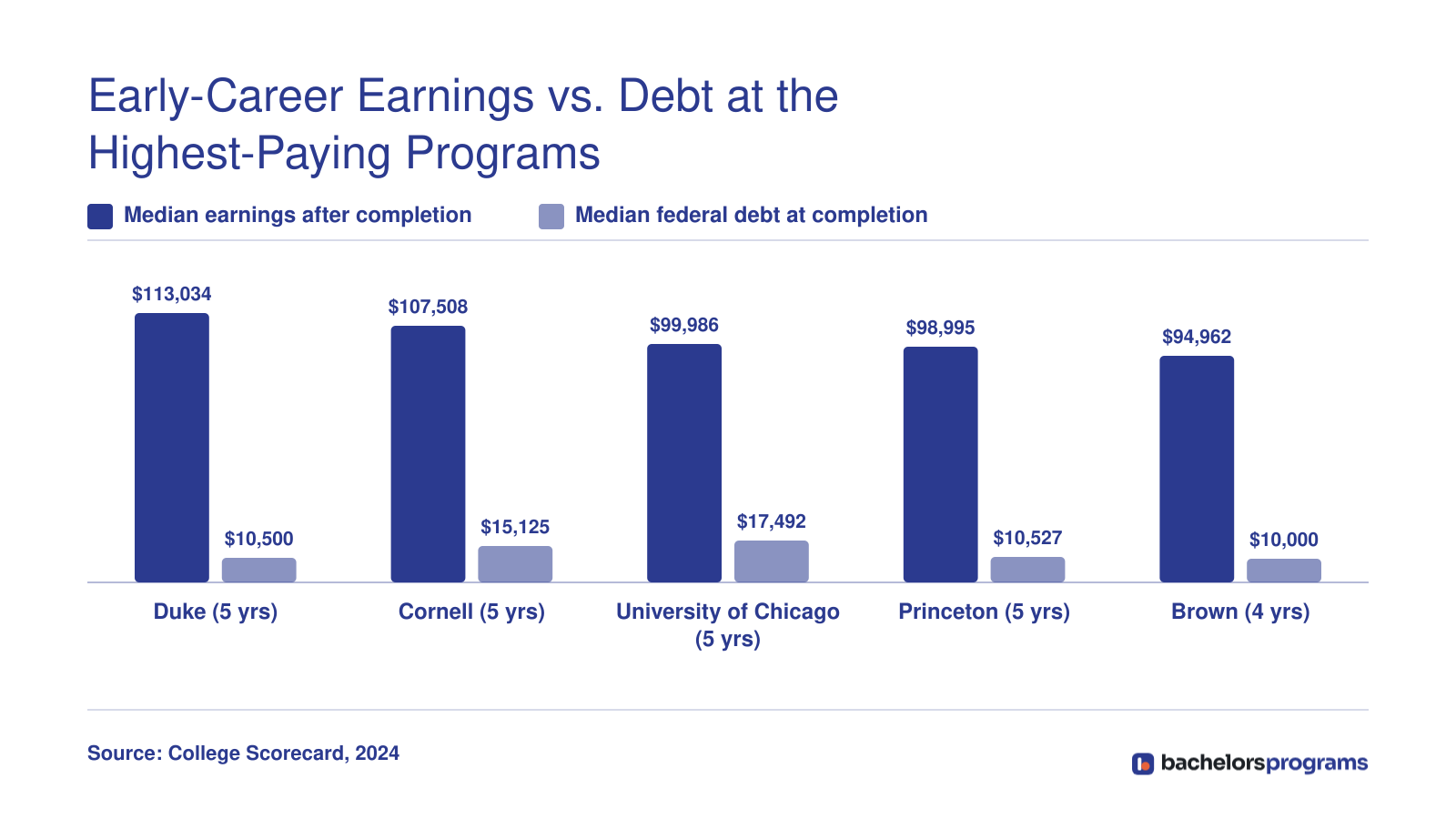
Early-Career Earnings vs. Debt at the Highest-Paying Programs
Each bar pair compares a public policy program's median earnings, measured 4 or 5 years after completion as labeled, with its graduates' median federal debt at completion. A healthy gap means total debt stays well below one year's earnings. Every program charted clears that bar easily, with debt equal to roughly 10% to 17% of earnings. Brown carries the lowest median debt shown, $10,000, which works out to about $106 a month on a standard 10-year repayment plan. Vanderbilt is left off the chart because no program-level debt figure is reported for it.
What Policy-Adjacent Occupations Pay Nationally
Urban and regional planning is a common policy-adjacent career. It offers a clearer growth outlook than political science, whose median pay is higher ($142,080) but whose employment BLS projects to decline 2% through 2035.
Public Policy or Public Administration: Which Major Fits Your Goals?
The two majors overlap, and many schools house them in the same department. The difference is where each one puts its weight: public policy centers on analyzing and designing policy, while public administration centers on managing and carrying it out. Use the comparison below to see which emphasis matches the work you want to do.
| Factor | Public Policy | Public Administration |
|---|---|---|
| Core focus | Design and impact of policy, including research, analysis, and evaluation | Implementation and management of policies and public organizations |
| Signature coursework | Introduction to Policy Analysis, Economics for Public Policy Analysis, Introduction to Policy Research, Applied Research Design | Public administration theory and practice, governmental budgeting and financial control, public-sector human resources |
| Quantitative intensity | Heavier: economics, statistics, and social-science research methods are central | Applied: statistics and policy-analysis techniques sit alongside budgeting, communications, and management training |
| Typical first jobs | Policy analyst, researcher, or consultant roles involving analysis and forecasting, often with more independent work | Program-management and leadership-track roles in nonprofits and in federal, state, and local government |
| Management emphasis | Generally less focused on organizational management | Greater emphasis on putting policy into practice through budgeting and management |
| Common graduate pathway | Master of Public Policy (MPP): policy research, analysis, evaluation, economics, and statistics | Master of Public Administration (MPA): day-to-day operations of public organizations, leadership, strategic planning, and public finance |
| Rule of thumb | Choose it if you want to analyze public problems and propose evidence-based solutions | Choose it if you want to lead programs and carry policies out in government or nonprofits |
Vetting a Program Before You Apply: Admissions, Transfer Credit and Internships
Rankings narrow the field. These checks tell you whether a program fits your record, your timeline and the experience you want.
- Admissions requirementsDuke, UNC Chapel Hill and Rutgers–New Brunswick are test-optional. At UNC, a weighted GPA of 2.8 is a testing threshold, not an admissions standard. Applicants below it must submit an ACT of 17+ or an SAT of 930+. Rutgers' 2026 profile lists a 3.8–4.2 high school GPA for its Bloustein School. Check each school's essay prompts directly.
- DeadlinesDuke lists November 2, January 4 and March 15 for 2026–2027. UNC uses two nonbinding first-year deadlines. Confirm which dates are binding before you commit.
- Transfer creditUNC caps transfer credit at 75 semester hours and requires a C or higher. Duke accepts no more than two years of outside work, and at least half of your major courses must be taken at Duke. Rutgers' Bloustein School expects 30+ credits by entry, plus English I and II with a C or better. Degree-completion students should get these caps in writing.
- Internships and capstonesGeorgia Tech offers a three-credit internship course and client-based capstones. UNC runs an honors seminar in Washington, D.C. UCLA places students in Los Angeles, Sacramento and D.C.
- SelectivityAdmission rates among the schools ranked here run from 3.6% at Stanford to 44.8% at Maryland. Michigan admits students to the major in sophomore year.
- Next stepRequest information from two or three shortlisted programs and compare their answers on these points.
Public Policy programs by state
Public Policy Degree Questions Readers Ask Most
These answers cover the questions prospective students ask most about public policy majors, from where to study to what the coursework demands. Requirements differ by school, so confirm details on each program's own page before you apply.
Which universities offer public policy as an undergraduate major?
Is a public policy degree worth the cost?
Can you earn a public policy bachelor's degree fully online?
What entry-level roles do public policy majors typically land?
Do public policy majors need a master's degree to advance?
Is public policy a good pre-law major?
How much statistics and economics does a public policy major require?
Compare Public Policy programs on the data that matters
Explore more Social Work & Social Sciences majors or browse every field of study.
All Social Work & Social Sciences programs Browse every field of study