Best Public Health Schools in Connecticut
Compare 9 accredited Public Health programs in Connecticut, with net price after aid, graduation rates, earnings and debt from IPEDS and the U.S. College Scorecard.

Which Connecticut colleges award a bachelor's degree in public health, and what does one actually cost? Published in-state tuition and fees start at $13,401 at Western Connecticut State University and reach $58,350 at Fairfield University, a gap of more than $44,000 a year before any aid is applied.
The standard credential is the Bachelor of Science (B.S.) in Public Health, though several campuses offer it as a health science major with a public health concentration. Fairfield University and Southern Connecticut State University hold CEPH accreditation, which matters for certain graduate and federal hiring paths.
Nearly every program in the state is campus-based, so where you live still shapes where you can study.
Key Points
- Fairfield and Southern Connecticut State hold CEPH accreditation for public health.
- Western Connecticut State University has the lowest average net price: $17,604.
- Public health bachelor's programs at Connecticut schools are campus-based, not fully online.
Best Bachelor's in Public Health Schools in Connecticut
Nine Connecticut colleges and universities award a bachelor's degree in public health or a closely related health science degree with a public health concentration. Three are public and six are private, and the credential varies by campus: most award a Bachelor of Science (B.S.) in Public Health, while a few award a B.S. in Health Sciences or a Bachelor of Arts. Across the schools below, institution-wide graduation rates run from about 42% to 84%.
Western Connecticut State University
#1Danbury, CT · ~$18,000/yr (est.)
Best for: Students who want a flexible community health track
Western Connecticut State University is a public university in Danbury whose CEPH-accredited B.S. in Public Health offers four concentration options. The Community Health track is the most flexible of them, leaving room for electives, a minor, or study abroad. A 12-credit practicum places students with local health departments, hospitals, and community agencies across Connecticut.
- CEPH-accredited B.S. in Public Health
- Community Health concentration is the most flexible of four options
- 12-credit public health practicum required
- 120 total credit hours with a 2.5 GPA minimum
- Coursework in epidemiology, biostatistics, and program planning
- Room for electives, a minor, or study abroad
- Practicum sites include local health departments and hospitals
University of Saint Joseph
#2West Hartford, CT · $28,000/yr (est. net price)
Best for: Students eyeing an accelerated public health path
The University of Saint Joseph is a private university in West Hartford with a health sciences focus and small classes. Its B.S. in Public Health is taught by practicing public health professionals and built around field-based projects and original research, so students assemble a professional portfolio before graduation. An accelerated five-year pathway combines the bachelor's with a graduate degree, and the Public Health Society adds networking and leadership experience.
- Accelerated five-year pathway to a graduate public health degree
- Taught by practicing public health professionals
- Internships with local health departments, hospitals, and community organizations
- Field-based projects and original research build a professional portfolio
- Public Health Society for networking and leadership
- Preparation for CDC training fellowships
Fairfield University
#3Fairfield, CT · $48,000/yr (est. net price)
Best for: Health equity advocates who want deep field immersion
Fairfield University is a private Jesuit university in Fairfield, and its public health program sits inside the Egan School of Nursing & Health Studies. The CEPH-accredited B.S. in Public Health pairs science coursework with a social justice lens and requires an immersion field internship plus a faculty-guided capstone. Students gain experience at hospitals, state health agencies, and humanitarian organizations, and a public health minor is available.
- CEPH-accredited undergraduate program, accredited since 2019
- 73 credit hours in the major
- Required immersion field internship
- Faculty-guided capstone project
- Housed in the Egan School of Nursing & Health Studies
- Combines science coursework with a social justice focus
- Public health minor available
Southern Connecticut State University
#4New Haven, CT · ~$21,000/yr (est.)
Southern Connecticut State University is a public university in New Haven with one of the earliest public health degrees in the country. The CEPH-accredited B.S. in Public Health is heavily hands-on: class projects and internships center on community service, with students planning real campaigns from start to finish. Connecticut's public health workforce planning names the university as a partner in a Community Health Leaders initiative.
- CEPH-accredited B.S. in Public Health
- One of the nation's earliest public health degrees
- Class projects and internships center on community service
- Students plan health campaigns from inception to evaluation
- Graduates work in local health departments, hospitals, and nonprofits
- Named a partner in Connecticut's Community Health Leaders initiative
University of New Haven
#5West Haven, CT · ~$34,000/yr (est.)
The University of New Haven is a private university in West Haven with a career-focused health sciences division. Its B.S. in Public Health covers epidemiology, biostatistics, health promotion, healthcare administration, and environmental health, and every student completes an internship matched to their interests plus a capstone serving a local organization. Partner sites include Yale New Haven Health and Griffin Hospital, and full-time and part-time enrollment are both available.
- Full-time and part-time enrollment options
- Internships matched to student interests
- Capstone project serves a local organization
- Partner sites include Yale New Haven Health and Griffin Hospital
- Faculty trained at Johns Hopkins, Yale, and Harvard
- Builds competency in five public health areas
- Accelerated dual-degree pathways available
Albertus Magnus College
#6New Haven, CT · ~$34,000/yr (est.)
Albertus Magnus College is a small private college in New Haven. Its B.S. in Public Health blends sociological, scientific, and mathematical approaches to disease prevention and health promotion, with a required practicum that puts classroom material to work in the field. Small classes and close faculty contact suit students who want a pre-med track or a stepping stone to graduate study in public health.
- Required practicum in a real public health setting
- Interdisciplinary coursework in sociology, science, and mathematics
- Small class sizes and close faculty mentorship
- Pairs well with pre-med requirements
- Pathway to graduate study in public health or epidemiology
- Financial aid and scholarships available
Eastern Connecticut State University
#7Willimantic, CT · ~$21,000/yr (est.)
Eastern Connecticut State University is a public university in Willimantic. Its public health offering is a B.S. in Health Sciences with a Public Health concentration, one of three concentration options, and the curriculum spans chemistry, mathematics, sociology, and psychology. Students can join undergraduate research using the state system's only virtual dissection table and study abroad in Ghana, and alumni have gone on to Yale's and UConn's public health schools.
- B.S. in Health Sciences with a Public Health concentration
- One of three concentration options in the major
- Only virtual dissection table in the Connecticut state system
- Study abroad opportunities in Ghana
- Coursework spans chemistry, mathematics, sociology, and psychology
- Covers substance abuse prevention and drinking water management
- Alumni have enrolled at Yale School of Public Health and UConn
Sacred Heart University
#8Fairfield, CT · ~$46,000/yr (est.)
Sacred Heart University is a private university in Fairfield with a large health professions footprint. Its B.S. in Health Science with a Public Health concentration layers global health, health promotion planning, emergency preparedness, and behavioral and mental health onto a core health science foundation. A Health Research Capstone has students design and carry out their own study before they graduate.
- B.S. in Health Science with a Public Health concentration
- CEPH-accredited program
- Health Research Capstone: design and conduct your own study
- Coursework in epidemiology, global health, and emergency preparedness
- Covers health promotion planning and behavioral and mental health
- Prepares students for government, nonprofit, and fellowship roles
Mitchell College
#9New London, CT · $30,000/yr (est. net price)
Mitchell College is a small private college in New London known for its structured student support. Its B.A. in Public Health, with a Community Health concentration, combines health promotion and disease prevention, health policy, and social and behavioral health with a community-based internship. Career development runs from the first-year experience through the capstone, and the program launched in fall 2023.
- B.A. in Public Health with a Community Health concentration
- Community-based internship required
- Coursework in health promotion, health policy, and social and behavioral health
- Career development support runs from first-year experience to capstone
- Pathway to advanced public health degrees
- Launched in fall 2023
Cost & outcomes by school
Federal data for the highest-earning Public Health programs, independent of the ranking above. Earnings are this field's bachelor's graduates four years after completing where the Scorecard reports them, else the school's undergraduate median.
| School | Net price / yr | Grad rate | Earnings | Debt | Grads/yr | Format |
|---|---|---|---|---|---|---|
| Fairfield University CT | $48,095 | 84% | $88,794 | $26,000 | 10 | Campus |
| Sacred Heart University CT | $46,174 | 74% | $75,059 | $25,000 | — | Campus |
| Albertus Magnus College CT | $34,028 | 52% | $60,144 | $30,964 | 1 | Campus |
| University of New Haven CT | $34,192 | 63% | $60,126 | $27,000 | — | Campus |
| Western Connecticut State University CT | $17,604 | 52% | $59,115 | $24,147 | 41 | Campus |
| Eastern Connecticut State University CT | $21,067 | 58% | $56,469 | $24,250 | — | Campus |
| Southern Connecticut State University CT | $20,857 | 50% | $53,997 | $21,500 | 14 | Campus |
| University of Saint Joseph CT | $27,989 | 64% | $52,827 | $27,000 | 8 | Campus |
| Mitchell College CT | $30,260 | 42% | $39,115 | $25,150 | — | Campus |
Sources: U.S. Department of Education. Net price, graduation rate, earnings and debt: College Scorecard (earnings and debt for this field's bachelor's graduates where reported, else school-wide); graduates: IPEDS. A dash means no figure is reported.
Cost, debt & payoff
Median earnings of this field's bachelor's graduates (4 yrs after completing, else the school's undergraduate median) vs. their median federal loan debt · U.S. College Scorecard
Across these programs the median graduate earns about $59,115 and finishes with roughly $25,150 in debt — a ratio that clears a common rule of thumb (keep debt below first-year salary). Net price and debt vary widely school to school, so check the per-school figures in the table above before you shortlist.
Are There CEPH-Accredited Public Health Programs in Connecticut?
Fairfield University's public health program has held CEPH accreditation since December 16, 2019, with its current term running through July 1, 2030. Southern Connecticut State University's has been accredited since May 30, 1998, through December 31, 2031. Those are the two schools where we could confirm CEPH accreditation covering the bachelor's degree.
Schools without confirmed status
University of Saint Joseph, University of New Haven, Albertus Magnus College, Eastern Connecticut State University, Sacred Heart University and Mitchell College did not appear on CEPH's accredited list in our check. Eastern and Sacred Heart award health science degrees with a public health focus. Western Connecticut State University's program page calls the program CEPH accredited, but we could not confirm that on CEPH's own listing, so ask the school directly.
No Connecticut school appears on CEPH's 2026 applicant list for a bachelor's program. Applicant status only means a school is in the review process. It does not guarantee accreditation.
How CEPH works and why it matters
CEPH can accredit undergraduate programs separately from school-level or graduate programs, and seeking accreditation is voluntary. Fairfield and Southern are each listed as a public health program covering both bachelor's and master's degrees.
Accreditation can matter if you plan graduate study or expect employers to check for it. It is not required for entry-level public health work, so a program without it can still be a sound choice. Check the current status on CEPH's website before you apply.
Most Affordable Bachelor's in Public Health Programs in Connecticut
Western Connecticut State University has the lowest average net price among the schools ranked here at $17,604 a year, with Southern Connecticut State University and Eastern Connecticut State University close behind. The three state universities post in-state tuition and fees near $13,400 to $13,900. The University of Saint Joseph and Mitchell College list higher sticker prices, but grant aid brings their average net price well below tuition. Figures come from the U.S. Department of Education's IPEDS and College Scorecard data (2024). Net price is the average annual cost after grants and scholarships.
| School | Location | Program | Sector | Tuition and Fees (In-State) | Average Net Price | Graduation Rate | Median Earnings, All Graduates (10 Years After Entry) |
|---|---|---|---|---|---|---|---|
| Western Connecticut State University | Danbury | Public Health (Community Health option) | Public | $13,401 | $17,604 | 51.8% | $59,115 |
| Southern Connecticut State University | New Haven | Public Health, B.S. | Public | $13,438 | $20,857 | 49.9% | $55,043 |
| Eastern Connecticut State University | Willimantic | Health Sciences Major (Public Health concentration) | Public | $13,928 | $21,067 | 57.5% | $56,469 |
| University of Saint Joseph | West Hartford | Public Health, B.S. | Private nonprofit | $47,278 | $27,989 | 63.8% | $59,908 |
| Mitchell College | New London | Public Health (Community Health) | Private nonprofit | $40,490 | $30,260 | 42.2% | $39,115 |
Online and Hybrid Bachelor's in Public Health Options at Connecticut Schools
At Connecticut schools, the bachelor's degree in public health is built around the campus, not the browser. Every public health program in our data at a Connecticut-based school is listed as campus delivery, and none is marketed as a fully online or hybrid bachelor's. Online coursework can still show up in an individual semester, but students who want the whole degree at a distance will not find that format here.
What campus delivery costs
- Public universities: Western Connecticut State University charges $13,401 in-state and $16,901 out-of-state; Southern Connecticut State University $13,442 and $16,942; Eastern Connecticut State University $13,928 and $17,426.
- Private colleges: Mitchell College $40,490, Albertus Magnus College $41,908, University of Saint Joseph $47,278, University of New Haven $47,332, Sacred Heart University $50,404, Fairfield University $58,400.
None of these are distance programs, so no school publishes a separate per-credit online rate for a public health bachelor's. The tuition above is what you budget.
Three things to weigh
- Internship placement: field experience is built into several programs, including Fairfield's required immersion internship, Mitchell's community-based internship and the practicum at Albertus Magnus. Ask who finds the site and whether you can complete it near home or must stay in Connecticut.
- Residency and price: at the three public universities, the out-of-state premium runs roughly $3,500 to $3,600 a year. The private colleges charge one rate regardless of residency, which can narrow the gap for non-residents.
- Live sessions: none of these programs publishes a synchronous requirement for online coursework, so confirm with an advisor before assuming recorded lectures fit your schedule.
Admission Requirements for Connecticut Public Health Bachelor's Programs
Selectivity varies widely across Connecticut's public health programs, from nearly open-door state schools to one highly selective private university.
How Selective Each School Is
Admission rates show the spread. Fairfield University admits about 33% of applicants, making it the most selective option here. The University of New Haven (about 60%), Albertus Magnus College (about 59%) and Sacred Heart University (about 65%) sit in the middle. The University of Saint Joseph admits about 79%. Western Connecticut State University (about 87%), Eastern Connecticut State University (about 83%) and Southern Connecticut State University (about 91%) are more accessible, and Mitchell College admits about 95%.
GPA, Testing and Transfer Policies
Published policy is thinner than the admission rates suggest.
- Southern Connecticut State University: The 2026-2027 catalog lists a 2.5 GPA requirement for the Public Health, B.S. major and a 2.0 cumulative GPA to graduate.1 Neither is a first-year admission minimum, and we found no first-year minimum, test policy or transfer-credit rule for this degree.
- Western Connecticut State University: It offers two bachelor's tracks, Allied Health Professions and Community Health.2 The Community Health option page lists a 2.5 GPA minimum for the major.2 The department directs applicants to Undergraduate Admissions, and no first-year minimum GPA, test policy or transfer-credit rule was found.
- Other schools: For Fairfield University, University of Saint Joseph, University of New Haven, Albertus Magnus College, Eastern Connecticut State University, Sacred Heart University and Mitchell College, no minimum GPA, test policy or transfer-credit rule was found on the admissions pages checked. Confirm each directly with the school before you apply.
Practical Tips
- Start at a community college: Students who begin at a Connecticut community college can often carry general education credit into a public health major. Ask the receiving school's transfer office which courses count toward the major and which only count as electives.
- Take biology and statistics early: High school biology and a statistics or data course prepare you for the epidemiology and biostatistics work in these programs.
- Watch deadlines: Early application deadlines can affect aid and scholarship consideration. Check each admissions page for current dates, since none are confirmed here.
Questions to Ask Yourself
Do you want a traditional campus experience near Connecticut hospitals and health departments, or do you need a hybrid or online format?
Do you have a specific concentration in mind, such as epidemiology, community health, health policy, or environmental health?
Does your plan depend on a CEPH-accredited program, or would a strong internship pipeline matter more?
Cost of a Bachelor's Degree in Public Health in Connecticut
Western Connecticut State University publishes $13,401 in in-state tuition and an average net price of $17,604. Net price is the average students pay after grants and scholarships, and it includes housing and living costs, which is why it can exceed tuition at public schools. It is an institution-wide average, not a quote for the public health program or for you.
Public vs. Private Schools
The three public options have the lowest tuition and net prices here:
- Western Connecticut State: $13,401 tuition, $17,604 net price, about 56% of students receiving Pell Grants.
- Southern Connecticut State: $13,438 tuition, $20,857 net price, about 57% Pell.
- Eastern Connecticut State: $13,928 tuition, $21,067 net price, about 50% Pell.
Private schools post much higher sticker prices, but aid narrows the gap. University of Saint Joseph lists $47,278 and averages $27,989 after aid. Mitchell College lists $40,490 and averages $30,260. Albertus Magnus College lists $41,908 and averages $34,028, with roughly 69% of students on Pell, a sign of heavy need-based aid. At the high end, Fairfield University averages $48,095 and Sacred Heart University $46,174.
Connecticut State Aid
The Roberta B. Willis Need-Based Grant offers up to $4,500 for 2026-2027.1 Connecticut residents attending full time at a Connecticut public or nonprofit private college qualify based on financial need.1 The state lists an application window of October 1, 2026 to June 30, 2027, but your college's own aid deadline usually comes sooner.1
The Willis Need-Merit Scholarship paid up to $5,250 at four-year schools in 2025-2026. Applicants need a Student Aid Index of 10,999 or lower, plus one of these: a top 20% class rank, an SAT of 1200 or higher, or an ACT of 25 or higher. A school counselor submits the application, and the FAFSA is due February 15 before the award year.
What to Do Next
- File the FAFSA each year, since it drives federal, state, and school aid.
- Treat February 15 as your target, then confirm each school's deadline.
- Compare net price, not sticker price, across schools.
- Run every school's net price calculator for a personal estimate.
Related Articles
Connecticut Health Education Specialist Pay at a Glance
Health education specialist is a common entry point for B.S. in Public Health graduates in Connecticut.
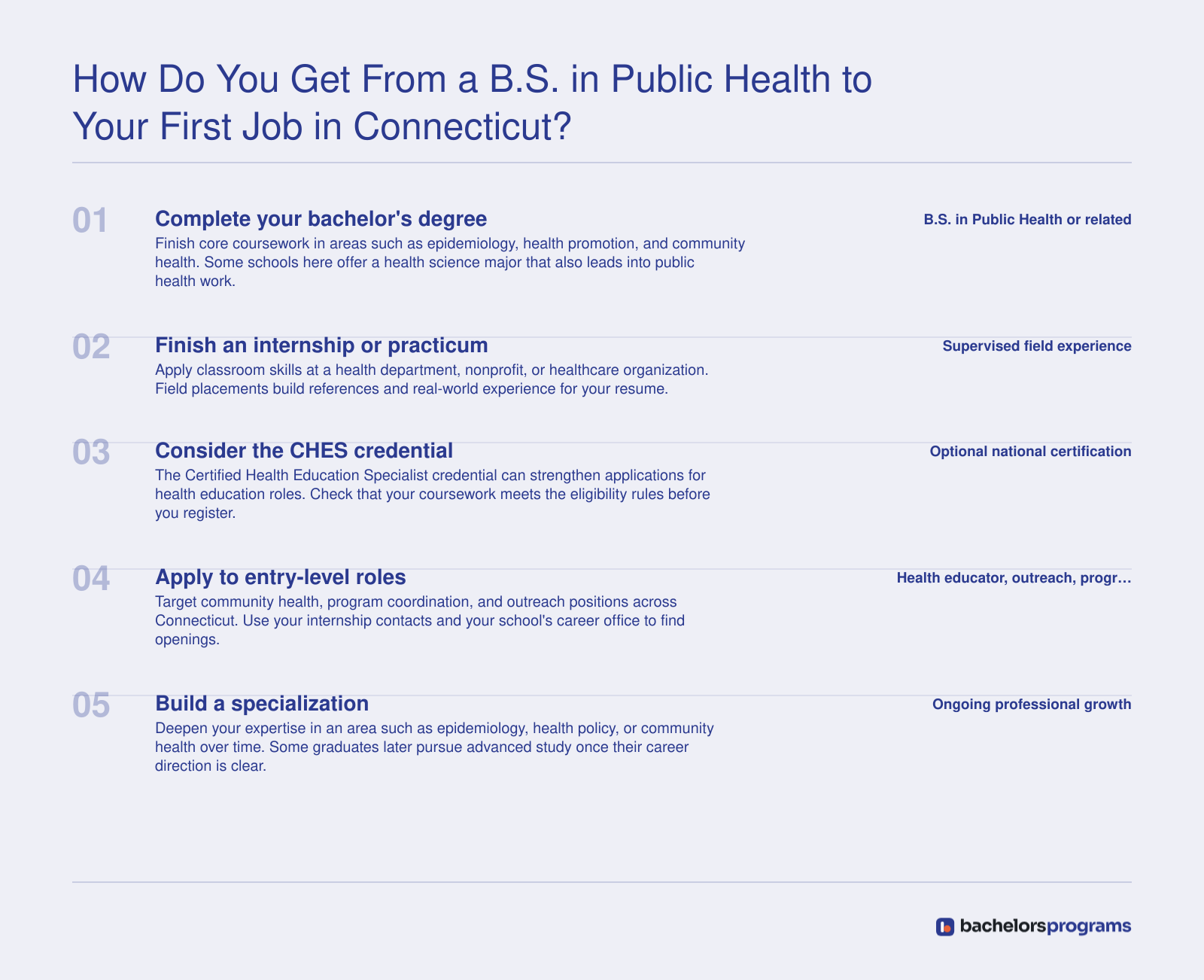
How Do You Get From a B.S. in Public Health to Your First Job in Connecticut?
A bachelor's degree in public health opens the door, but the steps after coursework shape how quickly you land your first role. Use this sequence as a general roadmap and confirm the details with your program advisor.
Common Questions About Public Health Bachelor's Programs in Connecticut
Which Connecticut schools offer a bachelor's degree in public health?
How much does a public health degree cost in Connecticut?
Can I transfer community college credits into a Connecticut bachelor's in public health program?
Do I need a license to work in public health in Connecticut?
Compare Public Health programs on the data that matters
Explore more Healthcare majors or browse every field of study.
All Healthcare programs Browse every field of study