Best Computer Science Schools in Connecticut
Compare 21 accredited Computer Science programs in Connecticut at 12 colleges, with net price after aid, graduation rates, earnings and debt from IPEDS and the U.S. College Scorecard.

Connecticut awards computer science bachelor's degrees as either a Bachelor of Science (B.S.) or a Bachelor of Arts (B.A.), and the price tags differ sharply across the state. Average net price runs from about $16,900 at Central Connecticut State University to about $48,100 at Fairfield University.
The schools below are Connecticut campus and online bachelor's programs at Connecticut-based schools. What separates these schools is cost, accreditation, admissions standards and whether the program runs online or on campus.
Price is only one filter. ABET accreditation is not universal among these programs, and Quinnipiac University and the University of New Haven are among the schools that advertise it, so check it before you commit.
Key Points
- UConn ranks first, teaching its B.S. at both Storrs and Stamford.
- Quinnipiac and Central Connecticut State let students choose a B.A. or B.S.
- Connecticut software developers earned a $128,450 median wage in May 2023.
Best Computer Science Schools in Connecticut: Our Top 10 Ranked
The University of Connecticut is our pick for the best computer science school in Connecticut: it is the state's flagship research university, it teaches the B.S. at both Storrs and Stamford, and it layers eight concentration options on top of a 120-credit core. Readers who would rather have a small liberal arts setting should look at Wesleyan and Connecticut College, while Quinnipiac, Fairfield, and the University of New Haven each run accredited, career-focused programs with required internships or capstones. UConn is a strong choice for computer science, especially for in-state students who want scale, research access, and a degree that recruiters recognize.
University of Connecticut
#1Storrs, CT · ~$25,000/yr (est.)
Best for: Students wanting the state's flagship CS program
UConn is Connecticut's flagship public research university and runs one of the largest computer science programs in the state, with the B.S. taught at both the Storrs and Stamford campuses. Students complete 120 credits, including 43 in computer science and engineering courses, and pick from eight concentration options. A senior design project and laboratory coursework from the first two years give the degree a strongly applied bent, and the university's overall graduation rate is 83%.
- Bachelor of Science degree, 120 total credit hours
- 43 credits in computer science and engineering courses
- Eight concentration options
- Program materials list ABET accreditation
- Senior Design Project in the final year
- Hands-on laboratory courses in the first two years
- Taught at both Storrs and Stamford
- Multivariable calculus required
Wesleyan University
#2Middletown, CT · $30,000 – $35,000/yr (est.)
Best for: Liberal arts students drawn to CS theory
Wesleyan is a private liberal arts university in Middletown that awards a Bachelor of Arts in Computer Science rather than a B.S. The major is compact, built on 10 courses that begin with the COMP211 and COMP212 gateway sequence and then spread across algorithms, systems, and mathematical foundations. Students can pursue research, an honors thesis, or a linked BA/MA path, and at most four courses may transfer in. The university's overall graduation rate is 93%.
- Bachelor of Arts degree
- 10 courses required, starting with COMP211 and COMP212
- Core coursework across four areas plus mathematical foundations
- At most four courses may transfer in
- Honors thesis and research opportunities
- Linked BA/MA option
Connecticut College
#3New London, CT · ~$36,000/yr (est.)
Best for: Research-minded students in AI and robotics
Connecticut College is a small private liberal arts college in New London whose computer science program is tied to its Ammerman Center for Arts and Technology. The work leans toward artificial intelligence, robotics, virtual reality, sound processing, and machine learning, with tracks available in AI and robotics and in virtual reality. Paid summer internships, independent studies, and faculty-student research give undergraduates early access to publishable work, and the college's overall graduation rate is 82%.
- Bachelor of Arts degree
- Tracks in artificial intelligence and robotics, and in virtual reality
- Paid summer internships available
- Independent studies and faculty-student research
- Ties to the Ammerman Center for Arts and Technology
- Coursework spans machine learning, bioinformatics and algorithmic game theory
- Students may co-author publications and present at conferences
Quinnipiac University
#4Hamden, CT · $41,000/yr (est. net price)
Quinnipiac University in Hamden offers computer science as either a B.A. or a B.S., so students can choose a technical degree or a broader one that leaves room for a second major. On-campus labs host four internal networks and give students access to both Windows and Linux systems, and the B.S. is accredited by the Computing Accreditation Commission of ABET. The school reports that its 2025 B.S. graduates were employed or in graduate study within six months, and its overall graduation rate is 76%.
- Bachelor of Arts and Bachelor of Science routes
- B.S. accredited by the Computing Accreditation Commission of ABET
- Labs host four internal networks
- Access to Windows and Linux systems
- B.S. coursework includes cryptography, artificial intelligence and robotics
- B.A. leaves room for a second major or minor
- STEM designation allows a 24-month OPT extension
Fairfield University
#5Fairfield, CT · $48,000/yr (est. net price)
Fairfield University is a private Jesuit university that awards a 127-credit B.S. in Computer Science, 91 of those credits inside the major. The program is accredited by ABET's Computing Accreditation Commission and adds concentrations in computer engineering and software engineering. A sophomore service-learning project, a junior entrepreneurial experience, and an industry-based senior design capstone build roughly 20 months of real-world experience before graduation, and the university's overall graduation rate is 84%.
- 127 credits, 91 of them in the major
- Accredited by ABET's Computing Accreditation Commission
- Concentrations in computer engineering and software engineering
- Senior Design Project I and II
- Sophomore service-learning and junior entrepreneurial experience
- Calculus I and II, discrete mathematics and statistics required
- Industry-based senior capstone
University of New Haven
#6West Haven, CT · ~$34,000/yr (est.)
The University of New Haven runs a STEM-designated B.S. in Computer Science accredited by CAC/ABET on its West Haven campus. Every student completes a 200-hour internship plus a two-course senior capstone, and electives support concentrations in software development and cyber security. The university's location between New Haven and Bridgeport puts students within reach of a dense corridor of technology and financial services employers, and its overall graduation rate is 63%.
- 128 credits required
- Accredited by CAC/ABET and STEM-designated
- 200-hour internship requirement
- Two-course senior capstone sequence
- Concentrations in software development and cyber security
- Core coursework in databases, hardware, programming and security
- UPE honor society chapter
University of Saint Joseph
#7West Hartford, CT · $28,000/yr (est. net price)
The University of Saint Joseph in West Hartford offers a B.S. in Computer Science with three routes: data science, software engineering, and a customizable CODE track. Core work covers programming, database design, data structures, algorithms, and web development, and an optional 21-month upside-down curriculum lets motivated students reach the workforce sooner. A senior capstone, internships with industry partners, and the chance to work in the university's own IT department make the degree practice-heavy, and its overall graduation rate is 64%.
- Concentrations in data science, software engineering, or the CODE track
- Senior capstone project required
- Optional 21-month upside-down curriculum
- Internships with industry partners
- Students can work in the university's IT department
- Small class sizes with faculty advising
- ACM student chapter on campus
Central Connecticut State University
#8New Britain, CT · ~$17,000/yr (est.)
Central Connecticut State University in New Britain awards both a B.S. and a B.A. in Computer Science, so students can pick the accredited technical degree or a shorter 38-credit major with lighter math and science requirements. The B.A. is built for transfer students and can be completed full- or part-time, while the B.S. covers software development, security, networking, databases, and artificial intelligence. Central also runs dual-enrollment partnerships with Connecticut high schools, and its overall graduation rate is 48%.
- ABET-accredited program
- Skills in software development, security, networking and databases
- Artificial intelligence coursework
- On-campus delivery
- 38-credit major
- Lighter math and science requirements than the B.S.
- Faster path to graduation, built for transfer students
- Full- or part-time, on-campus classes
- Internship opportunities available
- Can be paired with a complimentary minor
- Free on-campus child care for students
Western Connecticut State University
#9Danbury, CT · ~$18,000/yr (est.)
Western Connecticut State University in Danbury requires 120 semester hours for its B.S. in Computer Science, 63 of them in the major, and sets a 2.5 GPA minimum for the degree. The required sequence runs from introductory programming and C++ through data structures, computer organization, algorithms, operating systems, and a course in the theory of computation. Students take 12 hours of computer science electives and can build room for a minor, an internship, or study abroad. The university's overall graduation rate is 52%.
- 120 semester hours, 63 in the major
- 2.5 GPA minimum for the degree
- 12 semester hours of computer science electives
- Ethics in Computing course required
- Calculus I and two science courses required
- Room for a minor, internship, or study abroad
University of Bridgeport
#10Bridgeport, CT · $28,000/yr (est. net price)
The University of Bridgeport offers a campus B.S. in Computer Science that pairs core theory with hands-on work in software engineering, systems analysis, operating systems, and computer organization. A final-year design project and a set of computer science electives let students shape the degree toward web development, artificial intelligence, database administration, or security. The university's Bridgeport location keeps internships within reach of Fairfield County employers, and its overall graduation rate is 41%.
- Bachelor of Science degree
- Final-year design project
- Computer science electives to customize the degree
- Coursework in software engineering and systems analysis
- Covers operating systems and computer organization
- Humanities, math and science courses round out the degree
Cost & outcomes by school
Federal data for the highest-earning Computer Science programs, independent of the ranking above. Earnings are this field's bachelor's graduates four years after completing where the Scorecard reports them, else the school's undergraduate median.
| School | Net price / yr | Grad rate | Earnings | Debt | Grads/yr | Format |
|---|---|---|---|---|---|---|
| University of Connecticut CT | $25,097 | 83% | $108,934 | $25,000 | 205 | Campus |
| Fairfield University CT | $48,095 | 84% | $88,794 | $26,000 | — | Campus |
| Quinnipiac University CT | $40,675 | 76% | $77,324 | $26,000 | 34 | Campus |
| Sacred Heart University CT | $46,174 | 74% | $75,059 | $25,000 | — | Campus |
| Connecticut College CT | $36,175 | 82% | $75,001 | $26,352 | 33 | Campus |
| Wesleyan University CT | $30,177 | 93% | $73,897 | $17,000 | 65 | Campus |
| University of Hartford CT | $30,282 | 54% | $60,823 | $27,000 | — | Campus |
| University of New Haven CT | $34,192 | 63% | $60,126 | $27,000 | 23 | Campus |
| University of Saint Joseph CT | $27,989 | 64% | $59,908 | $27,000 | 2 | Campus |
| Western Connecticut State University CT | $17,604 | 52% | $59,115 | $24,147 | — | Campus |
| Central Connecticut State University CT | $16,857 | 48% | $58,562 | $22,300 | — | Campus |
| University of Bridgeport CT | $27,807 | 41% | $50,323 | $25,750 | 9 | Campus |
Sources: U.S. Department of Education. Net price, graduation rate, earnings and debt: College Scorecard (earnings and debt for this field's bachelor's graduates where reported, else school-wide); graduates: IPEDS. A dash means no figure is reported.
Cost, debt & payoff
Median earnings of this field's bachelor's graduates (4 yrs after completing, else the school's undergraduate median) vs. their median federal loan debt · U.S. College Scorecard
Across these programs the median graduate earns about $75,001 and finishes with roughly $26,000 in debt — a ratio that clears a common rule of thumb (keep debt below first-year salary). Net price and debt vary widely school to school, so check the per-school figures in the table above before you shortlist.
Most Affordable Computer Science Schools in Connecticut
These Connecticut schools post the lowest average net price for a bachelor's degree in computer science, based on 2024 U.S. Department of Education data from IPEDS and the College Scorecard. Net price is an average for first-time, full-time undergraduates receiving aid, and public school figures cover in-state students only, so treat it as a benchmark rather than a personal quote. After aid, Central Connecticut State University and Western Connecticut State University cost roughly $10,000 to $11,000 less per year than the University of Bridgeport and the University of Saint Joseph, while the University of Connecticut sits closer to the private schools at $25,097.
| School | City | Sector | In-State Tuition & Fees | Out-of-State Tuition & Fees | Average Net Price After Aid |
|---|---|---|---|---|---|
| Central Connecticut State University | New Britain | Public | $13,050 | $16,550 | $16,857 |
| Western Connecticut State University | Danbury | Public | $13,401 | $16,901 | $17,604 |
| University of Connecticut | Storrs | Public | $21,044 | $43,712 | $25,097 |
| University of Bridgeport | Bridgeport | Private nonprofit | $35,760 | $35,760 | $27,807 |
| University of Saint Joseph | West Hartford | Private nonprofit | $47,278 | $47,278 | $27,989 |
How to Choose a Bachelor's Degree in Computer Science in Connecticut
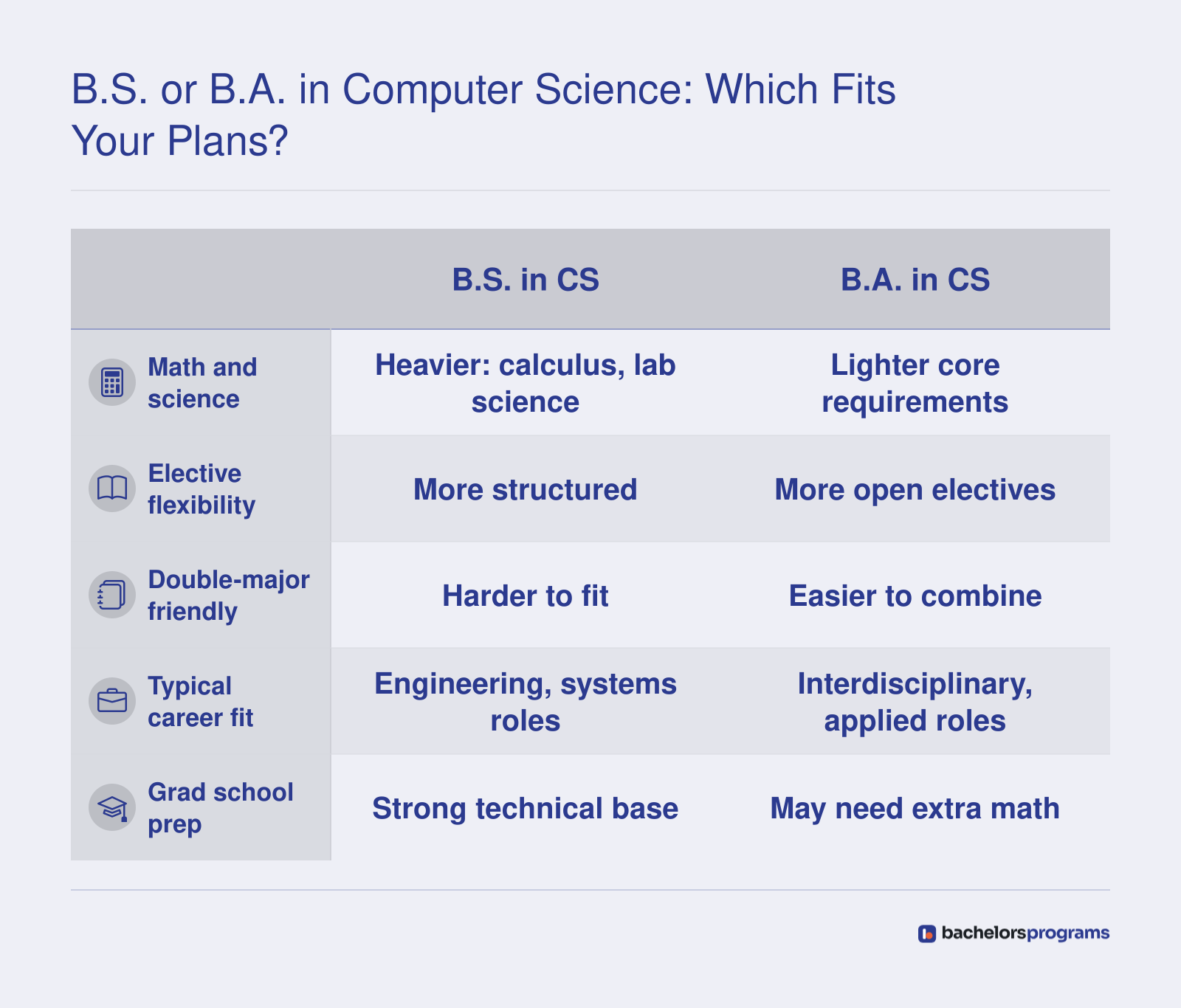
Should you earn a B.S. or a B.A. in computer science? The answer depends less on prestige than on how much math and science you want built into the degree and what you plan to do after graduation.
Start With the Degree Shape
A Bachelor of Science in Computer Science leans on calculus, discrete math, lab science and a longer technical core. It is the default for software engineering, graduate study, and government or defense roles that screen for technical depth. A Bachelor of Arts requires fewer science courses and leaves more room for a second major, a minor or a semester abroad. Neither is automatically stronger; the real question is which curriculum you will actually finish. Central Connecticut State University lists both a B.S. and a B.A., and Quinnipiac University offers a B.A. or B.S. in Computer Science, so you can compare both course sequences at one school before you commit.
Check ABET Accreditation
ABET accreditation signals that a program has been reviewed against published standards for faculty, curriculum and facilities. Employers, graduate committees and some federal contractors use it as a quick filter. Confirm the status yourself in ABET's directory rather than trusting a brochure, and ask whether the specific track you are applying to is the accredited one.
Match a Concentration to the Job
- Software engineering: the core track, best for product and application development.
- Cybersecurity: security operations, risk and compliance work.
- Artificial intelligence and data: machine learning, analytics and research support.
- Information systems: the bridge between technical teams and business operations.
Read the concentration list on each program page and choose the one whose required courses you would take anyway.
Fit the School Type to You
UConn, the public flagship in Storrs, pairs scale and research activity with in-state pricing. Private universities such as Fairfield, Sacred Heart and the University of Hartford offer smaller sections and closer faculty contact. Wesleyan and Connecticut College suit students who want computer science inside a liberal arts education. If you may go on to graduate school, ask about 4+1 pathways that let you begin master's coursework in your senior year, but treat that as an add-on rather than the reason to pick a school.
B.S. or B.A. in Computer Science: Which Fits Your Plans?
Several Connecticut schools award computer science as a B.S., and a few, such as Quinnipiac University and Central Connecticut State University, let you choose between a B.A. and a B.S. Requirements vary by school, so treat these as general patterns and confirm the details in each program's catalog.
Online and Hybrid Computer Science Bachelor's Options at Connecticut Schools
Fully online means every course is delivered over the internet, hybrid means some courses are online while others meet only on campus, and on-campus means you attend in person. The distinction matters in Connecticut because most computer science programs here are campus-based.
What the Schools Offer
Program pages for Wesleyan, UConn, Connecticut College, Quinnipiac, Saint Joseph, New Haven, Bridgeport, Fairfield, Central Connecticut State and Western Connecticut State all list campus delivery. Bridgeport's page states on-campus delivery outright.
Central Connecticut State University is the clearest place to look for flexibility. Its Computer Science B.S. is on-ground, while its separate Computer Science B.A. is labeled "Onground Hybrid Online" and requires 120 credits. Treat hybrid as a mix, not a guarantee that you can finish remotely.
Full Four-Year Versus Degree-Completion
The B.A. and B.S. programs above are full four-year degrees, whether you start as a first-year student or arrive with credit. Degree-completion is a different route: you finish an associate degree first, then enter a bachelor's program as a junior.
Community College Transfer Pathways
The Computer Science Studies A.A. Transfer Ticket from Connecticut's community colleges is a calculus-based pathway. It leads to Central Connecticut State's Computer Science B.S. (Alternative and Honors programs) and to Western Connecticut State's Computer Science B.S. The Transfer Ticket guarantees junior status, with 60 credits remaining after transfer. Prerequisites include Calculus I and II, Discrete Mathematics for Computer Science, Java I, Digital Design, Introduction to Database Design and Client-Side Web Development.
Who Benefits and What to Confirm
Working adults and transfer students gain the most from hybrid or part-time formats, since they can protect work hours and reuse earned credit. Before applying, confirm:
- Delivery: Which required courses, labs and capstones meet on campus, and which run online.
- Credits: That your community college courses match the Transfer Ticket list, and how many credits the school will accept.
- Scheduling: Whether upper-level courses are offered evenings or part-time, and whether you must complete them in a set sequence.
Related Articles
Admissions: GPA, Test Policy, and Transfer Credit for Connecticut CS Programs
Getting into a Connecticut university and getting into its computer science major are not always the same hurdle. Weigh overall admission odds against the grade and course requirements a department may add after you enroll.
Selectivity at a Glance
Overall admission rates give a rough read on competition:
- Most selective: Wesleyan University admits about 16 percent of applicants, Fairfield University about 33 percent and Connecticut College about 37 percent.
- Middle range: The University of Connecticut admits about 52 percent and the University of New Haven about 60 percent.
- Broadest access: Quinnipiac University (72 percent), Central Connecticut State University (73 percent), the University of Saint Joseph (79 percent), the University of Bridgeport (83 percent) and Western Connecticut State University (87 percent).
These are campus-wide figures. Computer science can be tighter than a school's overall rate, especially where a major has limited enrollment.
GPA and Test Policy
Published GPA floors vary. Western Connecticut State lists a 2.5 GPA minimum for the major and requires Calculus I. Wesleyan admits students to the major only after they earn a C- or better in its gateway course, COMP211.
Eligible Connecticut high school seniors can also use the state's Automatic Admission Program. It sets a 3.0 weighted or 2.75 unweighted GPA at participating public universities. It guarantees admission to the campus, not a seat in a specific CS program.
We could not confirm a current SAT or ACT policy for most of the schools here. Check each admissions page before deciding whether to send scores.
Transfer Credit and Community College Pathways
- UConn: Applicants with 12 or more credits earned after high school are reviewed as transfers.1 A successful transfer typically has about a 2.7 GPA in challenging coursework.1 Limited-enrollment programs may expect 3.0 or higher.
- Connecticut College: Transfers need at least one term at an accredited college after high school.
- Wesleyan: No more than four transferred courses count toward the major, and 300-level CS courses are taken at Wesleyan.
- Central and Western Connecticut State: A completed Computer Science Studies transfer associate degree (61 to 62 credits) from Connecticut's public community college brings guaranteed admission and junior standing. Individual programs may still add GPA requirements. State policy caps transfer associate degrees at 64 credits and bachelor's degrees at 128 unless an exception is approved.
Older 2021-22 pathway documents asked for a 2.5 GPA in CS and math courses and a C- or better in required major courses. Those terms may have changed, so confirm current rules with a transfer advisor. Finish calculus before you transfer and more programs stay within reach.
Questions to Ask Yourself
Are you starting at a Connecticut community college and planning to transfer, and have you checked that your math courses will count toward the CS major?
Does your target school admit directly into computer science, or must you apply to the major after enrolling?
Which schools on your shortlist offer a B.S., a B.A., or both?
Cost of a Computer Science Bachelor's Degree in Connecticut
The price on a Connecticut school's website is rarely what a computer science student ends up paying, and the gap is widest at private colleges.
Sticker Price vs. Net Price
In-state tuition and fees at Central Connecticut State University run $13,050, and Western Connecticut State University's are $13,401. The University of Connecticut charges Connecticut residents $21,044. Private sticker prices start at $35,760 at the University of Bridgeport and reach $70,342 at Wesleyan University.
Net price is the average cost after grants and scholarships. It is a sector-wide average for the whole school, not a figure for the computer science program or your income, and it usually includes housing, books and other costs of attendance. That is why UConn's average net price ($25,097) sits above its tuition. Among private schools, University of Saint Joseph averages $27,989, University of New Haven $34,192, Connecticut College $36,175, and Quinnipiac University $40,675.
Connecticut Aid Programs
- Roberta B. Willis Scholarship: The need-based grant offers up to $4,500 a year. The need-merit award offered up to $5,250 a year at four-year schools in 2025-2026, renewable for up to six years. It generally requires a top 20% class rank and/or an SAT of 1200 or ACT of 25, plus a Student Aid Index of $10,999 or less. Wesleyan is excluded. A counselor submits the application, and the deadline is February 15.
- Mary Ann Handley Award (PACT): This last-dollar program covers the gap between grants and tuition at Connecticut's community colleges, at all income levels. It does not cover books, housing, or transportation. It suits students who plan to start at a community college and transfer.
- CT State High School Partnership: Eligible juniors and seniors (generally top 20% of the class with a 3.0 GPA) can have tuition waived for approved courses. Concurrent Enrollment courses are tuition-free. Books remain a district or student cost.
One Example: Public vs. Private
Wesleyan's sticker price is about $49,300 above UConn's in-state tuition and fees. Its average net price of $30,177 is only about $5,100 above UConn's $25,097. Institutional grants do most of that work, so a private school's list price tells you little until you see the aid offer.
A Practical Tip
File the FAFSA as early as you can, and make sure it lists every Connecticut school you are considering. Then check each school's own scholarship page, since many merit awards at the private colleges are awarded automatically or require a separate form.
What Connecticut Computer Science Graduates Earn
UConn posts the strongest program-level earnings figure among the schools ranked here.
Computer Science Careers and Salaries in Connecticut
Bureau of Labor Statistics estimates put Connecticut's software developers at a median of $128,450 a year across 18,380 jobs as of May 2023, and information security analysts and computer and information research scientists also posted medians above $120,000 in the May 2022 survey. Graduates of a bachelor's degree in computer science typically start as junior software developers, programmer analysts, or IT and security staff at employers in insurance and finance, defense and aerospace, healthcare, and technology, and Connecticut requires no state license to work in software roles. These BLS figures cover every worker in each occupation, from new hires to senior staff, so read them separately from the early-career earnings that federal College Scorecard data reports for recent graduates of individual programs.
| Occupation | Median Annual Wage (CT) | Employment (CT) | BLS Survey Period |
|---|---|---|---|
| Software Developers | $128,450 | 18,380 | May 2023 |
| Computer and Information Research Scientists | $125,910 | 60 | May 2022 |
| Information Security Analysts | $123,310 | 1,450 | May 2022 |
| Computing jobs, Hartford-West Hartford-East Hartford metro area | $117,410 | 6,980 | May 2022 |
Compare Computer Science programs on the data that matters
Explore more Computers & IT majors or browse every field of study.
All Computers & IT programs Browse every field of study