Best Cybersecurity Schools in Connecticut
Compare 9 accredited Cybersecurity programs in Connecticut at 7 colleges, with net price after aid, graduation rates, earnings and debt from IPEDS and the U.S. College Scorecard.

Connecticut's cybersecurity employers cluster in Hartford's insurance towers, the state's hospital systems and New London's submarine shipyards. A bachelor's degree in cybersecurity is the credential their screening filters run on, ahead of any certification.
Most programs here award a Bachelor of Science (B.S.) in Cybersecurity, offered on campus and online at several of the state's colleges.
Price separates these programs. In-state tuition at a public college and the net price at a private one can sit thousands of dollars apart for graduates aiming at the same jobs. Clearance and certifications come after the degree, not instead of it.
Key Points
- Charter Oak State College offers the lowest-cost, fully online B.S. here.
- Sacred Heart, CCSU, and University of New Haven carry NSA CAE designations.
- Four years out, University of New Haven graduates earned $63,360 median.
Best Cybersecurity Schools in Connecticut for a Bachelor's Degree
Charter Oak State College is the best cybersecurity school in Connecticut for most readers, because it delivers a public Bachelor of Science in Cyber Security entirely online at the lowest published cost on this list. The schools that follow trade that low price for campus labs, research-active faculty, and internships built into the degree. Every card below names the format, the concentration options, and approximate school-wide cost and completion figures so you can compare like with like.
Charter Oak State College
#1New Britain, CT · $15,000 – $20,000/yr (est.)
Best for: Working adults with prior learning credit
Charter Oak State College is Connecticut's public online college, and its Bachelor of Science in Cyber Security runs 100 percent online with six start dates a year, so you do not have to wait for a fall term. The 45-credit cybersecurity curriculum covers network security, forensics, and incident response, and prior coursework or industry credentials can be evaluated for credit. In-state tuition and fees are about $8,500 a year; the average net price after aid is roughly $15,800 and the graduation rate is about 67 percent, both approximate, institution-wide figures. It fits students who want a public Connecticut degree without a commute.
- 45-credit cybersecurity curriculum
- 100 percent online delivery
- Six start dates each year
- Credit for prior learning and credentials
- Capstone course included
- Internship option available
Sacred Heart University
#2Fairfield, CT · ~$46,000/yr (est.)
Best for: Cyber defense focus with hands-on labs
Sacred Heart University awards a Bachelor of Science in Cybersecurity through its School of Computing and Engineering, taught on campus with hybrid delivery. The major centers on cyber operations and cyber defense, labs use current security technology, and students also study the legal, ethical, and social side of the field. Tuition and fees are about $50,400 and the average net price after aid is roughly $46,200, with a graduation rate near 73 percent, both approximate, institution-wide figures. Connecticut high schoolers also meet the field early through PioneerGuard, a GenCyber-funded summer program run in the university's cybersecurity and AI labs.
- On-campus with hybrid delivery
- Focus on cyber operations and cyber defense
- Labs use current security technology
- Coursework covers legal, ethical, and social issues
- 4+1 accelerated pathway available
- Prepares for penetration testing and forensics roles
University of New Haven
#3West Haven, CT · ~$34,000/yr (est.)
Best for: Career changers who want a built-in internship
The University of New Haven offers a Bachelor of Science in Cybersecurity through the Tagliatela College of Engineering, a 122-credit campus degree with a required internship and two capstone courses. Students pick Cyber Operations, Network Security, or a general concentration they build with an advisor, and electives reach into AI for cybersecurity. Tuition and fees are about $47,300 and the average net price after aid is roughly $34,200, with a graduation rate near 63 percent, both approximate, institution-wide figures. The program carries a Department of Homeland Security STEM designation, and the university leads an NSA-funded cybersecurity workforce development coalition.
- 122 credits, including 40 in the University Core
- Concentrations: Cyber Operations, Network Security, general
- 200-hour internship after 60 credits
- Two capstone courses
- Electives in AI for cybersecurity
- STEM-designated by the Department of Homeland Security
Central Connecticut State University
#4New Britain, CT · ~$17,000/yr (est.)
Central Connecticut State University offers a Bachelor of Science in Cybersecurity with tracks in Cyber Defense and Cyber Operations, plus a general option built around a minor. The 120-credit program includes a mandatory internship, starts in January and August, and holds NSA validation for its programs of study. In-state tuition and fees are about $13,050, the average net price after aid is roughly $16,900, and the graduation rate is about 48 percent, both approximate, institution-wide figures. The university describes its cyber operations designation as valid through 2029.
- 120 credits
- Tracks: Cyber Defense, Cyber Operations
- General option built around a minor
- Mandatory cybersecurity internship
- NSA-validated program of study
- ABET-accredited computing coursework
- January and August start dates
- Free on-campus child care
Western Connecticut State University
#5Danbury, CT · ~$18,000/yr (est.)
Western Connecticut State University awards a Bachelor of Business Administration in Cybersecurity through the Ancell School of Business, an on-campus degree that pairs technical security work with management coursework. Students cover network security, cryptography, penetration testing, digital forensics, cloud security, and database security, then apply them to realistic organizational scenarios. In-state tuition and fees are about $13,400, the average net price after aid is roughly $17,600, and the graduation rate is about 52 percent, both approximate, institution-wide figures. It suits students who want to sit on the strategy, risk, and policy side of security rather than only the tooling side.
- Offered through the Ancell School of Business
- Blends technical and managerial coursework
- Covers cryptography and penetration testing
- Digital forensics and cloud security included
- Risk management and incident response planning
- Works through real organizational security scenarios
Quinnipiac University
#6Hamden, CT · $41,000/yr (est. net price)
Quinnipiac University runs an accelerated dual-degree program that awards a Bachelor of Science in Data Science and a Master of Science in Cybersecurity in four years, with the undergraduate requirements finished in three. The graduate half covers database security, cryptology, and IT infrastructure and ends in a capstone built on commercial and open-source security tools. Tuition and fees are about $55,500 and the average net price after aid is roughly $40,700, with a graduation rate near 76 percent, both approximate, institution-wide figures. It is built for students who already know they want a graduate cybersecurity credential and want to compress the timeline.
- Four-year accelerated format
- Undergraduate requirements finished in three years
- Coursework in database security and cryptology
- Capstone uses commercial and open-source security tools
- Trains cloud native security professionals
- Open to first-year applicants
Albertus Magnus College
#7New Haven, CT · ~$34,000/yr (est.)
Albertus Magnus College offers a Bachelor of Science in Cybersecurity on its New Haven campus, built on a 51-credit major inside a 120-credit degree. The major blends computer information systems with criminal justice, so graduates understand both the technology and the investigation side, and small classes keep faculty contact high. Tuition and fees are about $41,900 and the average net price after aid is roughly $34,000, with a graduation rate near 51 percent, both approximate, institution-wide figures. It suits students who want a small liberal arts setting with a security-focused major.
- 51-credit major within 120 total credits
- Blends computer information systems with criminal justice
- Small class sizes
- Grounded in a liberal arts education
- Prepares for security analyst and system architect roles
Cost & outcomes by school
Federal data for the highest-earning Cybersecurity programs, independent of the ranking above. Earnings are this field's bachelor's graduates four years after completing where the Scorecard reports them, else the school's undergraduate median.
| School | Net price / yr | Grad rate | Earnings | Debt | Grads/yr | Format |
|---|---|---|---|---|---|---|
| Quinnipiac University CT | $40,675 | 76% | $83,759 | $26,000 | — | Campus |
| Sacred Heart University CT | $46,174 | 74% | $75,059 | $25,000 | 15 | Hybrid |
| Charter Oak State College CT | $15,815 | 67% | $64,209 | $18,683 | 17 | Online |
| University of New Haven CT | $34,192 | 63% | $63,360 | $27,000 | 126 | Campus |
| Albertus Magnus College CT | $34,028 | 52% | $60,144 | $30,964 | — | Campus |
| Western Connecticut State University CT | $17,604 | 52% | $59,115 | $24,147 | — | Campus |
| Central Connecticut State University CT | $16,857 | 48% | $58,562 | $22,300 | — | Campus |
Sources: U.S. Department of Education. Net price, graduation rate, earnings and debt: College Scorecard (earnings and debt for this field's bachelor's graduates where reported, else school-wide); graduates: IPEDS. A dash means no figure is reported.
Cost, debt & payoff
Median earnings of this field's bachelor's graduates (4 yrs after completing, else the school's undergraduate median) vs. their median federal loan debt · U.S. College Scorecard
Across these programs the median graduate earns about $60,144 and finishes with roughly $24,147 in debt — a ratio that clears a common rule of thumb (keep debt below first-year salary). Net price and debt vary widely school to school, so check the per-school figures in the table above before you shortlist.
How the Rankings Were Built: Cost, Outcomes, Selectivity, and Designations
The cheapest program is rarely the strongest one, so the order here weighs four measures side by side rather than relying on any single number.
- Affordability: What students actually pay once grants and scholarships are applied, known as the net price, counts for more than the published tuition rate.
- Outcomes: Graduation rates and the earnings of program graduates show whether students finish and what the degree does for them afterward.
- Selectivity and access: Admission rates and entry requirements show how open each school is, which matters if your GPA or test history is uneven.
- Designations: Federal cybersecurity designations signal that a program's curriculum has been reviewed against national standards.
Limits Worth Knowing
Most cost, graduation and earnings figures describe a whole institution rather than the cybersecurity major itself. Treat them as approximations of what a student in this field might see, and confirm program-level details with each school. Only bachelor's programs offered in Connecticut, or online by a Connecticut-based school, were counted.
A Small Field, Real Choices
Connecticut has a compact set of cybersecurity bachelor's options. That works in your favor: every school ranked here is a genuine candidate, and the differences come down to price, format, and how much admissions flexibility you need.
NSA-Designated Cybersecurity Programs at Connecticut Colleges
Yes. Connecticut has NSA-designated cybersecurity programs: Central Connecticut State University, Sacred Heart University, and the University of New Haven all appear on the National Centers of Academic Excellence in Cybersecurity (CAE) list, which the NSA co-sponsors. Central Connecticut State University holds both the Cyber Defense (CAE-CD) and Cyber Operations (CAE-CO) designations, and it says both bachelor's concentrations are NSA-validated programs of study. The designation signals that a curriculum meets federal standards, which federal employers recognize when hiring. The CyberCorps Scholarship for Service program, which can cover tuition in exchange for government service after graduation, generally partners with CAE-designated schools. The research for this page did not find a CAE designation for Charter Oak State College, Western Connecticut State University, Quinnipiac University, or Albertus Magnus College, so students who want a designated program should confirm current status with those schools directly.
| School | Designation | Validated Areas / Focus | Bachelor's Concentration |
|---|---|---|---|
| Central Connecticut State University | CAE-CD (2023-2028), CAE-CO (2024-2029) | Cyber Defense, Cyber Operations | Cyber Defense; Cyber Operations (B.S. in Cybersecurity) |
| University of New Haven | CAE-CO (redesignated through 2030) | Cyber Operations | Cyber Operations (B.S. in Cybersecurity) |
| Sacred Heart University | CAE-CD | Cyber Defense | N/A |
Online and Hybrid Bachelor's in Cybersecurity Options Based in Connecticut
Fully online study trades campus access for schedule control, while hybrid and campus programs give you labs, faculty time and peers in person. Connecticut schools cover all three formats, but only one program here is entirely online.
Fully Online
Charter Oak State College, based in New Britain, delivers its B.S. in Cyber Security 100% online. The degree requires 120 credits, including a 45-credit major with grades of C or higher. The college lists six start dates a year, so you are not tied to a fall intake.
Hybrid and Campus
Sacred Heart University in Fairfield offers its B.S. in Cybersecurity in a hybrid format. University of New Haven, Central Connecticut State University, Western Connecticut State University and Albertus Magnus College deliver theirs on campus. Western's program is a business-school degree, so expect a blend of technical and managerial coursework.
Who Online Fits Best
Working adults benefit from the flexible pacing. Transfer students and veterans may gain the most at Charter Oak, which accepts up to 87 credits from qualified two-year work and recognizes credit for prior learning, including ACE, CLEP, DANTES and military credit. Community-college graduates may qualify for a reduced rate. Whether every accepted credit counts toward the cybersecurity major is a question for an advisor.
Central and Western Connecticut State describe transfer routes for community-college students that avoid duplicated credits, subject to program and eligibility rules. Confirm cybersecurity-specific articulation before enrolling.
Published details on residencies, in-person sessions and exam proctoring vary, so ask each admissions office before you commit.
Related Articles
Getting in: GPA, Test Policies, and Transfer Credit for Connecticut Bachelor's Programs
What GPA and test scores do you need for a bachelor's in cybersecurity in Connecticut? At the University of New Haven, the answer is flexible. Its admissions pages publish no minimum first-year GPA, and the university is test-optional: SAT or ACT scores are not required for most programs, though they may be used for placement.
Check Each School's Policy
Charter Oak State College, Sacred Heart University, Central Connecticut State University, Western Connecticut State University, Quinnipiac University and Albertus Magnus College did not have a minimum GPA, test policy or transfer cap we could confirm for 2026. Read each admissions page before you apply, and ask the office to state its policy in writing if the page says nothing.
Community College Transfer Routes
Starting at a Connecticut community college and finishing at a four-year school is a well-worn path. At the University of New Haven, up to 90 semester credits may be accepted in transfer, and courses generally need a C or better to count as prerequisites. You must submit official transcripts from every college you attended. Credit is evaluated during admission, and the university does not offer preliminary evaluations beforehand, so expect some uncertainty until you are admitted. Its cybersecurity page welcomes transfers and lists no separate GPA threshold or testing requirement.
At other schools, ask the transfer office how many credits from your associate degree apply to the cybersecurity major, and request a course-by-course plan before you enroll.
Quick Tip
Apply to at least two schools: one more selective and one with open-access admissions. That pairing keeps a strong option on the table if your GPA, timeline or transfer credits limit your first choice.
What a Bachelor's in Cybersecurity Costs in Connecticut: Tuition, Net Price, and State Aid
A Connecticut private college's sticker price can run three to four times a public option's, but what families actually pay narrows that gap considerably.
Sticker Price vs. Net Price
The three public options charge in-state tuition and fees of about $8,506 at Charter Oak State College, $13,050 at Central Connecticut State University and $13,401 at Western Connecticut State University. The privates list far higher: Albertus Magnus College at $41,908, University of New Haven at $47,332, Sacred Heart University at $50,404 and Quinnipiac University at $55,480.
Net price, cost after grants, and a sector-level average rather than a personal quote, is about $15,815 at Charter Oak, $16,857 at Central and $17,604 at Western. For the privates it is roughly $34,000 at Albertus and New Haven, $40,675 at Quinnipiac and $46,174 at Sacred Heart. Institutional aid cuts private sticker prices by thousands of dollars, but the public schools stay well ahead on what you actually pay.
State Grants and Scholarships
The Roberta B. Willis Scholarship is the main state program.1 For FY 2026, need-merit awards reach $5,250 a year at four-year schools.1 They require a top 20% class rank or an SAT of 1200 (ACT 25), and they are renewable up to six years. The need-based Willis grant tops out at $4,500 and is awarded through the FAFSA.1 Central and Western are Connecticut State University institutions, so full-time undergraduates there may also qualify for the Connecticut State University Grant. CyberCorps Scholarship for Service participation could not be confirmed at any school here, so ask each program directly.
Ways to Lower the Total
Starting at one of Connecticut's community colleges can cut the first two years sharply, and the Mary Ann Hadley Award covers remaining tuition there. Charter Oak's fully online program, with its low tuition and credit for prior learning, is another route to a lower total.
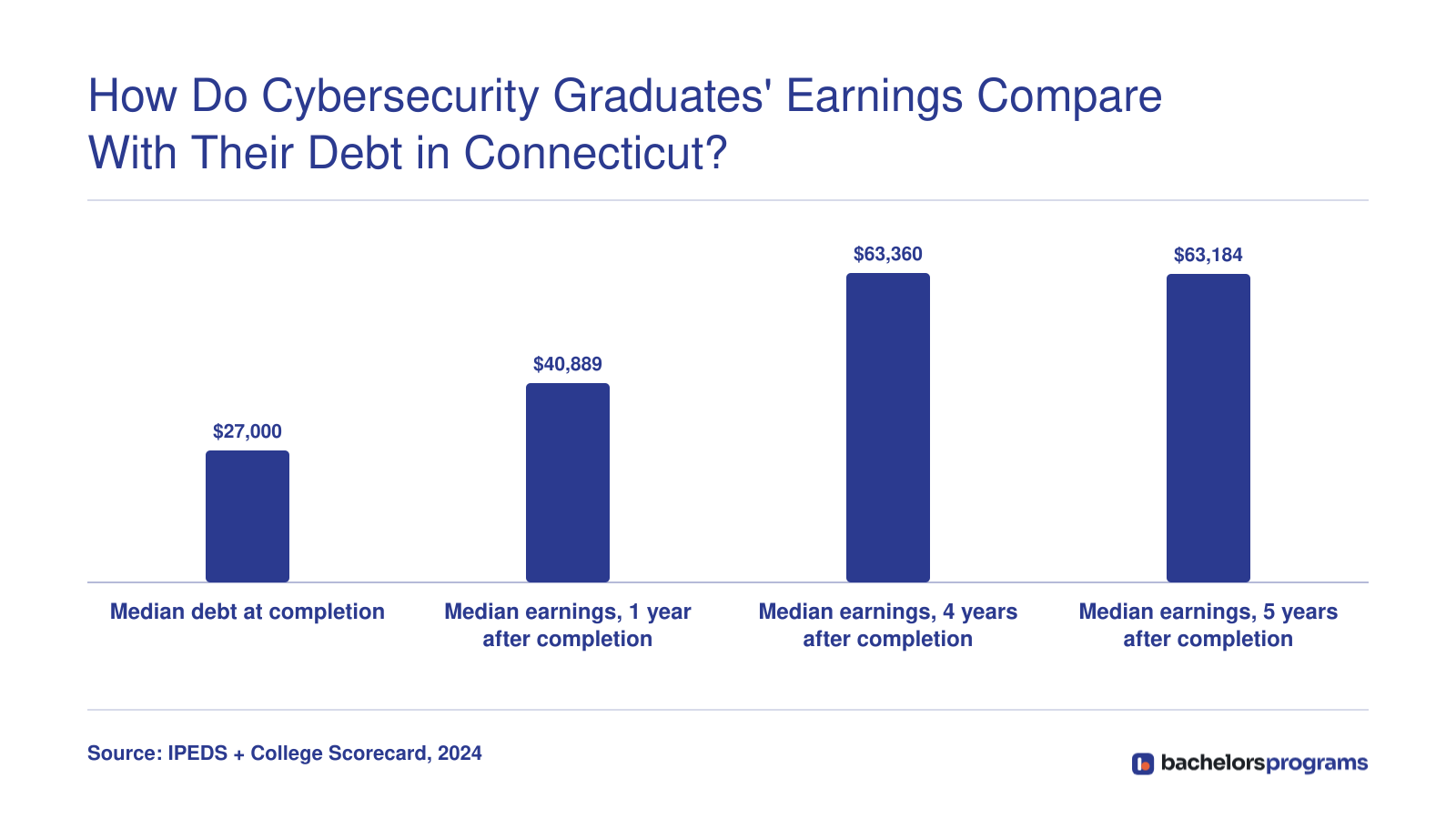
How Do Cybersecurity Graduates' Earnings Compare With Their Debt in Connecticut?
At the University of New Haven, cybersecurity bachelor's graduates borrowed a median of $27,000 and earned a median of $40,889 one year after completion. By year four, median earnings reached $63,360, more than twice the typical debt, which works out to about $286 a month on a 10-year repayment plan. Federal data do not yet report program-level earnings and debt for the other Connecticut cybersecurity programs, so they are left out of this chart rather than replaced with campus-wide figures.
What Information Security Analysts Earn in Connecticut
Connecticut pays information security analysts slightly above the national norm.
Questions to Ask Yourself
Can you commute to a campus, or do you need a Connecticut-based program you can complete entirely online?
Will you transfer community college credits, and has the school confirmed in writing that it accepts them?
Does the federal or defense work you want favor an NSA-designated program?
Can you cover the published price, or will you depend on in-state public tuition and Connecticut state aid?
Connecticut Cybersecurity Bachelor's Degrees: Common Questions
These short answers cover the questions Connecticut students ask most often about a bachelor's degree in cybersecurity. Figures reflect 2026 published pricing and designations, so confirm details with each school before you apply.
What is the best cybersecurity school in Connecticut?
Which Connecticut colleges offer a bachelor's degree in cybersecurity?
What does a bachelor's in cybersecurity cost at Connecticut colleges?
Are there NSA-designated cybersecurity programs in Connecticut?
Can you earn a bachelor's degree in cybersecurity online from a school based in Connecticut?
Do you need a license to work in cybersecurity in Connecticut?
Compare Cybersecurity programs on the data that matters
Explore more Computers & IT majors or browse every field of study.
All Computers & IT programs Browse every field of study