Best Business Degree Programs in Connecticut
Compare 38 accredited Business programs in Connecticut at 18 colleges, with net price after aid, graduation rates, earnings and debt from IPEDS and the U.S. College Scorecard.

A business bachelor's in Connecticut is a four-year degree in management, accounting, finance or marketing. In a state this compact, public and private campuses sit within a short drive of employers in Hartford, New Haven and Stamford, and online programs reach the rest of it.
Price separates them more than geography. Charter Oak State College charges a flat $8,506 in tuition for its fully online program. Quinnipiac University lists $55,480 in tuition and fees before aid cuts its average net price to $40,675.
The ranking weighs that gap, as do the cheapest and highest-earning picks, because a private sticker price rarely matches what families pay.
Key Points
- Charter Oak State College charges one flat $8,506 tuition, fully online.
- Quinnipiac's $55,480 sticker price drops to a $40,675 average net price.
- The University of Connecticut posts the highest graduation rate among these schools.
The 10 Best Business Bachelor's Programs in Connecticut
If you want the short answer, the University of Connecticut is the strongest choice for a traditional undergraduate business degree in the state: it combines the widest business curriculum, the largest alumni network and the highest graduation rate of any school on this list. The ten programs below are ranked, and each card lists format, in-state tuition, average net price and the graduation rate of the school that offers the program. Graduation rate is a school-wide figure, not a rate for any single major.
University of Connecticut
#1Storrs, CT · ~$25,000/yr (est.)
Best for: Traditional students wanting a flagship campus
The state's flagship public university and the most complete undergraduate business option in Connecticut. The Business Administration major is deliberately broad, letting students build a curriculum across finance, marketing, communications and human resources instead of locking into one track immediately. Bloomberg Market Concepts certification, internships and study abroad are built into the experience, and the major is also available at the Waterbury campus.
- Five 3000 and 4000 level business courses
- Bloomberg Market Concepts Certificate available
- Study abroad and internship opportunities
- Also offered at the Waterbury campus
- Median base salary of $66,330 reported for graduates
- Flexible interdisciplinary curriculum
Charter Oak State College
#2New Britain, CT · $15,000 – $20,000/yr (est.)
Best for: Working adults finishing a degree online
Connecticut's public online college, built for adults who are finishing a degree rather than starting one. The Business Administration bachelor's is fully online, charged at one flat tuition rate regardless of residency, and awards credit for prior learning and industry credentials. Concentrations in Small Business, Project Management and Human Resources let students aim the degree at a specific job rather than a general business credential.
- 100% online coursework, part-time or full-time
- Tracks: Small Business, Project Management, Human Resources
- One flat tuition rate for all students
- Six Sigma certification option
- Credit for prior learning and transfer credits accepted
- Multiple start dates per year
- Fast track option into a master's degree
- Accredited by NECHE
Eastern Connecticut State University
#3Willimantic, CT · ~$21,000/yr (est.)
Best for: Students weighing several concentration options
A mid-sized public university in Willimantic where the business major is a Bachelor of Science with a compact 54-credit structure. Students choose a concentration in Management, Marketing, Sport Management or International Business and complete an internship as part of the requirements. The 2.7 GPA threshold is higher than at most public options in the state, so it pays to hit that mark early.
- Tracks: Management, Marketing, Sport Management, International Business
- 54 total credits: 21 foundational, 18 core, 15 electives
- 2.7 minimum GPA requirement
- 24 business credits must be completed in residence
- Internship component included
- Bachelor of Science degree
Quinnipiac University
#4Hamden, CT · $41,000/yr (est. net price)
A private university in Hamden whose business school offers an AACSB-accredited BBA delivered fully online as a degree-completion program. Students may transfer between 30 and 91 credits, which makes it a practical landing spot for someone arriving with an associate degree. The School of Business alumni network of more than 21,000 and employer relationships with companies such as Travelers and PepsiCo support internships and hiring.
- AACSB accredited business school
- 121 total credit hours
- 30 to 91 transfer credits accepted
- Fully online degree-completion format
- 10% tuition discount for students with five or more years of experience
- Small classes taught by full-time doctoral faculty
- School of Business alumni network of more than 21,000
Central Connecticut State University
#5New Britain, CT · ~$17,000/yr (est.)
A public university in New Britain with an AACSB-accredited business degree offered on campus, in hybrid form and online, with January and August starts. The 120-credit program spans management, accounting, finance and marketing, and internships and study abroad sit alongside the core. Employees of participating chambers of commerce and local employers can qualify for a tuition discount through a one-year pilot.
- AACSB International accredited
- 120-credit comprehensive program
- Full-time and part-time tracks
- On-campus, hybrid and online formats
- Starts in January and August
- Internship and study abroad opportunities
- On-campus childcare available
- PhD-trained faculty
Western Connecticut State University
#6Danbury, CT · ~$18,000/yr (est.)
A public university in Danbury with a Bachelor of Business Administration in Management that carries three concentration options. The Ancell School of Business program totals 120 credits with 49 in the major, and an accelerated pathway toward an MBA is available for strong students. Courses are also offered at the Waterbury location, which helps students who commute from outside Danbury.
- 120 semester credits, 49 in the major
- Tracks: Human Resources Management, Small Business and Entrepreneurial Management, Supervisory Management
- Minimum 2.0 GPA requirement
- Accelerated BBA to MBA pathway possible
- Ancell School of Business program
- Courses also offered at the Waterbury location
Goodwin University
#7East Hartford, CT · ~$29,000/yr (est.)
A private university in East Hartford oriented toward working adults, with flexible scheduling and a career-focused curriculum. The Business Administration bachelor's runs in a hybrid format and includes an Entrepreneurship concentration for students who want to build or run a small business. Coursework covers strategic planning, financial management and startup development rather than theory alone.
- Entrepreneurship concentration
- Hybrid format combining online and on-campus coursework
- Built for working professionals and career changers
- Coursework in strategic planning, financial management and startup development
Southern Connecticut State University
#8New Haven, CT · ~$21,000/yr (est.)
A public university in New Haven with one of the largest business administration programs in the state by enrollment. Students choose a concentration such as Management, Business Economics or International Business and can apply to an accelerated pathway that counts graduate credits toward the bachelor's. The business core is paired with a required policy and strategy seminar, and the program admits students with a 2.0 GPA.
- 120 total credits required
- Management concentration with a 2.0 minimum GPA
- Accelerated pathway option into graduate study
- Dual credit graduate pathway available
- Comprehensive business core plus strategic business policy
- 33 business administration credits plus 27 economics credits
- Accelerated pathway requires a 3.0 GPA and 90 credits
- Up to 6 graduate credits per semester in the accelerated path
- C+ or better required in concentration courses
- 9 cognate credits required
- 21 international business concentration credits
- 60 major requirement credits plus 46 general education credits
- Four distinct prefix courses required in the concentration
- Cultural studies cognate options
- Business Policy and Strategy Seminar required
University of Hartford
#9West Hartford, CT · $30,000/yr (est. net price)
A private university in West Hartford whose Barney School of Business houses ten majors and fifteen minors under one roof. The B.S. in Business Administration carries concentrations in Accounting and in Business Analytics and Managerial Economics, with required internships built into the accounting track and preparation for the CPA and CMA exams. Students also gain applied experience through the school's alliance with Stanley Black & Decker and projects with local businesses.
- 120 total credits
- Required internships included
- Prepares students for CPA and CMA exams
- Beta Alpha Psi chapter on campus
- Rolling admission process
- Concentration pairs analytics with managerial economics
- Prepares students for data analytics careers
- Part of the Barney School of Business
- Core business curriculum with real-world experience
University of Bridgeport
#10Bridgeport, CT · $28,000/yr (est. net price)
A private university in Bridgeport with a flexible Business Administration bachelor's that runs both online and on campus. Seven-week accelerated courses let students finish in as little as 36 months, which appeals to career changers and transfer students. The Trefz School of Business maintains corporate partnerships that feed internships and experiential projects, and students have access to the on-campus Innovation Center.
- Online and on-campus options
- 7-week accelerated courses
- Degree completion possible in 36 months
- Taught by industry experts
- Access to the Innovation Center
- Coursework in marketing, accounting, management and entrepreneurship
Cost & outcomes by school
Federal data for the highest-earning Business programs, independent of the ranking above. Earnings are this field's bachelor's graduates four years after completing where the Scorecard reports them, else the school's undergraduate median.
| School | Net price / yr | Grad rate | Earnings | Debt | Grads/yr | Format |
|---|---|---|---|---|---|---|
| Fairfield University CT | $48,095 | 84% | $88,794 | $26,000 | 2,882 | Campus |
| Quinnipiac University CT | $40,675 | 76% | $83,759 | $26,000 | 3,320 | Online |
| Sacred Heart University CT | $46,174 | 74% | $75,059 | $25,000 | 3,642 | Campus |
| University of Connecticut CT | $25,097 | 83% | $73,997 | $21,500 | 11,874 | Campus |
| Charter Oak State College CT | $15,815 | 67% | $64,209 | $18,683 | 898 | Online |
| University of Hartford CT | $30,282 | 54% | $60,823 | $27,000 | 1,626 | Campus |
| Albertus Magnus College CT | $34,028 | 52% | $60,144 | $30,964 | 482 | Campus |
| University of New Haven CT | $34,192 | 63% | $60,126 | $27,000 | 1,938 | Campus |
| University of Saint Joseph CT | $27,989 | 64% | $59,908 | $27,000 | 442 | Campus |
| Western Connecticut State University CT | $17,604 | 52% | $59,115 | $24,147 | 1,468 | Campus |
| Central Connecticut State University CT | $16,857 | 48% | $58,562 | $22,300 | 3,216 | Online |
| Eastern Connecticut State University CT | $21,067 | 58% | $56,469 | $24,250 | 1,842 | Campus |
Sources: U.S. Department of Education. Net price, graduation rate, earnings and debt: College Scorecard (earnings and debt for this field's bachelor's graduates where reported, else school-wide); graduates: IPEDS. A dash means no figure is reported.
Cost, debt & payoff
Median earnings of this field's bachelor's graduates (4 yrs after completing, else the school's undergraduate median) vs. their median federal loan debt · U.S. College Scorecard
Across these programs the median graduate earns about $59,115 and finishes with roughly $24,250 in debt — a ratio that clears a common rule of thumb (keep debt below first-year salary). Net price and debt vary widely school to school, so check the per-school figures in the table above before you shortlist.
How We Sorted Connecticut's Business Programs: Value, Outcomes and Completion
A low sticker price and a strong graduate salary often point to different schools, and the honest comparison sits between them.
We weighed what students actually pay against what graduates earn and how many students finish. The inputs are plain: net price after aid, graduation rate, selectivity in admissions, earnings and debt for graduates of the specific business program, and the range of concentrations each school offers.
Two caveats carry real weight. The graduation rate is a whole-school average, so it describes the institution rather than the business major alone, and the net price is an estimate that shifts with family income and how aid is packaged. Program-level earnings cover graduates who received federal aid and reported income, so treat them as a signal rather than a promise.
Everything here sits at the bachelor's level, covering campus and online programs at Connecticut-based schools. Use the comparisons as a starting filter, then confirm the details with each school's own pages.
The Cheapest Business Bachelor's Programs in Connecticut
Every option in this table is a public institution, and Charter Oak State College stands out with one flat tuition rate of $8,506 for in-state and out-of-state students alike in its fully online program. Net price is higher than tuition because it reflects the full cost of attendance (including housing, books and other expenses) minus grants. Private schools in our ranking usually publish higher tuition, so compare what students actually pay after aid rather than the published price. Net price figures come from 2024 U.S. Department of Education data (IPEDS and College Scorecard) and are school-wide averages for aided students, not program-specific quotes, so your own cost will depend on your aid package.
| School | City | Format | In-State Tuition and Fees | Out-of-State Tuition and Fees | Average Net Price After Aid |
|---|---|---|---|---|---|
| Charter Oak State College | New Britain | Online | $8,506 | $8,506 | $15,815 |
| Central Connecticut State University | New Britain | Online | $13,050 | $16,550 | $16,857 |
| Western Connecticut State University | Danbury | Campus | $13,401 | $16,901 | $17,604 |
| Southern Connecticut State University | New Haven | Campus | $13,438 | $27,378 | $20,857 |
| Eastern Connecticut State University | Willimantic | Campus | $13,928 | $17,428 | $21,067 |
What a Connecticut Business Bachelor's Really Costs After Aid
Quinnipiac University lists tuition and fees of $55,480, yet its average net price is $40,675. The University of Hartford shows a similar drop, from $49,075 to $30,282. Private schools discount heavily, so the sticker price overstates what most students pay.
Public schools run the other way. The University of Connecticut charges $21,614 in tuition and fees, and Eastern Connecticut State University charges $13,928. Their average net prices are higher ($25,097 and $21,067), because net price counts living costs such as housing and food, minus grants. Compare net price to net price, never sticker to sticker.
State Aid Worth Checking
The Roberta B. Willis Scholarship is the main state merit-and-need award.1 Details from the Connecticut Office of Higher Education:
- Who qualifies: Connecticut residents attending a four-year public or nonprofit private college in the state.1
- Academic bar: High school seniors need a top 20 percent class rank. College undergraduates need a top 20 percent rank and/or an SAT of 1200 or an ACT of 25.1
- Need: A FAFSA must be filed, and the student's Student Aid Index must fall at or below the state's yearly cutoff.1
- Award: Up to $5,250 per year for a four-year program.1
- Deadline: February 15, with the application submitted by a high school counselor.1
The state also describes a Willis Need-Based Grant for residents, with an older reference of up to $4,500 per year.2 We could not confirm whether that figure still applies to 2026 awards, so ask the financial aid office before counting on it.
What We Could Not Verify
Aid to Public College Students is listed as state financial aid, but we found no 2026 eligibility rules, award maximum or deadline.3 Connecticut also describes free community college tuition as aid that closes the gap left by federal and state grants.3 We could not confirm its current dollar limits, enrollment requirements, deadline, or whether it covers fees and books. Confirm these directly with the schools or the Office of Higher Education.
A Practical Sequence
1. File the FAFSA as early as possible. Willis eligibility depends on it.1 2. Note the February 15 state deadline and ask your counselor to submit the Willis application. 3. Use the net price calculator on each school's site, then compare the results side by side.
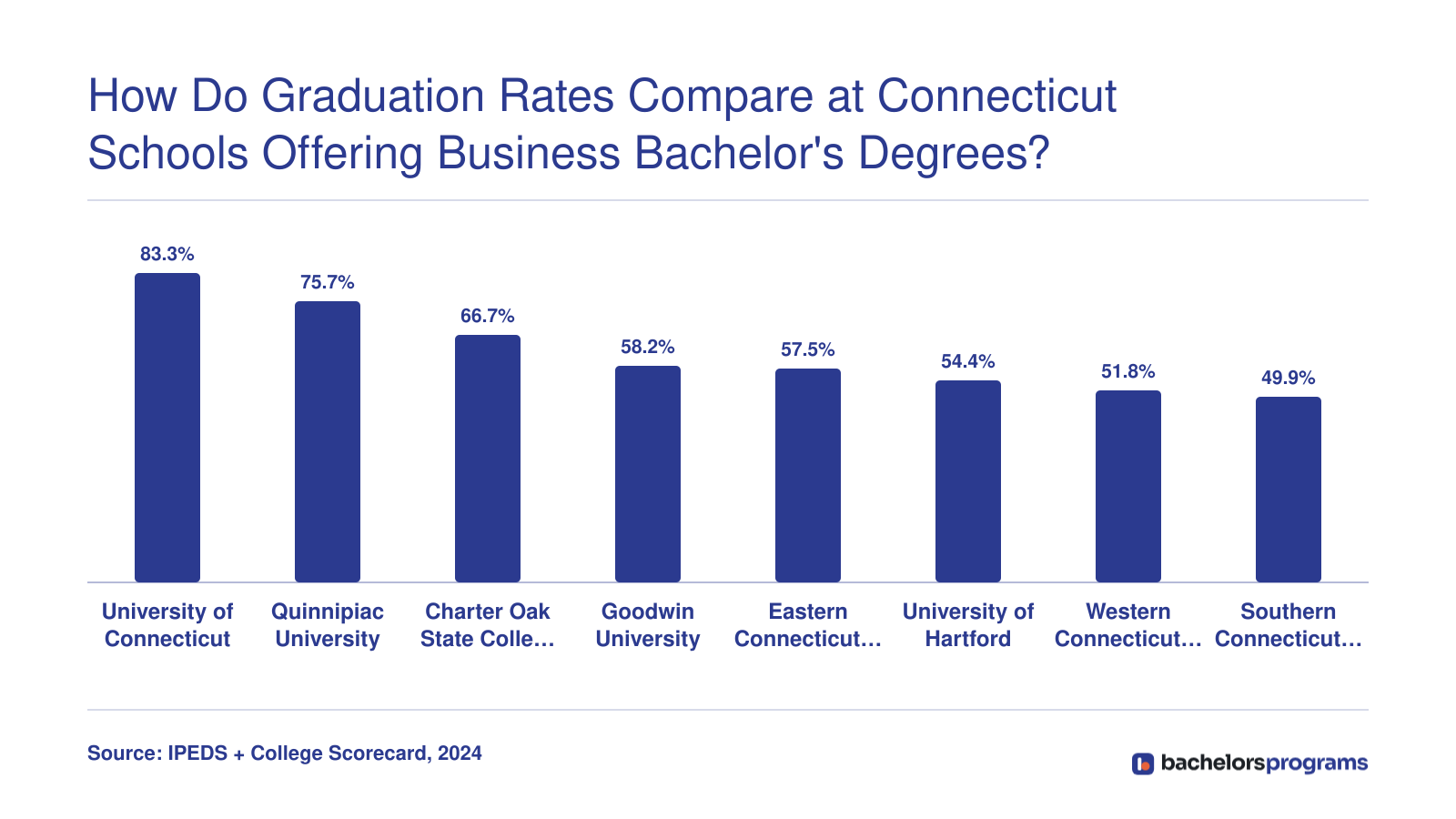
How Do Graduation Rates Compare at Connecticut Schools Offering Business Bachelor's Degrees?
Each bar shows a school's overall graduation rate: the share of first-time, full-time students who finish a bachelor's degree within six years. These are institution-wide figures, not rates for business majors, so read them as a signal of how well a school helps students finish rather than as a measure of its business program. Among the schools charted, the University of Connecticut leads at 83.3% and Southern Connecticut State University sits at 49.9%, a gap of about 33 percentage points that is worth weighing alongside cost and format.
Online, Hybrid and Evening Business Bachelor's Options at Connecticut Schools
Business is one of the easier bachelor's fields to finish without a weekly commute, but Connecticut schools differ widely in how much of it they deliver online.
Fully Online
Charter Oak State College in New Britain delivers its Business Administration bachelor's entirely online. It requires 120 credits, has no residency requirement and offers six start dates a year. Quinnipiac University's BBA completion program takes students who bring about 60 transferable credits and can be finished entirely online.
Hybrid, Accelerated and Evening
Goodwin University's Business Administration bachelor's, with an Entrepreneurship concentration, is hybrid, and the school describes online, on-campus, day, evening and weekend formats. The University of Bridgeport lists online and on-campus options, 7-week accelerated courses and completion in 36 months. Central Connecticut State University's program notes multiple learning formats, and its Management bachelor's (120 credits) is listed as hybrid. Confirm with the school which courses are remote before you enroll.
On-Campus Only
The University of Connecticut (fully face-to-face), Eastern Connecticut State University, Western Connecticut State University and the University of Hartford run campus-based programs. Eastern and Southern require 120 credits.
Why a Connecticut-Based Online Program Matters
Earning the degree online from a Connecticut school can keep you close to the state's internship pipeline and alumni network. It may also keep you in line for Connecticut aid, though eligibility depends on the program and your residency, so check with the financial aid office.
Can you earn a business degree online from a Connecticut school? Yes. Charter Oak and Quinnipiac are the clearest fully online routes, and Bridgeport and Goodwin add flexible alternatives.
Questions to Ask Yourself
Do you need to keep working in Hartford, Stamford or New Haven while you study?
Are you starting from a Connecticut community college with credits already earned?
Does AACSB accreditation matter for the roles you are targeting?
Can you cover the net price after aid without borrowing beyond what recent graduates carry?
Admission Requirements for Connecticut Business Bachelor's Programs
What GPA do you need to get into a Connecticut business bachelor's program? It depends on the school, and on whether you start as a first-year or transfer in.
Selectivity at a Glance
The federal scorecard admission rate is a school-wide figure, not a business-school figure, but it shows who is more selective. The University of Connecticut admits about 52 percent of applicants. Quinnipiac (72 percent) and Central Connecticut State (73 percent) come next. Eastern Connecticut State and the University of Bridgeport sit near 83 percent, Western Connecticut State at 87 percent, Southern Connecticut State at 91 percent and the University of Hartford at about 96 percent. Charter Oak State College and Goodwin University report no admission rate in our data.
GPA, Testing and Transfer Credit
UConn's business school sets the clearest bar for transfers. Direct admission requires at least 40 credits and all eight business prerequisite courses, plus either a 3.3 cumulative GPA or a 3.0 with every prerequisite finished. Quinnipiac lists a 3.0 for its Connecticut Guarantee business entries, and Goodwin and Bridgeport list a 2.0. Quinnipiac's program page says it accepts roughly 30 to 91 transfer credits. Eastern's program page cites a 2.7 minimum GPA, while Western and Southern list a 2.0 for the major. Hartford advertises rolling admission.
Most of these schools publish no first-year GPA expectation, testing policy or general transfer-credit rule on the pages we reviewed, so we have not inferred one. Confirm each on the school's admissions page before you apply.
Community College Pathways
Students starting at a Connecticut community college have structured routes:
- Guaranteed general admission: Associate graduates in good academic, financial and disciplinary standing are guaranteed admission to Central, Eastern, Southern and Western Connecticut State Universities and to Charter Oak. This does not cover programs with separate admission or capacity limits.
- Transfer Ticket: These associate degrees guarantee junior status at those same schools and leave 60 credits to finish, with no course-by-course review.
- Connecticut Guarantee: Admission to participating independent colleges, including Goodwin, Quinnipiac and Bridgeport, when program requirements are met.
- UConn Guaranteed Admission Program: Open to academically qualified community college students heading into the School of Business.
An advisor can confirm which courses count toward your major.
Related Articles
Business Careers and Salaries in Connecticut
A business bachelor's in Connecticut prepares you for office-based roles in finance, accounting, marketing, management and operations, and pay varies widely by occupation. The figures below come from Bureau of Labor Statistics occupational estimates. They are the most recent Connecticut numbers available for each role, and some are older than others.
Connecticut Wages by Role
BLS reports mean (average) wages for Connecticut, not medians, so treat these as rough benchmarks rather than what a new graduate will earn.
- Accountants and auditors: about 16,320 jobs and a mean annual wage of $90,570 (May 2023).1
- Marketing managers: a mean annual wage of $154,870 in older May 2021 estimates.2
- General and operations managers: a mean annual wage of $141,330, also from May 2021.2
- Management analysts: Connecticut figures were not available to us. Nationally, BLS lists a 2025 median of $101,860 and projects 10% growth from 2025 to 2035.3
For financial analysts, we could not confirm a current Connecticut figure. Across all business and financial occupations, Connecticut's mean annual wage was $96,150 in May 2023.1 Manager-level pay generally takes years of experience to reach.
Scorecard Earnings Are a Different Measure
College Scorecard earnings track graduates of a specific school and program in the years right after they finish. BLS wages cover every worker in an occupation, from entry-level to veteran. Do not compare the two directly, since the BLS numbers will usually run higher.
Where the Jobs Are
Connecticut's business employers cluster in insurance and finance (the Hartford area and Fairfield County), healthcare systems and manufacturing. Accounting and finance concentrations fit banks, insurers and advisory firms. Management and operations suit manufacturers and hospitals, and marketing fits employers in all of these sectors. Programs at schools such as the University of Connecticut, Quinnipiac University and the University of Hartford offer business administration degrees that can lead into these fields.
Licensure
Business administration is not a licensed field, and most business jobs do not require a license. The exception is accounting. If you want to become a CPA in Connecticut, you will need to meet the state's education, exam and experience requirements, so confirm current rules with the Connecticut State Board of Accountancy before choosing coursework.
Quick Answers About Business Bachelor's Degrees in Connecticut
These short answers draw on the sections above. Figures are published ranges, not guarantees, so confirm details with each school before you apply.
What is the best business school in Connecticut for undergraduates?
How much does a business degree cost in Connecticut?
Can you get a business degree online from a Connecticut school?
Is AACSB accreditation necessary for a Connecticut business bachelor's?
How much do business administration graduates earn in Connecticut?
Can I transfer from a Connecticut community college into a bachelor's in business?
Compare Business programs on the data that matters
Explore more Business & Management majors or browse every field of study.
All Business & Management programs Browse every field of study