Best Cybersecurity Schools in Idaho
Compare 4 accredited Cybersecurity programs in Idaho, with net price after aid, graduation rates, earnings and debt from IPEDS and the U.S. College Scorecard.

In Idaho, a bachelor's degree in cybersecurity works mainly as a local hiring credential. The market is small and tight-knit. Boise tech firms and healthcare systems, state government agencies, and Idaho National Laboratory hire many locally trained graduates, so internships and faculty contacts carry real weight.
The complication is naming. The Bachelor of Science (B.S.) in Cybersecurity is the common credential, but the programs here use different titles. Boise State offers Cyber Operations and Resilience, Lewis-Clark State emphasizes cybersecurity management, and Northwest Nazarene builds the field into computer science.
Cost varies less than curriculum does. Median borrowing at graduation runs from $18,500 to $23,750 across these schools, which makes program fit the sharper deciding factor.
Key Points
- Boise State offers a fully online B.S. in Cyber Operations and Resilience.
- Median graduate debt runs $18,500 (Lewis-Clark State) to $23,750 (Northwest Nazarene).
- No Idaho license is required, so certifications like CompTIA Security+ carry weight.
Best Cybersecurity Schools in Idaho, Ranked
Cybersecurity study in Idaho splits into two fairly different worlds. Public flagships such as Boise State and the University of Idaho carry large computing schools, dedicated labs, and research ties to employers like the Idaho National Laboratory, while regional and private institutions in Lewiston and Nampa build smaller, career-focused programs that lean on business coursework or faculty research. Delivery format matters just as much as size here: two of the four programs below can be completed entirely online.
Boise State University
#1Boise, ID · $20,000 – $25,000/yr (est.)
Best for: Online learners wanting asynchronous classes
Boise State University is the state's largest public research university and anchors Idaho's cybersecurity workforce pipeline through its Institute for Pervasive Cybersecurity, which connects students with industry, government, and nonprofit partners. Its School of Computing holds National Centers of Academic Excellence in Cybersecurity designations in both cyber defense and cyber research from the National Security Agency. The university also participates in the Cyber Service Academy, supports Department of Defense talent recruitment, and has collaborated with the Idaho Secretary of State on election-security work. Students come from across the country and roughly a quarter have a military affiliation.
- $395 per credit; seven-week courses, six start dates a year
- 100% online and asynchronous with no in-person requirements
- NSA Center of Academic Excellence designations in cyber defense and research
- No math or technical background required for admission
- Bachelor of Applied Science option lets AAS holders apply up to 47 technical credits
- 12-credit stand-alone cyber certificates finishable in two semesters
- Free training resources through VMware IT Academy, Palo Alto Academy, Cisco Networking Academy
- About 25% of students have a military affiliation
Lewis-Clark State College
#2Lewiston, ID · $16,000/yr (est. net price)
Best for: Transfer students holding an associate degree
Lewis-Clark State College is a smaller public college in Lewiston that frames cybersecurity around business and management rather than deep engineering, which suits students who expect to supervise security operations or move into IT leadership. The program accepts associate's degree holders in related fields and holds transfer agreements with other Idaho colleges. LC State also has applied ties to statewide cyber workforce efforts; the Idaho Army National Guard and the state's Information Technology Services division worked with the college on a vulnerability assessment. Class sizes are small and faculty contact is emphasized.
- Fully online, with coursework available at Lewiston and online
- Fuses cybersecurity, computer programming, and business management
- 120 credits; accepts associate's degree transfers in related fields
- Covers computer security basics, relevant laws, and human relations
- Small class sizes with emphasis on faculty interaction
- Transfer agreements with other Idaho colleges
University of Idaho
#3Moscow, ID · $10,000 – $15,000/yr (est.)
Best for: Hands-on learners wanting a technical campus degree
The University of Idaho is the state's land-grant flagship, and its cybersecurity degree sits inside the College of Engineering's computer science department, giving students a technically rigorous, lab-heavy path. The program is built for students who intend to write secure code, defend networks, or move into forensics and vulnerability research rather than general IT management. Coursework runs through two dedicated cybersecurity labs and closes with a two-course senior design capstone. The Moscow campus setting means in-person collaboration with engineering faculty and peers.
- 120 credits, including 82 credits of required coursework
- Required courses in secure coding, network defense, digital forensics, and vulnerability analysis
- Two cybersecurity labs plus a two-course senior design capstone
- Also requires calculus, discrete mathematics, statistics, and ethics
- On-campus program taught in Moscow
- Learning outcomes include applying legal and ethical principles and communicating professionally
Northwest Nazarene University
#4Nampa, ID · $25,000 – $30,000/yr (est.)
Northwest Nazarene University is a private Christian institution in Nampa with a computer science degree that carries a cybersecurity emphasis, so students graduate with a broad computing foundation rather than a narrow security-only transcript. Faculty-directed research is funded by NASA, the National Institutes of Health, the USDA, and the U.S. Forest Service, and summer internships give undergraduates lab experience that is unusual at a school this size. Computer science majors may also take graduate courses that count toward the university's MS in Artificial Intelligence. The campus is residential and close to the Boise metro job market.
- On-campus program in Nampa, Idaho
- Covers cyber analytics, penetration testing, risk assessment, and defense design
- Foundation in programming, software development, networking, graphics, and database design
- Faculty research funded by NASA, NIH, USDA, and the U.S. Forest Service
- Summer internships with faculty research
- Computer science majors can take graduate courses counting toward the MS in Artificial Intelligence
- Graduates pursue roles such as information security analyst and network engineer
Cost & outcomes by school
Federal data for the highest-earning Cybersecurity programs, independent of the ranking above. Earnings are this field's bachelor's graduates four years after completing where the Scorecard reports them, else the school's undergraduate median.
| School | Net price / yr | Grad rate | Earnings | Debt | Grads/yr | Format |
|---|---|---|---|---|---|---|
| University of Idaho ID | $14,831 | 57% | $54,670 | $21,982 | — | Campus |
| Northwest Nazarene University ID | $29,580 | 71% | $51,719 | $23,750 | — | Campus |
| Boise State University ID | $21,610 | 60% | $51,658 | $20,500 | 61 | Online |
| Lewis-Clark State College ID | $15,635 | 40% | $46,001 | $18,500 | — | Online |
Sources: U.S. Department of Education. Net price, graduation rate, earnings and debt: College Scorecard (earnings and debt for this field's bachelor's graduates where reported, else school-wide); graduates: IPEDS. A dash means no figure is reported.
Cost, debt & payoff
Median earnings of this field's bachelor's graduates (4 yrs after completing, else the school's undergraduate median) vs. their median federal loan debt · U.S. College Scorecard
Across these programs the median graduate earns about $51,689 and finishes with roughly $21,241 in debt — a ratio that clears a common rule of thumb (keep debt below first-year salary). Net price and debt vary widely school to school, so check the per-school figures in the table above before you shortlist.
How We Ranked Idaho's Bachelor's Degree in Cybersecurity Programs
What you are really paying for with a bachelor's degree in cybersecurity is three things: a recognized credential, hands-on technical skill, and a first-job network. The figures here show which Idaho schools deliver those three things at a price that holds up after aid.
What the Numbers Compare
- Cost and net price: Sticker tuition matters less than what a typical student actually pays after aid. Net price is the figure worth checking first.
- Graduation rates: A program students finish is worth more than one they leave. Completion rates say something about advising, course availability, and support.
- Outcomes: Federal earnings data shows what graduates of a school earn a few years after finishing, which gives a rough read on whether the investment pays back.
- Format and accreditation: Campus, online, or hybrid delivery changes the true cost. Regional accreditation is the baseline, because it is what makes transfer credit and federal aid work.
Where the Data Stops
Graduation rates and net price are reported for the whole institution, not for a single major, so they describe the school more than the cybersecurity classroom. Earnings are measured at set windows after completion, not on graduation day. Treat all of it as direction, not a promise.
Does Boise State Offer a Cybersecurity Degree?
Boise State does offer a cybersecurity bachelor's, though its main standalone degree carries a different name: the Bachelor of Science in Cyber Operations and Resilience.
The standalone bachelor's
That B.S. is 100% online and asynchronous, with seven-week courses, six start dates a year, and no in-person requirements. As a full bachelor's major, it is comparable to a B.S. in Cybersecurity, which is why it earns a place on this list. A related Bachelor of Applied Science in the same field serves students with an Associate of Applied Science and accepts up to 47 technical credits from another accredited institution.
On-campus and add-on options
Students who prefer campus can take the Cybersecurity emphasis within the Computer Science degree, offered through the Department of Computer Science. It is NSA-validated, Boise State is a National Center of Academic Excellence in Cyber Defense, and graduates receive an NSA-endorsed certificate. It remains an emphasis inside a computer science degree, not a separate major. The Cybersecurity minor is meant to pair with another major. A 12-credit Cyber Operations Certificate can be added to a bachelor's or stand alone, in as few as two semesters.
Who should still consider Boise State
Students who want to work in the Boise job market should look closely: the campus emphasis builds local connections, and the online degree lets working adults finish without relocating. Compare curriculum, not just program titles.
Online and Hybrid Cybersecurity Bachelor's Options at Idaho Schools
The trade-off is flexibility against proximity: a fully online cybersecurity bachelor's lets you keep working, while a campus program puts you in the same room as the lab equipment, the capstone team, and the faculty who write recommendation letters. Idaho gives you both, but not at every school.
Fully online pathways
Boise State's Bachelor of Science in Cyber Operations and Resilience is built for distance learners. The program listing describes asynchronous classes, seven-week course blocks, six start dates a year, full-time and part-time tracks, and no in-person requirements, at $395 per credit. Lewis-Clark State College offers its Cybersecurity Management degree in Lewiston and fully online, at 120 credits, with transfer agreements that accept associate degree work from Idaho colleges.
Campus-based pathways
The University of Idaho runs its 120-credit Cybersecurity B.S. on campus, with coursework based in Moscow and Coeur d'Alene and a required capstone. Northwest Nazarene University's Computer Science: Cybersecurity degree is likewise a campus program in Nampa, with penetration testing and cyber analytics coursework plus summer internships tied to faculty research. Neither publishes a fully online version of the degree.
What to verify before you apply
Published materials for the online options do not identify required residencies, on-site labs, or proctored exam centers, but program pages rarely spell out every course requirement. Ask the admissions office two questions directly: whether any single course carries an on-site component, and whether the school is authorized to enroll students in your state if you live outside Idaho. Both schools here are Idaho-based institutions, so you are dealing with in-state public colleges rather than a national online provider.
A plain recommendation
If you are already employed, serving in the military, or living outside driving range of Boise, Lewiston, Moscow, or Nampa, the online routes are the practical choice. If you are entering straight from high school and want lab access, research work, and internship pipelines, choose campus.
Admission Requirements for Idaho Cybersecurity Bachelor's Programs
Applying straight from high school and applying as a transfer follow different rules in Idaho, and the gap matters more than any single GPA number.
Freshman Admission, School by School
The University of Idaho publishes the clearest rules for its B.S. in Cybersecurity. A high school GPA of 3.0 or higher admits you regardless of test scores. Applicants between 2.60 and 2.99 need a minimum ACT of 15 or SAT of 740. The sources we reviewed give no firm minimum below 2.60.
Boise State University, Lewis-Clark State College, and Northwest Nazarene University did not have a current GPA or SAT/ACT policy we could confirm for these programs, so check each admissions page before you apply. Scorecard admission rates give a rough sense of selectivity: about 65% at Northwest Nazarene, 76% at Idaho, 87% at Boise State, and 88% at Lewis-Clark State.
Transfer Credit and the Community College Route
At the University of Idaho, students with 14 or more transferable semester credits after high school apply as transfers and need a 2.0 cumulative GPA on that college work. Fewer than 14 credits means you apply as a first-year student, test requirements included. No cybersecurity-specific transfer GPA is published.
Idaho's statewide articulation policy helps community college students heading to Boise State, Lewis-Clark State, or Idaho.1 An associate of arts or science degree satisfies general education at these public schools. So does the 36-credit General Education Framework for students who transfer without a degree.1 Non-remedial credits generally move between public institutions, and College of Western Idaho participates in the policy, with its transfer guidance noting that an associate degree waives general education.
That protection covers general education, not the major. We found no named community-college-to-cybersecurity pathway or guaranteed course equivalencies, so technical courses, upper-division prerequisites, and labs may still be evaluated individually. Northwest Nazarene is private, so confirm its transfer terms directly.
One Tip for Transfer Applicants
Before you apply, email the cybersecurity department and ask for a course-by-course review of your transcript. Institutional admission and acceptance of credits toward the major are separate decisions, and you want to know both answers early.
Related Articles
What a Cybersecurity Bachelor's Degree Costs in Idaho
Sticker tuition at Idaho's public universities is not what most students end up paying, and the gap between the two numbers should shape where you apply.
In-State Tuition vs. Net Price
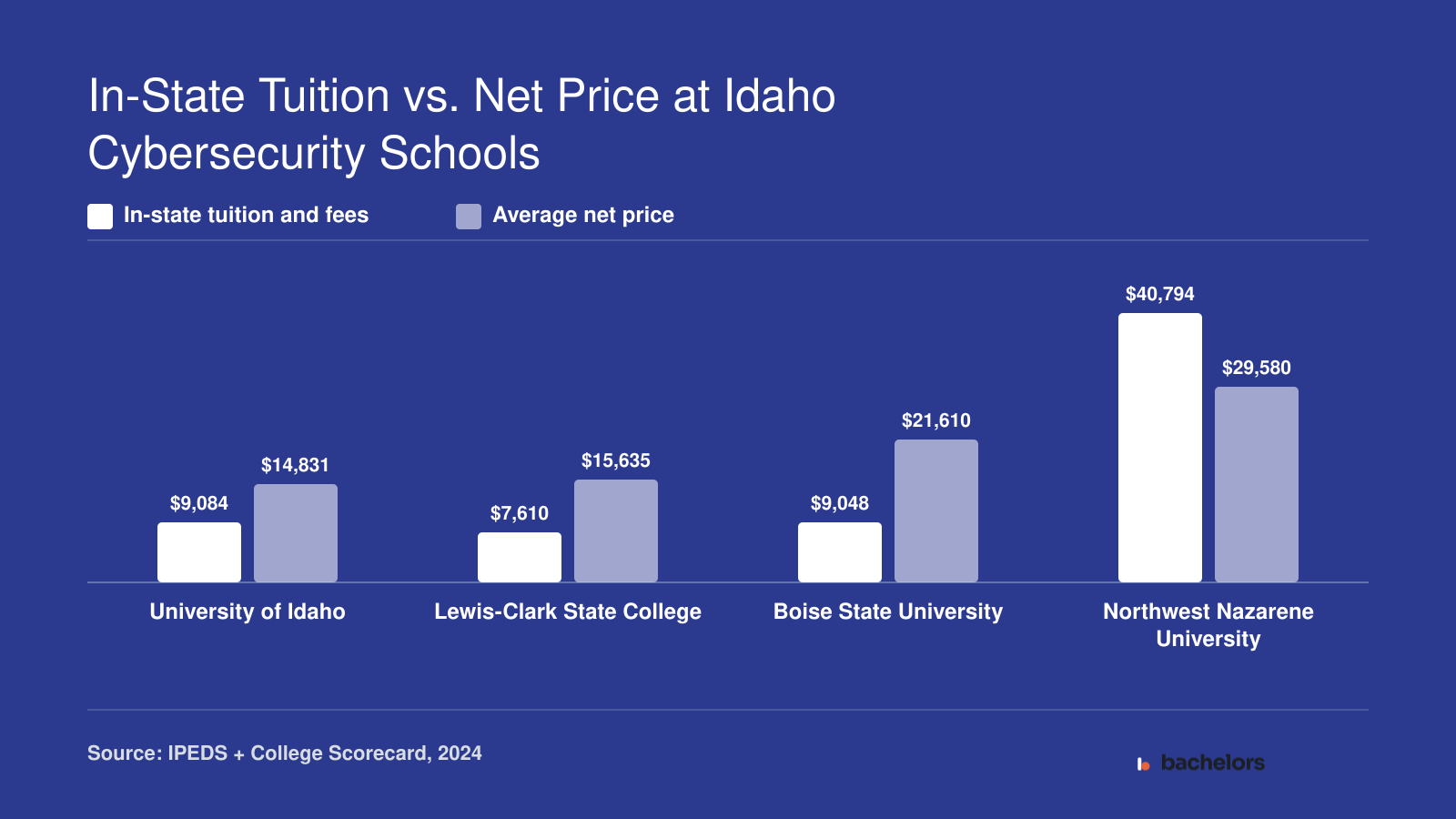
At the University of Idaho, in-state tuition and fees run $9,084 a year against $28,320 for non-residents, while the average net price after grant and scholarship aid comes to $14,831. Lewis-Clark State College charges $7,610 in-state ($22,028 out-of-state) and posts an average net price of $15,635. Boise State University sits at $9,048 in-state and $27,788 out-of-state, with a net price near $21,610. Northwest Nazarene University, the private option, lists $40,794 and lands near $29,580 net. Read net price as an approximate institution-wide average across all undergraduates, not a quote for one cybersecurity major; your own aid package will move it.
The Cheapest Route In
The most affordable path to a cybersecurity bachelor's degree in Idaho runs through Lewis-Clark State College, which carries the lowest in-state tuition here and offers its Cybersecurity Management degree fully online, so an Idaho resident can study without relocating. On net price, the University of Idaho edges ahead. Boise State prices its online B.S. in Cyber Operations and Resilience per credit at $395 rather than by academic year, which matters if you enroll part time. Median federal debt among graduates is $18,500 at LC State, $21,982 at Idaho, $20,500 at Boise State, and $23,750 at NNU.
Paying for It: Idaho Aid Programs
- Idaho Opportunity Scholarship: $0 to $3,500 a year for Idaho residents pursuing a first bachelor's degree; 2.7 unweighted GPA, a March 1 FAFSA, 30 credits a year, renewable up to four years.
- Idaho LAUNCH: covers 80 percent of tuition and fees up to $8,000 for eligible Idaho high school graduates entering in-demand programs. One-time, no FAFSA required, generally capped near $4,000 in the first year.
- WUE: reduced nonresident tuition at participating Western institutions. Amounts and eligibility rules vary by school.
In-State Tuition vs. Net Price at Idaho Cybersecurity Schools
The two bars measure different costs. In-state tuition covers tuition and fees only, while average net price is the full yearly cost of attendance, including housing and books, after grants and scholarships. That is why net price runs above tuition at Idaho's public schools but lands about $11,200 below Northwest Nazarene University's $40,794 tuition bill. The gap between sticker price and net price is where Idaho aid matters most.
What Completers Earn Against What They Pay
Debt is the clearest cost signal available. Median borrowing at graduation runs from $18,500 at Lewis-Clark State College to $23,750 at Northwest Nazarene University. Boise State University ($20,500) and the University of Idaho ($21,982) fall between them.
Idaho Licensing and Certification: No State License Required
Compare Cybersecurity programs on the data that matters
Explore more Computers & IT majors or browse every field of study.
All Computers & IT programs Browse every field of study