Best Public Health Schools in Idaho
Compare 4 accredited Public Health programs in Idaho, with net price after aid, graduation rates, earnings and debt from IPEDS and the U.S. College Scorecard.

What can you realistically study if you want a bachelor's degree in public health in Idaho? The list is short: four schools. Boise State University, Idaho State University, Brigham Young University-Idaho and The College of Idaho each offer a program. The B.S. in Public Health is the standard award, though titles and emphases vary by school.
Tuition ranges widely, and one school delivers its program fully online. No Idaho bachelor's program appears on the Council on Education for Public Health's accredited list as of November 2026, and the best-paid roles, such as epidemiologist, often expect a graduate degree.
Key Points
- Boise State offers a fully online, asynchronous B.A. in Public Health.
- Brigham Young University-Idaho charges $4,800 a year, before financial aid.
- As of November 2026, no Idaho public health bachelor's is CEPH accredited.
Best Bachelor's in Public Health Schools in Idaho, Ranked
Idaho has only a handful of four-year schools that award a bachelor's degree in public health, so this list is short and every entry carries real weight. Across the four schools offering this program, institution-wide graduation rates run from about 39% to 63%, which shows how wide the range in student outcomes is. What separates the top spot is a prevention-focused program with a built-in health science emphasis and data coursework, while the rest of the list competes on accreditation, online access, and statewide health partnerships.
Brigham Young University-Idaho
#1Rexburg, ID · ~$8,000/yr (est.)
Best for: Health science students seeking prevention careers
Brigham Young University-Idaho in Rexburg offers a Bachelor of Science in Public Health with a Health Science emphasis, and it is the most prevention-oriented program on this list. Coursework covers epidemiology, community health methods, health disparities, and emergency management, along with training in using AI to analyze health data and design evidence-based programs. Graduates typically move into entry-level clinical roles or continue toward physician, physician assistant, physical therapy, or dentistry credentials, and common job titles include epidemiologist, infection prevention coordinator, and environmental health specialist.
- Health Science emphasis with two concentration options
- Coursework in epidemiology, community health methods, health disparities
- Includes emergency management and evidence-based program design
- Adds AI and data analysis skills for public health work
- Prepares students for entry-level clinical or community health roles
- Common roles: epidemiologist, infection prevention coordinator
- Field settings include government, nonprofits, and schools
Boise State University
#2Boise, ID · $20,000 – $25,000/yr (est.)
Best for: Urban students wanting statewide health partnerships
Boise State University houses public health in its College of Health Sciences and gives undergraduates unusual contact with Idaho's public health system. Students choose an emphasis in environmental and occupational health and safety, health education and promotion, or a general track, and the department works with the Central District Health Department and the Idaho Department of Health and Welfare on applied projects. The School of Public and Population Health co-hosts the Idaho Health Priorities Conference with the Idaho Public Health Association in Boise in March 2027, and the Public Health Club adds networking, service, and leadership work.
- Three paths: environmental and occupational health, health education, general
- Online BA option built for working adults and distance learners
- Partnerships with Central District Health and Idaho Health and Welfare
- Public Health Club for networking, service, and leadership
- Co-hosts Idaho Health Priorities Conference with the state association
Idaho State University
#3Pocatello, ID · ~$12,000/yr (est.)
Best for: Working adults needing flexible part-time study
Idaho State University in Pocatello runs a Community and Public Health bachelor's program with two clear exits: Community Health for students who want to plan and evaluate health education, and Addiction Studies for those heading toward alcohol and drug counselor certification. The program is accredited by CEPH, admits students without a separate program application, and lets them study full time or part time with online access. An accelerated BS/MPH pathway and eligibility for the CHES and CPH exams make it the strongest fit for students who already know they want a public health career.
- CEPH accredited public health program
- Concentrations in Community Health and Addiction Studies
- No program admission requirements and no entrance exam
- Full-time or part-time study with online access
- Graduates eligible for CHES and CPH exams
- Addiction Studies courses directed at ADC certification
- Accelerated BS/MPH pathway available
- Minors and certificates available alongside the major
The College of Idaho
#4Caldwell, ID · ~$19,000/yr (est.)
The College of Idaho in Caldwell is a small liberal arts college, and its public health offering is a cooperative dual-degree arrangement with Idaho State University. Students begin undergraduate work on the Caldwell campus, then complete graduate-level public health training at Idaho State, finishing with both a bachelor's degree and a Master of Public Health. It suits students who want a broad liberal arts base before specializing, with the understanding that the graduate portion adds time and cost beyond a standalone bachelor's degree.
- Cooperative dual-degree with Idaho State University
- Earn a bachelor's degree and a Master of Public Health
- Undergraduate work at Caldwell; graduate study at Idaho State
- Graduate with degrees from both institutions
- Built on a liberal arts foundation
Cost & outcomes by school
Federal data for the highest-earning Public Health programs, independent of the ranking above. Earnings are this field's bachelor's graduates four years after completing where the Scorecard reports them, else the school's undergraduate median.
| School | Net price / yr | Grad rate | Earnings | Debt | Grads/yr | Format |
|---|---|---|---|---|---|---|
| Boise State University ID | $21,610 | 60% | $51,658 | $19,000 | 45 | Online |
| The College of Idaho ID | $19,481 | 63% | $48,473 | $24,500 | — | Campus |
| Idaho State University ID | $12,193 | 39% | $45,608 | $20,039 | 9 | Campus |
| Brigham Young University-Idaho ID | $8,221 | 56% | $44,015 | $13,043 | 110 | Campus |
Sources: U.S. Department of Education. Net price, graduation rate, earnings and debt: College Scorecard (earnings and debt for this field's bachelor's graduates where reported, else school-wide); graduates: IPEDS. A dash means no figure is reported.
Cost, debt & payoff
Median earnings of this field's bachelor's graduates (4 yrs after completing, else the school's undergraduate median) vs. their median federal loan debt · U.S. College Scorecard
Across these programs the median graduate earns about $47,041 and finishes with roughly $19,520 in debt — a ratio that clears a common rule of thumb (keep debt below first-year salary). Net price and debt vary widely school to school, so check the per-school figures in the table above before you shortlist.
How We Ranked Idaho Bachelor's in Public Health Schools
Where the Numbers Come From
Two U.S. Department of Education datasets supply the figures behind this ranking. The College Scorecard tracks what graduates earn and borrow. The Integrated Postsecondary Education Data System (IPEDS) reports tuition, net price and how many degrees each school awards. Each school's own bachelor's degree in public health page confirmed that the program exists.
What Moves a School Up or Down
Four measures shape the order most:
- Net price: what students pay after grants and scholarships.
- Graduation rate: the share of first-time students who finish within six years.
- Earnings: median pay for graduates after they leave school.
- Debt: the median loan balance students carry at graduation.
Graduation rate and net price describe the whole institution, not the public health major. Treat them as context for the school, not as results for the program. Where the Scorecard reports public health graduates separately, as it does for Brigham Young University-Idaho and Boise State University, those program-level earnings and debt figures appear in the profiles.
Why the List Is Short
A school qualifies only if it offers a bachelor's in public health on an Idaho campus or online from an Idaho-based institution. Out-of-state programs are left out, even those that enroll Idaho students.
Net price is an average. Your own aid package can land well above or below it.
Online and Hybrid Bachelor's in Public Health Options at Idaho Schools
Boise State University is the clearest online route among the schools here. Its program is a Bachelor of Arts in Public Health, not a B.S., and the school describes it as 100% online with asynchronous courses.1 That means no set login times, so you can work through coursework around a job or family schedule.
Format by School
- Boise State University: Fully online B.A., asynchronous. A campus option also exists in Boise.
- Idaho State University: Community and Public Health is listed as a campus program in Pocatello, though the program materials mention online access. Ask the department which courses are fully online and which meet in person.
- Brigham Young University-Idaho: Public Health: Health Science Emphasis is a campus program in Rexburg. We have no online version to point you to.
- The College of Idaho: Campus only, in Caldwell. Its public health path is a cooperative dual-degree arrangement with Idaho State University.
Who Each Format Suits
Boise State's online B.A. fits working adults, parents who cannot relocate, and rural Idaho students far from Boise, Pocatello, Rexburg, or Caldwell. The campus programs suit traditional-age students who want in-person classes, faculty contact, and student organizations. Idaho State's low student-to-teacher ratio and part-time options may appeal to students balancing school with other commitments.
Practical Details to Confirm
Public health programs often include a practicum or internship, and those experiences usually happen in person at a health department, clinic, or nonprofit, even when coursework is online. Boise State's catalog mentions a public health practicum, but the program page for the online B.A. does not spell out what it requires, so ask an advisor before enrolling.1 Do the same for tuition. Online and on-campus rates can differ, and Boise State's published figures do not settle that question for this program. Check the current rate for your format before you compare costs.
Admission Requirements for Idaho Bachelor's in Public Health Programs
Your admission to a bachelor's degree in public health in Idaho is decided at the university level, so the school's undergraduate admissions page is the document that matters. Boise State University, Idaho State University, Brigham Young University-Idaho and The College of Idaho each run their own process, and you should treat each one separately.
GPA and Test Scores
For the 2026-27 cycle, the admissions information we retrieved for Boise State, Idaho State and Brigham Young University-Idaho did not state a minimum GPA or an SAT/ACT policy. That does not mean no standard exists. It means you cannot rely on a number from a third-party site, including this one. Confirm the current GPA expectation and whether test scores are required, optional or not considered directly with each admissions office before you build an application list.
The College of Idaho is the same: check its undergraduate admissions page for current GPA and testing language.
Transfer Credit
Transfer policy is where public health students most often gain or lose time. The retrieved pages for Boise State, Idaho State and Brigham Young University-Idaho did not spell out credit limits for 2026-27. If you hold community college credits or a prior associate degree, ask each school three questions:
- Credit cap: How many credits can apply toward the bachelor's degree?
- General education: Do Idaho general education courses transfer as a block?
- Major courses: Which public health or science prerequisites will count toward the major?
Get the answers in writing, ideally as an unofficial credit evaluation.
Program Names to Search For
Titles differ across schools, which affects how you find the right application. Idaho State offers a Bachelor of Community and Public Health.1 Boise State offers a B.S. in Public Health, plus a B.A. in Public Health as an online degree-completion option. Brigham Young University-Idaho offers a public health bachelor's with a health promotion focus.2 Select the exact major when you apply so your file reaches the right department.
Contact the admissions office at each school you are considering, and ask a program advisor about any extra requirements for the public health major.
What a Bachelor's Degree in Public Health Costs in Idaho
Idaho's undergraduate aid rewards students who apply early, and the largest awards close months before classes start.
Tuition and Net Price
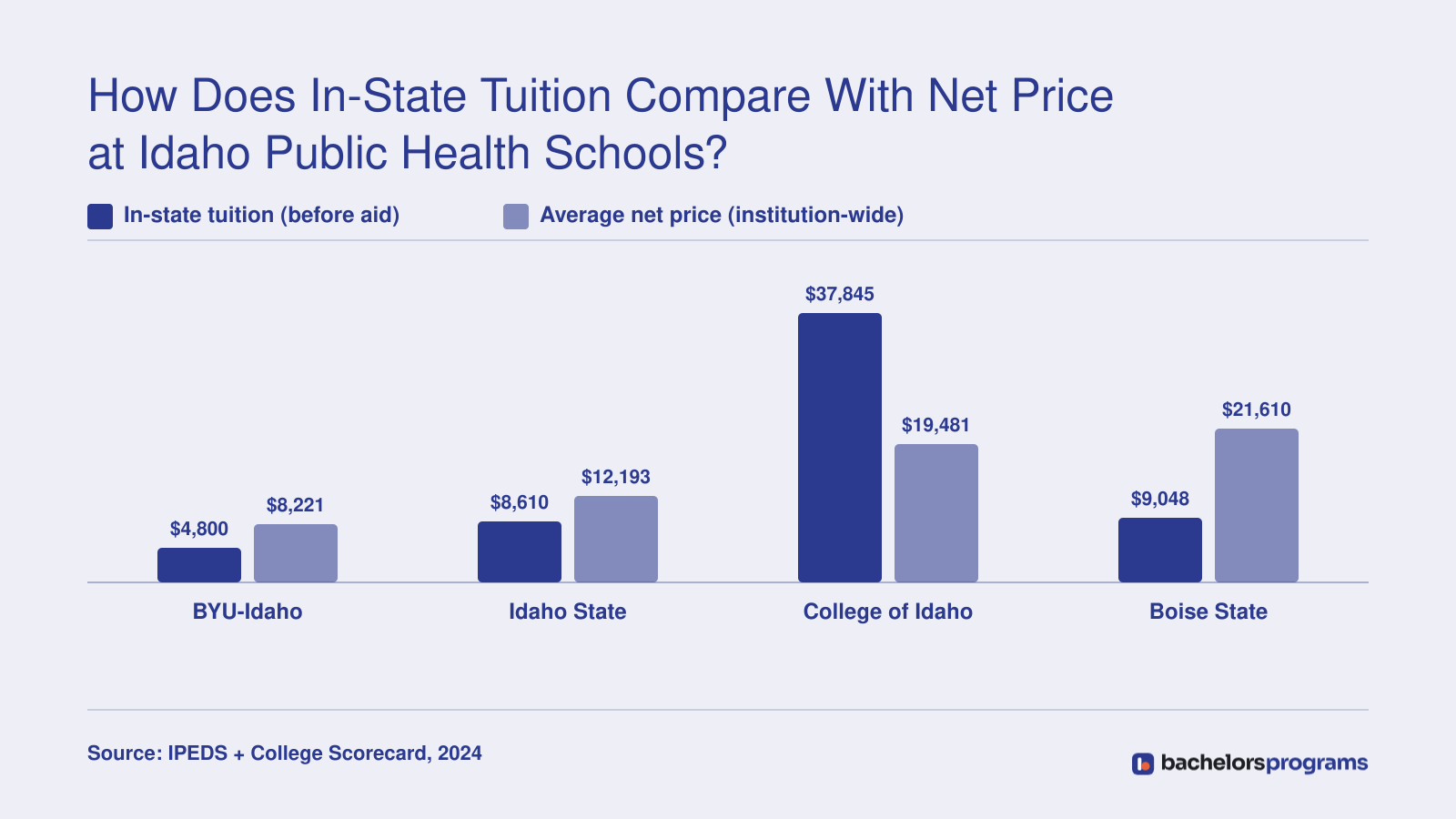
Sticker prices vary widely across the schools here. Brigham Young University-Idaho charges $4,800 a year for everyone, in-state or not. Idaho State University lists $8,610 in-state and $27,720 out-of-state, and Boise State University lists $9,048 in-state and $27,788 out-of-state. The College of Idaho charges $37,845 regardless of residency.
Net price after aid is an average estimate, not a quote, and it includes living costs. By that measure Brigham Young University-Idaho is cheapest at about $8,221, followed by Idaho State at $12,193, The College of Idaho at $19,481 and Boise State at $21,610.
Idaho State Aid
- Opportunity Scholarship: Need-based, up to $3,500 per year for Idaho residents who finished Idaho high school, home school or a GED and are pursuing a first bachelor's degree. Awards can drop to $0 if other aid covers your costs. It renews up to four years with a 2.7 GPA and on-time progress. For 2026-27 the application opens October 1, 2026, and the FAFSA is due March 1, 2027. Round 1 offers go out in April.
- Adult Learner version: A $3,500 need-based award for returning students with a 2.5 GPA, at least 24 college credits and part-time enrollment of 6 or more credits. The listed Spring deadline is December 1, 2026, so confirm dates for later terms.
- Idaho LAUNCH: A one-time grant covering 80% of tuition and fees, up to $8,000, for the current Idaho high school graduating class. In the first year you can use at most half, or $4,000, unless your program runs under 12 months. The priority deadline is November 30, 2026, because funds are limited. The Career Pathway Plan is due May 31, and applications close April 15.
Stacking Aid
File the FAFSA as soon as it opens, since the Opportunity Scholarship excludes late filers and the FAFSA also drives school-based aid. Then apply for LAUNCH by its priority date, and compare each school's award letter against the aid you expect from the state. Because the Opportunity Scholarship shrinks when other aid already covers your costs, judge schools by net price rather than by how many awards you collect.
How Does In-State Tuition Compare With Net Price at Idaho Public Health Schools?
Published tuition and what students actually pay rarely match. Tuition here is the in-state rate before any aid. Net price is an institution-wide average for aided students, not a public health figure, and it subtracts grants from the full cost of attendance, which includes housing and books. That is why net price runs above tuition at Brigham Young University-Idaho, Idaho State University and Boise State University, while at The College of Idaho, aid brings a $37,845 tuition bill down to a $19,481 average net price.
Accreditation and CEPH Status for Idaho Bachelor's in Public Health Programs
As of a November 2026 check of the Council on Education for Public Health's accredited programs and applicant listings, no bachelor's-level public health program at an Idaho institution appears as accredited or as an applicant.1 The one Idaho entry on CEPH's roster is Idaho State University's Master of Public Health, accredited since October 2002 and currently in good standing through December 2030.2 That accreditation covers the graduate degree only; it does not extend to undergraduate coursework.3
What CEPH Accreditation Actually Covers
CEPH is the specialized accreditor for schools and programs of public health. It reviews curriculum against a defined set of competencies, faculty qualifications, student services, and assessment practices. For students, the practical stakes show up in two places: some public health employers, particularly federal and larger health agency hiring pipelines, recognize the CEPH label, and a CEPH-accredited bachelor's can shorten or simplify entry into certain accelerated graduate pathways later on.
What the Absence of CEPH Status Does Not Mean
It does not mean a degree is unaccredited. Brigham Young University-Idaho, Boise State University, Idaho State University, and The College of Idaho all hold institutional accreditation, and that is what governs federal financial aid eligibility, credit transfer between schools, and whether a graduate program will accept the degree as a qualifying bachelor's. CEPH also does not publish a list of programs that lack its accreditation, so an absence from the directory is simply an absence, not a finding against a program.
One Step to Take
Before you apply, search the school by name in CEPH's program directory, then ask the department chair whether the undergraduate program has applied, plans to apply, or has decided against CEPH review. Programs will tell you.
What Idaho Public Health Careers Pay
Wage and employment figures below come from the Idaho Department of Labor's occupational wage estimates (May 2024 for health education specialists and community health workers, 2025 for epidemiologists). Health education specialists are the largest of these groups in Idaho, with 370 jobs and a median wage of $70,070. Epidemiologists earn the most but fill only about 40 positions statewide, and the state's occupational projections point to growth for health education specialists and a slight decline for epidemiologists.
| Occupation | Idaho Median Annual Wage | Idaho Employment | Job Outlook |
|---|---|---|---|
| Health education specialists | $70,070 | 370 jobs | Growth projected statewide |
| Community health workers | $46,320 | 310 jobs | N/A |
| Epidemiologists | $85,450 | 40 jobs | Slight decline projected statewide |
Is a Bachelor's in Public Health Worth It in Idaho?
The degree is affordable and leads to entry-level public health work, but the best-paid roles often sit beyond it. Here is how the numbers and the credentials line up.
Earnings and Debt
The wage table above shows what the occupations pay. Program-level figures from the federal College Scorecard show what graduates here actually earn early on. Boise State University public health graduates had median earnings of $46,117 one year after finishing, with median program debt of $19,000. Brigham Young University-Idaho graduates earned a median of $30,128 one year out, rising to $44,015 four years after finishing, with median debt of $13,043. Idaho State University and The College of Idaho report no comparable earnings figures for these programs.
Who Hires in Idaho
Seven independent public health districts cover all 44 counties, including Panhandle Health District, Central District Health and Eastern Idaho Public Health. The Idaho Department of Health and Welfare also employs public health staff4, and nonprofits and schools hire for community work. Typical bachelor's-level titles include health educator, community health educator, program coordinator, health program specialist and outreach worker. Qualifications vary by district and position, so read each posting. Central District Health lists StateCareers.Idaho.Gov as its application route.
Credentials: CHES Is Optional
Public health is not broadly licensed in Idaho, and no source shows CHES being legally required for entry-level work. CHES, from the National Commission for Health Education Credentialing, is the main optional credential for health educators.1 It requires a bachelor's degree plus one of two routes:
- Major route: a transcript showing a major in health education.
- Credit route: at least 25 semester credits (37 quarter hours) at grade C or better covering the Nine Areas of Responsibility, including at least 12 semester credits of process courses, no more than 9 topic-focused and no more than 6 other.2
Meeting these rules makes you eligible to sit for the exam, not certified. Idaho State University notes that finishing its degree does not itself award CHES, CPH or MCHES.3
The Verdict
The degree pays off for community-facing, entry-level roles at districts, state programs and nonprofits, especially with low debt. Higher-paid analytical roles such as epidemiologist generally call for graduate study, so plan for that if those are your goal.
Related Articles
How to Choose the Right Idaho Public Health School
Picking the cheapest school and picking the best-fitting one are not always the same decision. Match your situation to the picks below, then confirm the details with each program.
Match the School to Your Situation
- In-state traditional student: Start with Boise State University (Public Health, Boise) or Idaho State University (Community and Public Health, Pocatello). Both are public, so compare their in-state tuition and net price figures from the cost section and let the lower net price after aid break a tie.
- Online or working adult: Look first at Boise State University, whose B.A. in Public Health runs fully online and asynchronously. Review the online and hybrid section above and confirm which required courses can be completed remotely before you apply.
- Community college transfer: Boise State and Idaho State are the stronger fits, because public universities in the state usually have established transfer routes. Use the admissions and transfer details above, and get your credit evaluation in writing.
- Career-focused student: Idaho State's Community and Public Health program suits students aiming at community-based roles. The College of Idaho (Public Health, Caldwell) suits those who want a smaller private campus and are willing to weigh its net price against the public options.
Whatever your type, check the accreditation and CEPH discussion above. Some employers and graduate programs look at it, so decide how much it matters for your goals.
Your Next Steps
1. Contact the admissions office and the program to confirm your transfer pathway and which credits will count. 2. File the FAFSA and any Idaho state aid application early, since deadlines can arrive before admission decisions. 3. Ask the program how practicum placements work, including who arranges them, where students have been placed, and whether placements are possible near you.
Compare Public Health programs on the data that matters
Explore more Healthcare majors or browse every field of study.
All Healthcare programs Browse every field of study