Best Early Childhood Education Schools in Idaho
Compare 6 accredited Early Childhood Education programs in Idaho at 3 colleges, with net price after aid, graduation rates, earnings and debt from IPEDS and the U.S. College Scorecard.
A bachelor's degree in early childhood education in Idaho usually carries the Bachelor of Science (B.S.) in Early Childhood Education designation, and early earnings are modest: University of Idaho graduates in the teacher education field group reported a median of $40,677 a year after finishing. Pay climbs once a state certificate is in hand, so the credential chain sets the ceiling, not the diploma alone.
Comparing Idaho-based programs, campus and online, turns on federal outcomes data and each school's published admission rules. Cost, format and licensure carry more weight than the major's name. Field placement is where online study usually gets complicated.
Key Points
- Boise State's Inclusive Early Childhood Education degree pairs general and special education.
- College Scorecard: BYU-Idaho teacher education graduates earned $41,342 median after one year.
- Idaho's Blended Early Childhood endorsement is the key public school credential.
Best Bachelor's Programs in Early Childhood Education in Idaho: Our Ranked List
Three Idaho institutions award bachelor's degrees that prepare students to work with young children, and each takes a different route: a private university with its own licensed child development labs, a land-grant campus with a northern Idaho transfer pathway, and a Boise set of programs built around inclusive classrooms and online completion. Tuition, net price after aid and graduation rates appear on each card; graduation rates describe the whole institution rather than one major, and net price is an institution-wide average, so treat both as context rather than a program price tag.
Brigham Young University-Idaho
#1Rexburg, ID · ~$8,000/yr (est.)
Best for: Students pairing early childhood with special education
Brigham Young University-Idaho in Rexburg offers two bachelor's routes into the field: an early childhood education degree that pairs general preparation with special education coursework and K-3 experience, and a child development B.S. aimed at preschool and child care administration. Both draw on the university's child development labs, which are licensed under Idaho child-care standards and serve toddlers and preschoolers, so students practice assessment and instruction with real children rather than waiting for a final placement. Federal data for these majors show median earnings of $41,342 one year after graduation and $42,923 four years out, with 169 bachelor's degrees awarded in the year covered.
- Prepares teachers for infants, toddlers, preschoolers and grades K-3
- Coursework spans child development, early intervention principles and special education law
- Practice with varied assessment tools and instruction planning for diverse learners
- Training includes collaboration with parents, therapists and case workers
- Example four-year class plan published
- Also prepares students for graduate study in occupational therapy or speech-language pathology
- Built for preschool and child care administration roles
- Four-year plan of study published
- Includes AI training for developmental monitoring
- Companion Child Development (A.A.S.) also offered
University of Idaho
#2Moscow, ID · $10,000 – $15,000/yr (est.)
Best for: North Idaho transfers entering through community college
The University of Idaho delivers its child development B.S. on the Moscow campus as a 120-credit, four-year degree covering physical, cognitive, linguistic and social-emotional development from conception through adolescence. Students observe and document children in real settings and meet with parents about their progress, and Coeur d'Alene students can enter the same degree pathway through a 2+2 partnership with North Idaho College. Completion can make graduates eligible for Idaho's blended early childhood and early childhood special education certification. Federal data show median earnings of $40,677 one year after graduation and $50,237 four years out, with 76 bachelor's degrees awarded.
- 120 credits completed over four years on the Moscow campus
- Covers development from conception through adolescence
- Students observe and document children in real settings and confer with parents
- Coeur d'Alene entry through a 2+2 partnership with North Idaho College
- Leads to eligibility for Idaho's blended early childhood certification
Boise State University
#3Boise, ID · $20,000 – $25,000/yr (est.)
Best for: Working adults holding a technical certificate
Boise State University gives students the widest menu in the state: a hybrid Bachelor of Arts in Inclusive Early Childhood Education for children from birth through kindergarten, a campus-based blended early childhood and special education degree that carries Idaho certification from birth through grade three, and a fully online Bachelor of Applied Science with an early childhood emphasis for people who already hold a technical certificate or applied associate degree. The inclusive track does not lead to teacher certification and is designed for educators working outside the public school system. Federal data show median earnings of $42,237 one year after graduation and $47,419 four years out, with 84 bachelor's degrees awarded in the field.
- Hybrid delivery, with some courses offered online only
- Focus on children from birth through kindergarten, all abilities included
- Does not lead to teacher certification
- Admission reviewed at two points: upper division and culminating experiences
- Upper-division entry requires a 3.0 GPA in EDEC 221 and EDEC 223
- Fingerprinting and background check required before culminating admission
- Prepares graduates for settings outside the public school system
- Leads to Idaho certification for birth through grade three
- Full year internship with two semesters of student teaching
- Student teaching split across two different classroom settings
- Praxis entrance exam required, along with a 3.0 GPA minimum
- Nationally accredited teacher certification program
- Certifies graduates to teach children with and without disabilities
- Fully online, 120 total credit hours
- Requires a completed technical certificate or applied associate degree
- Accepts 20 to 48 technical credits toward the degree
- $395 per credit, with estimated book costs of about $1,500
- 28 credits of emphasis coursework plus 37 credits of University Foundations
- Military benefits accepted; approved for military students through AU-ABC
Cost & outcomes by school
Federal data for the highest-earning Early Childhood Education programs, independent of the ranking above. Earnings are this field's bachelor's graduates four years after completing where the Scorecard reports them, else the school's undergraduate median.
| School | Net price / yr | Grad rate | Earnings | Debt | Grads/yr | Format |
|---|---|---|---|---|---|---|
| University of Idaho ID | $14,831 | 57% | $50,237 | $24,250 | 51 | Campus |
| Boise State University ID | $21,610 | 60% | $47,419 | $22,177 | 94 | Hybrid |
| Brigham Young University-Idaho ID | $8,221 | 56% | $42,923 | $15,000 | 161 | Campus |
Sources: U.S. Department of Education. Net price, graduation rate, earnings and debt: College Scorecard (earnings and debt for this field's bachelor's graduates where reported, else school-wide); graduates: IPEDS. A dash means no figure is reported.
Cost, debt & payoff
Median earnings of this field's bachelor's graduates (4 yrs after completing, else the school's undergraduate median) vs. their median federal loan debt · U.S. College Scorecard
Across these programs the median graduate earns about $47,419 and finishes with roughly $22,177 in debt — a ratio that clears a common rule of thumb (keep debt below first-year salary). Net price and debt vary widely school to school, so check the per-school figures in the table above before you shortlist.
How We Ranked Idaho Bachelor's Programs in Early Childhood Education
How do you compare Idaho early childhood programs when some numbers describe a whole university and others describe a single major? Four criteria shaped the order, and they do not all measure the same thing.
- Graduation rate and net price: Institution-wide. These reflect the whole school, not just education majors.
- Earnings and debt: Program-level. These come from College Scorecard data on graduates of the specific field.
- Completions: Program-level. This shows how many students finish the field, a rough sign of how established it is.
- Delivery format: Campus at BYU-Idaho and the University of Idaho, hybrid at Boise State.
Accreditation and approval
CAEP accreditation applies to a university's educator preparation provider, not to one degree. Boise State holds CAEP Full Accreditation at both the initial-licensure and advanced levels, decided October 22, 2023.1 The University of Idaho appears among CAEP-accredited providers in CAEP's 2025 search material, but we could not confirm its current decision date or level.2 We did not confirm BYU-Idaho's CAEP status in the records we reviewed.
NAEYC recognition is a separate, early-childhood-specific credential, and we found no confirmation of it for any program here. Idaho State Department of Education approval matters most for a teaching license, and the records we reviewed did not settle it. These are gaps in the available records, not findings against a program, so ask each school directly before you apply.
What a ranking can't capture
No data set shows fit, faculty mentorship, or how well a program places graduates in your local districts and child care centers. Treat the order as a starting point, then visit, ask about practicum placements, and talk with current students.
Online and Hybrid Bachelor's Options at Idaho Schools
The flexibility of an online or hybrid bachelor's degree in early childhood education in Idaho comes with a catch: the field experiences are still local. The format decides how you attend class, but placement logistics decide whether you can finish. Among the programs ranked here, Boise State's inclusive early childhood education bachelor's is hybrid, while BYU-Idaho's and the University of Idaho's are campus-based, and none is listed as fully online.
What Each Format Looks Like
- Boise State University: The inclusive early childhood education bachelor's uses hybrid delivery, mixing online coursework with in-person expectations. The program also requires fingerprinting and a background check, a common step before working in licensed early childhood or school settings. Confirm the current online-to-campus split with an advisor.
- BYU-Idaho: The early childhood education/early childhood special education B.A. and the child development B.S. are campus programs in Rexburg. Plan on attending classes in person.
- University of Idaho: The child development B.S. is a 131-credit campus program in Moscow. The university says much of the training happens in real-world infant, toddler, preschool, and primary-grade settings, and the program leads to Idaho blended early childhood/early childhood special education certification.
The 2+2 Route in Northern Idaho
The University of Idaho also runs a 2+2 partnership in northern Idaho. Students complete lower-division coursework first and then finish the bachelor's through the partnership. Ask which institution delivers the upper-division early childhood courses and whether any of those courses are online, then confirm the credit split and sequence with an advisor.
One Question for Working Adults
If you are studying from a distance, ask whether field experiences or practicum hours can be arranged near your home or whether you must travel to the campus region. Get the answer in writing, along with the expected hours and the types of settings, whether infant/toddler, preschool, or primary grade. That answer often matters more than the online or hybrid label.
Admission Requirements for Idaho Early Childhood Education Bachelor's Programs
Admission to an early childhood education bachelor's program in Idaho usually involves two separate gates: first the university, then the teacher-education or professional preparation portion of the program. Each gate can carry its own GPA minimum, coursework, and application timing, so treat admissions as a research task you work through in order rather than a single checkbox.
Start With the School's Own Pages
Open the official admissions page for each program you are considering, then look for the education department or college of education page linked from it. From those pages, pull five things: the current minimum GPA for freshman admission, the SAT or ACT policy (many schools now publish a test-optional or test-flexible statement), how transfer credits are evaluated, whether an associate degree articulates into the bachelor's, and any separate admission requirements for the teacher-education program itself.
Work the same list for Brigham Young University-Idaho, the University of Idaho, and Boise State University, since their policies are written independently and are not interchangeable.
Where to Look, in Order
- University admissions and teacher-education pages: the authoritative source for GPA, testing, deadlines, and program admission.
- Idaho State Board of Education and Idaho Department of Education: for the high school graduate admission waiver and the state's educator-preparation rules.
- BLS.gov and professional associations such as NAEYC: for context on the field, not for admission rules.
Practical Search Tips
Use site-specific searches such as "site:uidaho.edu admissions early childhood" or "site:boisestate.edu teacher education admission" to cut past marketing pages. Watch for the phrases transfer equivalency, articulation agreement, teacher education admission, and test-optional, which tend to sit on the pages that actually matter.
Policies vary by cohort and admissions year, and some programs simply do not publish a stated policy for a given requirement. If a page is silent or looks out of date, contact admissions or an education advisor directly with a short list of questions:
- What GPA do I need to be admitted, and what GPA keeps me in the teacher-education program?
- Are test scores required, optional, or used for placement only?
- Which of my transfer credits count toward the major, and is there an articulation agreement with my school?
- When is the program application due, and what happens if I miss it?
Confirm every requirement with the school before you apply. Deadlines and thresholds change, and a policy that was accurate last year may already be replaced.
Related Articles
What a Bachelor's Degree in Early Childhood Education Costs in Idaho
The lowest published tuition in Idaho is not automatically the lowest bill; compare sticker price with what students actually pay. For a bachelor's degree in early childhood education, that gap matters because Idaho's public options cluster near the same tuition while their net prices diverge sharply.
Sticker Prices and Average Net Price
- Brigham Young University-Idaho: tuition and fees about $4,800 for Idaho and out-of-state students; average net price about $8,200.
- University of Idaho: resident tuition and fees about $9,084; nonresident about $28,320; average net price about $14,800.
- Boise State University: resident tuition and fees about $9,048; nonresident about $27,788; average net price about $21,600.
Net price is an institution-wide average after grants and scholarships, not a quote for one major. Your number will move with housing, credit load, course fees, and the aid you qualify for.
Idaho Aid That Lowers the Bill
The Idaho Opportunity Scholarship is the state's main award for residents. It requires a minimum 2.7 GPA, is open to Idaho students attending an eligible Idaho institution, pays up to $3,500 a year, and can be renewed. File the FAFSA early, because state deadlines and renewal rules are set annually.
Idaho LAUNCH is the state's workforce grant. University of Idaho's program page cites awards up to $8,000 total, but eligibility, approved programs, and deadlines are revised each year, so confirm current terms with the state or a financial aid office before you count on the money.
Borrowing and the Value Question
Median debt among graduates who borrowed is about $14,000 at BYU-Idaho, $20,500 at Boise State, and $22,000 at University of Idaho. Those figures are not specific to early childhood graduates, but they show how much borrowing surrounds each campus.
On price alone, BYU-Idaho is the lowest-cost option here, with the smallest sticker price, net price, and median debt. Boise State and University of Idaho sit close together on tuition, but Boise State's higher net price means grants and scholarships matter more there. The best value depends on Idaho aid eligibility, commuting or housing costs, and whether a campus or hybrid format fits your schedule.
Idaho Teacher Certification for Early Childhood Education Graduates
What does it take to teach young children in an Idaho public school? A bachelor's degree is the starting point, but the license is a separate credential issued by the state.2
The Blended Early Childhood Endorsement
Idaho's main credential for this field is the Blended Early Childhood Education/Early Childhood Special Education endorsement.1 It covers birth through grade 3, so it reaches well beyond preschool.1 Graduates are prepared to teach young children in general early childhood settings and to support children with disabilities; the blended standards apply on top of the Idaho Core Teaching Standards. Boise State University lists a Blended Early Childhood/Early Childhood Special Education program, which is the pathway most directly named for this endorsement.
Main Steps to Certification
The Idaho State Department of Education outlines the traditional route this way:
- Approved program: Complete a State Board-approved educator preparation program.2 Out-of-state programs generally need CAEP or AAQEP accreditation.2
- Student teaching: Preparation includes coursework, assessments, and supervised student teaching. Ask each program for its exact clinical requirements.
- Praxis exams: Idaho requires state-approved Praxis content and professional teaching knowledge exams.3 Confirm current test names and passing scores with the Department, since they can change. Candidates who certify through the ABCTE route are exempt.3
- Institutional recommendation: Your college verifies completion and recommends you for the endorsement. It stays valid for two years after you finish the program.2
- Application: Submit the educator-certification application packet and meet the minimums in Idaho Code §33-1202.
Candidates entering through a nontraditional route typically receive an interim certificate valid for three years while finishing requirements for a five-year renewable certificate.4
Approval Is Not Accreditation
State approval and program accreditation are different things. A state-approved program leads to certification eligibility. CAEP or NAEYC accreditation is a quality review of the program itself and does not, by itself, qualify you for an Idaho certificate. Before you enroll, use the Department's certification lookup and the school's licensure page to confirm the program is state-approved for the endorsement you want.
Licensed Roles vs. Child-Care Roles
Public-school instructional staff, including pre-K through 3rd grade classroom teachers, must hold an Idaho certificate under §33-1201.4 Many preschool and child-care positions are classified, non-certificated roles that do not require a teaching certificate.4 Those jobs may still carry other licensing, training, or background-check rules, so check requirements for any specific employer. A bachelor's degree serves either path, but only the certificate qualifies you for public-school teaching.
Early Childhood Education Careers and Salaries in Idaho
Idaho wages below come from the Bureau of Labor Statistics May 2023 State Occupational Employment and Wage Estimates, the latest Idaho release, and they climb sharply once a role requires a bachelor's degree and a state teaching certificate: elementary teachers earn nearly double what preschool teachers earn. Growth figures are BLS national projections for 2025 to 2035, so check the Idaho Department of Labor for regional demand. Public-school kindergarten and elementary jobs require a bachelor's degree and Idaho certification, and federal Head Start rules push many programs to hire lead teachers with a bachelor's in early childhood education or a related field.
| Occupation | Idaho Median Annual Wage | Projected Job Growth | Typical Entry Education |
|---|---|---|---|
| Preschool Teacher (except special education) | $31,780 (May 2023) | 4% nationally (2025-2035) | Associate's degree typical; bachelor's often preferred for Head Start lead teachers |
| Kindergarten Teacher (except special education) | $50,810 (May 2023) | N/A | Bachelor's degree plus Idaho teaching certificate |
| Elementary School Teacher (except special education) | $61,670 (May 2023) | N/A | Bachelor's degree plus Idaho teaching certificate |
| Preschool and Child Care Center Director | N/A | -3% nationally (2025-2035) | Bachelor's degree typical, plus work experience in early childhood settings |
What Do Idaho Early Childhood Graduates Earn After Finishing Their Bachelor's?
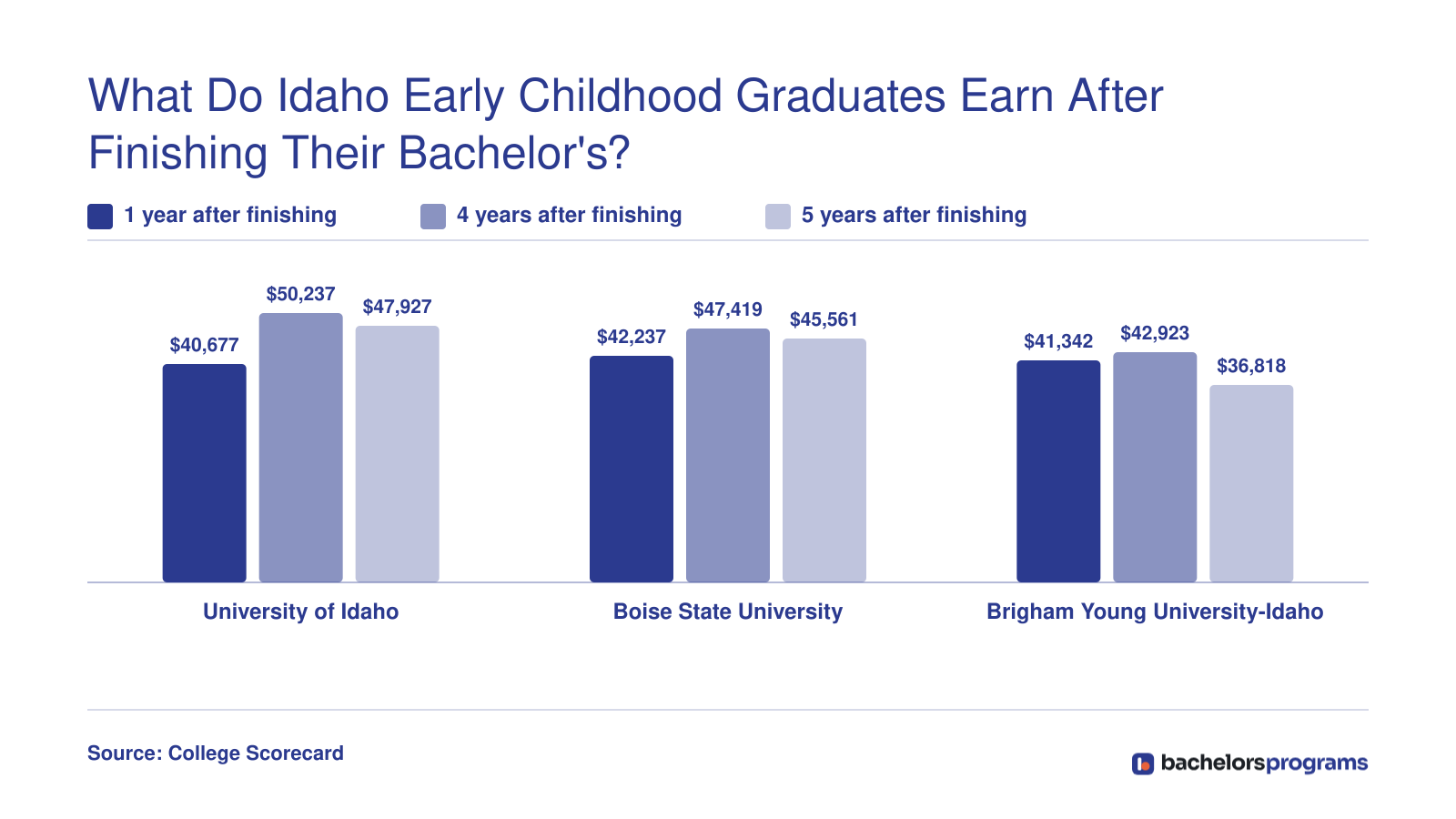
College Scorecard tracks program-level median earnings for each school's bachelor's graduates in the teacher education field group that includes early childhood. One year after finishing, medians are close: $40,677 at the University of Idaho, $41,342 at Brigham Young University-Idaho and $42,237 at Boise State University. By four years after finishing, the University of Idaho leads at $50,237. Five years after finishing, Brigham Young University-Idaho graduates report $36,818. The Idaho wages in the table above are reported by occupation, while these figures are reported by school, so use both when you weigh a program.
Choosing the Right Idaho School for Your Bachelor's Degree in Early Childhood Education
Boise State University's Inclusive Early Childhood Education program bundles general and special education preparation into one degree, which matters if you want to serve children with disabilities in a blended classroom. That program, along with its Blended Early Childhood/Early Childhood Special Education track, is the clearest fit for a special-needs focus among the Idaho schools on this list.
Quick Matches by Student Type
- Special-needs focus: Boise State University. Choose the inclusive route for a single blended license path, or the blended early childhood/special education track if you want both credentials spelled out on your transcript.
- Working adult: Brigham Young University-Idaho in Rexburg offers the widest set of related bachelor's options, including an Early Childhood Education / Early Childhood Special Education B.A. and a Child Development B.S. Compare each program's format on the school's own pages before committing, since delivery varies by degree.
- Community-college transfer: Boise State's Bachelor of Applied Science with an Early Childhood Education emphasis is designed for students arriving with applied or technical coursework already completed.
- Northern Idaho: University of Idaho in Moscow pairs a Child Development program with a residential campus and lower living costs than the Treasure Valley.
- Southern Idaho: Boise State puts you in the state's largest metro, with the most child care centers, preschools and early intervention employers nearby for practicum placements and post-graduation hiring.
Your Next Three Steps
1. Confirm the program holds state approval for Idaho teacher certification, and ask which credential you will graduate eligible for. 2. Check the school's admissions page for the current GPA and test policy rather than relying on older guides; policies change year to year. 3. File the FAFSA in the fall before you plan to enroll so Idaho grants and federal aid are calculated off the current year's income data.
Ready to compare? Compare the programs above, or contact each Idaho school directly for current tuition, start dates and application deadlines.
Compare Early Childhood Education programs on the data that matters
Explore more Education & Teaching majors or browse every field of study.
All Education & Teaching programs Browse every field of study