Best Criminal Justice Schools in Idaho
Compare 5 accredited Criminal Justice programs in Idaho at 3 colleges, with net price after aid, graduation rates, earnings and debt from IPEDS and the U.S. College Scorecard.

A bachelor's degree in criminal justice, commonly a Bachelor of Science (B.S.) in Criminal Justice, is not a law enforcement license. Idaho peace officers still need POST certification, whatever they majored in.
The list here is deliberately focused: Northwest Nazarene University in Nampa, Boise State University, and Lewis-Clark State College in Lewiston. Only Boise State lists a fully online option. Lewis-Clark calls its degree justice studies, which changes the label more than the career paths.
With so few programs in the state, location and delivery format often decide the choice before curriculum does.
Key Points
- Boise State University offers its B.S. in Criminal Justice fully online.
- Lewis-Clark State graduates earned a median $40,442 one year after finishing.
- Sworn officer jobs in Idaho require POST certification, not just a degree.
Best Bachelor's Degree in Criminal Justice Schools in Idaho, Ranked
Only three Idaho schools, offering five qualifying bachelor's program listings, met the criteria for this ranking of bachelor's degrees in criminal justice. Between them they cover a faith-based private campus in the Treasure Valley, the state's largest criminal justice program with a fully online track, and a northern Idaho justice studies degree with three separate concentrations. Across the three, schools offering this program have institution-wide graduation rates ranging from 40% to 71%, and those figures describe each whole institution rather than the criminal justice major.
Northwest Nazarene University
#1Nampa, ID · $25,000 – $30,000/yr (est.)
Best for: Students seeking a faith-based justice curriculum
Northwest Nazarene University is a private Christian campus in Nampa, in the heart of the Treasure Valley, and its justice major is a Bachelor of Arts rather than the more common Bachelor of Science. Criminological theory and investigative methods sit alongside a required criminal justice practicum, and the university frames the whole degree around ethics and moral standards. Classes stay small, faculty mentors come from the field, and the program is built to support students heading into probation, forensic technician or legal assistant work, or on to graduate study and law school.
- Required criminal justice practicum built into the major
- Coursework in criminological theories and investigative models and methods
- Leads to probation officer, forensic technician and legal assistant roles
- Prepares students for graduate study or law school
- Christian-based education taught in an ethics context
- Internships and field experiences offered
Boise State University
#2Boise, ID · $20,000 – $25,000/yr (est.)
Best for: Working adults needing a fully online option
Boise State University carries the largest criminal justice program in the state, awarding a Bachelor of Science on campus in Boise and through a fully online track, with more than a hundred bachelor's degrees in the field reported in the latest federal count. Students enter as pre-majors and must earn a B- or better in four core criminal justice courses before applying for upper-division standing at 58 credits, so the major rewards early focus. Electives reach into criminal law, organized crime, criminalistics and white collar crime, and graduates move into law enforcement, court services, corrections, victim services and research.
- Fully online option available alongside campus classes
- Pre-major status first, then upper-division standing at 58 credits
- B- or better required in CJ 101, CJ 202, CJ 203 and CJ 204
- Electives in criminal law, organized crime, criminalistics, white collar crime
- Five courses open only to admitted majors
- Criminal justice minor available for students in other majors
- Graduates work in law enforcement, court services, corrections, victim services
- Advising help with transfer equivalencies
Lewis-Clark State College
#3Lewiston, ID · $16,000/yr (est. net price)
Best for: Students planning law enforcement or corrections careers
Lewis-Clark State College awards a Bachelor of Arts or Bachelor of Science in Justice Studies, a 120-credit degree split into three concentrations: Policing and Law Enforcement, Law and the Legal System, and Corrections and Human Services. The core runs through criminal procedure, criminal law, criminology, and crime, justice and ethics, and every student completes a practicum plus a research project and seminar. Field internships are arranged with criminal justice, legal and social service agencies, a separate forensic science minor pairs naturally with the policing track, and a co-admission agreement with North Idaho College lets northern Idaho students start at a community college and continue into the bachelor's.
- 83 program credits plus 37 to 42 general education credits, 120 total
- Emphasis adds 15 credits, including Criminal Investigations and Community Policing
- Cybercrime, White Collar Crime and Constitutional Law within the emphasis
- Core includes Police in America, Corrections in America, Criminal Procedure
- Practicum in Justice Studies plus a research project and seminar
- Field internships arranged with criminal justice and legal agencies
- Prepares for local, regional and national law enforcement work
- Built for law school and legal-profession pathways
- Bachelor of Arts track requires 16 language credits
- Bachelor of Science track includes 9 diversity credits
- 23 elective credits required
- Offered as either a BA or a BS degree
- Probation and parole career path supported by the concentration
- Community-based corrections coursework
- Required practicum in Justice Studies
- Research project and seminar required
Cost & outcomes by school
Federal data for the highest-earning Criminal Justice programs, independent of the ranking above. Earnings are this field's bachelor's graduates four years after completing where the Scorecard reports them, else the school's undergraduate median.
| School | Net price / yr | Grad rate | Earnings | Debt | Grads/yr | Format |
|---|---|---|---|---|---|---|
| Northwest Nazarene University ID | $29,580 | 71% | $51,719 | $23,750 | 6 | Campus |
| Boise State University ID | $21,610 | 60% | $50,297 | $20,375 | 124 | Online or campus |
| Lewis-Clark State College ID | $15,635 | 40% | $49,716 | $23,250 | 13 | Campus |
Sources: U.S. Department of Education. Net price, graduation rate, earnings and debt: College Scorecard (earnings and debt for this field's bachelor's graduates where reported, else school-wide); graduates: IPEDS. A dash means no figure is reported.
Cost, debt & payoff
Median earnings of this field's bachelor's graduates (4 yrs after completing, else the school's undergraduate median) vs. their median federal loan debt · U.S. College Scorecard
Across these programs the median graduate earns about $49,716 and finishes with roughly $23,250 in debt — a ratio that clears a common rule of thumb (keep debt below first-year salary). Net price and debt vary widely school to school, so check the per-school figures in the table above before you shortlist.
How We Ranked Idaho Criminal Justice Schools
The lowest sticker price is not always the cheapest degree, and a well-known campus is not always the best fit for your career plans. We compare Idaho criminal justice programs on the measures that change what you actually pay and what you actually get: in-state tuition and net price after grants and scholarships, graduation rate, graduate earnings and typical debt where the schools publish it, the number of degrees completed, and whether the program runs on campus, online, or a mix of both.
What the Numbers Can and Cannot Tell You
Net price and graduation rate are institution-wide averages, not criminal justice program figures. A university's overall graduation rate blends every major on campus, so read it as context rather than a verdict on the department you are applying to. Earnings and debt figures carry the same caveat.
Which Schools Made the List
Only bachelor's programs at Idaho-based schools, campus or online, are included. Northwest Nazarene University, Boise State University, and Lewis-Clark State College anchor the ranking for that reason.
What is the best criminal justice school in Idaho? There is no single answer. It depends on your budget, your need for online flexibility, and whether your goal is law enforcement, corrections, or law school. Start with the ranked list, then match it to your own constraints.
Criminal Justice, Justice Studies, or Criminology: What Idaho Programs Call the Degree
Is a justice studies degree the same as a criminal justice degree? In Idaho, the labels differ more than the career paths do. Northwest Nazarene University offers a Criminal Justice BA, Boise State University a Criminal Justice degree, and Lewis-Clark State College a Justice Studies BA/BS. All three prepare students for work in the justice system.
How the Three Names Differ
Criminal justice centers on practice: how policing, courts, and corrections operate day to day. Coursework tends toward criminal law, investigations, and agency operations.
Justice studies leans toward policy and the wider social context. Students examine why systems work as they do and how they could change, often with a research project or seminar.
Criminology focuses on theory and research: why crime occurs, how it is measured, and what patterns emerge. It suits students headed toward analysis or further study.
Concentrations and Career Tracks
Lewis-Clark State lists a Policing and Law Enforcement concentration. Boise State's electives in criminal law, criminalistics, and white collar crime let students lean toward courts or investigative work, and its listed careers include corrections and victim services. Northwest Nazarene points toward probation work and forensic technician roles, plus law school or graduate study.
A Quick Rule of Thumb
- Want to work in the field soon: choose a criminal justice program.
- Interested in policy or law school: justice studies fits well.
- Drawn to research: look for criminology coursework.
Online and Hybrid Bachelor's in Criminal Justice Options at Idaho Schools
Yes, you can earn a bachelor's degree in criminal justice online from an Idaho-based school: Boise State University states that every course required for its B.S. in Criminal Justice is available online, so the major can be finished fully online. Northwest Nazarene University and Lewis-Clark State College offer their programs on campus, and both build hands-on field work into the degree. Confirm current delivery options with each school before you apply, since formats and locations can change.
| School | Program | Delivery Format | Fully Online Option | In-Person Requirements and Pathway Notes |
|---|---|---|---|---|
| Northwest Nazarene University (Nampa) | Criminal Justice BA | Campus | Not offered as a fully online program | Criminal justice practicum required; internships and field experiences offered; flexible class scheduling options |
| Boise State University (Boise) | B.S. in Criminal Justice | Campus and online | Yes, the major can be completed 100% online | An in-person Criminal Justice B.S. in Twin Falls appears on Boise State's alternative fee list at $300 per credit hour; its exact scope is not spelled out. The 100% online Online Degree Pathway can supply up to 60 credits (40 University Foundations, 20 electives) before students move into an online or on-campus bachelor's |
| Lewis-Clark State College (Lewiston) | Justice Studies BA/BS | Campus | Not offered as a fully online program | Field internships with criminal justice agencies and a practicum in justice studies; 120 total credit hours with a choice of concentration options |
How Long a Bachelor's in Criminal Justice Takes in Idaho
A bachelor's degree in criminal justice is built around roughly 120 credits, which usually means about four years of full-time study. Boise State University sets its general baccalaureate requirement at 120 credits and describes the degree as typically four years or more full-time. One catalog listing puts the Bachelor of Science in Criminal Justice at 122 credits, so confirm the exact total with the school before you plan.
Full-Time vs. Part-Time Pacing
Full-time students who carry a standard course load and avoid gaps generally finish in about eight semesters. Part-time pacing runs longer. Boise State's online pathway allows either format, and part-time students typically take one class per seven-week session or two classes per 15-week semester. Schools do not publish a standard part-time completion time, so the real answer depends on your course load, any credits you bring in, and which courses are offered each term.
Upper-division rules can also affect the timeline. Boise State requires at least 40 upper-division credits, 30 of them earned at Boise State. The major alone may not supply enough upper-division credits, so some students need extra advanced coursework.
The 2+2 Transfer Route
Many students complete an associate degree first, then transfer for the last two years. Done well, this protects credits and can lower the cost of the first half of the degree. The catch is the upper-division requirement: lower-level credits may count toward the 120 total without satisfying the 40 advanced credits. Ask an advisor at Boise State, Northwest Nazarene University, or Lewis-Clark State College for a transfer evaluation before you enroll.
Boise State publishes degree-planning information for the major. Check each school's advising office for term-by-term plans.
Related Articles
Are Idaho Criminal Justice Programs Accredited, and Do They Offer Internships?
The accreditation that matters for a criminal justice degree in Idaho sits with the school, not the program. Criminal justice has no required programmatic accreditation, so the credential to look for is institutional accreditation from the Northwest Commission on Colleges and Universities (NWCCU). Boise State University has been NWCCU accredited since 1941,1 and Lewis-Clark State College since 1964.2 Lewis-Clark State's most recent NWCCU evaluation, in Fall 2024, found the college substantially compliant with the commission's standards.2
How to Verify It Yourself
Search the NWCCU institutional directory for the school's name. The listing shows accreditation status, the year of first accreditation, and the most recent and next scheduled evaluations. Use it to check Northwest Nazarene University as well, and look for a school's current status rather than relying on a brochure.
Internships and Field Placement
Criminal justice programs commonly offer internships for credit with police departments, courts, probation offices, and corrections agencies. Whether a practicum is required, how many credits it carries, and which Idaho agencies host students differ by program. Check the catalog and ask the department directly at Northwest Nazarene, Boise State, and Lewis-Clark State before you enroll.
Why It Affects Transfer and Aid
Institutional accreditation from a federally recognized accreditor like NWCCU is what makes a school eligible for federal student aid. It also tends to ease credit transfer between regionally accredited schools, though the receiving school makes the final call.
Criminal Justice Careers and Wages in Idaho
Frontline policing and corrections hire on a steady, replacement-driven cycle, while investigative and analyst roles open less often and pay more. Idaho's wage data draws that line clearly.
Policing, Corrections, and Supervision
May 2023 state figures put the median annual wage for Idaho police and sheriff's patrol officers at $66,170 across roughly 2,980 jobs.1 Correctional officers and jailers in Idaho number about 1,800, with a median of $51,620. Nationally, the Bureau of Labor Statistics projects 3% growth for police and sheriff's patrol officers from 2025 to 2035.2 Correctional officers and bailiffs, a broader national category, are projected to shrink 7% over the same window, yet still produce about 30,000 openings a year as officers retire or leave.3
Probation, Courts, and Investigation
Probation officers and correctional treatment specialists sit at a national median of $66,270 as of May 2025, with 3% projected growth and about 7,900 openings a year nationally through 2035.4 Idaho detectives and criminal investigators, about 470 of them, earn a median of $83,2701; the national median for the role is $93,790. Court clerks, pretrial services staff, and case managers round out the court-side job family.
Where Criminology Degrees Fit
A criminology or justice studies background leads to research and analyst work as well as sworn roles: crime analysis, victim services, compliance, and policy research units inside agencies.
Every figure above is an occupational wage for the job itself, not what graduates of any single program earn. Program-level earnings appear in the next section.
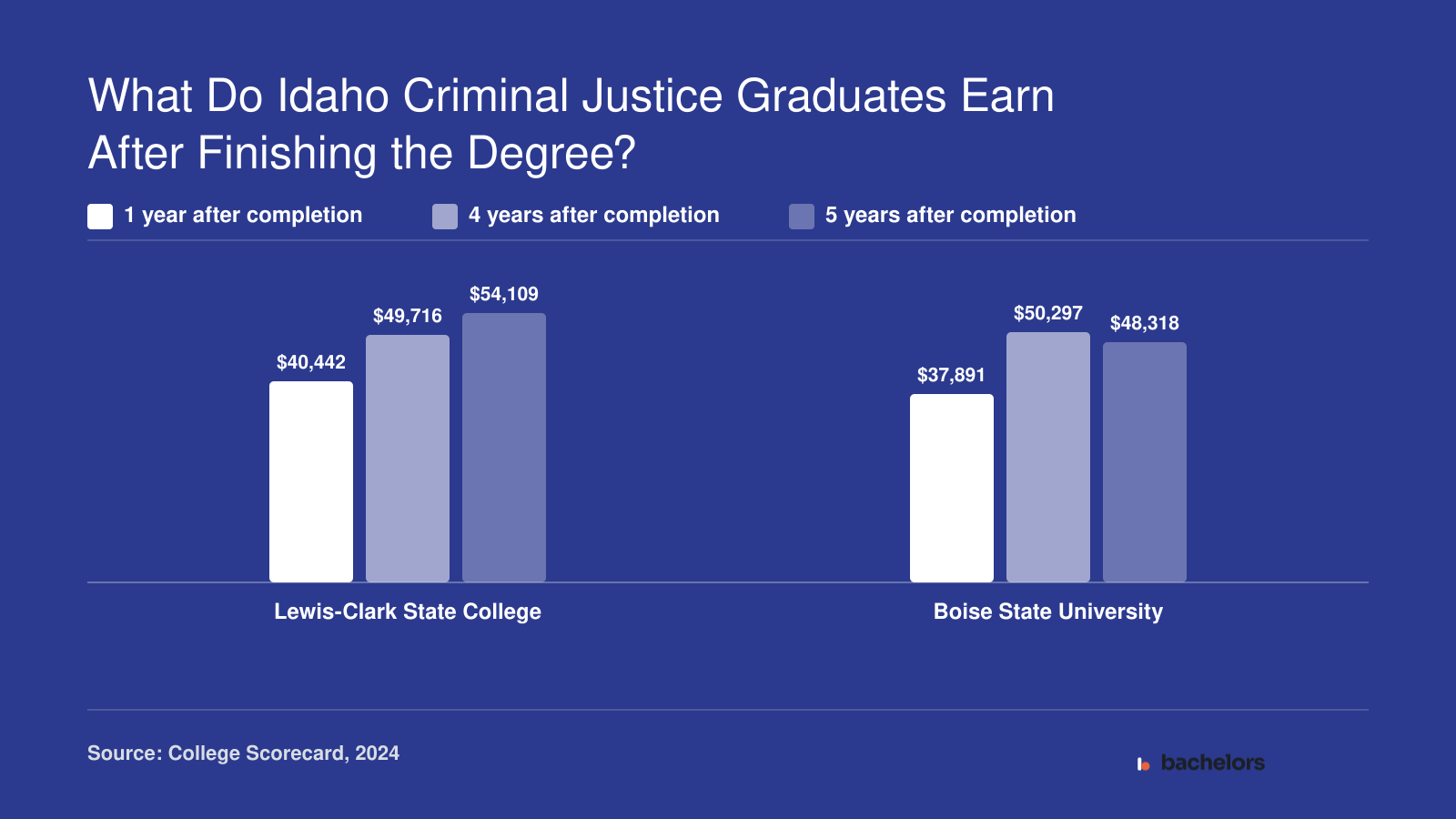
What Do Idaho Criminal Justice Graduates Earn After Finishing the Degree?
Lewis-Clark State College criminal justice graduates (14 completers in the reported cohort) earned a median $40,442 one year after completion, $49,716 four years after completion and $54,109 five years after completion. Boise State University graduates (116 completers) earned a median $37,891 one year after completion, $50,297 four years after completion and $48,318 five years after completion. Program-level earnings for Northwest Nazarene University's criminal justice bachelor's are not reported.
Idaho POST Certification: The Path to Becoming a Peace Officer
For aspiring officers the real decision is timing: finish a bachelor's degree first, or get hired and into the academy sooner. Either way, a criminal justice degree is not a license. Every sworn law enforcement career in Idaho runs through Idaho Peace Officer Standards and Training (POST) certification, and no degree replaces it.1
Basic POST Requirements
Idaho POST's certification procedures and the state's administrative rules set out the standard route:
- Employment: An Idaho agency must hire you into a POST-required position (or you work as POST staff). The agency submits the application, and there is no self-sponsor option.2
- Education: A high school diploma from an accredited or recognized high school is the minimum.1
- Screening: A comprehensive agency background investigation and a passing aptitude test.1
- Academy: Meet minimum physical standards, keep at least a 75% academic average, pass demonstrative assessments (ARCON, EVOC, Tac Med, SFST, POST PRT and a firearms short course), then score 75% on certification exams. One retake is allowed.3
- After the academy: At least 40 field-training hours and six consecutive months of probation with the hiring agency.2
Requirements generally must be finished within 12 months of employment.1
Where a Bachelor's Fits
Idaho POST does not require a college degree for initial basic certification.1 A bachelor's degree in criminal justice can strengthen a hiring application. POST also counts regionally accredited college credit as training hours (one semester credit equals 20 hours), mainly toward higher-level certificates.4 That credit does not replace the academy, field training or probation.
Timing the Degree and the Academy
Because the standard route starts with a job offer, a common sequence is to finish the degree, apply to agencies, then attend the academy as a new hire. A separate POST-approved college academy route exists at a few Idaho colleges.2 Students pay for it and must secure Idaho agency employment within three years to use that training.2 Once certified, officers complete 40 training hours each year.2
Common Questions About Criminal Justice Degrees in Idaho
What is the best criminal justice school in Idaho?
How long does it take to get a criminal justice degree in Idaho?
Are there accredited criminal justice programs in Idaho?
Can you get a bachelor's degree in criminal justice online in Idaho?
How much does a criminal justice degree cost in Idaho?
Compare Criminal Justice programs on the data that matters
Explore more Criminal Justice & Law majors or browse every field of study.
All Criminal Justice & Law programs Browse every field of study