Best Finance Schools in Idaho
Compare 5 accredited Finance programs in Idaho, with net price after aid, graduation rates, earnings and debt from IPEDS and the U.S. College Scorecard.

Idaho students can earn a finance bachelor's degree at a flagship business school, a regional public university or a small private college, and the price gap is wide. In-state tuition at the University of Idaho is $9,824, while The College of Idaho charges $37,845 before aid. Most programs award a Bachelor of Science (B.S.) in Finance or a Bachelor of Business Administration, and the differences show up in net price, accreditation and how closely each program ties to Boise's banking and corporate base.
Online study is the exception: Idaho State University lists a fully online BBA in Finance, while the other programs here are campus-based.
Key Points
- Boise State, University of Idaho and Idaho State hold AACSB accreditation.
- Brigham Young University-Idaho finance graduates leave with median debt of $13,843.
- Idaho LAUNCH favors workforce training, so confirm finance eligibility before applying.
Best Finance Schools in Idaho: Ranked Bachelor's Programs
Five Idaho colleges award a bachelor's degree in finance, and all five deliver it on campus, from a flagship research university to a small private liberal arts college. The order below reflects on-time completion, net price after aid and program-level outcomes. Each card keeps school-wide figures separate from finance-program results so you can compare like with like.
University of Idaho
#1Moscow, ID · $10,000 – $15,000/yr (est.)
Best for: Students wanting to manage a real portfolio
The flagship public university in Moscow delivers its finance major entirely on campus, and its Barker Trading and Capital Management Program gives students a working trading room and a portfolio to run. School-wide, in-state tuition is $9,084, the average net price after aid is $14,831, the graduation rate is 57% and 65% of undergraduates receive Pell grants. The finance program awarded 42 bachelor's degrees in the most recent year reported; graduates earned a median $46,428 one year after finishing and $71,929 four years after finishing, with median debt of $21,400.
- 120-credit, four-year Bachelor of Science in Business with a finance major
- Barker Capital Management and Trading Program uses an on-campus trading room
- Students help manage a student-run portfolio of more than $1.1 million
- Coursework covers ethical financial strategy, market behavior and risk exposure
- Nearly half of College of Business and Economics students complete internships
- Rolling admissions open each September
- Davis Student Investment Group and national competitions add applied experience
Boise State University
#2Boise, ID · $20,000 – $25,000/yr (est.)
Best for: City-based students targeting corporate finance roles
Boise State sits in the state capital, where finance majors can reach banks, corporate offices and public-sector employers while studying on campus. School-wide, in-state tuition is $9,048, the average net price after aid is $21,610, the graduation rate is 60% and the Pell share is 61%. The Finance BBA awarded 78 bachelor's degrees, and graduates earned a median $48,712 one year after finishing and $70,449 four years after finishing, with median debt of $20,000. Internships are built into the degree, and a double major with accountancy is an option.
- Emphasizes pragmatic applications of financial decision-making theory
- Builds cash flow analysis and financial risk estimation skills
- Internships provide practical experience in real business settings
- Option to double major with accountancy
- Prepares graduates for corporate finance, banking, investment and financial planning
- A 2026 partnership with Westmark Credit Union adds personal-finance resources
Idaho State University
#3Pocatello, ID · ~$12,000/yr (est.)
Best for: Cost-conscious students seeking a direct-entry major
Idaho State University in Pocatello runs its B.B.A. in Finance on campus and admits students to the major without a separate program application or entrance exam. School-wide, in-state tuition is $8,610, the average net price after aid is $12,193, the graduation rate is 39% and the Pell share is 68%. The program conferred 32 bachelor's degrees; graduates earned a median $49,121 one year after finishing and $73,295 four years after finishing. An applied educational requirement can be met through an internship or applied coursework.
- 120 credit hours including general education and free electives
- No program-specific admission requirements and no entrance exam
- Applied educational requirement met through an internship or applied coursework
- Core finance courses include Corporate Financial Management, Investments and Advanced Corporate Financial Management
- Business core spans accounting, economics, statistics and marketing
- Adds data analytics and professional development skills
Brigham Young University-Idaho
#4Rexburg, ID · ~$8,000/yr (est.)
Brigham Young University-Idaho in Rexburg posts the lowest sticker price in this group: tuition is $4,800 and the average net price after aid is $8,221. School-wide, the graduation rate is 55% and 75% of students receive Pell grants. Finance is the largest program here by completions, with 187 bachelor's degrees, and graduates earned a median $56,043 one year after finishing and $89,686 four years after finishing, with median debt of $14,220. Students pick from five informal tracks, among them financial planning, corporate finance and business analytics.
- STEM-designated finance degree with hands-on AI and spreadsheet technology
- Five tracks: financial planning, corporate finance, business analytics, investment and banking, integrated business core
- Experiential learning through cases, simulations and real-world projects
- Prepares graduates for investment banking, corporate finance and wealth management
- Faculty bring real-world professional experience to the classroom
The College of Idaho
#5Caldwell, ID · ~$19,000/yr (est.)
The College of Idaho is a private liberal arts college in Caldwell, and its B.S. in Finance is a campus program built around a required internship and applied projects. School-wide, tuition is $37,845, the average net price after aid is $19,481, the graduation rate is 63% and the Pell share is 51%. Classes are small, with a 10-to-1 student-faculty ratio, and the curriculum pairs financial modeling and portfolio analysis with an explicit ethical framework.
- Required internship alongside hands-on projects
- Coursework in risk management, financial modeling, portfolio analysis and capital budgeting
- Ethical financial decision-making emphasized throughout
- Small classes and faculty mentorship
- Study can be personalized through the college's flexible curriculum
Cost & outcomes by school
Federal data for the highest-earning Finance programs, independent of the ranking above. Earnings are this field's bachelor's graduates four years after completing where the Scorecard reports them, else the school's undergraduate median.
| School | Net price / yr | Grad rate | Earnings | Debt | Grads/yr | Format |
|---|---|---|---|---|---|---|
| Brigham Young University-Idaho ID | $8,221 | 56% | $89,686 | $13,843 | 187 | Campus |
| Idaho State University ID | $12,193 | 39% | $73,295 | $20,039 | 51 | Campus |
| University of Idaho ID | $14,831 | 57% | $71,929 | $20,755 | 47 | Campus |
| Boise State University ID | $21,610 | 60% | $70,449 | $20,000 | 117 | Campus |
| The College of Idaho ID | $19,481 | 63% | $48,473 | $24,500 | — | Campus |
Sources: U.S. Department of Education. Net price, graduation rate, earnings and debt: College Scorecard (earnings and debt for this field's bachelor's graduates where reported, else school-wide); graduates: IPEDS. A dash means no figure is reported.
Cost, debt & payoff
Median earnings of this field's bachelor's graduates (4 yrs after completing, else the school's undergraduate median) vs. their median federal loan debt · U.S. College Scorecard
Across these programs the median graduate earns about $71,929 and finishes with roughly $20,039 in debt — a ratio that clears a common rule of thumb (keep debt below first-year salary). Net price and debt vary widely school to school, so check the per-school figures in the table above before you shortlist.
How We Ranked Idaho's Bachelor's in Finance Programs
Federal outcomes data has changed how students compare finance degrees, shifting the focus from reputation to what graduates earn and owe. The ranking here uses College Scorecard and IPEDS data on net price, program earnings, median debt, completions, graduation rate and selectivity.
Program-Level vs. Institution-Wide Figures
Earnings, median debt and completions are program-level. They describe finance graduates specifically at schools such as the University of Idaho, Boise State University, Idaho State University, Brigham Young University-Idaho and The College of Idaho.
Graduation rate and net price are institution-wide. They reflect the whole university, not only finance majors, so treat them as a guide to the school's overall experience and cost. Selectivity also describes the institution's admissions as a whole.
Scope of the Data
The data covers bachelor's programs located in Idaho, plus online programs offered by Idaho-based schools. Programs outside that scope are not part of the comparison.
Limits to Keep in Mind
Net price is an average across students who received aid, so your own bill may be higher or lower. Scorecard also publishes medians only, which shows a typical graduate but not the spread of outcomes around it.
Which Idaho Schools Have AACSB-Accredited Finance Programs?
Yes. Boise State University, the University of Idaho and Idaho State University each hold AACSB business accreditation, according to AACSB International's accredited-schools directory as checked in November 2026. AACSB accredits the business school as a whole, reviewing faculty, curriculum and outcomes across its degrees, rather than certifying a finance major by itself, so a finance bachelor's at these schools sits inside an accredited business college. For Brigham Young University-Idaho and The College of Idaho, check each school's own site for its current business accreditation (AACSB, ACBSP or institutional accreditation only) before you apply.
| School | Accreditation (AACSB or other) | Finance Program or Concentration | Source |
|---|---|---|---|
| Boise State University | AACSB business accreditation | Bachelor of Business Administration in Finance (AACSB listing: Finance, incl. Banking) | AACSB accredited-school profile, checked November 2026 |
| University of Idaho | AACSB business accreditation | Bachelor of Science in Business with a finance major (AACSB listing: BS in Business, Finance, incl. Banking) | AACSB accredited-school profile, checked November 2026 |
| Idaho State University | AACSB business accreditation | Bachelor of Business Administration in Finance (AACSB listing: Finance, incl. Banking) | AACSB accredited-school profile, checked November 2026 |
| Brigham Young University-Idaho | N/A | Finance bachelor's program | School program page |
| The College of Idaho | N/A | Finance bachelor's program | School program page |
Online and Hybrid Bachelor's in Finance Options at Idaho Schools
The finance majors at the schools ranked here are listed as campus-based, so anyone who needs online study has to check what each school actually delivers. Delivery varies by location and program, not by school.
Where Online and Hybrid Study Is Confirmed
Idaho State University's Idaho Falls bachelor's program page lists the Finance, B.B.A. as campus-based, hybrid and fully online. Students in that route can complete the degree without coming to campus, though some classes may meet at set times online, and optional on-campus classes may be available. Whether the Pocatello program shares those options is not confirmed on the pages reviewed.
University of Idaho offers a fully online Bachelor of Business Administration: 120 credits, asynchronous eight-week courses, with applied finance as one of four skill-focused certificate areas. That is a general business degree with finance coursework, not the same credential as the campus Finance, B.S. Brigham Young University-Idaho publishes a Finance bachelor's degree but does not confirm online delivery, and Boise State University and The College of Idaho list their finance degrees as campus programs.
A Certificate Is Not a Degree
University of Idaho's Applied Finance undergraduate certificate is fully online and 12 credits, available on its own or alongside the online B.B.A. It is a credential, not a bachelor's degree. Treat it as a supplement to a degree, not a substitute for one.
Who Online Study Suits
Working adults who need asynchronous coursework around a job, rural Idaho students far from a campus, and transfer students assembling credits from more than one institution are the strongest fits for these options.
Related Articles
What a Bachelor's Degree in Finance Costs in Idaho
Sticker tuition tells you very little about what an Idaho finance degree will cost you. The average net price after grants and scholarships is the better yardstick, and the two numbers can rank these schools in very different orders.
Tuition Versus Net Price
Tuition and fees cover instruction and mandatory charges only.1 Net price starts from the full cost of attendance, which adds housing, food, books and transportation, then subtracts grant and scholarship aid. That is why a school with low tuition can still post a higher net price than you expect.
Boise State's in-state tuition is about $9,048 in federal data, yet its average net price is $21,610, the highest among the schools here. The College of Idaho's is $19,481 against a $37,845 sticker price. University of Idaho averages $14,831, Idaho State $12,193, and Brigham Young University-Idaho $8,221, the lowest.
Aid Access and Current Published Rates
Pell Grant share gives context for how many students receive need-based aid: roughly 75% at BYU-Idaho, 68% at Idaho State, 65% at University of Idaho, 61% at Boise State and 51% at The College of Idaho.
Published figures for 2026-27 point the same way for the public schools:
- Boise State: an estimated $9,789 in direct costs, subject to change and excluding some add-on fees.
- University of Idaho: $9,8242, though the State Board of Education does not finalize amounts until late spring. The Board's FY 2026 total was $9,400.3
- Idaho State: about $9,339 for 2026-273, against $8,914 for FY 2026.
No current-year published rate could be confirmed for BYU-Idaho or The College of Idaho, so use the federal figures above as a rough guide and check each school's tuition page.
The Out-of-State Gap
Non-residents at the three public schools face tuition from about $27,700 to $29,300, roughly three times the in-state rate. BYU-Idaho and The College of Idaho are private and charge one rate regardless of residency.
Net price is an average across students, not a personal quote. Your own figure depends on your family's finances, scholarships and housing choices, so run each school's net price calculator before you compare.
Idaho LAUNCH, the Opportunity Scholarship and Other State Aid
Idaho's biggest state aid push now leans toward in-demand workforce training, which means a four-year finance degree does not automatically qualify for every program. Here is how the two main awards work for bachelor's students.
Idaho LAUNCH
LAUNCH is a one-time award covering 80% of tuition and fees, up to $8,000.1 First-year use is capped at $4,000, though programs shorter than 12 months can use the full amount. There is no GPA or financial need requirement.1
To qualify, you must:
- Be an Idaho resident under 21 by April 15.
- Be in the current Idaho high school graduating class (public, charter, private, home school, or GED completer).
- Enroll at an eligible Idaho institution in an approved in-demand program, starting by the fall after graduation.
- Submit a Career Pathway Plan by May 31.
LAUNCH can cover a first bachelor's degree, but only when the program is on the approved list. Confirm that finance is listed at the school you are considering, such as Boise State University, before counting on it. The fall 2026 cycle closed April 15, 2026, so plan around the next cycle's dates.
Idaho Opportunity Scholarship
This award applies directly to a first bachelor's degree.2 It pays up to $3,500 per academic year and is renewable for up to four years. Applicants need Idaho residency, an Idaho high school, home school or GED pathway, and enrollment at an eligible Idaho institution. The minimum unweighted GPA is 2.7, or 2.5 for adult learners.2 Renewal requires good standing, satisfactory progress and on-time completion, which means four years for a bachelor's degree. Students who already hold a bachelor's degree are not eligible.
The 2026-27 application opened October 1, 2026, and closes March 1, 2027.2
Next Steps
File the FAFSA early, since the scholarship requires it. Then check current deadlines and award rules on the State Board of Education's Next Steps Idaho site.
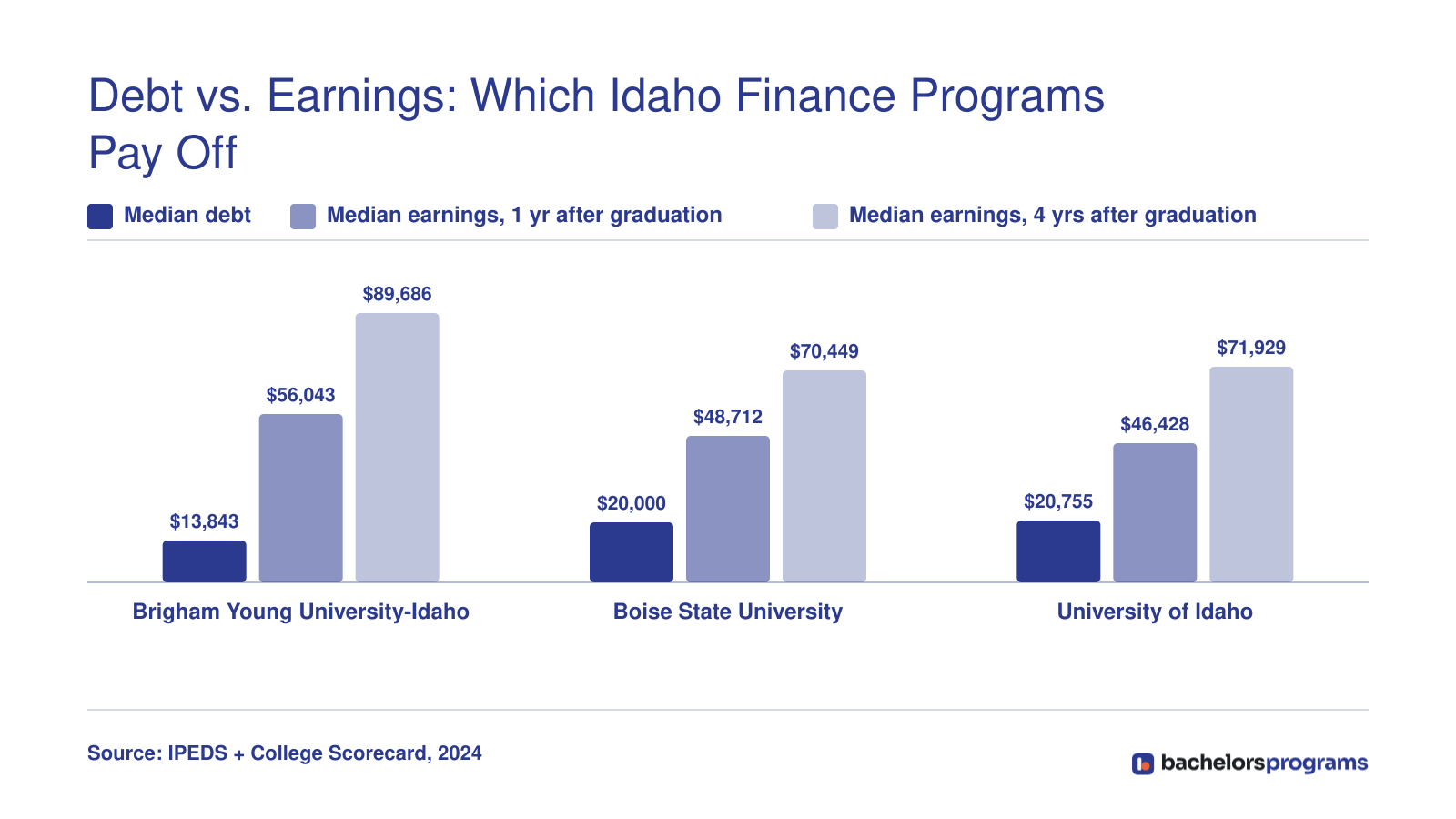
Debt vs. Earnings: Which Idaho Finance Programs Pay Off
This chart compares finance bachelor's graduates' median debt with their median earnings one year and four years after graduation. Brigham Young University-Idaho has the best earnings-to-debt ratio here: its graduates' median debt of $13,843 is about a quarter of their $56,043 median first-year earnings. Idaho State University (median earnings of $49,121 one year out and $73,295 four years out) and The College of Idaho do not appear in the chart because their finance program debt figures are not reported.
CFP Exam Prep and Licensing for Finance Careers in Idaho
Most Idaho finance jobs fall into two groups: roles that need no license, and roles where a credential is tied to what you sell or advise. Corporate finance, credit analysis and bank roles usually sit in the first group. Securities and insurance work sit in the second, and your employer normally sponsors the license.
What Each Credential Covers
- Series 7 and 66: Needed for securities and advisory work. A FINRA member firm must sponsor you through Form U4, so you cannot sit them alone.
- Idaho insurance producer license: Required to sell, solicit or negotiate insurance. Idaho requires the line exam and fingerprinting but no pre-licensing course; the fingerprint fee is $65, and licenses renew every two years.
- CFP certification: Voluntary, and the clearest signal for personal financial planning.
The CFP Path
CFP Board separates education, exam, experience and ethics. You need a bachelor's degree in any accredited discipline, but the degree alone does not satisfy the coursework; a CFP Board Registered Program or capstone is also required. The exam may be taken before the degree is finished, with up to five years to complete it afterward. Experience means 6,000 qualifying hours, about three years full time, and only personal-planning work counts.
Who Regulates What
The Idaho Department of Finance oversees securities and investment adviser representatives, who generally take a Modified Series 65 or the Modified Series 66 alongside the SIE and Series 7. A CFP designation can waive the exam in some cases. The Idaho Department of Insurance licenses producers.
Choosing the Right Idaho Finance School for You
Which Idaho finance program fits your goals best? The answer depends on what you need most, and each type of student has one number to check and one step to take.
Match the School to Your Situation
- Best in-state value: Compare net price, not sticker tuition. University of Idaho, Boise State University, Idaho State University and The College of Idaho price very differently once aid is applied. Next step: run each school's net price calculator with your own household numbers.
- Investing and portfolio focus: Look at graduate earnings and the upper-level curriculum. Next step: read the course catalog for investments, portfolio management or security analysis electives, then ask whether students manage real money.
- Financial planning: Check completions, since steady graduate numbers suggest an established program. Next step: ask whether the coursework meets CFP Board education requirements, which can shorten your path to the CFP exam.
- Online flexibility: Program format is the deciding factor. Next step: confirm on each program page whether the full finance degree can be completed online or only in part, and whether Brigham Young University-Idaho or any other school here requires time on campus.
Verify Fit Before You Apply
Whatever your type, ask admissions three things:
- Is the finance program AACSB accredited, and does that apply to the specific degree you want?
- How do students find internships, and do they earn credit?
- Which of your community college or prior credits transfer into the finance major?
Written answers let you compare schools on equal terms and avoid surprises after you enroll.
Idaho Finance Degree FAQs
What is the best college for finance in Idaho?
How much does a finance degree cost in Idaho?
Can you get a bachelor's degree in finance online in Idaho?
Do you need a license to work in finance in Idaho?
Can community college credits transfer into an Idaho finance bachelor's program?
Compare Finance programs on the data that matters
Explore more Business & Management majors or browse every field of study.
All Business & Management programs Browse every field of study