Best Computer Science Schools in Illinois
Compare 72 accredited Computer Science programs in Illinois at 46 colleges, with net price after aid, graduation rates, earnings and debt from IPEDS and the U.S. College Scorecard.
A bachelor's degree in computer science, awarded in Illinois as a Bachelor of Science (B.S.) or Bachelor of Arts (B.A.) in Computer Science, is a four-year undergraduate program in programming, algorithms, systems, and software design. Few states offer a wider range of places to earn one: a flagship public research university, regional publics, and private universities from Chicago to the Mississippi River.
The deciding factor is fit. Selectivity, price, and program structure differ sharply from one campus to the next, and Chicago's financial and corporate tech employers recruit unevenly across them.
Where you study often shapes your first internship more than your diploma does.
Key Points
- The University of Illinois Urbana-Champaign's Siebel School tops Illinois computer science.
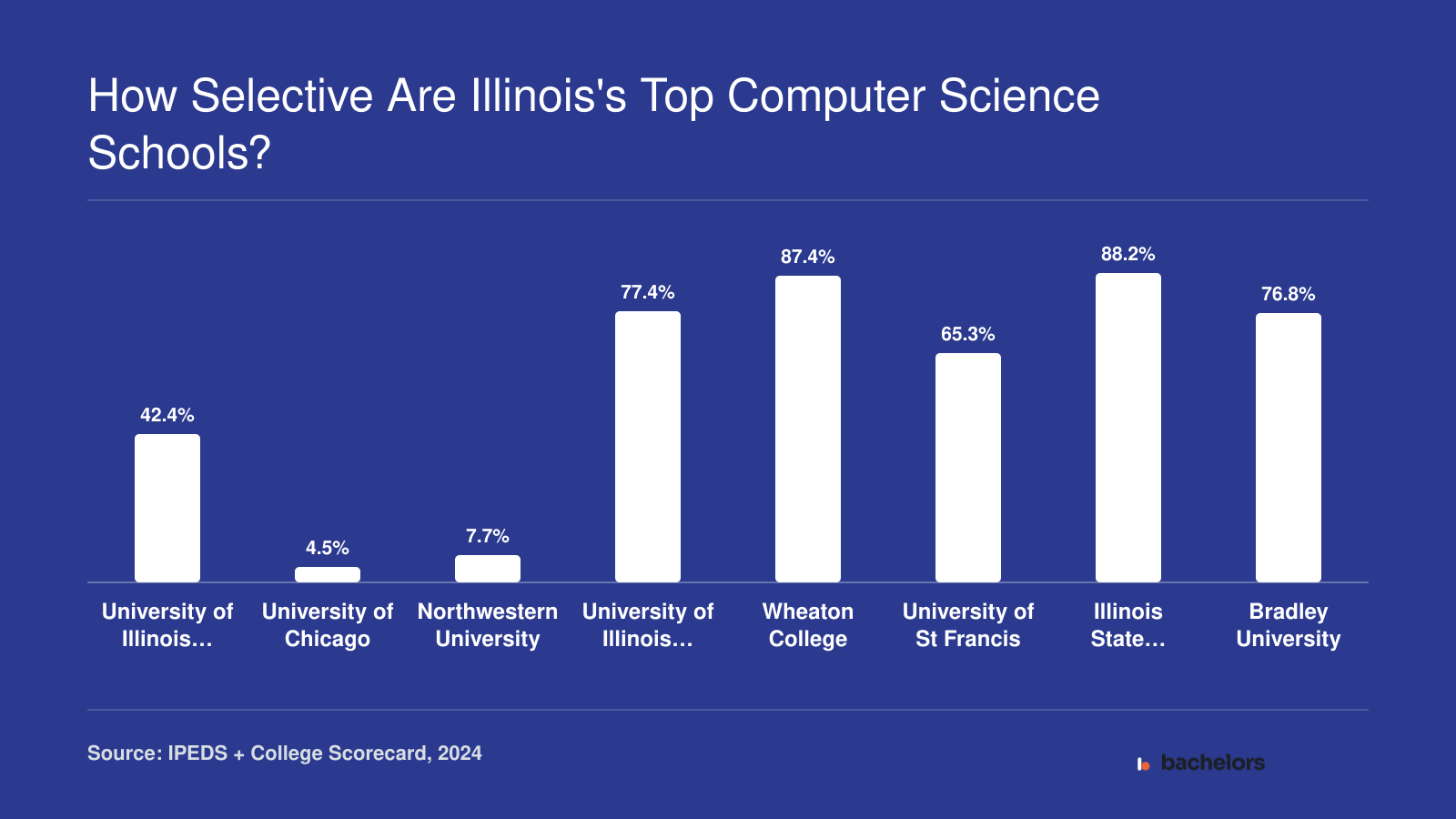
- Acceptance ranges from 4.5% (University of Chicago) to 88.2% (Illinois State University).
- Illinois requires no license to work as a software developer.
Best Computer Science Schools in Illinois: Our Top 10
The strongest computer science program in Illinois is at the University of Illinois Urbana-Champaign, where the Siebel School pairs a top-ten national reputation with internship participation and first-choice placement rates that few programs in the country match. The rest of the list mixes private research universities, an urban public option, and smaller colleges that offer tighter classes and, in several cases, a lower net price after aid. Every entry below is a bachelor's degree in computer science at a school based in Illinois.
University of Illinois Urbana-Champaign
#1Champaign, IL · ~$14,000/yr (est.)
Best for: Future software engineers wanting research depth
The state's flagship CS program sits in the Siebel School of Computing and Data Science, where students study computing theory and software development alongside artificial intelligence, data science, and social computing. It is ranked among the top seven undergraduate CS programs nationally, most students complete an internship or co-op, and 96% land their first-choice destination after graduation. Alumni have founded PayPal and YouTube, and no prior programming experience is required to start.
- 9 concentration options; trending areas include AI, cybersecurity, quantum
- No prior programming experience required to enter the major
- Ranked among the top 7 undergraduate CS programs nationally
- 95% of students complete an internship or co-op
- 96% of graduates secure their first-choice destination
- Alumni have founded PayPal and YouTube
- Research, mentorship, and showcase opportunities for undergrads
- Guaranteed admission to the school's Master of Computer Science programs
University of Chicago
#2Chicago, IL · ~$15,000/yr (est.)
Best for: Theory-minded students drawn to rigorous academics
Chicago's computer science department awards both a Bachelor of Arts and a Bachelor of Science, letting students pick a broad liberal arts path or a deeper technical one with systems, theory, and machine learning requirements. Coursework sits inside the College's core curriculum, so majors also complete general education work in mathematics and the physical sciences. Placement exams let experienced students skip introductory courses, and honors and a joint bachelor's/master's option are available.
- At least 14 computer science courses required
- Introductory sequence taught in Python and C
- Theory requirement of two courses
- Eight electives spread across five areas
- Placement exams for students with prior experience
- Honors option available; joint B.A./M.S. program offered
- Seven-course computer science minor available
- At least 15 computer science courses required
- Adds systems, theory, and machine learning requirements beyond the B.A.
- Specialization requirement plus electives numbered CMSC 20000 or above
- Prepares students for industry roles or graduate study
- Honors option with thesis available
Northwestern University
#3Evanston, IL · $29,000/yr (est. net price)
Best for: Interdisciplinary learners combining CS with other fields
Northwestern splits computer science across two colleges: a Bachelor of Science through the McCormick School of Engineering and a Bachelor of Arts through the Weinberg College of Arts and Sciences. Either degree can carry one of nine concentrations, from artificial intelligence and machine learning to security and privacy, robotics, and quantum. Undergraduates may enter the Research Track in their third year, and a combined bachelor's/master's option lets them begin graduate work early.
- B.S. through McCormick School of Engineering; B.A. through Weinberg
- 9 concentration options, from AI and machine learning to quantum
- B.S. requires 48 total units
- Research Track opens in the third year
- Combined bachelor's/master's option through McCormick
- Peer Mentor Program with regular office hours
- Students attend the Grace Hopper and Tapia conferences
- 18 full-time teaching faculty in the department
- Bachelor of Arts awarded through the Weinberg College of Arts and Sciences
- At least 45 units, including seminar, writing, and language requirements
- Easier to pair with a second major in arts and sciences
- Undergraduate research and study abroad opportunities
- Minor available alongside the major
University of Illinois Chicago
#4Chicago, IL · ~$11,000/yr (est.)
UIC's computer science department produces more CS bachelor's graduates than any other school on this list, and its ABET-accredited major offers three concentration options, including a computer systems track. The 128-credit degree blends College of Engineering requirements with technical electives in networking, computer architecture, and compiler design. A zero-credit professional development seminar is required before graduation, and the campus sits just west of Chicago's Loop.
- ABET-accredited program with three concentration options
- 128 total credit hours, including 18 in technical electives
- Four technical electives from a designated list such as networking or compilers
- Core courses in systems programming, operating systems, computer algorithms
- Zero-credit professional development seminar required before graduation
- At least one course in probability and statistics
- Four-year sample plan of study published
Principia College
#5Elsah, IL · $30,000 – $35,000/yr (est.)
Principia is a small Christian Science college in Elsah, Illinois, with a computer science major built on programming, data structures, and software design. Students advance into computer software architecture, advanced databases, and a computer issues seminar, with business and technology courses rounding out the degree. The program is on campus, requires a cumulative 2.000 average, and offers an optional internship.
- 54 total credit hours with a 2.0 GPA minimum
- Minimum grade of C required in core courses
- Core sequence: programming, data structures, programming languages, software design
- Advanced work in software architecture and databases
- Computer issues seminar plus responsible business and technology courses
- Optional internship for real-world experience
- At least 22 elective semester hours
Wheaton College
#6Wheaton, IL · ~$27,000/yr (est.)
Wheaton College, a Christian liberal arts school in the western suburbs, offers computer science as both a Bachelor of Arts and a Bachelor of Science. The 50-credit major includes a project-based software development course, a mentored research seminar with faculty, and a social and ethical issues capstone. Student teams have taken first place in their division at the ACCA programming competition 23 times since 2001.
- 50 total credit hours; offered as a B.A. or B.S.
- 3 concentration options
- Project-based software development course in year two
- Mentored research seminar with faculty
- Social and Ethical Issues capstone
- Electives in machine learning, databases, and information security
- 23 first-place ACCA programming division finishes since 2001
- Computer Science Lab housed in the Meyer Science Center
University of St Francis
#7Joliet, IL · ~$13,000/yr (est.)
The University of St. Francis is a private Catholic university in Joliet offering a Bachelor of Science in Computer Science with an applied, systems-oriented focus. Coursework spans C++, Java, and Visual Basic, plus seminars ranging from bioinformatics to game programming. Students work with multiple server platforms, databases, and internet programming, and the school recommends pairing the major with a minor in information technology, mathematics, accounting, or finance.
- Coursework in C++, Java, and Visual Basic
- Seminars from bioinformatics to human-computer interaction to game programming
- Covers systems programming, server platforms, databases, and internet programming
- Recommended minors in information technology, mathematics, accounting, or finance
- Higher Learning Commission accredited
- Prepares students for programmer, systems analyst, and software engineer roles
Illinois State University
#8Normal, IL · ~$19,000/yr (est.)
Illinois State's computer science program is ABET-accredited and takes a generalist approach, teaching software development alongside computational theory, hardware, and operating systems. Students work in multiple programming languages and can use an accelerated option to begin a master's degree while finishing the bachelor's. The program sits in the School of Information Technology, and applicants apply as freshmen or transfers with a priority deadline.
- ABET-accredited Bachelor of Science in Computer Science
- General CS major covering software development, theory, hardware, operating systems
- Hands-on work in multiple programming languages
- Accelerated option to begin a master's degree
- Apply by the priority deadline; separate freshman and transfer processes
- Housed in the School of Information Technology
Bradley University
#9Peoria, IL · ~$23,000/yr (est.)
Bradley University in Peoria structures its CS major around four concentrations: artificial intelligence, computer game technology, data science, and software, web, and computer security. Classes are small and collaborative, and students compete in coding challenges through the ACM student chapter. Internships have placed students at Walgreens, Caterpillar, and the Federal Reserve Bank of Chicago, and graduates have gone on to Microsoft and Epic Systems.
- 4 concentrations: artificial intelligence, game technology, data science, security
- AI concentration requires 12 semester hours, 9 of them required
- Small, collaborative classes
- ACM student chapter competes in coding challenges
- Internships at Walgreens, Caterpillar, and the Federal Reserve Bank of Chicago
- Scholarships available to computer science students
- Graduates hired at Microsoft and Epic Systems
Lake Forest College
#10Lake Forest, IL · ~$29,000/yr (est.)
Lake Forest College is a small liberal arts school north of Chicago where computer science majors most often join the business, finance, and data science career pathway. The college reported a 100% outcome rate for its class of 2023 within six months of graduation, and recent graduates have worked as data scientists, software engineers, and technology consultants. Internships have included Argonne National Laboratory, Motorola Solutions, and Ernst & Young.
- Class of 2023 reported a 100% outcome rate within six months
- Recent roles include data scientist, Java software engineer, technology consultant
- Internships at Argonne National Laboratory, Motorola Solutions, Ernst & Young
- Most majors join the business, finance, and data science career pathway
- Alumni have entered M.S. data science, J.D., and Ph.D. statistics programs
Cost & outcomes by school
Federal data for the highest-earning Computer Science programs, independent of the ranking above. Earnings are this field's bachelor's graduates four years after completing where the Scorecard reports them, else the school's undergraduate median.
| School | Net price / yr | Grad rate | Earnings | Debt | Grads/yr | Format |
|---|---|---|---|---|---|---|
| University of Illinois Urbana-Champaign IL | $14,355 | 85% | $181,981 | $18,983 | 458 | Campus |
| University of Chicago IL | $14,860 | 96% | $178,068 | $15,000 | 230 | Campus |
| Northwestern University IL | $29,167 | 95% | $155,106 | $14,646 | 137 | Campus |
| Illinois Institute of Technology IL | $18,425 | 75% | $120,953 | $23,750 | 111 | Campus |
| University of Illinois Chicago IL | $10,974 | 62% | $120,470 | $17,418 | 402 | Campus |
| Illinois State University IL | $19,398 | 65% | $111,099 | $22,043 | 57 | Campus |
| Bradley University IL | $22,719 | 76% | $107,379 | $27,000 | 38 | Campus |
| Southern Illinois University Edwardsville IL | $14,889 | 57% | $106,082 | $21,551 | 60 | Campus |
| University of Illinois Springfield IL | $9,833 | 53% | $102,020 | $24,925 | 96 | Hybrid |
| Elmhurst University IL | $24,185 | 70% | $101,273 | $20,489 | 22 | Campus |
| Northern Illinois University IL | $13,391 | 49% | $93,438 | $21,004 | 139 | Campus |
| Benedictine University IL | $22,313 | 50% | $91,698 | $24,000 | 9 | Online |
Sources: U.S. Department of Education. Net price, graduation rate, earnings and debt: College Scorecard (earnings and debt for this field's bachelor's graduates where reported, else school-wide); graduates: IPEDS. A dash means no figure is reported.
Cost, debt & payoff
Median earnings of this field's bachelor's graduates (4 yrs after completing, else the school's undergraduate median) vs. their median federal loan debt · U.S. College Scorecard
Across these programs the median graduate earns about $79,877 and finishes with roughly $23,750 in debt — a ratio that clears a common rule of thumb (keep debt below first-year salary). Net price and debt vary widely school to school, so check the per-school figures in the table above before you shortlist.
Most Affordable Bachelor's in Computer Science Schools in Illinois
This table sorts schools by average net price after grants and scholarships, drawn from 2024 IPEDS and College Scorecard data. The federal government calculates that figure separately for public and private nonprofit schools, so treat it as an estimate of what a typical aided student pays, not an exact quote. The gap between sticker price and net price is widest at the private schools: Saint Xavier University lists $37,940 in tuition and fees but averages $10,970 after aid, and Dominican University and University of St Francis also come in near $11,700 and $13,000 against sticker prices above $38,000.
| School | City | Sector | Average Net Price After Aid | In-State Tuition and Fees | Format |
|---|---|---|---|---|---|
| Saint Xavier University | Chicago | Private nonprofit | $10,970 | $37,940 | Campus |
| University of Illinois Chicago | Chicago | Public | $10,974 | $14,338 | Campus |
| Dominican University | River Forest | Private nonprofit | $11,745 | $38,978 | Campus |
| Eastern Illinois University | Charleston | Public | $12,786 | $13,679 | Campus |
| University of St Francis | Joliet | Private nonprofit | $13,006 | $38,110 | Campus |
Highest-Earning Illinois Computer Science Bachelor's Programs
The University of Chicago leads at $227,147 five years out, and debt stays modest across the board: Northwestern University graduates pair the lowest reported median debt ($14,646) with $156,137 in earnings, while Knox College graduates carry the most debt ($25,896) yet still earn $112,708, more than four times what they borrowed. Every figure below belongs to the computer science program itself, not the school as a whole, and the ROI proxy is a relative return score where higher is stronger.
| School | Location | Median Earnings 1 Year After Finishing | Median Earnings 5 Years After Finishing | Median Debt | Monthly Payment (10-Year Plan) | ROI Proxy (Higher Is Stronger) |
|---|---|---|---|---|---|---|
| University of Chicago | Chicago, IL | $117,578 | $227,147 | N/A | N/A | 6.1 |
| University of Illinois Urbana-Champaign | Champaign, IL | $124,530 | $170,405 | $18,983 | $201 | 4.2 |
| Northwestern University | Evanston, IL | $99,981 | $156,137 | $14,646 | $155 | 6.0 |
| University of Illinois Chicago | Chicago, IL | $78,040 | $116,325 | $17,418 | $185 | 4.1 |
| Knox College | Galesburg, IL | N/A | $112,708 | $25,896 | $275 | 2.0 |
Online and Hybrid Bachelor's in Computer Science at Illinois Schools
The B.S. in Computer Science at the University of Illinois Urbana-Champaign requires 128 credits in the 2026-2027 catalog, and it is delivered on campus. Every other ranked school whose program page we verified is also campus-based. A fully online or hybrid bachelor's degree in computer science is not something these program pages describe, so plan on in-person study at these schools.
Which Formats These Schools Use
Every program in the top rankings is campus-based:
- Large public universities: University of Illinois Urbana-Champaign, University of Illinois Chicago and Illinois State University.
- Research universities: University of Chicago and Northwestern University, where the degree can be a B.S. or a B.A. depending on the school.
- Smaller private colleges: Principia College, Wheaton College, University of St Francis, Bradley University and Lake Forest College.
UIUC's program page also notes that the B.S. is open to first-year students for 2026-2027. None of the verified pages describe a degree-completion-only track.
What Delivery Looks Like
Campus programs generally mean scheduled, in-person class meetings, labs and faculty office hours. Online formats are usually split into synchronous classes (set meeting times) and asynchronous ones (work on your own schedule). The program pages for the schools above describe neither format, so don't assume either is available. Illinois State University's page says first-year applicants and transfer applicants apply separately, which matters if you are starting from a community college.
Who Fits Campus Study
A first-year student who can relocate benefits most from the campus format. It brings access to labs, student chapters, career fairs and the internship pipelines these departments publicize. Working adults and transfer students need to ask more questions. Before applying, email the department and ask three things:
- Are evening or blended sections offered for upper-level courses?
- How many credits will transfer, and does the school cap transfer hours?
- Can required courses be taken part-time?
The answers can change which school is realistic for you, and they are not always on the program page. If you need fully online coursework, confirm the format with the department before you build an application list around it.
Related Articles
How Selective Are Illinois's Top Computer Science Schools?
Admission rates at the top-ranked Illinois schools range from 4.5% at the University of Chicago to 88.2% at Illinois State University, so where you apply shapes your odds as much as your application does. These rates cover each school as a whole, not the computer science major. Popular CS programs can admit a smaller share of applicants than the campus-wide figure suggests.
Admissions for Illinois Computer Science Bachelor's Programs: GPA, Test Policy, and Transfer Credit
Admission to an Illinois computer science bachelor's program is decided largely by the transcript, and the math on it does most of the talking.
How Selective Is Computer Science at Illinois?
The University of Illinois Urbana-Champaign sets the benchmark. Illinois reports a 38.1% admit rate for the 2026 first-year class and a 32.8% rate for applicants offered their first-choice major1, but it does not publish a computer science-specific figure. Because the CS major admits students directly as first-years, both campus numbers function as a ceiling rather than a target, and direct entry to computer science is more selective than either.
GPA and Test Scores
For 2026, the middle 50% of students admitted to the engineering program that houses computer science posted a GPA of 3.90 to 4.00, against 3.70 to 4.00 campus-wide. Submitted SAT scores ran 1490 to 1550 and ACT 33 to 35, with 84% of that group sending scores; campus-wide, the ranges were 1440 to 1540 and 31 to 35. These describe students who enrolled, not thresholds. The admissions pages reviewed here do not state whether the SAT or ACT is required, optional, or disregarded for 2026, so read the ranges as a profile of test-takers and confirm the current cycle's rule before planning around it. Where a school publishes only campus-wide policies, the general first-year requirements govern; if a program states no separate policy, ask the department.
Transfer Credit and the Illinois Articulation Initiative
The transfer path into UIUC computer science is narrow. Students admitted to the CS majors as first-years are direct admits and cannot switch in later through an on-campus transfer.3 External applicants should carry a 3.5 or better cumulative and technical GPA.2 The mathematics and computer science and statistics and computer science routes require a 3.67 plus two required CS courses beyond the introductory sequence taken at Illinois, with at least an A- in them; CS + X routes require a 3.50 and a B+.3 Illinois caps no transfer credit but requires 45 hours in residence, 21 of them upper-level.4 For general education, the Illinois Articulation Initiative's core is the standard community college pathway; it protects the gen-ed block, not admission to the major.
One Application Tip
Finish calculus before senior year and add a second calculus course or linear algebra if your school offers it. Strong math preparation is the clearest signal a CS applicant can send.
Cost of a Bachelor's Degree in Computer Science in Illinois
Public universities and private colleges in Illinois price a bachelor's degree in computer science very differently on paper, but the gap shrinks once aid is applied. Net price averages what students actually pay once grants and scholarships are applied, so your own bill will vary.
Sticker Price vs Net Price
At the University of Illinois Urbana-Champaign, published in-state tuition and fees run about $16,004, and the average net price is about $14,355. The University of Illinois Chicago lists about $14,338 in tuition and fees, with a net price near $10,974. Eastern Illinois University, in our directory, comes in around $13,679 and $12,786.
Private schools start far higher. The University of St Francis lists roughly $38,110 in tuition and fees, yet its average net price is about $13,006. The University of Chicago's published figure is about $70,662, with an average net price near $14,860. Institutional aid narrows that gap at private schools, so compare net price, not sticker price.
The Illinois MAP Grant
The Monetary Award Program (MAP) is need-based aid from the Illinois Student Assistance Commission (ISAC). It covers tuition and mandatory fees at approved Illinois schools and does not need to be repaid.1 To qualify, you generally need to:
- Residency: Be an Illinois resident (for dependent students, based on the parent listed on the FAFSA).1
- Status: Be a U.S. citizen, an eligible noncitizen, or eligible under the RISE Act.
- Progress: Enroll at least 3 credit hours per term and keep satisfactory academic progress.
- Degree history: Not already hold a bachelor's degree, and have used fewer than 135 MAP-paid credit hours.
The maximum award is $8,400 for 2023-24 and later years, though your actual amount depends on your need, your school's tuition and fees, and your course load.1 Awards are prorated by credit hour, and 15 hours per term earns the full term amount. Need is calculated from the FAFSA or ISAC's Alternative Application, so submit one as soon as applications open.2 Funding is limited and depends on yearly state appropriations.
Other Illinois Aid
ISAC also lists scholarship programs for teachers, nursing students, veterans' dependents, displaced workers, and the iGROW Tech program for undergraduates. Eligibility, award amounts, and funding change from year to year, so check ISAC's website for current details. The State Scholar designation is honorary and carries no money.3 Ask each school's financial aid office about institutional scholarships too, since NEIU-style merit and need awards vary by campus.
One Way to Lower the Bill
Start at an Illinois community college, then transfer into a four-year computer science program. You pay lower tuition for the first two years, and MAP can still apply at approved schools. Confirm in advance which credits your target program will accept.
ABET Accreditation for Computer Science Bachelor's Programs at Ranked Illinois Schools
ABET accreditation is an independent review of a computer science program, not of the college as a whole. It is one of the few quality markers a prospective computer science student can verify from the outside. It tells employers and graduate admissions offices that the curriculum, faculty, facilities, and student outcomes have been measured against published standards. Some federal and government jobs, along with a number of defense and contracting employers, treat an accredited degree as a hiring plus or a requirement.
What the Computing Accreditation Commission covers
ABET's Computing Accreditation Commission (CAC) handles computer science and similarly named computing programs. Accreditation is program-specific: a school can hold ABET status for its B.S. in Computer Science and not for a B.A., a minor, or a related information systems major. Check the exact degree and campus, not the university's general reputation. Accreditation also matters if you plan to transfer between programs or apply to graduate school, since some admissions committees use it as a quick screen.
Verified status at ranked Illinois schools
| School | Program | ABET status |
|---|---|---|
| Illinois State University | B.S. in Computer Science | Accredited by CAC1 |
| Southern Illinois University Edwardsville | B.S. in Computer Science | Accredited by CAC2; the B.A. is not listed as accredited |
| University of Illinois Chicago | B.S. in Computer Science | Accredited by CAC through 20273 |
For the University of Illinois Urbana-Champaign, University of Chicago, Northwestern University, and the other schools ranked here, the bachelor's computer science program's ABET status could not be verified from the school pages and accreditor search reviewed for this section. That does not mean a program lacks accreditation. It means the status was not confirmed, so ask the department directly or search ABET's accredited program database before you apply.
Internships and Co-Op Pipelines for Illinois CS Students
The internship decision in Illinois often comes down to geography versus structure: a Chicago campus puts you near the city's trading, banking and corporate employers, while a downstate campus may offer a formal co-op or research-park pipeline that delivers comparable experience. For a bachelor's degree in computer science, the practical question is which route gives you a substantive project, a supervisor and a return offer.
Formal co-op and internship pipelines
The University of Chicago runs the Jeff Metcalf Internship Program, which provides 4,500 paid internships a year, and its Careers in Technology office arranges employer visits, workshops and treks; published partners include Apple, Amazon, Google, Microsoft, IBM, Bank of America and Argonne National Laboratory1. At the University of Illinois Urbana-Champaign, Research Park lists a Caterpillar corporate parallel co-op in product development for engineering, technology and CS students, running Aug. 17 to Dec. 30, 2026. Synchrony's ETC internship has hosted more than 400 Illinois students2, and former interns have moved into full-time technology, analytics and credit roles. Eastern Illinois University uses a formal internship process with a coordinator; the standard placement is 8 to 10 weeks full time or 15 weeks part time, with at least 51% of the work in computer science3.
Chicago access and downstate strategy
UIC directs CS and economics students to LAS Career Development and Internships4, and graduates enter technology, finance, consulting, analytics and policy. Lake Forest College reports CS internships and jobs in and beyond Chicago, with recent employers including Argonne, Groupon, Motorola Solutions, U.S. Bank and CVS Health. Proximity helps Chicago-area students attend employer treks and city career fairs during the semester; downstate students can use Research Park co-ops, remote internships and summer Chicago programs. Start as a sophomore: have career services review your resume in the fall, then apply to summer postings by early winter.
Employers hiring in Chicago and Illinois
Published destinations and partners include Amazon, Apple, Google, Microsoft, Cisco, Databricks, Bloomberg, Citadel, CME Group and DRW Holdings. These are recruiting relationships and outcomes, not a guarantee that every employer posts a CS internship each year.
Computer Science Careers in Illinois for Bachelor's Graduates
Do you need a license to work as a software developer in Illinois? No. The state does not require a license for software developers or for most computing roles, so a bachelor's degree in computer science, a portfolio, and internship experience carry the weight in hiring. Some specialties, such as work on certain government or security contracts, may ask for separate certifications or clearances, but those come from employers and agencies, not from a state board.
Wages and Demand
Illinois labor data puts the median annual wage for software developers statewide at $135,808, or $65.30 an hour.1 The Chicago metro figure the state publishes is lower at $109,703, or $52.74 an hour2, but it is dated 2021, so do not read the gap as a current difference between the city and the rest of Illinois. For a newer Chicago-area reference, the Bureau of Labor Statistics reports a mean hourly wage of $54.84 across all computer and mathematical occupations in the Chicago-Naperville-Elgin area as of May 2025.3
Nationally, the BLS projects 10 percent growth for software developers from 2025 to 2035.4 For software developers, quality assurance analysts, and testers combined, it projects about 185,400 additional jobs over that period.4
How These Figures Relate to Earnings Shown Earlier
The earnings in the tables above describe what graduates of each program earn after finishing, across all jobs they hold. The wages here describe everyone working in one occupation, including people with many years of experience. They are different measures, so treat the occupational medians as a longer-term benchmark, not a starting-salary prediction.
Common Entry-Level Roles
- Software developer: Builds and maintains applications, often in finance, insurance, and healthcare technology.
- Quality assurance analyst or tester: Checks software before release, common in logistics and enterprise software firms.
- Systems or data analyst: Supports business operations in manufacturing, retail, and professional services.
- Web or application developer: Works for agencies, hospitals, universities, and Chicago-area startups.
Graduates of the schools ranked here tend to find the densest hiring in the Chicago area, though employers in central and southern Illinois also recruit from nearby campuses.
Compare Computer Science programs on the data that matters
Explore more Computers & IT majors or browse every field of study.
All Computers & IT programs Browse every field of study