Best Cybersecurity Schools in Illinois
Compare 23 accredited Cybersecurity programs in Illinois at 19 colleges, with net price after aid, graduation rates, earnings and debt from IPEDS and the U.S. College Scorecard.

Which Illinois employers actually hire new security graduates? Chicago's banks, hospital systems and government agencies keep a steady need for entry-level analysts, which is why a bachelor's degree in cybersecurity has become a common choice at campuses from Chicago to Carbondale.
Most schools award a Bachelor of Science (B.S.) in Cybersecurity, though some fold the subject into an applied science or technology degree. Tuition, format and NSA designation vary widely from one school to the next.
Employers tend to look past the degree title to hands-on skills and certifications, so what you build during the program counts.
Key Points
- University of Illinois Springfield posts the lowest average net price here: $9,833.
- Loyola University Chicago's cybersecurity B.S. holds an NSA Cyber Defense designation.
- Illinois requires no cybersecurity license; employers weigh certifications like Security+.
10 Best Bachelor's Degree in Cybersecurity Programs in Illinois, Ranked
Ten Illinois cybersecurity bachelor's programs make this list, spanning large public universities, small private colleges and fully online completion degrees. Some are stand-alone Bachelor of Science degrees in cybersecurity; others fold the security coursework into computer science or business. The range matters, because the format you choose shapes both what you pay and how quickly you finish.
Lewis University
#1Romeoville, IL · ~$17,000/yr (est.)
Best for: Community college transfer students
A private Catholic university in Romeoville, Lewis runs its cybersecurity bachelor's inside a computer science department and requires a capstone that doubles as the advanced writing requirement. The major is unusually deep at 67 credits, and the school has built a transfer path with Joliet Junior College for students who start at a two-year school. Schools offering this program graduate about 67% of students.
- 120 total credit hours, with 67 of them in the major
- Capstone project (CPSC 49300) satisfies the Advanced Writing Requirement
- Coursework in digital forensics, wireless security and penetration-testing programming
- Nested in computer science: Linux, networks, file systems, databases and encryption
- One computer science elective at the 30000 level or higher required
- Cybersecurity majors cannot also minor in cybersecurity
- Recommended minors include computer science, data science, IT and mathematics
Illinois State University
#2Normal, IL · ~$19,000/yr (est.)
Best for: Hands-on learners wanting security labs
Illinois State's School of Information Technology pairs security theory with lab work, and its cyber defense designation from the NSA and Department of Homeland Security is the clearest signal of program maturity here. Students come in as freshmen, transfers or current Illinois State students, and scholarship priority deadlines reward early applicants. The school graduates about 65% of students.
- Covers security basics, cryptography, ethical hacking, defenses and forensics
- Hands-on work includes building network defenses and running simulated attacks
- Requires a background in programming, networking, hardware and systems software
- School of Information Technology holds an NSA and DHS Center of Academic Excellence designation
- Admits freshmen, transfer students and current Illinois State students
- Priority deadlines improve scholarship consideration
Southern Illinois University Edwardsville
#3Edwardsville, IL · $10,000 – $15,000/yr (est.)
Best for: Business-minded future security managers
SIUE takes a different route: cybersecurity here is a specialization inside the Bachelor of Science in Business Administration rather than a stand-alone science degree. That makes it a fit for students who want accounting, finance and management fluency alongside security skills, with a 2.5 GPA bar in the information systems courses. The school graduates about 57% of students.
- Cybersecurity specialization inside the Bachelor of Science in Business Administration
- Pairs information systems management with security and risk skills
- Business core covers accounting, economics, finance, management and marketing
- Students must hold a 2.5 GPA in all CMIS courses
- Prepares for roles in information security and security management
Loyola University Chicago
#4Chicago, IL · ~$36,000/yr (est.)
Loyola's Chicago campus houses a cybersecurity bachelor's in the Department of Computer Science, and the program carries an NSA Center of Academic Excellence designation that was renewed for 2025 through 2030. For students who want a city campus within reach of Chicago employers, it is the most centrally located option on this list. The school graduates about 73% of students.
- Designated an NSA and DHS Center of Academic Excellence in Cyber Defense
- Validated program of study, re-designated for 2025 through 2030
- Housed in the Department of Computer Science
- Curriculum covers cyber defense principles and practices
Eastern Illinois University
#5Charleston, IL · $14,000 – $16,000/yr (est.)
Eastern Illinois offers an online completion degree rather than a from-scratch bachelor's, built for people who already hold IT coursework or a certification and want the credential finished. Credit for prior learning and employer-based internship hours keep the timeline short for working professionals. The school graduates about 47% of students.
- Online completion degree for students with existing IT or cybersecurity study
- 30-hour major core plus an 18-hour foundation core
- Choose three of five electives, from ethical hacking to facility security
- Up to 12 credits through an internship or Credit for Prior Learning
- IT and cyber professionals can complete internship hours on employer projects
- Entry requires 30 transferable credits, three years of IT work or a certification
Quincy University
#6Quincy, IL · ~$20,000/yr (est.)
Quincy is a small private university where the cybersecurity major is deliberately stitched to a liberal arts core, so students take cryptography and forensics alongside writing and critical thinking work. A capstone and support courses in math and programming round out a curriculum aimed at analysts, security engineers and information assurance specialists. The school graduates about 45% of students.
- Minimum 2.0 GPA required
- Capstone applies classroom skills to real-world security challenges
- Coursework in cryptography, network security, forensics and incident response
- Support courses in mathematics and programming build the technical base
- Covers legal, ethical and social issues in security
- Blends technical training with a broad liberal arts foundation
University of Illinois Springfield
#7Springfield, IL · ~$10,000/yr (est.)
UIS runs a 36-credit cybersecurity major with dedicated labs, and its computer science department serves as a Cisco Regional Networking Academy for schools across central Illinois. Multiple start dates and a fully online version make it one of the more flexible public options here, and the school reports that 98% of students receive aid. The school graduates about 53% of students.
- 36 credit hours in the major, structured as a four-year degree
- Cybersecurity labs and current security technology
- Multiple start dates per year; $50 application fee for domestic undergraduates
- Personal statement of 250 to 650 words required with the application
- School reports that 98% of students receive financial aid
- Computer science department is a Cisco Regional Networking Academy
Southern Illinois University-Carbondale
#8Carbondale, IL · $10,000 – $15,000/yr (est.)
SIU Carbondale's cybersecurity technology degree breaks 120 credits into a university core, a foundation tier, 42 major credits and electives, and can be finished on campus or online. Students get an unusually active club scene for the field, including a competitive Security Dawgs team and a Women in Cybersecurity chapter. The school graduates about 62% of students.
- 120 credit hours: 39 core, 24 foundation, 42 major, 15 electives
- Small classes taught by experienced faculty
- Student groups include the Security Dawgs, Women in Cybersecurity and Tech Dawgs
- Prepares for information security analyst and ethical hacking roles
Elmhurst University
#9Elmhurst, IL · ~$24,000/yr (est.)
Elmhurst, west of Chicago, structures its cybersecurity major around 12.5 courses, with ethical hacking, penetration testing, cryptography and digital forensics built into the required sequence. Transfer credit is accepted and internships are encouraged but not required, which suits students balancing a job with school. The school graduates about 70% of students.
- 12.5 computer science and cybersecurity courses across four years
- Courses in ethical hacking, penetration testing, cryptography and digital forensics
- Capstone software engineering project required
- Internships recommended but not required
- Transfer credits accepted
- Criminal justice coursework recommended alongside the major
Aurora University
#10Aurora, IL · $19,000/yr (est. net price)
Aurora splits its cybersecurity bachelor's into two tracks, so students can lean toward hands-on infrastructure work or toward oversight and governance. The major is 56 credits inside a 120-hour degree, with no grade below C counting toward it, and the university sits in the western Chicago suburbs. The school graduates about 60% of students.
- 56 credits in the major within a 120 semester hour degree
- Tracks: Technical Analyst, Policy and Management
- Technical Analyst track builds and maintains secure infrastructure
- Policy and Management track covers oversight of security operations
- Core coursework in programming and technical skill building
- No grade below C counts; 30-hour residency and upper-division requirements
Cost & outcomes by school
Federal data for the highest-earning Cybersecurity programs, independent of the ranking above. Earnings are this field's bachelor's graduates four years after completing where the Scorecard reports them, else the school's undergraduate median.
| School | Net price / yr | Grad rate | Earnings | Debt | Grads/yr | Format |
|---|---|---|---|---|---|---|
| DePaul University IL | $30,902 | 68% | $68,751 | $23,168 | — | Campus |
| Lewis University IL | $17,028 | 67% | $66,099 | $21,500 | 19 | Campus |
| Loyola University Chicago IL | $36,079 | 73% | $64,194 | $24,157 | 43 | Campus |
| Illinois State University IL | $19,398 | 65% | $62,117 | $20,482 | — | Campus |
| Elmhurst University IL | $24,185 | 70% | $61,462 | $20,489 | — | Campus |
| Aurora University IL | $18,838 | 60% | $58,709 | $20,318 | — | Hybrid |
| McKendree University IL | $24,717 | 53% | $58,572 | $23,250 | — | Campus |
| University of Illinois Springfield IL | $9,833 | 53% | $57,103 | $19,128 | — | Hybrid |
| Southern Illinois University Edwardsville IL | $14,889 | 57% | $56,346 | $20,500 | — | Campus |
| Western Illinois University IL | $12,937 | 45% | $54,163 | $25,251 | — | Campus |
| Southern Illinois University-Carbondale IL | $13,297 | 62% | $53,390 | $21,543 | — | Campus |
| Olivet Nazarene University IL | $20,729 | 61% | $53,213 | $25,000 | — | Campus |
Sources: U.S. Department of Education. Net price, graduation rate, earnings and debt: College Scorecard (earnings and debt for this field's bachelor's graduates where reported, else school-wide); graduates: IPEDS. A dash means no figure is reported.
Cost, debt & payoff
Median earnings of this field's bachelor's graduates (4 yrs after completing, else the school's undergraduate median) vs. their median federal loan debt · U.S. College Scorecard
Across these programs the median graduate earns about $54,163 and finishes with roughly $21,543 in debt — a ratio that clears a common rule of thumb (keep debt below first-year salary). Net price and debt vary widely school to school, so check the per-school figures in the table above before you shortlist.
What Sits Behind These Rankings
Every school on this list is in Illinois and offers a bachelor's-level cybersecurity program, whether you study on campus in Romeoville or Macomb or log in from home. Graduate certificates and master's tracks were left out, so each figure describes an undergraduate path.
What Each Figure Tells You
- Net price: The average yearly cost after grants and scholarships, based on federal College Scorecard data. It shows what students typically pay, not the sticker tuition.
- Graduation rate: The share of students who finish a bachelor's degree. It is a quick read on whether students who start at a school tend to complete.
- Format and completions: Whether the program runs on campus, online or both, plus how many students earn the degree each year, a rough sign of program size.
- Earnings: Median pay for graduates of the program itself, the closest look at what this specific degree returns.
Where the Numbers Fall Short
Net price is a broad average rather than a cybersecurity-specific cost, so your bill after aid may land well above or below it. Graduation rate covers the whole institution, not cybersecurity majors alone. Earnings are measured at different points after graduation depending on the school, so a one-year figure and a later one are not a fair side-by-side match. Treat each number as a starting point, then confirm cost and outcomes with each school's admissions and financial aid offices.
Which Illinois Schools Hold an NSA Cyber Defense Designation
What the schools here publish
Among the programs below, Loyola University Chicago states the clearest claim: its Bachelor of Science in Cybersecurity carries a National Security Agency Center of Academic Excellence in Cyber Defense designation with a validated program of study, initially granted for 2020 through 2025 and re-designated through 2030. Illinois State University also describes its cybersecurity major as a National Center of Academic Excellence program designated by the NSA and the Department of Homeland Security, though it does not publish the designation window on the program page.
University of Illinois Springfield appeared in an older NSA announcement of designated institutions covering 2009 through 2014.1 That is history, not current status, and we could not confirm a live designation from the official directory. The same caution applies to Lewis University, Southern Illinois University Edwardsville, Eastern Illinois University, Quincy University, Southern Illinois University-Carbondale, Elmhurst University and Aurora University: none of them advertises a current CAE-CD designation on the program pages we reviewed. Treat that as unverified rather than disqualifying, and ask admissions directly.
What the label actually means
CAE-CD recognition means a regionally accredited institution has mapped a cybersecurity degree or certificate to the NSA's knowledge units and had that curriculum reviewed; it applies at the associate, bachelor's and graduate levels.2 It is a curriculum signal that some federal agencies and scholarship programs look for, not a job guarantee, not a substitute for institutional accreditation, and no assurance that any graduate will clear a security clearance or land a federal role.
Check the list yourself
Designations expire and get re-validated on cycles, and the NSA's updated CAE-CD requirements took effect in January 2026 starting with Cycle Assignment 25.3 Many third-party "NSA-designated school" roundups still repeat designations that lapsed years ago. Before you apply on the strength of that credential, pull up the NSA's own CAE designated-institutions directory and confirm the school and the specific program are listed today.
Cheapest Illinois Cybersecurity Bachelor's Programs by Net Price
Even among the lowest-cost options, average net price varies by about $3,500, from $9,833 at the University of Illinois Springfield to $13,297 at Southern Illinois University-Carbondale. Tuition and fees are published prices before any aid, while net price is the average a student pays after grants and scholarships, calculated across the whole institution rather than the cybersecurity program alone. All figures come from the U.S. Department of Education's IPEDS and College Scorecard data for 2024.
| School | Location | Format | In-State Tuition and Fees (Before Aid) | Average Net Price After Aid (Institution-Wide) |
|---|---|---|---|---|
| University of Illinois Springfield | Springfield, IL | Hybrid, with a fully online option | $12,252 | $9,833 |
| National Louis University | Chicago, IL | Campus, with a fully online option | $12,705 | $12,641 |
| Eastern Illinois University | Charleston, IL | Online degree completion | $13,679 | $12,786 |
| Western Illinois University | Macomb, IL | Campus | $15,264 | $12,937 |
| Southern Illinois University-Carbondale | Carbondale, IL | Campus or online | $13,334 | $13,297 |
Questions to Ask Yourself
Can you commute to a campus, or does your schedule demand a fully online program?
Do the federal or defense jobs you want expect an NSA-designated program?
Are you bringing community college credits into the major?
Does the program's cost after aid actually fit your budget?
Related Articles
Questions to Ask Yourself
Do you want to work in Chicago's finance and healthcare sectors, or in government and defense?
Will you pursue Security+ during your degree or after graduation?
Would you accept more debt for a program with stronger four-year earnings, or does the cheapest net price win?
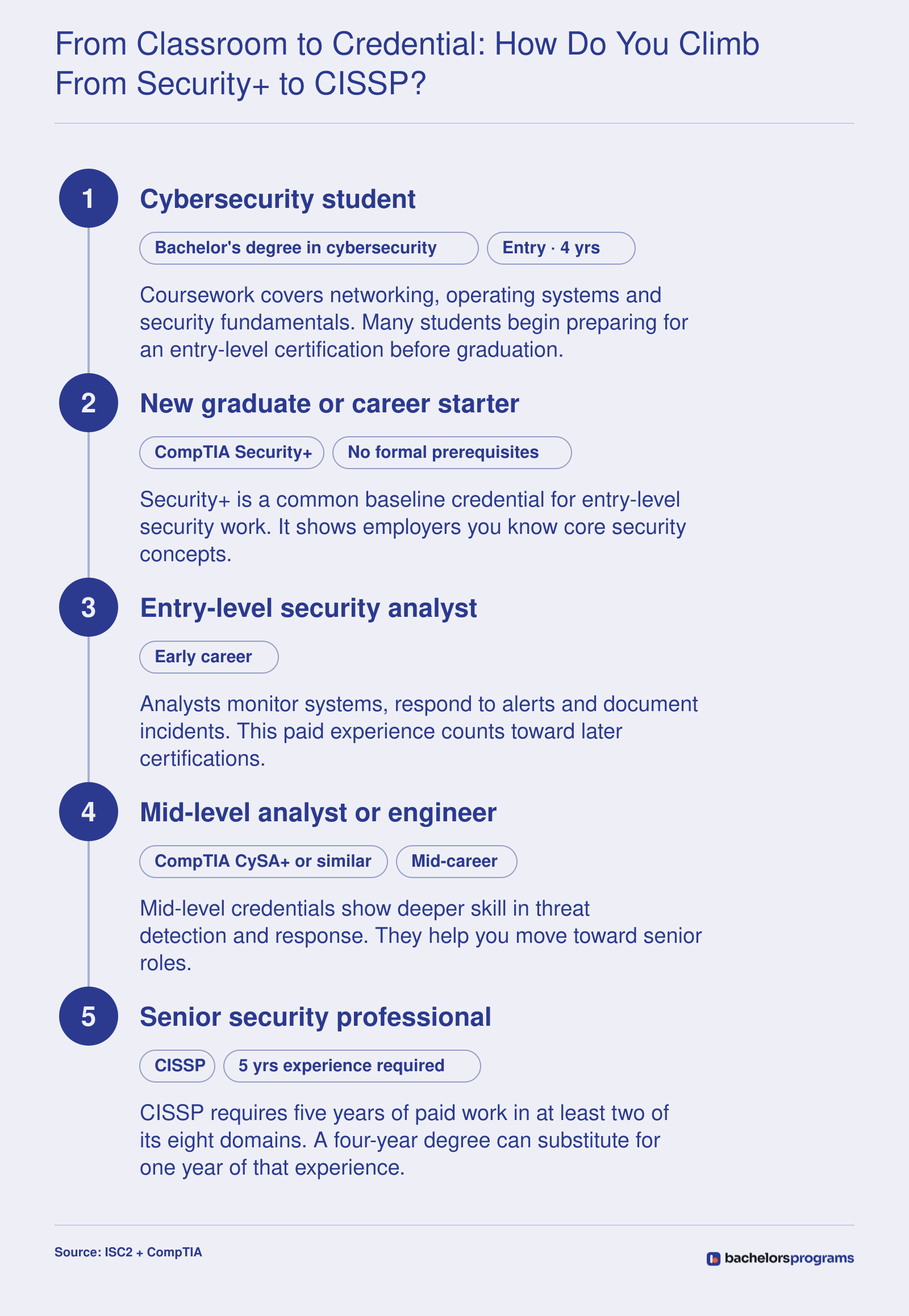
From Classroom to Credential: How Do You Climb From Security+ to CISSP?
Cybersecurity has no Illinois state license, so employers rely on industry certifications as proof of skill. A bachelor's degree in cybersecurity is the first rung, and each certification after it builds on work experience you gain along the way.
Illinois Cybersecurity Degree Questions, Answered Quickly
These short answers draw on the sections above. Confirm details with each school before you apply.
Which Illinois colleges are NSA-designated Centers of Academic Excellence in cyber defense?
What do cybersecurity bachelor's graduates earn in Illinois?
Can international students enroll in Illinois cybersecurity bachelor's programs?
Compare Cybersecurity programs on the data that matters
Explore more Computers & IT majors or browse every field of study.
All Computers & IT programs Browse every field of study