Best Forensic Science Schools in Illinois
Compare 6 accredited Forensic Science programs in Illinois, with net price after aid, graduation rates, earnings and debt from IPEDS and the U.S. College Scorecard.
A degree titled forensic science and a chemistry degree with a forensic focus can lead to the same crime lab, but they are not the same product.
Illinois schools offer the degree as a Bachelor of Science (B.S.) or a Bachelor of Arts (B.A.) in Forensic Science, on campus or online from an Illinois-based institution. Dedicated degrees are kept separate from minors, course sequences and forensic technology certificates, programs that use the word forensic without delivering the credential.
The Illinois State Police asks lab trainees for a bachelor's in forensic or natural science, so rigorous chemistry or biology coursework counts either way.
Key Points
- Loyola University Chicago's B.S. in Forensic Science appears in FEPAC's 2026 materials.
- Loyola graduates' median pay: $51,202 one year out, $64,194 after four.
- Illinois issues no forensic scientist license; Illinois State Police set hiring standards.
Best Bachelor's in Forensic Science Schools in Illinois, Ranked
Loyola University Chicago tops this list because it is the only school here that awards a dedicated Bachelor of Science in Forensic Science. The other five entries teach forensic science through a chemistry concentration or a criminal investigation major, which suits students who want a lab science or a crime-scene focus instead. Each entry notes whether the credential is a standalone forensic degree or a track inside another major.
Loyola University Chicago
#1Chicago, IL · ~$36,000/yr (est.)
Best for: Chicago students seeking a dedicated forensic B.S.
Loyola University Chicago is the one school in this ranking that awards a dedicated Bachelor of Science in Forensic Science rather than a concentration inside a chemistry or criminal justice major. The Chicago campus program builds across pattern evidence, biology-DNA and chemistry, with a toxicology capstone option and an accelerated path to a master's in five years. Its school-wide graduation rate is 73 percent, and forensic science graduates earned a median of $51,202 one year after finishing, with about 95 percent employed at that point.
- 85 to 87 credit hours required in the forensic science major
- Concentrations in pattern evidence, biology-DNA and chemistry
- DNA work through Forensic Molecular Biology lecture and laboratory
- Toxicology capstone option: Forensic Toxicology I with lab
- Test optional, no entrance exam, and a $0 application fee
- First-year applicants submit a transcript and one recommendation letter
- Accelerated bachelor's to master's path completed in five years
- Related minor in computer crime and forensics
Lewis University
#2Romeoville, IL · ~$17,000/yr (est.)
Best for: Hands-on crime scene investigation learners
Lewis University in Romeoville trains students for field work as crime scene investigators, pairing criminal justice coursework with chemistry, biology, physics and anatomy. Its forensic credential is a Bachelor of Arts in Forensic Criminal Investigation, and qualified students can apply nine graduate credit hours toward a master's in criminal justice. Extras include travel study at the University of Tennessee forensic anthropology facility and a 3+1 pathway from Kishwaukee Community College that applies a 35 percent tuition reduction to the final 39 credits at Lewis. The school-wide graduation rate is 67 percent.
- 128 total credit hours in the bachelor's degree
- Structured as a Bachelor of Arts in Forensic Criminal Investigation
- Nine graduate hours count toward the M.S. in Criminal Justice
- Travel study at the University of Tennessee forensic anthropology facility
- Certificate from the University of Tennessee after field work on skeletal remains
- Faculty ties to local, state and federal agencies support internships
- 3+1 pathway from Kishwaukee Community College with reduced tuition on final credits
- Chemistry major with a forensic science concentration available instead
Southern Illinois University Edwardsville
#3Edwardsville, IL · $10,000 – $15,000/yr (est.)
Best for: Chemistry-focused students wanting lab forensics
Southern Illinois University Edwardsville offers forensic science through a Forensics Chemistry specialization inside its chemistry B.S., aimed at students who want laboratory rather than field careers. Coursework covers the analytical techniques used on nonbiological evidence, and graduates move into forensic lab analyst, toxicology and trace evidence roles in local, state and federal labs. The university partners with the Illinois State Police on forensic research and runs a justice and workforce campus in Belleville with regional law enforcement and college partners. Its school-wide graduation rate is 57 percent.
- Forensics Chemistry specialization inside the chemistry B.S.
- Emphasis on nonbiological evidence from crime scenes and legal cases
- Prepares forensic lab analysts, toxicologists and trace evidence examiners
- Graduates work in local, state, federal and private crime labs
- Career paths cited with the DEA and ATF
Quincy University
#4Quincy, IL · ~$20,000/yr (est.)
Quincy University lists a Chemistry with Forensic Science concentration within its Bachelor of Science in Chemistry, alongside general chemistry and pre-medical tracks. The forensic option is a concentration inside the chemistry major rather than a standalone forensic science degree, so the coursework leans heavily on chemistry fundamentals. Its school-wide graduation rate is 45 percent.
- Forensic Science concentration inside the Chemistry B.S.
- Sits within the chemistry major rather than as a standalone forensic degree
- Offered next to general chemistry and pre-medical science tracks
- Listed in the 2026-2027 academic catalog
Olivet Nazarene University
#5Bourbonnais, IL · $21,000/yr (est. net price)
Olivet Nazarene University awards a Bachelor of Science in Chemistry with four concentrations, one of which is Forensics Chemistry. The degree requires at least 120 semester hours, a 2.0 overall and major GPA, and 30 upper-division credits, with supporting courses specified by the department. Its school-wide graduation rate is 61 percent.
- Forensics Chemistry is one of four chemistry concentrations
- Other tracks: general, biochemistry, and earth and environmental chemistry
- 120 semester hours required for the bachelor's degree
- 2.0 overall GPA and 2.0 major GPA minimums
- 30 upper-division credit hours required
- Supporting courses specified by the department
Western Illinois University
#6Macomb, IL · ~$13,000/yr (est.)
Western Illinois University offers a Bachelor of Science in Forensic Chemistry that prepares students for work in local, regional, state or federal crime labs, or for graduate study in forensic science and toxicology. The curriculum emphasizes chemistry theory and laboratory practice alongside written and oral communication. Its school-wide graduation rate is 45 percent.
- Bachelor of Science in Forensic Chemistry
- Prepares students for forensic and criminal investigation laboratories
- Strong chemistry theory plus experimental laboratory background
- Pathway to graduate study in forensic science, chemistry or toxicology
- Federal employers cited include the DEA, FDA, EPA and OSHA
- Written and oral communication skills built into the major
Cost & outcomes by school
Federal data for the highest-earning Forensic Science programs, independent of the ranking above. Earnings are this field's bachelor's graduates four years after completing where the Scorecard reports them, else the school's undergraduate median.
| School | Net price / yr | Grad rate | Earnings | Debt | Grads/yr | Format |
|---|---|---|---|---|---|---|
| Lewis University IL | $17,028 | 67% | $66,099 | $21,500 | 19 | Campus |
| Loyola University Chicago IL | $36,079 | 73% | $64,194 | $24,157 | 43 | Campus |
| Southern Illinois University Edwardsville IL | $14,889 | 57% | $56,346 | $20,500 | — | Campus |
| Western Illinois University IL | $12,937 | 45% | $54,163 | $25,251 | — | Campus |
| Olivet Nazarene University IL | $20,729 | 61% | $53,213 | $25,000 | — | Campus |
| Quincy University IL | $20,359 | 45% | $50,369 | $24,000 | 2 | Campus |
Sources: U.S. Department of Education. Net price, graduation rate, earnings and debt: College Scorecard (earnings and debt for this field's bachelor's graduates where reported, else school-wide); graduates: IPEDS. A dash means no figure is reported.
Cost, debt & payoff
Median earnings of this field's bachelor's graduates (4 yrs after completing, else the school's undergraduate median) vs. their median federal loan debt · U.S. College Scorecard
Across these programs the median graduate earns about $55,255 and finishes with roughly $24,079 in debt — a ratio that clears a common rule of thumb (keep debt below first-year salary). Net price and debt vary widely school to school, so check the per-school figures in the table above before you shortlist.
How We Ranked Illinois Forensic Science Schools
What Counts as a Ranked Program
Only bachelor's degree programs with a forensic science focus are ranked. That includes a Bachelor of Science in Forensic Science, as well as forensic chemistry and forensic investigation degrees, and concentrations or specializations built into a bachelor's. Minors, stand-alone course sequences and graduate degrees are left out.
Factors We Weighed
Each school was compared on four things:
- Outcomes: College Scorecard data on graduation and earnings.
- Cost: Published tuition and net price, meaning what students pay after grants and scholarships.
- Program completions: How many students finish a degree in the field, a sign the program is active.
- Accreditation: Institutional accreditation, plus programmatic recognition where a program holds it.
Limits of the Data
Some of the figures are less precise than they look, so read them as guides rather than guarantees.
- Graduation rate, net price and 10-year earnings describe the whole school, not the forensic science program alone.
- Net price is a sector average, not a personal quote. Your own cost depends on your aid package, family income and residency.
- A school's overall earnings can reflect majors that have nothing to do with forensics.
For program-specific costs and outcomes, ask the admissions office directly.
How Rankings Are Checked
Every listing is reviewed against the school's current program page to confirm the degree exists and is described accurately. Name recognition and reputation play no part in the order. A well-known university gets no boost for its name, and a small school loses nothing for being less visible.
What a Bachelor's Degree in Forensic Science Covers in Illinois
Only one Illinois bachelor's program appears in 2026 materials from the Forensic Science Education Programs Accreditation Commission (FEPAC): Loyola University Chicago's Bachelor of Science in Forensic Science. That makes it a useful benchmark for judging any forensic curriculum. Whatever the school, the degree is built on lab science first and crime-scene work second.
B.S. or B.A.: Lab Track vs. Investigative Track
Forensic science bachelor's degrees come as a Bachelor of Science (B.S.) or a Bachelor of Arts (B.A.). The B.S. typically carries more chemistry, biology and lab hours, so it fits students aiming to analyze evidence in a crime lab. A B.A. or investigation-focused program usually trades some upper-level science for criminal justice, law and scene-processing courses, which suits roles closer to investigation. Lewis University's Forensic Criminal Investigation program leans investigative. Southern Illinois University Edwardsville, Western Illinois University, Quincy University and Olivet Nazarene University build their options on chemistry.
Core Science and Common Concentrations
Expect general and organic chemistry, biology, biochemistry and genetics early, followed by instrumental analysis and forensic coursework. Common concentrations include:
- DNA and biology: molecular biology and genetics for DNA casework.
- Chemistry and toxicology: drug analysis, toxicology and trace evidence chemistry.
- Criminalistics: fingerprints, firearms, trace evidence and scene documentation.
- Digital forensics: recovering and analyzing evidence from computers and devices.
What FEPAC Accreditation Means
FEPAC reviews programs against consensus standards covering science and forensic curriculum, faculty, institutional support, student assessment and ties to forensic laboratories.2 The process requires a self-study and an on-site visit, and accreditation lasts five years if requirements continue to be met.2 Loyola was re-accredited in spring 2022, reports accreditation through 2027, and appears among programs accepted for FEPAC's 2026/27 application cycle. A program's absence from that listing does not by itself prove it lacks accreditation, so check the FEPAC directory before applying.
Accreditation and Crime-Lab Hiring
FEPAC says employers increasingly treat accredited programs as the "gold standard" because they signal preparation in biochemistry, biology, chemistry and genetics. FEPAC also states that employers do not exclude applicants from nonaccredited programs. A chemistry- or biology-heavy degree with strong lab coursework can still lead to crime-lab work. Accreditation does not guarantee a job or prove you meet a lab's additional requirements, so compare any program's science credits against FEPAC's coursework standards.
Online and Hybrid Bachelor's Options at Illinois Schools
Online delivery has reshaped graduate study in forensic science far faster than it has the bachelor's degree, a gap Illinois applicants should note.
What the Illinois Programs Actually Offer
Each forensic science program on this page is built as a campus-based science degree. Loyola University Chicago's B.S. in Forensic Science runs 86 to 88 credits in Chicago, and the required coursework includes bench laboratories such as Forensic Drug Chemistry Laboratory I. Lewis University's forensic criminal investigation program in Romeoville prepares students for on-site field work. The chemistry-centered programs at Southern Illinois University Edwardsville, Quincy University, Olivet Nazarene University and Western Illinois University lean on analytical and instrumental labs as well.
Why Labs Keep These Degrees On Campus
Forensic science rests on a chemistry and biology foundation, and no one learns to run a gas chromatograph, preserve trace evidence or pipette a DNA sample at a distance. Hybrid designs handle this by moving lectures online and compressing lab sections into on-campus blocks, often on evenings or weekends, but that schedule only works if you can reach campus repeatedly each term.
Online Criminal Justice Is Not the Same Degree
Fully online forensic-adjacent bachelor's degrees are usually criminal justice or forensic technology programs. They cover law, investigation procedure and evidence handling; they do not carry the natural science sequence that crime laboratories expect for analyst roles.
Before You Apply
Ask the department in writing which courses require physical attendance, how many sessions per term, and whether lab science transfer credit is accepted. Confirm the program's exact title as well: a chemistry degree with a forensic concentration is not the same credential as a B.S. in Forensic Science.
Illinois Forensic Scientist Licensure at a Glance
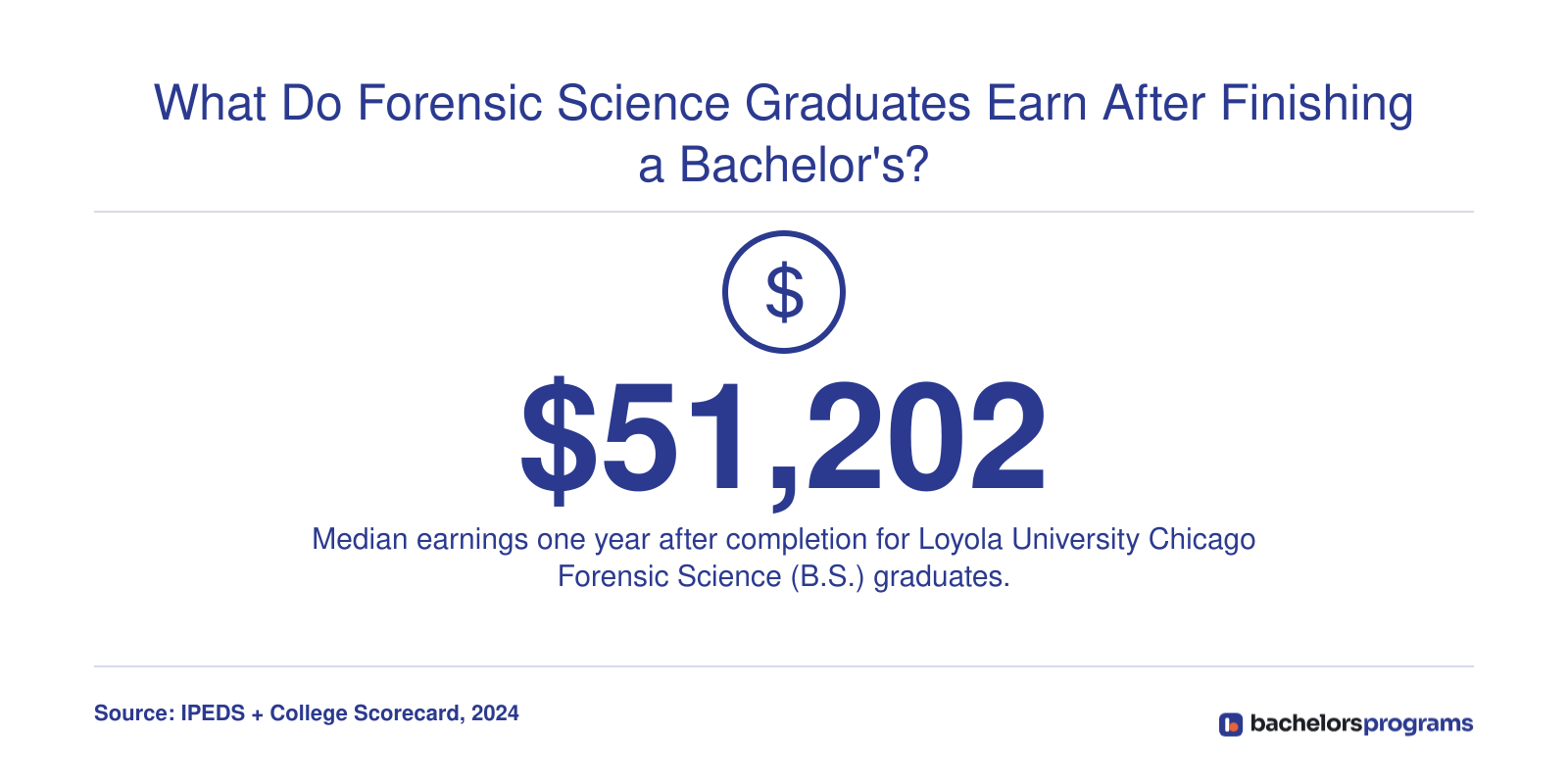
What Do Forensic Science Graduates Earn After Finishing a Bachelor's?
Program-level earnings are published for Loyola University Chicago's Forensic Science (B.S.): graduates earned a median of $51,202 one year after completion, rising to $64,194 four years after completion, with about 95.2% employed one year out. These figures track forensic science completers specifically, not the university as a whole. Other schools ranked here are left out of this comparison because their forensic programs lack a published program-level figure. Treat early-career pay as a starting point, not a career ceiling.
Related Articles
What Forensic Science Technicians Earn in Illinois
Illinois workNet reports a $128,283 median annual wage ($61.68 per hour) for forensic science technicians in Illinois. That is about $56,000, or roughly 78%, above the national median of $72,060 reported in May 2025 BLS wage data.
Compare Forensic Science programs on the data that matters
Explore more Criminal Justice & Law majors or browse every field of study.
All Criminal Justice & Law programs Browse every field of study