Best Public Health Schools in Illinois
Compare 21 accredited Public Health programs in Illinois, with net price after aid, graduation rates, earnings and debt from IPEDS and the U.S. College Scorecard.
A bachelor's degree in public health is the entry credential for health educators, community health workers, and program coordinators, and in Illinois the common version is the Bachelor of Science (B.S.) in Public Health. Programs range from flagship research campuses to small private colleges, and they differ sharply in price, selectivity, and format.
All of the programs here are bachelor's degrees at Illinois schools, taught on campus or online. The real trade-off is cost against credential: what you pay, the fieldwork you get, and whether the program is accredited matter more than the name on the diploma.
Most entry-level public health jobs reward practical experience over school prestige.
Key Points
- Lowest net price: University of Illinois Chicago, $10,974 a year after aid.
- Most programs here are campus-based; Northwestern offers an online Health Sciences BS.
- CEPH accreditation is the strongest quality signal for undergraduate public health.
Best Bachelor's in Public Health Schools in Illinois: Our Top 10
Illinois has a deeper bench of undergraduate public health programs than many students expect, from large research flagships with four concentration tracks to smaller private colleges that build fieldwork into the degree. This top 10 spans Chicago, its suburbs, and downstate, and includes one fully online option for students who cannot relocate. Two data notes as you compare: the graduation rates shown are institution-wide, with schools offering this program ranging from roughly 57% to 95%, and the net price after aid figures are sector-average approximations rather than quotes.
University of Illinois Urbana-Champaign
#1Champaign, IL · ~$14,000/yr (est.)
Best for: Residential students wanting four concentration tracks
UIUC is the state's flagship public research university, and its public health bachelor's sits inside the College of Applied Health Sciences with four concentration tracks covering community health practice, epidemiology, health education and promotion, and health administration and policy. Coursework builds practical skills in program management, policy analysis, and emergency preparedness, and students get dedicated degree planning support. It offers the most traditional residential college experience on this list, with a large campus and a very broad course catalog.
- CEPH accredited
- 4 concentrations, including epidemiology and health administration and policy
- Coursework in program management, policy analysis, and emergency preparedness
- Career paths from health educator to epidemiologist
- Dedicated degree planning support
- Financial aid available
Northwestern University
#2Evanston, IL · $29,000/yr (est. net price)
Best for: Working adults needing a fully online degree
Northwestern is a private research university in Evanston, and its public health offering is a Bachelor of Science in Health Sciences with a Public Health concentration delivered online through the School of Professional Studies. The 45-unit degree is built for working adults, with a capstone project and room to add an elective certificate in an area such as data science or leadership. Students who want a major research university name without relocating get a rare combination here.
- CEPH accredited
- Public Health concentration within the Health Sciences BS
- 45 total credit hours
- Capstone project required
- Add an elective certificate outside the major
- Online coursework designed for working adults
- 3 concentration options
University of Illinois Chicago
#3Chicago, IL · ~$11,000/yr (est.)
Best for: Chicago students focused on health equity
UIC is Chicago's public research university, and its public health bachelor's is a deliberately interdisciplinary Bachelor of Arts that pulls coursework from sociology, psychology, education, public policy, and gender and women's studies. Students build a personalized focus of study around health equity and the social determinants of health, then move into government agencies, health associations, and community organizations. The university's Policy, Practice and Prevention Research Center also partnered with the Illinois Department of Public Health and the Illinois Public Health Institute on the state's Healthy Illinois 2028 assessment and improvement plan, giving students a direct line to statewide health planning work.
- CEPH accredited
- Interdisciplinary coursework from sociology to public policy
- Students design a personalized focus of study
- Emphasis on health equity and social determinants
- Prepares for government agencies and community organizations
- Many graduates continue to graduate study
Illinois Institute of Technology
#4Chicago, IL · ~$18,000/yr (est.)
Illinois Tech is a private, technology-focused university in Chicago, and its undergraduate health offering is a Bachelor of Science in Behavioral Health and Wellness with an optional public health specialty track. The curriculum blends psychology, sociology, political science, and nutritional science, and teaches students to design wellness plans around nutrition, exercise, and substance use. A capstone project and an emphasis on guiding patients through complex health systems make it a fit for students who want applied, person-centered health work rather than a traditional public health track.
- Optional public health specialty track
- Blends psychology, sociology, and nutritional science
- Capstone project ties coursework to real settings
- 3 concentration options
- Prepares for behavioral health coaching and policy analysis
- Students learn to design individualized wellness plans
Lewis University
#5Romeoville, IL · ~$17,000/yr (est.)
Lewis is a private Lasallian Catholic university in Romeoville, southwest of Chicago, and it offers a Bachelor of Science in Public Health through its College of Nursing and Health Sciences. The program pairs a public health core with a distinctive organizational communication minor, so graduates can carry health messages across diverse communities. A values-driven, service-oriented campus culture and health-sciences resources define the experience.
- Includes an Organizational Communication minor
- Housed in the College of Nursing and Health Sciences
- Lasallian Catholic, values-driven campus
- Prepares for public health agencies, hospitals, and nonprofits
- Strong foundation for graduate study in public health
Bradley University
#6Peoria, IL · ~$23,000/yr (est.)
Bradley is a private university in Peoria whose public health offering is a Public Health Education major available as either a Bachelor of Arts or a Bachelor of Science. The degree is interdisciplinary and community-focused, built on natural and social science foundations, and it includes 160 contact hours of professional work experience plus electives in areas such as women's health, child health, mental health, or sustainability. Graduates are eligible to sit for the Certified Health Education Specialist credential, and community partners include organizations such as the American Red Cross and the YMCA.
- Public Health Education major offered as a BA or BS
- 160 contact hours of professional work experience
- Eligible to sit for the CHES credential
- Electives in women's, child, and mental health
- 4 concentration options
- Community partners include the American Red Cross and YMCA
Southern Illinois University-Carbondale
#7Carbondale, IL · $10,000 – $15,000/yr (est.)
Southern Illinois University Carbondale is a public research university in the southern part of the state, and its public health bachelor's is a Bachelor of Science with a built-in minor in Health Care. The program aims at health education and health promotion work in community and clinical settings rather than classroom teaching, so students learn to design wellness initiatives and teach healthy behaviors. It is one of the lower-cost four-year options on this list and sits in the College of Health and Human Sciences.
- CEPH accredited
- Built-in minor in Health Care
- Focus on health education and health promotion
- Prepares for community and clinical, non-classroom roles
- Offered by the College of Health and Human Sciences
Illinois State University
#8Normal, IL · ~$19,000/yr (est.)
Illinois State is a public university in Normal, in the central part of the state, and its public health major is built around partnerships with local agencies. Students work on food drives, health policy advocacy, and service projects with organizations such as Heartland Head Start, and a required internship caps the practical side of the degree. An accelerated pathway lets strong students move into a Master of Public Health in five years.
- CEPH accredited
- Community partners built into most classes
- Required internship in a professional setting
- Accelerated bachelor's-to-MPH pathway
- Coursework in grant writing and health communication
- Scholarships and financial aid available
Elmhurst University
#9Elmhurst, IL · ~$24,000/yr (est.)
Elmhurst is a private university in the Chicago suburb of Elmhurst, and its Bachelor of Science in Public Health carries a concentration in Public Health Leadership and Innovation. The curriculum covers research methods, epidemiology, and global health, and it adds leadership courses aimed at designing multidisciplinary solutions to community health problems. A required fieldwork placement and community health project give students applied experience before graduation, and prerequisite coursework applies.
- Concentration in Public Health Leadership and Innovation
- Coursework in research methods, epidemiology, and global health
- Required fieldwork and community health project
- Prerequisite courses required
- Pathway to a master's in public health
- Scholarships and financial aid available
Southern Illinois University Edwardsville
#10Edwardsville, IL · $10,000 – $15,000/yr (est.)
SIUE is a public university in Edwardsville, on the Illinois side of the St. Louis metro, and its public health bachelor's is a Bachelor of Science with service-learning built into the first course. Students can intern with organizations such as the Illinois Public Health Association, the SIU School of Medicine, and the St. Louis Area Food Bank, and every senior designs and carries out a community health project. Faculty-led travel study courses and an active honor society round out a program that emphasizes prevention, promotion, and protection.
- CEPH accredited
- Service-learning begins in the first class
- Senior capstone community health project
- Internships with the Illinois Public Health Association
- Faculty-led global travel study courses
- Eta Sigma Gamma honor society
- Foundation for graduate and professional programs
Cost & outcomes by school
Federal data for the highest-earning Public Health programs, independent of the ranking above. Earnings are this field's bachelor's graduates four years after completing where the Scorecard reports them, else the school's undergraduate median.
| School | Net price / yr | Grad rate | Earnings | Debt | Grads/yr | Format |
|---|---|---|---|---|---|---|
| Northwestern University IL | $29,167 | 95% | $89,363 | $14,684 | 86 | Online |
| Illinois State University IL | $19,398 | 65% | $84,790 | $20,009 | 22 | Campus |
| Illinois Institute of Technology IL | $18,425 | 75% | $82,592 | $25,000 | — | Campus |
| Loyola University Chicago IL | $36,079 | 73% | $71,530 | $24,157 | 35 | Campus |
| Illinois Wesleyan University IL | $28,199 | 75% | $70,871 | $27,000 | — | Campus |
| Bradley University IL | $22,719 | 76% | $66,852 | $27,000 | 9 | Campus |
| Lewis University IL | $17,028 | 67% | $66,099 | $21,500 | 2 | Campus |
| University of Illinois Urbana-Champaign IL | $14,355 | 85% | $65,978 | $19,728 | 137 | Campus |
| Benedictine University IL | $22,313 | 50% | $63,446 | $22,500 | — | Online |
| Augustana College IL | $22,736 | 73% | $62,971 | $27,000 | 25 | Campus |
| Elmhurst University IL | $24,185 | 70% | $61,462 | $20,489 | 12 | Campus |
| University of Illinois Chicago IL | $10,974 | 62% | $58,603 | $20,500 | 32 | Campus |
Sources: U.S. Department of Education. Net price, graduation rate, earnings and debt: College Scorecard (earnings and debt for this field's bachelor's graduates where reported, else school-wide); graduates: IPEDS. A dash means no figure is reported.
Cost, debt & payoff
Median earnings of this field's bachelor's graduates (4 yrs after completing, else the school's undergraduate median) vs. their median federal loan debt · U.S. College Scorecard
Across these programs the median graduate earns about $61,462 and finishes with roughly $22,162 in debt — a ratio that clears a common rule of thumb (keep debt below first-year salary). Net price and debt vary widely school to school, so check the per-school figures in the table above before you shortlist.
Cheapest Bachelor's in Public Health Programs in Illinois
Every one of the lowest-cost options below is a public university, and University of Illinois Chicago, also in our top 10, posts the lowest average net price at $10,974 a year after grants and scholarships, according to 2024 U.S. Department of Education data from IPEDS and the College Scorecard. Governors State University, Chicago State University, Eastern Illinois University, and Western Illinois University, all in our directory, follow with net prices of roughly $12,300 to $12,900. Governors State, Chicago State, and Western Illinois charge the same tuition to in-state and out-of-state students, while Chicago State and Eastern Illinois offer online delivery for students who need flexibility.
| School | City | Program | Format | In-State Tuition and Fees | Out-of-State Tuition and Fees | Average Net Price (after aid) | Graduation Rate |
|---|---|---|---|---|---|---|---|
| University of Illinois Chicago | Chicago | Bachelor of Arts in Public Health | Campus | $14,338 | $29,884 | $10,974 | 62% |
| Governors State University | University Park | Bachelor of Health Science in Community Health | Campus | $12,004 | $12,004 | $12,329 | 22% |
| Chicago State University | Chicago | Public Health, BS | Online | $12,754 | $12,754 | $12,335 | 15% |
| Eastern Illinois University | Charleston | Public Health | Online | $13,679 | $16,217 | $12,786 | 47% |
| Western Illinois University | Macomb | Public Health | Campus | $15,264 | $15,264 | $12,937 | 45% |
Cost of a Bachelor's in Public Health in Illinois: Tuition, Net Price, and State Aid
In-state and out-of-state students pay very different prices at Illinois' flagship universities, but at many regional publics, residency barely changes the bill.
In-State vs. Out-of-State Tuition
In-state tuition and fees for a bachelor's in public health at Illinois public universities run from $12,004 at Governors State University to $18,267 at the University of Illinois Urbana-Champaign. Several regional publics charge everyone the same rate:
- Southern Illinois University Edwardsville: $12,092
- Northern Illinois University: $13,060
- Southern Illinois University-Carbondale: $13,334
- Western Illinois University: $14,572
Residency counts most at the flagships. Nonresidents pay $34,500 at the University of Illinois Chicago and $40,096 at Urbana-Champaign. Northeastern Illinois University charges out-of-state students $22,726.
Net Price After Aid
Net price is what students actually pay after grants and scholarships. It is a school-wide average across aided undergraduates, not a figure specific to public health majors. At these public schools, it ranges from $10,974 at UIC to $14,889 at SIUE. Private schools such as Northwestern University, Bradley University and Loyola University Chicago build their own aid packages, so run each school's net price calculator before ruling one out.
The Illinois MAP Grant
The Monetary Award Program is run by the Illinois Student Assistance Commission (ISAC).1 It is a need-based grant that pays toward tuition and mandatory fees at approved Illinois colleges, public and private.1 Financial need drives eligibility, not grades or test scores. To qualify:
- Residency: You must be an Illinois resident. For dependent students, the parent on the FAFSA must also be a resident.4
- Degree status: You cannot already hold a bachelor's degree.
- Enrollment: You must take at least 3 credit hours and keep satisfactory academic progress.4
- Limit: Awards stop after 135 paid credit hours.4
ISAC lists the maximum award as $8,400.2 Its 2025-26 formula trimmed the effective top award to $8,064 and set a $300 minimum.3 That formula also made students with a Student Aid Index of $9,000 or more ineligible.3 A full term award requires 15 semester hours, and lighter loads are prorated.2
MAP funding is limited and depends on state appropriations. File the FAFSA, or Illinois' Alternative Application, as soon as it opens each year.
Online and Hybrid Bachelor's in Public Health Options at Illinois Schools
Can you earn a bachelor's degree in public health online from an Illinois school? Yes, but the choices are narrower than the campus options. Most of the programs here are campus-based. In our data, Northwestern's Health Sciences, BS is the one tagged online, and its listing describes online courses for foundational disciplines rather than a fully remote degree.
Where online delivery is published
Eastern Illinois University is the clearest example in the sources reviewed. It lists its B.S. in Public Health: Community Health and its B.S. in Health Administration as available in person or fully online.1 Its B.S. in Public Health: Emergency Management and Disaster Preparedness is described as completely online.2 It is a degree-completion path for EMS professionals, and up to 12 semester hours can come from Prior Learning Assessment.
By contrast, the University of Illinois Urbana-Champaign lists an on-campus B.S., and the University of Illinois Chicago lists its public health bachelor's degrees as onsite. Northern Illinois University and Southern Illinois University Edwardsville confirm their B.S. programs but do not publish them as online or hybrid.
What "online" still involves
Online does not mean no fieldwork. Health Administration at EIU includes a supervised health-care internship, and the Emergency Management option includes an internship course.3 UIUC requires an 8-credit Health Internship, and UIC requires an internship after its prerequisite courses.4 EIU does not say whether its internships must be in person or can be done locally.
Who benefits and what to confirm
Online formats suit working adults, EMS professionals, and transfer students who want credit for coursework they finished earlier. Before applying, ask each school:
- Internship: Can it be completed near home, and who arranges the placement?
- Campus visits: Are any residencies or in-person sessions required?
- Course schedule: Are required courses offered on a rotating schedule?
- Credit: How many prior credits will count toward the degree?
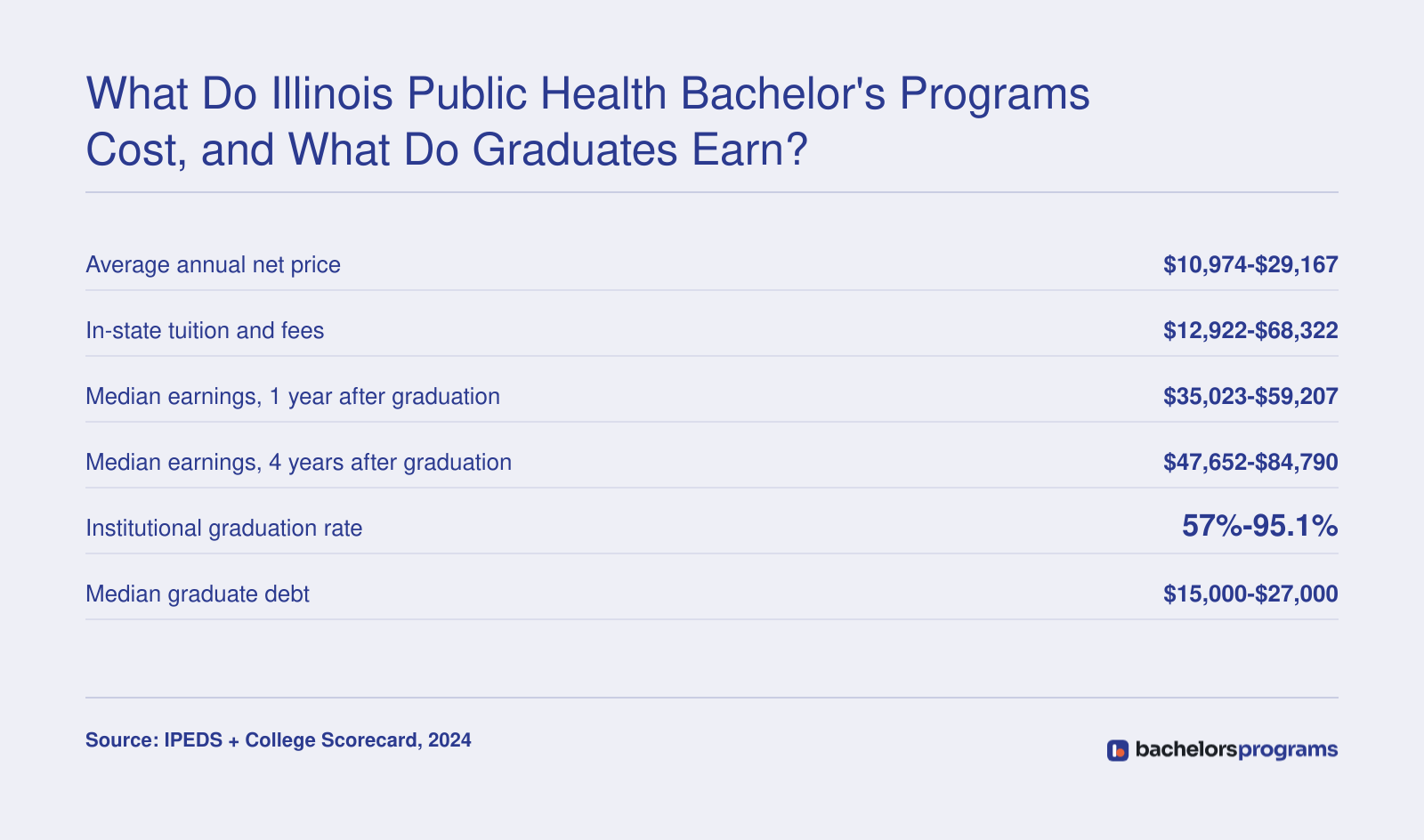
What Do Illinois Public Health Bachelor's Programs Cost, and What Do Graduates Earn?
These figures span the schools ranked here and show how widely cost and outcomes vary across Illinois. Earnings are program-level medians for public health graduates and are reported at one year and four years after graduation. Northwestern University delivers its health sciences degree with a public health concentration online. The other programs below are campus-based.
Admission Requirements for Illinois Public Health Bachelor's Programs
Selective flagship campuses and open-access regional universities ask for very different things, and that gap shapes where you apply. A student with a 3.2 GPA who looks like a long shot in Urbana-Champaign may be a routine admit at Chicago State University, Governors State University, or Northeastern Illinois University, where access is central to the mission.
GPA and test policy
Most Illinois public universities review high school GPA, course rigor, and a personal statement together rather than enforcing one hard cutoff. At the University of Illinois Chicago, the public health program's application materials list a Common Application with UIC-specific questions and essays, a $70 nonrefundable fee (waivers available), and an official high school transcript. ACT and SAT scores are optional for first-year applicants and may be sent electronically or shown on an official transcript. UIC does not publish a minimum or typical undergraduate GPA on that page, so treat any number you hear secondhand with caution. The University of Illinois Urbana-Champaign catalog entry for the Health Education and Promotion bachelor's degree describes the degree structure (120 total hours, at least 40 upper-division) but not a GPA floor or a 2026 test policy, so check the campus admissions office directly before you assume.
Transfer credit
Transfer applicants to UIC use the UIC transfer application, pay the same $70 fee, and submit official transcripts from every college attended, a personal statement explaining their interest and preparation for the public health major, and a resume covering employment plus volunteer or service work. Recommendation letters and supplemental materials are optional uploads. Equivalent coursework completed elsewhere with a grade of B or better can satisfy the undergraduate quantitative reasoning requirement.
Before you enroll, run your community college coursework through the Illinois Articulation Initiative, the statewide agreement that lets general education credit move between participating Illinois institutions. Confirming an IAI match before you enroll in a course is far cheaper than discovering afterward that it transfers as an elective.
What You Can Do With a Bachelor's Degree in Public Health in Illinois
A bachelor's degree in public health leads mainly to entry-level jobs that teach, connect, or analyze: educating communities about health, linking residents to care, and helping agencies track programs and outcomes. Illinois graduates find these jobs at health departments, hospitals, nonprofits, and social service agencies, in Chicago and in downstate communities alike.
Roles and Wages
The Bureau of Labor Statistics (BLS) publishes the clearest occupational numbers, and its figures are national 2025 data, not Illinois-specific estimates.
- Health education specialist: The typical entry-level requirement is a bachelor's degree, with no on-the-job training expected. The median wage is $64,070 a year ($30.80 an hour).1 BLS projects 6% growth from 2025 to 2035, about 3,900 added jobs, and roughly 6,900 openings a year. Related titles include health educator and public health educator.
- Community health worker: The typical entry requirement is a high school diploma or equivalent, but a public health bachelor's can help applicants compete for roles with heavier educational or analytical duties. The median wage is $51,850 a year ($24.93 an hour).2 BLS projects 13% growth from 2025 to 2035, about 8,200 added jobs, and roughly 7,000 openings a year.
- Public health analyst: This is a job title more than a BLS category. Employers may classify these roles under different titles and codes, so no single wage figure fits them.
For Illinois-specific wages, check the Illinois Department of Employment Security (IDES) occupational estimates. Pay in the Chicago area often differs from pay downstate.
Licensing and Optional Credentials
Public health has no single Illinois license for bachelor's graduates. Employers set their own requirements, and clinical roles such as nursing carry separate licenses that this degree does not provide.
The main optional credential is Certified Health Education Specialist (CHES), offered through the National Commission for Health Education Credentialing (NCHEC). Eligibility generally rests on holding at least a bachelor's degree with a set amount of health education coursework, followed by a certification exam. Because pathways and rules change, confirm current requirements with NCHEC before planning around it. CHES tends to help most for health educator postings, where employers may list it as preferred or required.
Occupational Wages vs. Graduate Earnings
BLS and IDES wages describe what everyone in an occupation earns, including experienced workers. College Scorecard earnings, by contrast, track recent graduates of a specific program in the years right after they finish. Expect Scorecard figures to run lower than occupational medians, and use both to set realistic starting expectations.
Related Articles
CEPH Accreditation and Choosing Between Chicago and Downstate Schools
CEPH accreditation is the strongest quality signal an Illinois public health bachelor's program can carry, and fewer undergraduate programs hold it than students expect.
What CEPH actually accredits
The Council on Education for Public Health reviews schools and programs, and at the undergraduate level it recognizes two categories: public health programs that sit inside an accredited unit, and standalone baccalaureate programs.1 Accreditation follows the specific program and its named degree offerings, so a health-related bachelor's at an accredited university is not automatically covered.
The Illinois schools that hold it
- Illinois State University: its Public Health Program is CEPH-accredited through December 31, 2030.1
- Southern Illinois University Edwardsville: both the Bachelor of Science in Public Health and the MPH are accredited.2
- University of Illinois Chicago: the BA and BS in Public Health, offered through the School of Public Health, are fully accredited.3
At the University of Illinois Urbana-Champaign, CEPH accreditation covers the Master of Public Health.1 Its BS-MPH option layers undergraduate study onto the accredited graduate degree; that does not make the bachelor's itself CEPH-accredited.
Chicago or downstate
Chicago campuses, UIC chief among them, put students within reach of city and county health departments, hospital systems, and nonprofit agencies that host internships. Elmhurst and Lewis add suburban options in the metro. The trade-off is living cost and, at UIC, a published in-state rate above $15,000 before aid.
Downstate campuses cost less on paper: SIUE and Southern Illinois University-Carbondale both publish in-state tuition under $14,000, and Illinois State sits close behind. Average net price after aid runs near $11,000 at UIC and near $19,400 at Illinois State, so the gap narrows once aid is applied. Smaller downstate programs often place interns with county health departments and rural clinics.
Transferring into graduate study
A CEPH-accredited bachelor's eases the move into an MPH, and Illinois State offers an accelerated bachelor's-to-MPH path.
Frequently Asked Questions About Illinois Public Health Bachelor's Programs
What is the best public health school in Illinois?
Are there CEPH-accredited public health schools in Illinois?
Can you earn a bachelor's degree in public health online from an Illinois school?
Do you need a license to work in public health in Illinois with a bachelor's degree?
How much does a public health degree cost in Illinois?
Compare Public Health programs on the data that matters
Explore more Healthcare majors or browse every field of study.
All Healthcare programs Browse every field of study