Best Information Technology Schools in Nebraska
Compare 5 accredited Information Technology programs in Nebraska, with net price after aid, graduation rates, earnings and debt from IPEDS and the U.S. College Scorecard.
Employers increasingly hire on demonstrated technical skills, which makes the choice of a bachelor's degree in information technology more about program design than brand. Nebraska schools usually award the Bachelor of Science (B.S.) in Information Technology, though titles vary, a networking-focused major at Kearney, a concentration at Omaha.
The programs on this list are bachelor's degrees at Nebraska schools, offered on campus and online. The ranked set is small, so treat it as a focused shortlist rather than a long directory.
The real tension is fit: a public campus with labs, a private school with a faith-based setting, or a flexible adult-learner format, each trades cost, schedule and hands-on access differently.
Key Points
- Bellevue University posts the strongest early-career earnings among reported IT programs.
- Net price after aid usually lands well below published tuition.
- University of Nebraska at Kearney pairs information technology with networking coursework.
Best Nebraska Schools for a Bachelor's Degree in Information Technology
Five Nebraska colleges qualified for this ranking, each awarding a bachelor's degree in information technology or a closely related title such as information technology and networking. The list spans public and private institutions, campus programs with dedicated cyber labs, and a fully online degree based in Bellevue. All figures below come from federal data, and earnings are reported for graduates of the IT program itself rather than for the institution as a whole.
University of Nebraska at Kearney
#1Kearney, NE · $16,000/yr (est. net price)
Best for: Prospective security analysts wanting lab access
The University of Nebraska at Kearney awards a Bachelor of Science in Information Technology and Networking through its Department of Cyber Systems, a 120-credit program that closes with a capstone and offers an internship elective. The department runs a Cyber Operations Center with a mini data center, a security lab and Nebraska industry partners that support internships and professional development. Net price after aid comes to about $16,242, and the school-wide graduation rate is 58%. Program graduates earned a median of $60,771 one year after finishing and $61,988 four years out.
- 120 total credit hours, with the major option taking 48
- 3-credit Cyber Systems Capstone closes the degree
- 6 credit hours of program electives
- Internship in cyber systems available as an elective
- Coursework in virtualization, cloud computing and systems administration
- Housed in the Department of Cyber Systems
- Education abroad and undergraduate research offered
- Sample four-year plan runs eight semesters at about 15 credits
University of Nebraska at Omaha
#2Omaha, NE · $10,000 – $15,000/yr (est.)
Best for: Career changers stacking IT certificates
UNO offers its IT path as a Bachelor of Multidisciplinary Studies with a 30-credit Information Technology concentration, drawing coursework from the College of Information Science and Technology alongside a 15-credit third content block in another field. Undergraduate certificates in Data Management, IT Administration and Systems Development fit inside the concentration, and qualified high school students can start coursework early through the college's Early Entry option. Net price after aid is about $13,441 and the school-wide graduation rate is 47%. The college has also announced Nebraska's first bachelor's degree in artificial intelligence.
- 120 total credit hours
- 30-credit IT concentration drawn from College of Information Science and Technology units
- 51-credit major requirements plus a 15-credit third content block
- At least 12 upper-level credits must be completed at UNO
- Multidisciplinary Capstone Seminar required
- Data Management, IT Administration or Systems Development certificate options
- Minimum grade of C- required in general education courses
Union Adventist University
#3Lincoln, NE · $20,000 – $25,000/yr (est.)
Best for: Private-college students wanting a required internship
Union Adventist University, a private institution in Lincoln, offers a Bachelor of Science in Information Technology with 66 to 67 required credit hours in the major and a required internship in computing. The core runs through networking, systems administration, virtualization and cloud computing, and cybersecurity, with 15 hours of upper-level electives in computing, math or business. Net price after aid is about $23,716 and the school-wide graduation rate is 52%. An IT associate degree and an IT minor are also offered.
- 66 to 67 required credit hours
- Internship in Computing required
- Core covers networking, systems administration and cybersecurity
- Virtualization and cloud computing coursework included
- 15 hours of upper-level CPTR, MATH or BUAD electives
- IT associate degree and IT minor also offered
- At least 124 semester hours required for the bachelor's degree
Bellevue University
#4Bellevue, NE · ~$18,000/yr (est.)
Bellevue University delivers a fully online bachelor's degree in information technology built around 127 credit hours, with coursework aligned to CompTIA, Cisco CCNA and Microsoft certification exams. Every major completes a faculty-approved IT project, research study, certification or internship, and military students pay a reduced per-credit rate. Net price after aid is about $17,550 and the school-wide graduation rate is 33%. Program graduates earned a median of $60,188 one year after finishing and $80,378 four years out.
- Fully online option available
- 127 total credit hours, including 36 in major requirements
- $459 per credit, or $250 per credit for military students
- Prepares for CompTIA A+, Network+, Security+ and Server+, Cisco CCNA and Microsoft exams
- Faculty-approved IT project, research study, certification or internship required
- Certification-focused elective built with a faculty sponsor
- Kirkpatrick Signature Series required
- Accredited by the Higher Learning Commission
York University
#5York, NE · ~$21,000/yr (est.)
York University's E.A. Levitt School of Business awards a Bachelor of Arts in Education, Business, Marketing, and Information Technology with a 7-12 teaching endorsement, aimed at students who want to teach business and technology in middle and high school. Students can join a Collegiate FBLA chapter, and the degree also opens paths into business management, human resources, banking and consulting. Net price after aid is about $20,951 and the school-wide graduation rate is 52%.
- Leads to a 7-12 teaching endorsement
- Combines business, marketing and information technology coursework
- Offered by the E.A. Levitt School of Business
- Collegiate FBLA chapter available to students
Cost & outcomes by school
Federal data for the highest-earning Information Technology programs, independent of the ranking above. Earnings are this field's bachelor's graduates four years after completing where the Scorecard reports them, else the school's undergraduate median.
| School | Net price / yr | Grad rate | Earnings | Debt | Grads/yr | Format |
|---|---|---|---|---|---|---|
| Bellevue University NE | $17,550 | 33% | $80,378 | $22,253 | 133 | Online |
| University of Nebraska at Kearney NE | $16,242 | 58% | $61,988 | $19,500 | 19 | Campus |
| Union Adventist University NE | $23,716 | 52% | $55,045 | $27,000 | 3 | Campus |
| University of Nebraska at Omaha NE | $13,441 | 47% | $53,909 | $19,000 | 6 | Campus |
| York University NE | $20,951 | 52% | $44,130 | $21,500 | — | Campus |
Sources: U.S. Department of Education. Net price, graduation rate, earnings and debt: College Scorecard (earnings and debt for this field's bachelor's graduates where reported, else school-wide); graduates: IPEDS. A dash means no figure is reported.
Cost, debt & payoff
Median earnings of this field's bachelor's graduates (4 yrs after completing, else the school's undergraduate median) vs. their median federal loan debt · U.S. College Scorecard
Across these programs the median graduate earns about $55,045 and finishes with roughly $21,500 in debt — a ratio that clears a common rule of thumb (keep debt below first-year salary). Net price and debt vary widely school to school, so check the per-school figures in the table above before you shortlist.
How We Ranked Nebraska IT Schools
A recognizable name on a diploma and a strong return on the tuition bill are not the same thing. Our ranking favors the second. Each IT bachelor's program here is scored on the numbers that shape what you pay and what you earn, not on reputation alone.
What We Measure
- Net price: average yearly cost after federal, state, and school aid for first-time, full-time students who receive aid.
- Graduation and retention: the share of students who return for a second year and the share who finish.
- Program completions: how many IT bachelor's degrees the program actually awards.
- Earnings and debt: median pay for graduates a few years into their careers, plus typical federal borrowing at graduation.
- Selectivity: the share of applicants a school admits.
Program Numbers vs. School Numbers
Earnings, debt, and completions describe the IT program itself. Graduation rates and net price cover the whole institution, so a solid IT department can sit inside a school whose overall completion rate is middling. Both matter: the program builds your skills, the institution sets your bill.
What the Numbers Cannot Tell You
Net price is an estimate for a typical aid recipient, not a personal quote. Your figure depends on family income, Nebraska residency, and the aid package you are actually offered. To be considered at all, a school needs a Nebraska bachelor's IT listing with reported federal outcome data, so some smaller programs do not appear here; where a school reports nothing for a measure, that measure drops out rather than being guessed.
IT vs. MIS vs. Computer Science vs. Cybersecurity Bachelor's Degrees in Nebraska
A bachelor's degree in information technology is one of several computing paths at Nebraska schools. The right fit depends on whether you want to run an organization's technology systems, connect technology to business decisions, build software, or defend networks and data. The table below compares these degree types and lists ABET program accreditation and National Center of Academic Excellence in Cybersecurity designations where the schools hold them.
| Degree | Core Focus | Best For | Nebraska Schools Offering It | ABET / NSA CAE Status |
|---|---|---|---|---|
| Information Technology | Applied computing, networking, and technology infrastructure | Students seeking careers designing, implementing, and managing organizational technology systems | University of Nebraska at Kearney (Information Technology and Networking Comprehensive); University of Nebraska at Omaha (Information Technology Concentration); Union Adventist University; Bellevue University | UNK's Information Technology and Networking Comprehensive program is accredited by the ABET Computing Accreditation Commission under criteria for Information Technology and similarly named computing programs |
| Management Information Systems | Applying computers and information systems in business and government to process data and solve organizational problems | Students who want to bridge business needs, technology, analytics, information security, and organizational management | University of Nebraska at Omaha | UNO's Bachelor of Science in Management Information Systems has been accredited by ABET since 2002 |
| Computer Science | Computing theory, programming, software development, and specialized areas including artificial intelligence, game programming, internet technologies, information assurance, and software engineering | Students seeking broad computing and software-development preparation | University of Nebraska at Omaha; University of Nebraska at Kearney | UNK's Computer Science Comprehensive program is accredited by the ABET Computing Accreditation Commission under criteria for Computer Science and similarly named computing programs |
| Cybersecurity | Designing, developing, managing, and securing information systems, including risk assessment, penetration testing, ethical hacking, defense-in-depth strategies, and secure coding | Students preparing for cybersecurity analysis, penetration testing, secure coding, cyber defense, and information-security careers | University of Nebraska at Omaha; University of Nebraska at Kearney | UNO holds National Center of Academic Excellence in Cybersecurity designations in Cyber Defense (CAE-CD) and Cyber Operations (CAE-CO) |
Online and Hybrid Bachelor's in IT Options at Nebraska Schools
The tradeoff in Nebraska is rarely online versus on campus. It is how much lab time, face-to-face instruction and internship access you are willing to trade for a schedule that bends around a full-time job.
Fully Online and Flexible Formats
Bellevue University is the most clearly online-first option on this list. Its information technology bachelor's is offered fully online, with winter starts and a published rate of $459 per credit; the university charges the same tuition to in-state and out-of-state students. The program also prepares students for Cisco, Microsoft, Linux and CompTIA certifications and requires a faculty-approved IT project or internship, which keeps applied work in the curriculum.
The University of Nebraska at Kearney takes a different route. Its Bachelor of Science in Information Technology and Networking Comprehensive keeps required core courses online, with electives available online, on campus, or both, so the degree can be completed without traveling to Kearney.1 For students who want mostly online coursework plus the occasional campus elective, that mix is a hybrid path. University of Nebraska Online, the system's shared portal, says most online courses are asynchronous, though some require students to be online at a specific time.2 Confirm per-course scheduling before you commit.
Campus-Based Programs
UNO lists its IT concentration as a campus program in Omaha, and Union Adventist University in Lincoln and York University in York also publish campus delivery. Choose these if you want physical labs, in-person faculty access and local employer recruiting. York's version is an education degree with a 7-12 business, marketing and information technology endorsement, so it leads to classroom teaching rather than a general IT role.
Out-of-State Access and Cost
Nebraska's public universities charge non-residents more: UNK publishes roughly $8,564 in-state against $16,484 out-of-state, and UNO about $8,718 against $23,206. The private schools here publish one rate for everyone. UN Online says its courses can be taken from anywhere with internet access, but out-of-state students should confirm that the specific IT program accepts them before applying.2
How to Choose
- Working full time: prioritize asynchronous online coursework and ask how many courses carry live meeting times.
- Need labs or an internship: a campus program in Omaha, Lincoln or York puts you closer to employers and equipment.
- Want both: UNK's online core plus optional campus electives is the middle path.
Related Articles
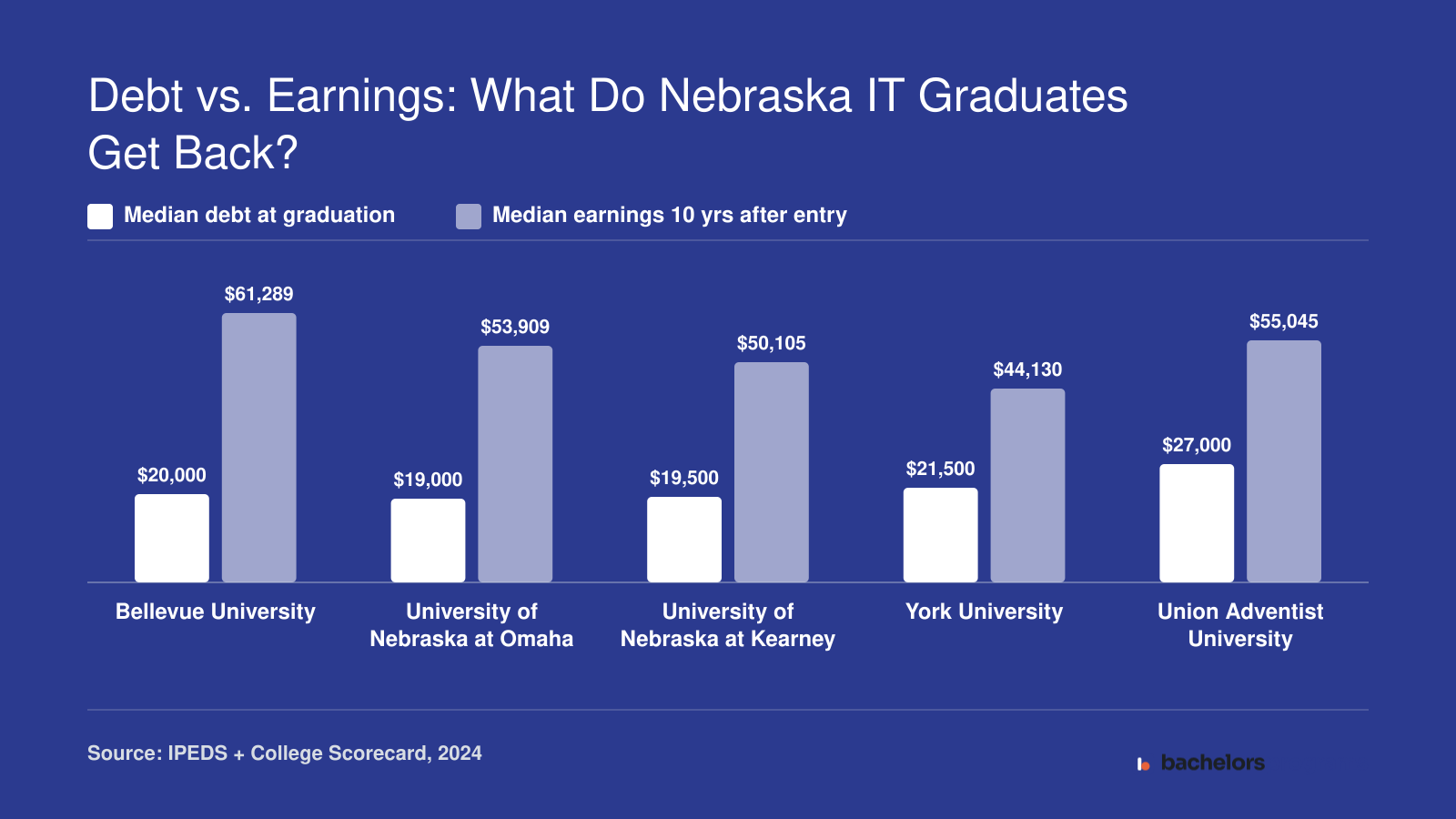
Debt vs. Earnings: What Do Nebraska IT Graduates Get Back?
This chart compares each school's median federal loan debt at graduation with the median earnings of former students 10 years after they first enrolled. Both figures cover the whole school, not the IT major alone. Bellevue University has the strongest balance, with earnings about three times its median debt ($61,289 vs. $20,000). Union Adventist University has the weakest, at roughly two to one ($55,045 vs. $27,000), and York University sits just above it.
Early-Career Earnings From Nebraska IT Programs
Bellevue University's information technology graduates post the strongest earnings figure among the programs with reported federal data.
Compare Information Technology programs on the data that matters
Explore more Computers & IT majors or browse every field of study.
All Computers & IT programs Browse every field of study