Best Elementary Education Degree Programs in Nebraska
Compare 15 accredited Elementary Education programs in Nebraska, with net price after aid, graduation rates, earnings and debt from IPEDS and the U.S. College Scorecard.

Nebraska's Initial Teaching Certificate starts with a bachelor's degree in elementary education from a state-approved teacher-preparation program, usually the Bachelor of Science (B.S.) in Elementary Education with a K-6 endorsement. That approval requirement narrows the field before cost or campus feel enters the decision. The programs ranked here come from public and private Nebraska institutions that award the degree on campus or online, for students who plan to teach in the state or study remotely. Tuition spread and transfer policy vary widely, and the endorsement printed on a certificate decides which grade levels a teacher can be hired to cover.
Key Points
- Elementary teachers earned a $63,970 national median wage in May 2025.
- Since June 4, 2025, Nebraska no longer requires a Praxis content exam.
- Chadron State offers the most flexible route; student teaching stays in person.
Best Nebraska Schools for a Bachelor's Degree in Elementary Education
The ten cards below cover every Nebraska institution in this ranking that awards a bachelor's degree in elementary education, from the state's flagship public campus to small private colleges in Omaha, Seward and York. Each card notes the city, the delivery format, in-state tuition, average net price after aid and the school's graduation rate, plus the details that actually separate one program from another. The full explanation of how these schools were ordered appears at the end of the article in How We Ranked These Nebraska Programs.
University of Nebraska-Lincoln
#1Lincoln, NE · $15,000 – $20,000/yr (est.)
Best for: Future teachers wanting a large research campus
Nebraska's flagship public university prepares elementary teachers through the College of Education and Human Sciences, awarding a Bachelor of Science in Education and Human Sciences with a K-6 field endorsement. The 120-credit plan layers reading, math, science and social studies methods onto early field placements in Lincoln-area public and private schools, then closes with a full-day student teaching semester and a capstone seminar. Students apply separately to the Teacher Education Program after reaching 30 credits and a 2.75 GPA, so the degree rewards steady progress in the first two years. Tuition runs $10,434 in state, and the school reports a 67% graduation rate.
- 120 credit hours on a published four-year plan
- 2.8 GPA minimum for Teacher Education Program admission
- Capstone seminar alongside student teaching
- Full-day student teaching for an entire semester
- Early field placement in public and private schools
- Criminal history background check before first practicum
- Certifies K-6 teaching in all subjects
- Praxis content exam may be required by the state
Creighton University
#2Omaha, NE · $30,000 – $35,000/yr (est.)
Best for: Omaha students eyeing Catholic school classrooms
Creighton is the largest private university on this list, and its elementary education bachelor's degree sits inside a Jesuit teacher preparation program built for both K-6 public certification and K-8 parochial classrooms. Coursework runs 52 credits beyond the university core, and students serve as tutors, teaching assistants and student teachers across Omaha metro public and private schools. Admission is test optional, and the financial aid office administers more than $200 million in student aid each year. Net price after aid averages about $31,568.
- Test optional: ACT or SAT scores not required
- 52 credits beyond Creighton's core requirements
- Prepares for K-6 public and K-8 parochial classrooms
- Student teaching in Omaha metro public and private schools
- Accelerated bachelor's-to-master's option saves a year
- Jesuit tradition teacher preparation, fully accredited
- Over $200 million in student aid awarded annually
- Fall start; applications open August 1 of the prior year
University of Nebraska at Kearney
#3Kearney, NE · $16,000/yr (est. net price)
Best for: Future teachers wanting a guaranteed district pipeline
UNK awards a Bachelor of Arts in Education with a teaching field endorsement in elementary education, and its Kearney location puts students inside a dense network of partner schools for early field work. The endorsement block and the major option each carry 49 credits and lead to a 12-credit student teaching semester that can be arranged in Nebraska or another state. Students apply separately to teacher education, and a published four-year plan keeps the course sequence clear. Tuition is $6,690 in state, with an average net price near $16,242.
- 120 credit hours, four-year plan published
- 49-credit endorsement block plus 49-credit major option
- 12-credit all-day student teaching semester
- Placements arranged in Nebraska or out of state
- Field experience in literacy, math and content-area reading
- Separate application to all teacher education programs
- Methods courses over 10 years old must be repeated
- Degree plan honored for five years before revision
College of Saint Mary
#4Omaha, NE · $17,000/yr (est. net price)
College of Saint Mary is a Catholic women's college in Omaha, and elementary education is one of five pathways inside its Nebraska Department of Education accredited teacher education program. The elementary pathway leads to K-6 certification, with classroom observation that starts in the first year and a full-time student teaching placement as lead teacher. Every admitted full-time undergraduate is guaranteed a merit scholarship, which softens the sticker price of a private education. Tuition is $24,510 and average net price after aid is roughly $16,590.
- K-6 certification pathway within Teacher Education
- Nebraska Department of Education accredited program
- Five concentration options at the bachelor's level
- Classroom placement starts a year earlier than usual
- Full-time student teaching as lead teacher
- Endorsements add subjects and grade levels to the license
- Guaranteed merit scholarship for admitted full-time students
- One of the Midwest's few all-women's colleges
University of Nebraska at Omaha
#5Omaha, NE · $10,000 – $15,000/yr (est.)
UNO's Bachelor of Science in Education in Elementary Education leads to initial K-6 certification and is organized in five parts, from general education through a required 12-credit concentration. Candidates finish clinical practice in Omaha metro partner schools with a mentor teacher, mentor-coaches and university faculty support, and can add ESL K-12 or special education K-8 endorsements. Admission to the Educator Preparation Program happens separately, usually after sophomore-year coursework, and requires a 2.75 cumulative GPA. In-state tuition is $8,718, with an average net price near $13,441.
- 120 credit hours: 34 general education, 69 major
- 12-credit concentration required: Inclusive Educator or Child, Youth, and Community Science
- Optional ESL K-12 and Special Education K-8 endorsements
- 2.75 GPA and a C minimum in certification courses for clinical practice
- Initial K-6 teacher certification on graduation
- Five-part program of study with clinical practice and seminar
Nebraska Wesleyan University
#6Lincoln, NE · ~$18,000/yr (est.)
Nebraska Wesleyan offers the elementary education major as either a B.A. or a B.S. on its Lincoln campus, and the 65-hour major is unusually methods-heavy for a private liberal arts college. Practicums run in K-6 literacy and math plus an adapted methods placement, and the capstone pairs supervised student teaching with a seminar. The education department layers additional certification requirements on top of the major, so advisors map the sequence early. Tuition is $42,274; average net price after aid is about $18,327.
- Two degree options: B.A. or B.S. in Elementary Education
- 65-hour major including capstone coursework
- Methods practicums in K-6 literacy and K-6 math
- Adapted methods practicum for K-6 included
- Theory of reading and children's literature coursework
- Special education introduction built into the major
- Supervised elementary student teaching capstone
- Additional certification requirements set by the department
Wayne State College
#7Wayne, NE · ~$15,000/yr (est.)
Wayne State charges the same tuition to Nebraska and out-of-state students and locks that rate, which puts its published price among the lowest on this list at $5,880. The elementary education endorsement needs no additional endorsements, and students can complete two 40-hour practicums and a semester of clinical practice in Wayne or at the South Sioux City site. Juniors can also substitute teach for pay through NENTA, which puts real classroom responsibility behind them before graduation. Average net price after aid is roughly $15,360.
- CAEP accredited and Nebraska Department of Education approved
- 120 credit hours: 73 in endorsement and educator core
- Optional 22-credit math concentration raises total to 95
- Two 40-hour practicums plus a semester of clinical practice
- Paid substitute teaching available to juniors through NENTA
- Locked tuition rate, same for in-state and out-of-state students
- Campus options in Wayne or South Sioux City
- Praxis required for licensure, not for graduation
Chadron State College
#8Chadron, NE · ~$13,000/yr (est.)
Chadron State runs its Bachelor of Science in Education in Elementary Education for grades K-8 in both face-to-face and online formats, and publishes advising templates for each. A four-year course rotation takes the guesswork out of sequencing, and the department also advises working teachers who want to add an endorsement or renew a certificate. Average net price after aid is about $12,549, the lowest figure among the ten schools here, against published tuition of $5,880. The school reports a 50% graduation rate.
- Face-to-face and online advising templates both published
- Four-year course rotation maps the full sequence
- K-8 elementary education endorsement
- Advising for adding endorsements or renewing certificates
- Built for students who already hold a degree, too
Concordia University-Nebraska
#9Seward, NE · ~$24,000/yr (est.)
Concordia pairs a 120-credit B.S.Ed. in Elementary Education with a distinctly Lutheran and Christian school focus, while the credential still leads to a Nebraska teaching certificate. Students log 100 hours of field experience and then split student teaching into two 8-week placements, one local and one in a different town, state or country. Nine subject concentrations, classes averaging 11.2 students and optional Lutheran, Christian or international teaching diplomas give the program a specific identity. Tuition is $39,800, and average net price after aid is about $23,965.
- 120 credit hours over four years in Seward
- 100 hours of field experience across varied classrooms
- Two 8-week student teaching placements, one away from Seward
- Nine concentrations, from art and music to language arts
- CAEP accredited and approved by the Nebraska Department of Education
- Lutheran, Christian and International Teaching diploma options
- Average class size of 11.2 with a 14:1 student-faculty ratio
- Supplemental endorsements in special education, ESL and coaching
York University
#10York, NE · ~$21,000/yr (est.)
York University awards a Bachelor of Arts in Education in Elementary Education for grades K-8, and it places every first-year education major in a local school during their first semester. Majors log more than 100 clinical hours before student teaching, with coursework in math, language arts and science methods plus inclusion and learning-disability intervention. Elementary education is the largest program in the department, which also runs placement services and advising for graduates. Tuition is $22,500, with an average net price near $20,951.
- Certifies teaching in kindergarten through grade 8
- 100 clinical hours before student teaching
- First-semester placement in local schools for first-year majors
- Methods courses in math, language arts and science
- Inclusion, collaboration and learning-disability intervention coursework
- Accredited by the Nebraska Department of Education
- Built on the InTASC Model Core Teaching Standards
- Placement services and advising for graduates
Cost & outcomes by school
Federal data for the highest-earning Elementary Education programs, independent of the ranking above. Earnings are this field's bachelor's graduates four years after completing where the Scorecard reports them, else the school's undergraduate median.
| School | Net price / yr | Grad rate | Earnings | Debt | Grads/yr | Format |
|---|---|---|---|---|---|---|
| Creighton University NE | $31,568 | 83% | $73,911 | $25,000 | 12 | Campus |
| Bellevue University NE | $17,550 | 33% | $61,289 | $20,000 | 12 | Campus |
| Nebraska Wesleyan University NE | $18,327 | 66% | $56,405 | $27,000 | 16 | Campus |
| Union Adventist University NE | $23,716 | 52% | $55,045 | $27,000 | 2 | Campus |
| College of Saint Mary NE | $16,590 | 61% | $54,338 | $24,250 | 6 | Campus |
| Doane University NE | $26,364 | 57% | $53,163 | $27,000 | 6 | Campus |
| Hastings College NE | $24,452 | 49% | $51,303 | $25,609 | 15 | Campus |
| University of Nebraska at Omaha NE | $13,441 | 47% | $48,486 | $20,500 | 134 | Campus |
| University of Nebraska-Lincoln NE | $17,747 | 67% | $48,046 | $22,185 | 198 | Campus |
| Chadron State College NE | $12,549 | 50% | $45,577 | $18,186 | 52 | Online or campus |
| Concordia University-Nebraska NE | $23,965 | 65% | $45,047 | $27,000 | 57 | Campus |
| Peru State College NE | $11,632 | 38% | $44,850 | $20,841 | 27 | Online or campus |
Sources: U.S. Department of Education. Net price, graduation rate, earnings and debt: College Scorecard (earnings and debt for this field's bachelor's graduates where reported, else school-wide); graduates: IPEDS. A dash means no figure is reported.
Cost, debt & payoff
Median earnings of this field's bachelor's graduates (4 yrs after completing, else the school's undergraduate median) vs. their median federal loan debt · U.S. College Scorecard
Across these programs the median graduate earns about $48,486 and finishes with roughly $22,185 in debt — a ratio that clears a common rule of thumb (keep debt below first-year salary). Net price and debt vary widely school to school, so check the per-school figures in the table above before you shortlist.
The 5 Most Affordable Nebraska Elementary Education Programs
Published in-state tuition and fees is the sticker price before any aid. Average net price is an approximate yearly figure for the full cost of attendance (including housing, books and other expenses) minus grants and scholarships, which is why it runs higher than tuition at these public colleges. Sorted by net price using 2024 U.S. Department of Education data from IPEDS and the College Scorecard, the lowest is Peru State College, a school in our directory, at about $11,632 a year, roughly $4,600 less than the fifth-lowest, University of Nebraska at Kearney, at about $16,242.
| School | City | Format | In-State Tuition and Fees (Published, Before Aid) | Average Net Price (Approximate, After Aid) | Graduation Rate |
|---|---|---|---|---|---|
| Peru State College | Peru | Campus and online | $8,640 | $11,632 | 38% |
| Chadron State College | Chadron | Campus and online | $8,290 | $12,549 | 50% |
| University of Nebraska at Omaha | Omaha | Campus | $8,718 | $13,441 | 47% |
| Wayne State College | Wayne | Campus | $8,216 | $15,360 | 52% |
| University of Nebraska at Kearney | Kearney | Campus | $8,676 | $16,242 | 58% |
Online and Hybrid Elementary Education Options at Nebraska Schools
Online coursework buys you flexibility, but teacher preparation has a hard limit: you learn to run a classroom by standing in one. The answer is a qualified yes. Chadron State College is the clearest flexible route among the Nebraska-based schools here. It offers its Bachelor of Science in Education in Elementary Education (K-8) on both an online and a face-to-face program template. The University of Nebraska at Omaha describes in-person and hybrid options for its bachelor's program1, though its materials do not establish a fully online degree.
Campus-Based Programs
Most of the programs ranked here are delivered on campus. Wayne State College teaches its program in Wayne or South Sioux City. The University of Nebraska-Lincoln, Creighton University, College of Saint Mary, Nebraska Wesleyan University, Concordia University-Nebraska and York University all list campus delivery. The University of Nebraska at Kearney does have an online option, but it is post-baccalaureate transitional certification for people who already hold a degree3. It is not the undergraduate elementary bachelor's.
How Student Teaching Works
Every route ends in a full-time classroom placement:
- UNO: 16 weeks of full-day clinical practice in the Omaha area or another identified local metro, arranged and supervised by the university1.
- UNK: 16 weeks (12 credit hours), mostly in its Network of Partner Schools2. Qualified students may arrange placements elsewhere in Nebraska or in another state.
- UNL: Full-day, every day, for an entire semester4. Placements depend partly on whether a qualified cooperating teacher is available, and out-of-state requests are not guaranteed and take longer.
- Concordia: Two 8-week placements, one local and one elsewhere, after 100 hours of documented field experience5.
- Wayne State: Advisers help students select their placement.
Limits to Plan Around
Hybrid students should still expect in-person field hours well before student teaching. York majors log more than 100 hours observing local elementary classrooms. UNL requires a criminal history background check before the first practicum4. Chadron State's program page does not spell out how online students are placed. If you live far from campus, ask the education office in writing where placements can happen and who arranges them before you enroll.
Admission Requirements: GPA, Test Policy, and Transfer Credit
Getting into an elementary education program in Nebraska usually means clearing two separate gates. The first is admission to the university itself, handled by the admissions office. The second is admission to the teacher education program, which typically comes a year or two later, once you have completed prerequisite coursework. A student can be fully enrolled at a university and still not be admitted to the educator preparation program. Knowing which gate you are standing at prevents a lot of confusion.
First Gate: Getting Into the University
The published requirements differ noticeably by campus.
- University of Nebraska-Lincoln: Elementary education applicants from outside UNL need at least a 2.0 accumulated GPA with no high school deficiencies. Current UNL students may apply after completing 12 graded Nebraska credit hours, also at a 2.0 with deficiencies cleared. Transfers from another UNL college need a 2.0 cumulative GPA and good standing.1
- University of Nebraska at Omaha: Applicants with at least 12 University of Nebraska System credits need a 2.50 NU System GPA for the initial application. Students already enrolled at UNO need a 2.75 cumulative GPA for formal admission to teacher education, and outside transfers need a 2.50 combined GPA on all attempted coursework.2
- Creighton University: Test scores in the ACT or SAT are listed, but the university is test optional.
- Wayne State College, Peru State College, Doane University: Each of these schools required the Praxis II as of 2021, but the material available here gives no GPA or transfer policy detail for them.4
Admission rates shown on this page come from federal College Scorecard data, not from the schools' own published class profiles.
Second Gate: The Teacher Education Program
Program admission is where the state-level recommendations matter most. A 2021 Nebraska report found that 11 of 15 institutions required an admission GPA above 2.5, and that Praxis Core was then required for formal admission.4 That report is dated. The University of Nebraska at Kearney now states that Praxis Core is no longer required for Nebraska certification, though Praxis Subject Assessments still are.3 Verify any single school's exam policy with that school's college of education for the year you apply.
One Tip for Transfer Students
Community college credit is generally the cheapest path into these programs, but timing matters more than cost. Program admission is often tied to a specific semester and a set of prerequisite courses, so confirm the application deadline and the required GPA before you finish your associate degree, not after. Ask whether your credits transfer as equivalent coursework or as elective hours, because only equivalencies count toward program entry.
Related Articles
Cost of an Elementary Education Degree in Nebraska
The gap between published tuition and what Nebraska students actually pay is wide enough to change where you enroll, especially when a public campus is compared with a private one.
Sticker Price Versus Net Price
Among the public universities ranked here, in-state tuition runs from $8,294 at Chadron State College and Wayne State College to $10,434 at the University of Nebraska-Lincoln, with the University of Nebraska at Kearney at $8,676 and the University of Nebraska at Omaha at $8,718. Concordia University-Nebraska charges $40,640 and Nebraska Wesleyan University $43,572.
Average net price after aid narrows that spread: $12,549 at Chadron State, $13,441 at UNO, $15,360 at Wayne State, $16,242 at UNK, $17,747 at UNL, $18,327 at Nebraska Wesleyan, and $23,965 at Concordia. These are school-level averages for first-time, full-time students, not a quote for your situation. The share of undergraduates receiving Pell Grants ranges from 41% at Concordia to 63% at Chadron State, and median federal debt among graduates runs from $18,875 to $26,970.
Nebraska Aid for Future Teachers
The Nebraska Opportunity Grant is need-based aid for Nebraska residents who have not yet earned a bachelor's degree, have high financial need, and enroll at an eligible Nebraska institution.1 The Attracting Excellence to Teaching Program is a forgivable loan for teacher-education students working toward initial certification: $3,000 per year for up to five consecutive years, for a potential maximum of $15,000.2 The 2026 application opened April 15, 2026, and the institution review deadline is June 1, 2026.2
Forgiveness begins after your first two years of full-time teaching, at up to $3,000 per teaching year, or up to $6,000 per year in a very sparse district or a building where at least 40% of students qualify for the poverty factor.2 AETP Student Teaching is a one-time forgivable loan for the student-teaching semester, with the same June 1, 2026 review deadline and the same forgiveness terms3, according to the Nebraska Coordinating Commission for Postsecondary Education.
How to Lower the Real Price
File the FAFSA, apply for the Nebraska Opportunity Grant, and submit the AETP application as soon as the window opens. AETP awards are first-come, first-served, so an early file can matter. Then layer on school scholarships; institutional aid often shrinks the gap between a private college's sticker price and a public one's.
The 5 Highest-Earning Nebraska Elementary Education Programs
Doane University's earnings are reported four years after completion, while the other programs are sorted on five-year earnings, so compare figures from the same window. The gaps run a few thousand dollars, which is small next to how much Nebraska district salary schedules reward degree level and years of experience, so weigh cost, debt and program fit alongside these numbers.
| School | City | Median Earnings, 1 Year After Graduation | Median Earnings, 4 Years After Graduation | Median Earnings, 5 Years After Graduation | Median Debt at Graduation |
|---|---|---|---|---|---|
| Doane University | Crete | Not reported | $53,163 | Not reported | $27,000 |
| Hastings College | Hastings | $40,406 | Not reported | $47,644 | $25,609 |
| Concordia University-Nebraska | Seward | $43,067 | $45,047 | $47,488 | $27,000 |
| University of Nebraska-Lincoln | Lincoln | $44,011 | $48,046 | $47,126 | $22,185 |
| Wayne State College | Wayne | $41,322 | $43,369 | $46,674 | $19,731 |
How to Become an Elementary Teacher in Nebraska: Licensure and Endorsements
Nebraska's path from a bachelor's degree to an elementary classroom now turns on program approval and paperwork as much as on a final content exam. Since June 4, 2025, the Nebraska Department of Education has not required a Praxis content test for a full certificate when an applicant completed an approved program at a Nebraska college or university1, which puts more weight on choosing the right program early.
From Bachelor's Degree to Initial Certificate
Four things stand between graduation and a Nebraska Initial Teaching Certificate:
- Complete a state-approved educator preparation program and earn your bachelor's degree.2
- Clear Praxis Core, which functions as a basic skills requirement taken before program admission rather than at the end.1
- Apply through the NDE TEACH system with official transcripts and institutional verification.2
- Pay the fee: $65 for the certificate in 2026, or $125 for certificate plus fingerprints, with fingerprinting itself at $60.3 The certificate is valid for one year.2
Which Grades the Endorsement Covers
NDE lists the elementary credential as Elementary Education K-6 (K-8 Self Contained).4 State materials do not establish a separate K-8 endorsement, even though some programs here, including Chadron State College and York University, advertise a K-8 preparation track that aligns with the self-contained designation.
Fingerprints and Background Check
The background check is conditional.5 First-time fingerprints and an FBI check apply only to applicants who have not been Nebraska residents for the five years immediately before applying and who have never held a Nebraska certificate or permit.5 LiveScan and ink-roll prints both work, but NDE accepts no electronic submissions and requires mailed physical cards.5 Once you hold a Nebraska certificate or permit, you generally will not be printed again.
Add-Ons and Program Approval
Special education and early childhood endorsements are the common add-ons for elementary teachers. An added endorsement costs $55 and can be earned through a Nebraska institution, an online or out-of-state institution, or a Praxis content test where NDE permits that route.4
Program comparison data does not capture accreditation, so verify approval yourself. NDE lists 16 approved educator preparation programs in Nebraska, every Nebraska institution must complete state approval, and many also hold CAEP accreditation.6 NACTE membership counts as neither state approval nor CAEP accreditation.6 Out-of-state programs must be regionally accredited and meet Nebraska requirements.6
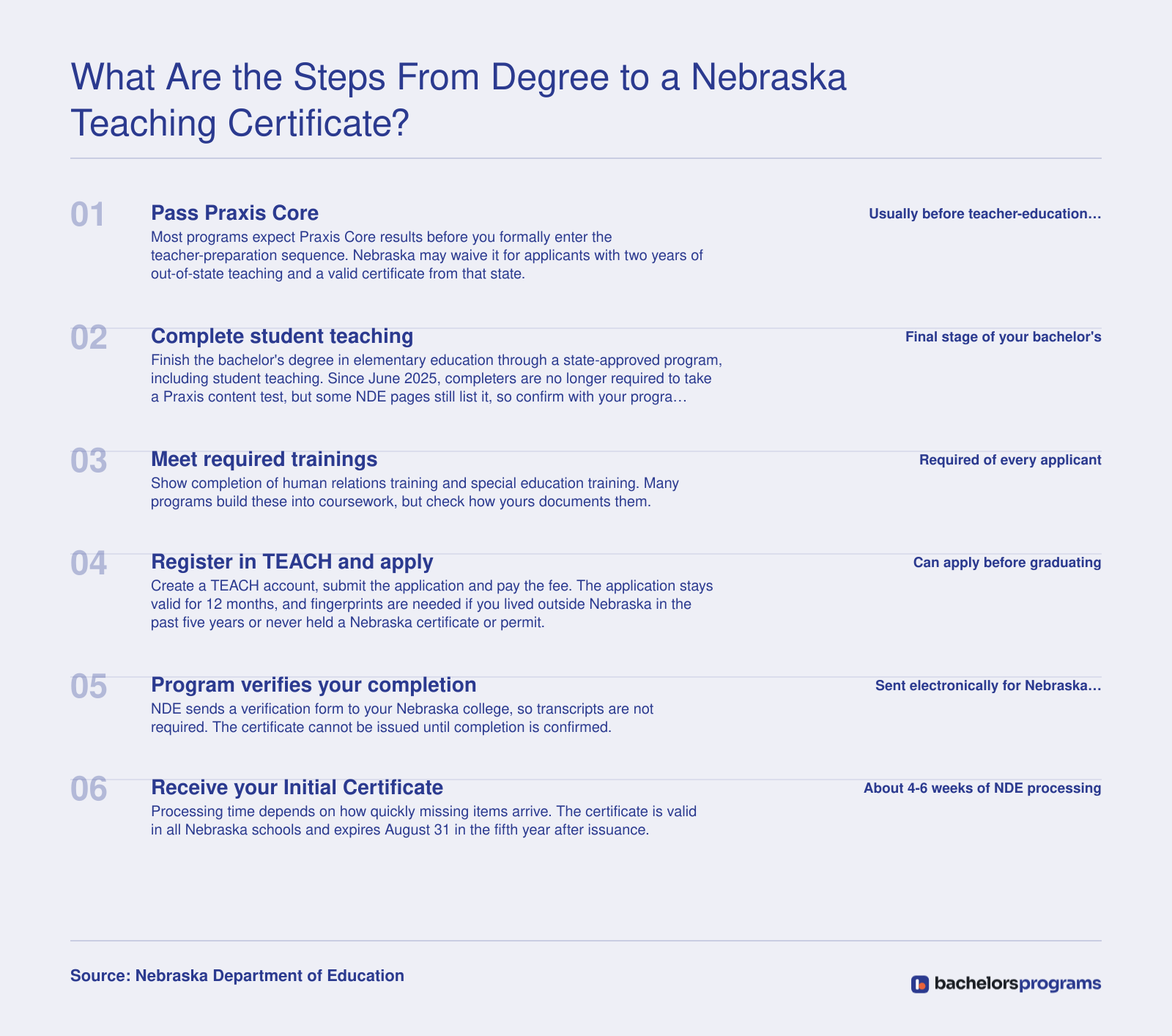
What Are the Steps From Degree to a Nebraska Teaching Certificate?
Nebraska's Initial Teaching Certificate is built for people who have just finished an approved teacher-preparation program. The order below follows Nebraska Department of Education guidance. Timing inside your program varies by school, so confirm details with your education department.
Elementary Teacher Careers and Pay in Nebraska
The Pay Picture: National Median, Nebraska Starting Point
The Bureau of Labor Statistics puts the national median annual wage for elementary school teachers, except special education, at $63,970 as of May 2025.1 That is a national number, and BLS does not report a directly comparable Nebraska median for this occupation, so treat it as a benchmark rather than a local promise. On the entry end, the Bureau of Labor Statistics reports an average starting teacher salary of $46,324 statewide.2 Together they sketch the arc: a first-year Nebraska teacher lands near the state average, and the national median reflects an experienced teacher's midpoint.
Demand and Shortage Areas
Elementary education is on Nebraska's proposed shortage-area list for 2026-27, alongside special education and several other subjects.3 The state's fall 2025 vacancy survey counted 489.70 unfilled positions, down from 669.35 a year earlier, with 135 districts reporting gaps.4 Special education carried the heaviest need at 140 unfilled roles, and elementary education ranked among the top five.4 Districts cited "no applicants" as their main staffing obstacle 60% of the time, and 18% pointed to a lack of fully qualified applicants.4
Nationally, BLS projects 0% employment growth for kindergarten and elementary school teachers from 2025 to 2035, with roughly 99,400 openings per year on average, mostly from retirements and turnover rather than new positions.1
Reading Graduate Earnings Against Teacher Pay
Federal Scorecard earnings data tracks graduates, not occupations, so keep the two separate. Four years after finishing, median earnings for elementary education graduates run near $48,000 at the University of Nebraska-Lincoln, about $48,500 at the University of Nebraska at Omaha, and roughly $42,000 at the University of Nebraska at Kearney. Median federal debt among graduates was about $23,100 at Lincoln and $20,000 at Kearney. Those earnings sit below the $63,970 national teacher median largely because they capture the first years of a career, which is exactly when added endorsements and district choice move a paycheck most.
How We Ranked These Nebraska Programs
The rankings draw on two federal sources: IPEDS for tuition and College Scorecard for institution-level and program-level outcomes. Each Scorecard figure comes from a specific data snapshot, and those snapshot years differ from measure to measure, so a number here reflects the release it was drawn from, not necessarily this year.
What the Ranking Covers
The list covers bachelor's degree programs in elementary education at Nebraska schools, both on-campus and online. Programs were matched to verified program pages, so a school appears only where it offers an elementary education bachelor's program, whether the credential is a B.S., a B.S.Ed., or a Bachelor of Arts in Education with an elementary endorsement.
Limits Worth Knowing
Several measures are averages for the whole institution, not for the elementary education program alone:
- Graduation rate: This reflects all undergraduates at the school, so it may differ from the rate for education majors.
- Net price: This is an institution-wide average after grants and scholarships. Your own cost depends on your aid package and family income.
- Earnings: The measurement window differs by program, so compare earnings figures as rough signals and not as exact predictions.
Smaller programs can also have limited outcome data, which is why some figures are missing for certain schools.
Admissions, Licensure, and Aid
Admissions requirements, licensure steps, and financial aid details come from school pages and Nebraska state agency pages checked in November 2026. Policies change, especially around test requirements and endorsement rules, so confirm current details with each school's admissions office and the Nebraska Department of Education before you apply.
Compare Elementary Education programs on the data that matters
Explore more Education & Teaching majors or browse every field of study.
All Education & Teaching programs Browse every field of study