Best Forensic Science Schools in Nebraska
Compare 3 accredited Forensic Science programs in Nebraska, with net price after aid, graduation rates, earnings and debt from IPEDS and the U.S. College Scorecard.
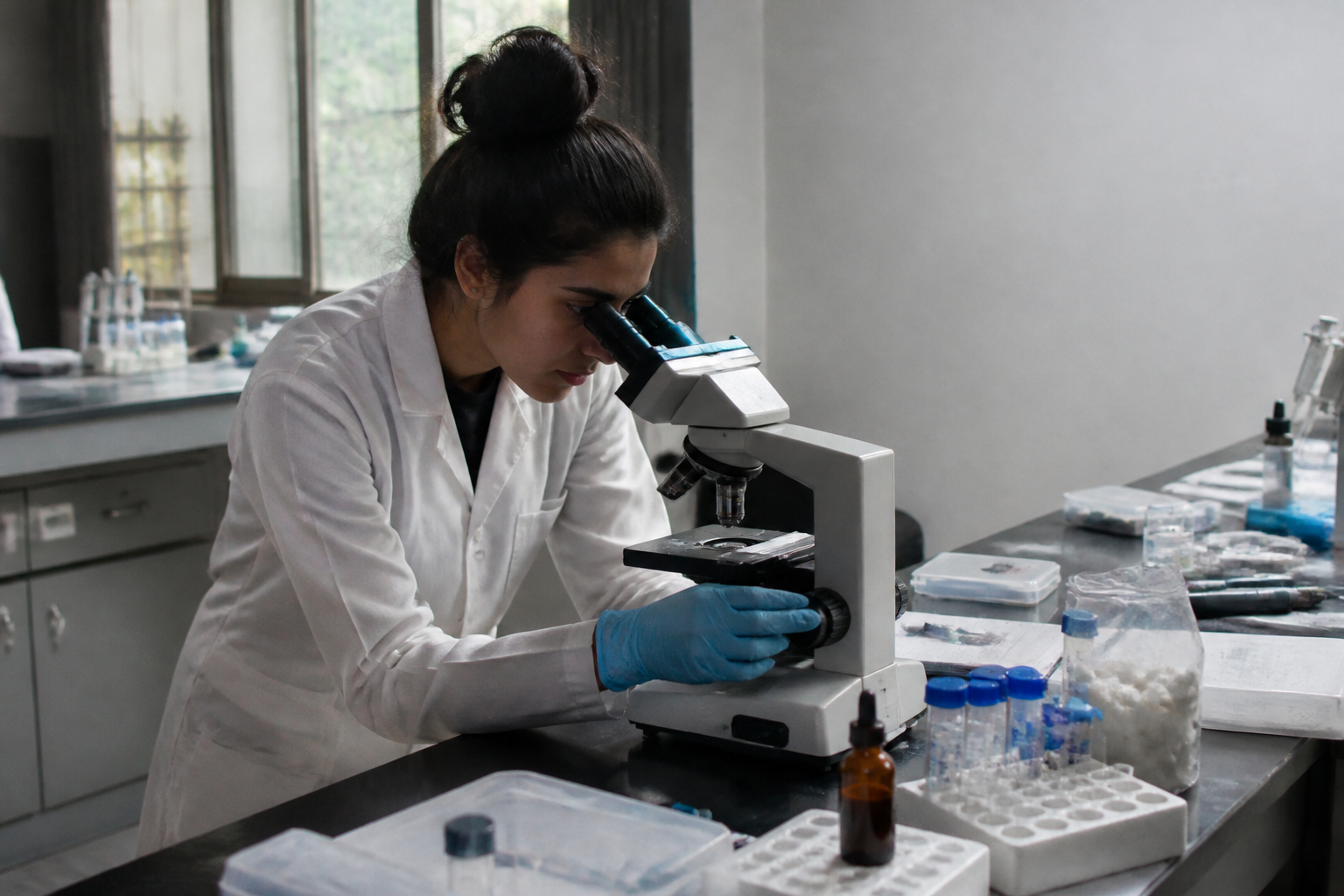
A forensic science bachelor's degree, a B.S. or a B.A., is rarer in Nebraska than the demand for crime lab work suggests. The state has only a few options, and not all carry the forensic science label.
University of Nebraska-Lincoln offers a standalone Forensic Science degree. University of Nebraska at Kearney builds its path inside a chemistry major with a forensics emphasis, and Wayne State College pairs chemistry with criminal justice. Each route leads toward lab work but trains you differently.
Nebraska does not license forensic analysts individually, so employers weigh your coursework, lab skills and internship record.
Key Points
- University of Nebraska-Lincoln's B.S. in forensic science offers four concentration options.
- Nebraska has no individual license; DNA labs need national accreditation.
- Forensic science technicians nationwide earn a median of $79,200 a year.
Best Forensic Science Schools in Nebraska: Our Ranked List
Nebraska offers a small but focused set of bachelor's degree in forensic science pathways, and each one takes a different shape. One is a full B.S. in forensic science with four concentration options, one blends chemistry with criminal justice coursework, and one builds a dual degree across two departments. Here is how they compare for students planning a laboratory or crime scene career.
University of Nebraska-Lincoln
#1Lincoln, NE · $15,000 – $20,000/yr (est.)
Best for: Students wanting four forensic concentration tracks
The University of Nebraska-Lincoln is the state's largest public research university and the only Nebraska school in this group that grants a stand-alone Bachelor of Science in Forensic Science. Students choose among four options, including Forensic Biology, Crime Scene Investigation, and Forensic Chemistry, and the college requires a capstone and an experiential learning course before graduation. Its size brings research laboratories, internships with crime laboratories and police departments, and an honors thesis option.
- Bachelor of Science in Forensic Science with four options
- Options include Forensic Biology, Crime Scene Investigation, Forensic Chemistry, and a Pre-Law 3-3 track
- Forensic Biology option requires 51 credit hours, including Advanced Forensic DNA Methods
- Core curriculum totals 118 credit hours; college requires at least 120 to graduate
- Capstone course (FORS 485) and an Experiential Learning course required
- Transfer students may apply up to 60 credits from a two-year college
- Honors thesis option and crime laboratory internships available
University of Nebraska at Kearney
#2Kearney, NE · $16,000/yr (est. net price)
Best for: Chemistry-focused students keeping a second major
The University of Nebraska at Kearney delivers forensics through a Chemistry Comprehensive Bachelor of Science with a Forensics emphasis, pairing laboratory science with 10 credits of required Criminal Justice coursework. Classes are taught on campus by chemistry and criminal justice faculty, and the plan leaves room for an unrelated minor or second major. UNK also extends in-state tuition to all undergraduates through the New Nebraskan Tuition Waiver and participates in the Nebraska Promise free-tuition program for qualifying state residents.
- Bachelor of Science in Chemistry Comprehensive with a Forensics emphasis
- 120 credit hours on a four-year plan
- Includes 10 credits of required Criminal Justice coursework
- Room for an unrelated minor or second major
- Chemistry and Criminal Justice faculty teach on campus in Kearney
- Tuition listed at $244 per credit hour
- New Nebraskan Tuition Waiver places all undergraduates at in-state rates
- Prerequisites for some Criminal Justice courses may be waived with department permission
Wayne State College
#3Wayne, NE · ~$15,000/yr (est.)
Best for: Northeast Nebraska students pairing two majors
Wayne State College in northeast Nebraska structures its forensics offering as a dual bachelor's degree that combines chemistry with criminal justice, so students graduate with credentials in both fields. The subject is also available as a minor, which suits students majoring in another science or in criminal justice who want forensic coursework on the side. It is the most compact of the three Nebraska options and is built around two complementary departments rather than a single forensic department.
- Dual bachelor's degree pairing chemistry with criminal justice
- Forensic Science Studies also offered as a minor
- Built around two departments rather than a single forensic program
Cost & outcomes by school
Federal data for the highest-earning Forensic Science programs, independent of the ranking above. Earnings are this field's bachelor's graduates four years after completing where the Scorecard reports them, else the school's undergraduate median.
| School | Net price / yr | Grad rate | Earnings | Debt | Grads/yr | Format |
|---|---|---|---|---|---|---|
| University of Nebraska-Lincoln NE | $17,747 | 67% | $58,037 | $25,125 | 30 | Campus |
| University of Nebraska at Kearney NE | $16,242 | 58% | $50,105 | $19,500 | — | Campus |
| Wayne State College NE | $15,360 | 52% | $47,075 | $19,000 | — | Campus |
Sources: U.S. Department of Education. Net price, graduation rate, earnings and debt: College Scorecard (earnings and debt for this field's bachelor's graduates where reported, else school-wide); graduates: IPEDS. A dash means no figure is reported.
Cost, debt & payoff
Median earnings of this field's bachelor's graduates (4 yrs after completing, else the school's undergraduate median) vs. their median federal loan debt · U.S. College Scorecard
Across these programs the median graduate earns about $50,105 and finishes with roughly $19,500 in debt — a ratio that clears a common rule of thumb (keep debt below first-year salary). Net price and debt vary widely school to school, so check the per-school figures in the table above before you shortlist.
How We Ranked Nebraska Bachelor's Programs in Forensic Science
The order of schools here rests on a few factors: what a forensic science bachelor's degree costs you and what it is likely to deliver. Each one is described below so you can weigh it against your own priorities.
What Drove the Order
- Net price after aid: What students actually pay after grants and scholarships, which matters more than sticker tuition.
- Graduation rate: How many students at the institution finish their degrees.
- Program-level outcomes: What each school itself reports about life after graduation for its forensic science students.
- Selectivity: How competitive admission is, which signals how much preparation you will need.
- Specializations and lab access: Whether the curriculum offers forensic biology, chemistry or crime scene tracks, and how much hands-on laboratory time students get.
What the Numbers Do and Don't Tell You
Both numbers are institution-wide averages, not program figures. They describe the whole University of Nebraska-Lincoln, the University of Nebraska at Kearney or Wayne State College, not the forensic science students alone. A chemistry-heavy program may differ from the campus average, so treat these figures as a starting point and ask each admissions office for program-specific details.
Who Made the List
Only Nebraska-based bachelor's programs were considered, in both campus and online formats. The list is short because few Nebraska schools offer a forensic science program at the bachelor's level. We did not add filler schools to make it look longer. Every school here has a verified program page: Forensic Science at Lincoln, a Chemistry Comprehensive with a Forensics Emphasis at Kearney, and Forensic Science Studies at Wayne State.
Specializations and Lab Experience: Forensic Biology, Chemistry, and Crime Scene Investigation
A standalone forensic science degree and a chemistry degree with a forensics emphasis can both lead to the lab, but they are built differently. All three Nebraska schools follow one model or the other.
Standalone Degree or Emphasis?
University of Nebraska-Lincoln offers a Forensic Science program with four concentration options, and the one in our data is Forensic Biology, which centers on analyzing biological material. University of Nebraska at Kearney takes the chemistry route: its Chemistry Comprehensive program carries a Forensics Emphasis and leads to a B.S. in chemistry. Wayne State College offers Forensic Science Studies as a dual degree pairing chemistry with criminal justice, and also as a minor.
Comparing the Tracks
- Forensic biology: Lincoln is the clearest fit here. Its program prepares students for forensic science laboratory employment.
- Forensic chemistry: Kearney's chemistry-based degree is the most direct path. It also includes 10 credits of criminal justice coursework and leaves room for a minor or second major. Wayne State's chemistry side offers a similar foundation.
- Crime scene and investigative work: Wayne State's criminal justice pairing leans this way. Kearney's criminal justice credits add some exposure as well.
Lab and Hands-On Experience
Lincoln requires an Experiential Learning course and a capstone, offers an honors thesis option, and lists crime laboratory internships at police departments. Kearney names forensic labs and federal agencies among its career outcomes. Wayne State's published details are thinner, so ask the department directly about lab access and internship placement before you apply.
A Practical Tip
If you want to work as a crime-lab analyst, favor a chemistry-based track, since lab roles typically center on a strong science foundation. If you are drawn to investigative roles, look for a criminal justice pairing, such as Wayne State's dual degree. Either way, confirm which courses and lab hours your intended track actually includes.
Nebraska Forensic Science Licensure and Certification at a Glance
Admissions Requirements: GPA, Test Policy, and Transfer Credit
The choice here is predictability versus flexibility. The University of Nebraska schools publish numeric benchmarks, while Wayne State College leans on a holistic review with fewer fixed numbers. The general admissions pages reviewed describe no separate forensic science admission requirement at any of the three schools, so these requirements apply to the university as a whole.
School-by-School Requirements
- University of Nebraska-Lincoln: Applicants complete a 16-unit high-school core and meet one performance measure: a 3.0 cumulative GPA, ACT 20, SAT 1040, or upper-half class rank.1 The university is test-optional, so ACT and SAT scores are not required.1 Transfer applicants generally need a 2.0 cumulative GPA and a 2.0 for the most recent term.2 Those with fewer than 24 semester hours must also meet the 16-unit core.
- University of Nebraska at Kearney: Applicants complete the same 16-unit core plus one measure: 50th-percentile class rank, ACT 20, SAT 1040, or a 3.0 cumulative GPA. Kearney publishes no test-optional policy. Students can self-report ACT or SAT scores on the application, but official scores and high-school transcripts are required before enrollment. Transfer applicants must submit official transcripts, and no transfer GPA minimum appears in the pages reviewed.
- Wayne State College: No minimum GPA or numbered core-course list is published. Applicants submit an official transcript showing college-preparatory coursework, and they may apply test-considered or test-optional. A personal essay may be requested for holistic review. Transfer students with at least 24 semester credits can be admitted without high-school records at a 2.5 GPA with no transferable course below a C.3
Transfer credit matters most if you start at a community college. UNL accepts up to 60 semester credits from two-year colleges and up to 90 in total from all institutions. Its pages do not explain how individual courses are evaluated, or whether every accepted course counts toward a specific major. Wayne State College publishes no general cap on transferable credit and no course-equivalency rule. Kearney's pages reviewed state no cap either. Ask each admissions office for a written course evaluation before you commit, especially for chemistry and biology prerequisites.
Related Articles
Nebraska Forensic Science Technician Pay
Forensic science technicians nationwide earned a median of $79,200 a year, or $38.08 an hour, across about 19,120 jobs. A Nebraska-specific median is not shown in current BLS results.
Compare Forensic Science programs on the data that matters
Explore more Criminal Justice & Law majors or browse every field of study.
All Criminal Justice & Law programs Browse every field of study