Best Finance Schools in Nevada
Compare 8 accredited Finance programs in Nevada at 3 colleges, with net price after aid, graduation rates, earnings and debt from IPEDS and the U.S. College Scorecard.

Finance employment in Nevada splits along two corridors: the Las Vegas resort and gaming economy, where revenue management, credit, and hospitality finance roles cluster, and Reno's banking, insurance, and wealth management employers.
A bachelor's degree in finance, most often the Bachelor of Science (B.S.) in Finance, is the common entry credential for both. UNLV sits beside the Strip; UNR draws on northern Nevada's commercial lending and insurance base. Finance graduates from the two campuses report median earnings of $72,227 to $76,319 four years after finishing.
For applicants the tension is cost against placement: the cheapest school is seldom the one with the strongest outcomes.
Key Points
- UNLV offers the lowest average net price after grants, at $10,359.
- Median finance debt runs $14,875 at UNLV and $15,750 at UNR.
- UNLV finance graduates earn a $76,319 median four years after finishing.
Best Bachelor's Degree in Finance Programs in Nevada: Our Top Picks
Three Nevada universities award a bachelor's degree in finance, and they differ sharply in size, setting, and student profile. Two are large public research campuses, one in Reno and one in Las Vegas; the third is a smaller teaching university in Henderson. Here is how each one stacks up on the measures that matter most to students choosing a finance program.
University of Nevada-Reno
#1Reno, NV · $16,000/yr (est. net price)
Best for: Finance majors aiming at charter exams
The University of Nevada, Reno offers its finance degree on a large, research-intensive campus with a curriculum built around investment analysis, banking, and financial management. It is one of the few Nevada programs holding CFA Institute University Affiliation, which means coursework covers most of the CFA Program Candidate Body of Knowledge and positions graduates to pursue the charter. The university's graduation rate is about 61%, and finance graduates here report median earnings of $72,227 four years after finishing, against median debt of $15,750. More than half of students complete their degree with no debt.
- CFA Institute University Affiliation covering 70% of the CFA body of knowledge
- 120-credit, four-year degree with tracks in accounting and economics
- 76% of students receive financial aid
- Local internship opportunities in the Reno area
- Careers in banking, investments, insurance, and financial management
- Builds communication, information technology, and global business skills
University of Nevada-Las Vegas
#2Las Vegas, NV · ~$10,000/yr (est.)
Best for: Las Vegas students seeking hands-on investing
UNLV's Lee Business School teaches finance through a Bachelor of Science in Business Administration, with core work in corporate finance, investments, and financial markets and institutions. The department leans hard on practice: student-run investment groups, the President's Investment Challenge, Rebels on Wall Street, and industry mentoring all sit alongside the coursework. The university's graduation rate is about 51%, and finance graduates report median earnings of $76,319 four years after finishing, with median debt of $14,875. Las Vegas adds a dense local market of banks, gaming companies, and corporate finance offices for internships.
- Three concentrations: financial management, investments, and financial services
- Covers time value of money, risk and return, and cash flow valuation
- Student-run investment groups and industry mentor opportunities
- President's Investment Challenge and Rebels on Wall Street programs
- Pathways in corporate finance, risk management, fintech, and quantitative finance
- Four-year plan of study available
Nevada State University
#3Henderson, NV · ~$14,000/yr (est.)
Best for: Henderson commuters wanting a small-campus business degree
Nevada State University in Henderson is the smallest of the three, a teaching-focused campus where finance sits inside a Bachelor of Business Administration with a Financial Services concentration. Students take a shared foundation in accounting, management, marketing, and finance before specializing in how firms maximize returns while controlling risk, aimed at banks, mortgage brokers, investment firms, insurers, and planning practices. The university's graduation rate is about 34%, and because the business degree carries five concentrations, finance students work alongside a broad business cohort rather than a narrow finance-only one.
- 120-credit business administration degree with a Financial Services concentration
- One of five concentrations in the Bachelor of Business Administration
- Shared foundation in accounting, management, marketing, and finance
- Prepares for roles with banks, mortgage brokers, and investment firms
- Coursework on maximizing returns while controlling risk exposure
- Listed outcomes include business analyst, financial advisor, and operations coordinator
Cost & outcomes by school
Federal data for the highest-earning Finance programs, independent of the ranking above. Earnings are this field's bachelor's graduates four years after completing where the Scorecard reports them, else the school's undergraduate median.
| School | Net price / yr | Grad rate | Earnings | Debt | Grads/yr | Format |
|---|---|---|---|---|---|---|
| University of Nevada-Las Vegas NV | $10,359 | 51% | $76,319 | $14,875 | 154 | Campus |
| University of Nevada-Reno NV | $15,927 | 61% | $72,227 | $15,750 | 132 | Campus |
| Nevada State University NV | $14,068 | 34% | $53,166 | $19,691 | — | Campus |
Sources: U.S. Department of Education. Net price, graduation rate, earnings and debt: College Scorecard (earnings and debt for this field's bachelor's graduates where reported, else school-wide); graduates: IPEDS. A dash means no figure is reported.
Cost, debt & payoff
Median earnings of this field's bachelor's graduates (4 yrs after completing, else the school's undergraduate median) vs. their median federal loan debt · U.S. College Scorecard
Across these programs the median graduate earns about $74,273 and finishes with roughly $15,313 in debt — a ratio that clears a common rule of thumb (keep debt below first-year salary). Net price and debt vary widely school to school, so check the per-school figures in the table above before you shortlist.
How We Ranked Nevada's Bachelor's Degree in Finance Programs
The cheapest published tuition and the strongest student outcomes rarely land on the same campus, which is why a single number makes a poor sorting tool. We weigh cost next to completion, earnings, and debt so a low price cannot carry a school on its own, and a strong reputation cannot hide a weak payoff.
What We Weigh
- Cost and net price: What students actually pay after grant aid matters more than the sticker figure, because it shapes how much debt follows graduation.
- Graduation and retention: A program that keeps students enrolled and finishes them protects both time and tuition dollars.
- Earnings and debt: Median pay after finishing and typical borrowing show whether the degree carries its cost.
- Selectivity and completions: Admissions standards and the number of degrees awarded signal who the program serves and how reliably it delivers on the credential.
How to Read the Numbers
Graduation rates and net price are institution-wide averages, not figures for the finance major alone, so treat them as a read on the whole school. The ranking covers only Nevada-based bachelor's programs, campus and online. A program can look affordable at the top line and still cost more over four years if students take longer to finish. Compare the schools below on the factor you can least afford to get wrong.
UNLV vs. UNR: Las Vegas and Reno Finance Programs Compared
UNLV and UNR both offer a bachelor's degree in finance. Before you apply, confirm accreditation, curriculum emphases, and employer connections on each school's official pages. Use this matrix as a checklist. The school columns show what to look for at each campus, and the last column shows where to confirm it and what to ask.
| What to Compare | UNLV Lee Business School (Las Vegas) | UNR College of Business (Reno) | How to Verify |
|---|---|---|---|
| Bachelor's credential | Bachelor of Science in Business Administration, Finance | Bachelor of Science in Finance | Open each school's finance program page and current undergraduate catalog. Confirm the degree name, core business courses, and required finance courses. |
| AACSB accreditation | Listed in AACSB's Accredited Schools Directory. Accreditation applies at the business-school level, not to the finance major alone. | Search the directory for "University of Nevada, Reno" and confirm the current status before relying on it. | Search AACSB's Accredited Schools Directory by school name. Then compare the result with the accreditation statement on each business college's website. |
| CFA Institute University Affiliation | Check the CFA Institute's list of affiliated universities. | Check the same list. | Search the CFA Institute University Affiliation Program list by school name. AACSB accreditation does not indicate CFA affiliation, and CFA affiliation does not indicate AACSB accreditation. |
| Finance concentrations or emphases | Look for named tracks, such as investments, banking, or corporate finance, on the program page. | Look for the same on the program page. | Count only options listed in the current catalog. Ask an advisor: "Do these electives form a formal emphasis that appears on my transcript?" |
| Local job market | Economy centered on hospitality, gaming, conventions, tourism, real estate, and consumer services. | Economy weighted toward logistics, distribution, manufacturing, technology, construction, healthcare, and gaming. | Compare Las Vegas and Reno metro-area data for financial analysts, financial managers, and loan officers in the Occupational Employment and Wage Statistics (OEWS) data on BLS.gov. Then review local chamber of commerce and major employer career pages. |
| Employer partners and placement | Ask Lee Business School career services. | Ask College of Business career services. | Request employer-partner lists, internship sites, and recent alumni placement data. Ask what share of finance majors complete internships and which employers hired recent graduates. |
Online and Hybrid Bachelor's in Finance Options at Nevada Schools
Online delivery promises flexibility, but Nevada's finance bachelor's programs still run through the classroom. The state's finance programs are campus-based, so a student who needs a fully remote degree has to weigh an adjacent business major against waiting for a finance program that may never go online.
Campus Programs, Not Online Ones
University of Nevada, Reno, University of Nevada, Las Vegas, and Nevada State University each list their finance or business administration bachelor's as a campus program in 2026. None of these schools is identified as offering a fully online B.S. in Finance.
What Is Online at These Schools
UNLV's online catalog carries a Minor in Finance and online bachelor's degrees in Entrepreneurship and Management, not Finance. At UNR, the 100% online, asynchronous offering is the Personal Financial Planning certificate, and the online degree is an Executive MBA. Neither substitutes for the B.S. in Finance. Individual courses inside the campus programs may be delivered online in a given term, so ask the department which sections run remotely before you build a schedule around it. Nevada State lists no separate online business administration or finance track in its 2026 program pages.
Confirming a Finance Emphasis
A general online business administration degree is not the same credential as a finance degree. Before enrolling, check whether the program names a finance concentration on the transcript, whether it requires upper-division finance coursework such as corporate finance, investments, and financial institutions, and whether the business school's finance faculty teach those courses.
Admissions for Nevada Bachelor's in Finance Programs: GPA, Test Policy, and Direct Entry
For a bachelor's degree in finance in Nevada, admission often happens in two stages: first to the university, then to the business major. Below is what UNLV publishes on its admissions pages and what to verify directly with UNR and Nevada State University.
- Minimum GPA (UNLV)University of Nevada-Las Vegas admits first-year students with a 3.0 GPA across 13 core high school units: 4 English, 3 math, 3 social science and 3 natural science. Students can also qualify with a 1120 SAT (1040 for exams taken before March 2016) or a 22 ACT composite.
- Test policy (UNLV)UNLV does not require ACT or SAT scores for admission or scholarship consideration. It encourages them because they can be used for course placement.
- Deadlines (UNLV)Applications open October 1. The fall priority deadline for financial aid and scholarships is November 15, and the fall application deadline is June 1.
- Direct entry vs. later admission (UNLV)UNLV admits business students as pre-majors. They apply to the finance major later and need major admission before taking 300- and 400-level business courses. Pre-majors must be eligible for MATH 124 and ENG 101 through ACT, SAT, ALEKS or departmental placement scores.
- Transfer and internal GPA (UNLV)New transfer students need a 2.75 transfer GPA as calculated by UNLV. Current UNLV students moving into the business pre-major need a 2.5 UNLV GPA.
- UNR and Nevada State UniversityWe could not confirm current GPA minimums, test policies, deadlines or business-college entry rules from the University of Nevada-Reno or Nevada State University admissions pages. Check with each school's admissions office before you apply.
Related Articles
What a Finance Bachelor's Costs in Nevada: Tuition, Net Price, and Debt
Nevada State University has the lowest sticker price, while UNLV has the lowest average net price after grants at $10,359. Median debt for finance graduates is $14,875 at UNLV and $15,750 at UNR, or roughly $158 and $167 a month on a 10-year repayment plan. Out-of-state students should look at the Western Undergraduate Exchange: UNR lists 2026-27 WUE tuition of $15,770 and Nevada State lists $11,250, but WUE pricing is not automatic for every applicant.
| School | In-State Tuition and Fees | Out-of-State Tuition and Fees | Average Net Price | Median Debt (All Graduates) | Median Debt (Finance Graduates) |
|---|---|---|---|---|---|
| University of Nevada-Las Vegas | $9,748 | $27,411 | $10,359 | $19,450 | $14,875 |
| Nevada State University | $6,765 | $21,833 | $14,068 | $19,691 | N/A |
| University of Nevada-Reno | $9,578 | $27,720 | $15,927 | $18,922 | $15,750 |
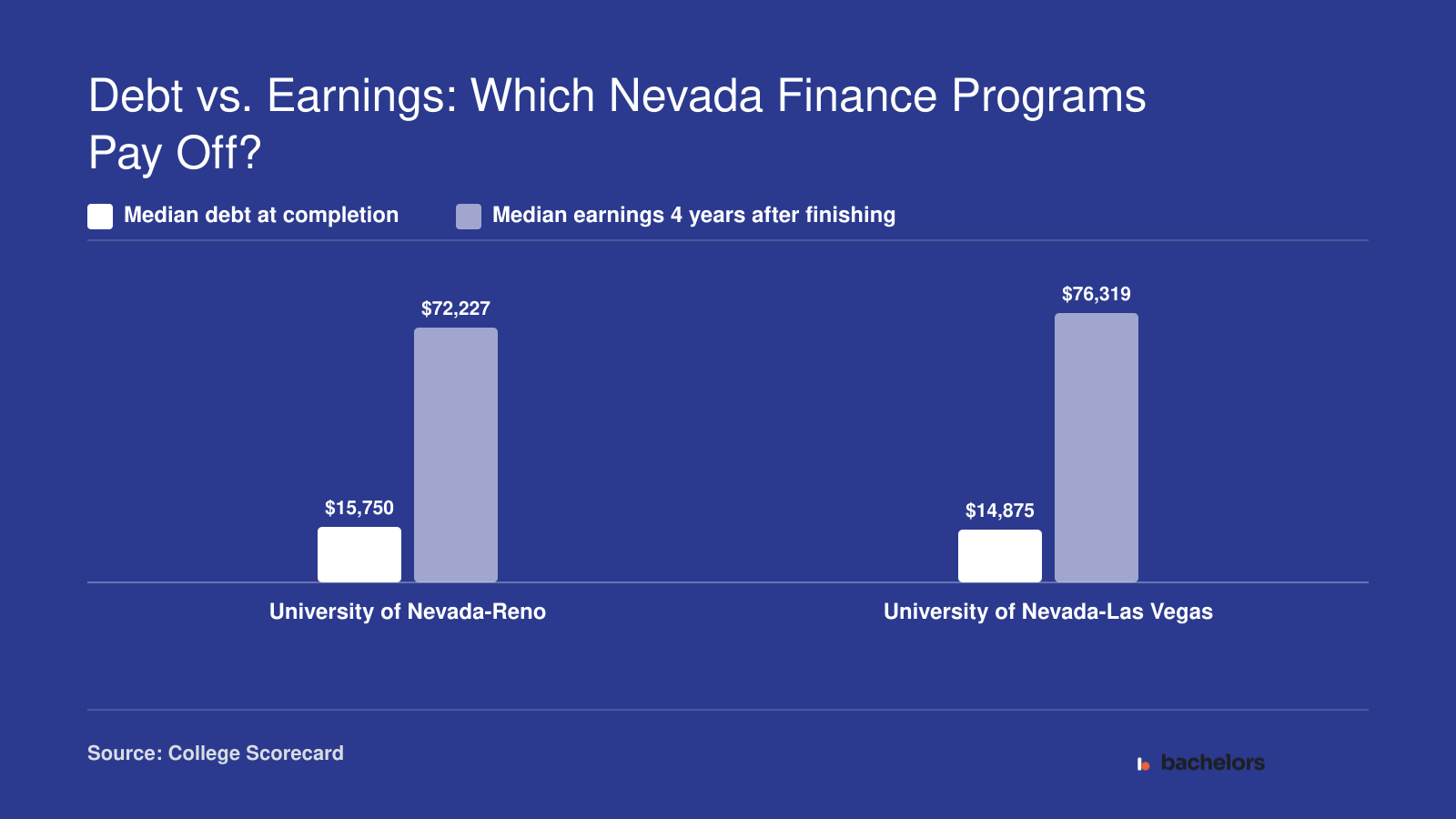
Debt vs. Earnings: Which Nevada Finance Programs Pay Off?
Finance graduates at UNLV and the University of Nevada-Reno finish with median debt between $14,875 and $15,750. Four years after finishing, their median earnings are $72,227 to $76,319. At both schools, typical earnings at the four-year mark run more than four times typical debt at completion.
Questions to Ask Yourself
Do you want Las Vegas hospitality and gaming finance or Reno-area banking and corporate finance, and could you live there for four years?
Will you start at a community college and transfer, and does your target business school's admission rules fit that plan?
Is an AACSB-accredited or CFA-affiliated program important to the roles you want?
Median Earnings Four Years After Finishing a Finance Bachelor's in Nevada
UNLV's finance graduates post the highest four-year median earnings among the schools ranked here.
Frequently Asked Questions About Finance Schools in Nevada
These answers cover the questions students ask most when comparing a bachelor's degree in finance in Nevada. Figures come from school and accreditor pages and may change, so confirm current details with each school.
Which Nevada school is best for an undergraduate finance degree?
How do UNR and UNLV compare on tuition, curriculum, and outcomes for finance?
Can you get a bachelor's degree in finance online in Nevada?
Are Nevada finance programs AACSB accredited?
How much do finance graduates from Nevada schools earn?
Compare Finance programs on the data that matters
Explore more Business & Management majors or browse every field of study.
All Business & Management programs Browse every field of study