Best Early Childhood Education Schools in Nevada
Compare 3 accredited Early Childhood Education programs in Nevada, with net price after aid, graduation rates, earnings and debt from IPEDS and the U.S. College Scorecard.

A bachelor's degree in early childhood education prepares you to teach children from birth through the early grades, and Nevada schools award it as both a Bachelor of Science and a Bachelor of Arts. The state's early childhood teaching license covers birth through grade 2, but not every degree is built to qualify you for it.
The Nevada-based programs, on campus and online, differ on licensure, format and cost. Great Basin College and Nevada State University both offer a bachelor's in the field, but neither program page states plainly whether its degree meets the state's birth-through-grade-2 licensure requirements.
The gap matters in the job market: a non-licensure degree can lead to preschool or childcare work, but a public school classroom requires the license.
Key Points
- UNLV offers both licensure and non-licensure early childhood bachelor's tracks.
- Nevada's Early Childhood Education License covers birth through grade 2.
- UNLV early childhood graduates earned a median $49,475 one year out.
Best Early Childhood Education Schools in Nevada: Our Ranked List
UNLV takes the top spot because, among the ranked Nevada schools, it is the only one offering both a licensure and a non-licensure route to a bachelor's degree in early childhood education, backed by a working early learning campus. The list covers the three public institutions in the state that currently award a bachelor's degree in the field, with campus and fully online options. Tuition, net price after aid and graduation rate are school-wide averages rather than program-specific numbers, and the next section explains how we weighed them.
University of Nevada-Las Vegas
#1Las Vegas, NV · ~$10,000/yr (est.)
Best for: Las Vegas students aiming for licensure
UNLV runs its early childhood programs through the Department of Early Childhood, Multilingual, and Special Education, and it gives students a choice between a licensure track aimed at teaching and a non-licensure track aimed at preschool and childcare leadership. Students train alongside an operating early learning center, and the Marlow Early Childhood Education Campus opened in 2026 with four additional classrooms and space for research and community outreach. The department also works with the Clark County School District on teacher-training initiatives tied to local staffing shortages, and UNLV partners with the University of Nevada, Reno and Great Basin College on parallel programs meant to serve learners across the state.
- Licensure and non-licensure tracks
- Two concentration options
- Prepares students for preschool provider and administrator roles
- Coursework in child observation and assessment
- Family and community engagement coursework
- Childcare teaching and administration career paths
- State education department career preparation
Great Basin College
#2Elko, NV · ~$8,000/yr (est.)
Best for: Rural Nevadans needing online coursework
Great Basin College offers a non-licensure Bachelor of Arts in Early Childhood Education built around children from birth through age five, with a curriculum aligned to NAEYC Professional Standards. Students blend infant and toddler education, early childhood education, special education with behavioral interventions, and English language acquisition, then move into teaching or leadership roles in licensed childcare, preschool and Head Start programs. Admission is competitive each semester and requires prerequisite coursework, a minimum GPA and a background check, and students who stop short of the bachelor's can exit with an Associate of Arts. The college also participates in Nevada's EmployNV partnership, which brings career coaching and employer connections to students.
- 120 credit hours with a fully online course sequence
- Non-licensure degree focused on birth through age five
- Curriculum aligned with NAEYC Professional Standards
- 2.5 GPA minimum plus prerequisite coursework
- FBI background check and fingerprinting required
- Competitive admission each semester
- Associate of Arts exit option after lower-division work
- Field experiences with mentor teachers
Nevada State University
#3Henderson, NV · ~$14,000/yr (est.)
Best for: Future early intervention specialists
Nevada State University houses its early childhood work in the School of Education and combines a birth-to-second-grade teaching license with a special education endorsement covering children ages 0 to 7. The Early Childhood and Early Childhood Special Education bachelor's is described as the first program of its kind in Nevada, and the 120-credit sequence runs from child development to inclusive practices and educational strategies. Graduates move into preschool teaching, early intervention, special education assistance and developmental therapy roles, and the university publishes a full course sequence and current catalog requirements.
- 120 credit hours delivered in person
- Leads to a Nevada teaching license, birth to 2nd grade
- Adds special education endorsement for ages 0 to 7
- First such program in Nevada
- Coursework in child development and inclusive practices
- Prepares preschool teachers and early intervention specialists
Cost & outcomes by school
Federal data for the highest-earning Early Childhood Education programs, independent of the ranking above. Earnings are this field's bachelor's graduates four years after completing where the Scorecard reports them, else the school's undergraduate median.
| School | Net price / yr | Grad rate | Earnings | Debt | Grads/yr | Format |
|---|---|---|---|---|---|---|
| University of Nevada-Las Vegas NV | $10,359 | 51% | $56,095 | $21,226 | 332 | Campus |
| Nevada State University NV | $14,068 | 34% | $54,646 | $24,585 | 90 | Campus |
| Great Basin College NV | $8,471 | 41% | $39,289 | $15,750 | 32 | Online |
Sources: U.S. Department of Education. Net price, graduation rate, earnings and debt: College Scorecard (earnings and debt for this field's bachelor's graduates where reported, else school-wide); graduates: IPEDS. A dash means no figure is reported.
Cost, debt & payoff
Median earnings of this field's bachelor's graduates (4 yrs after completing, else the school's undergraduate median) vs. their median federal loan debt · U.S. College Scorecard
Across these programs the median graduate earns about $54,646 and finishes with roughly $21,226 in debt — a ratio that clears a common rule of thumb (keep debt below first-year salary). Net price and debt vary widely school to school, so check the per-school figures in the table above before you shortlist.
How We Ranked Nevada's Bachelor's Degree in Early Childhood Education Programs
A strong early childhood education program in Nevada should put you in a classroom, on a licensure track and earning a salary, without burying you in debt. Every school on this list was measured against that standard.
What We Looked At
- Cost and net price: The price that matters is what you pay after grants and scholarships, not the sticker price, because it decides how much you borrow.
- Completion and graduation outcomes: A degree only pays off if you finish it, and graduation rates show how often students at a school do.
- Earnings and debt for this field: Program-level figures show what early childhood graduates specifically earn and owe, not the averages for a whole university.
- Number of completers: A steady flow of graduates signals an established program that runs its courses on a dependable schedule.
- Licensure pathway: If you plan to teach in a Nevada public school, your bachelor's degree needs to line up with state licensure requirements.
- Delivery format: Campus, hybrid and online options matter if you work, raise children or live far from Las Vegas, Henderson or Elko.
Who Is Included
The list covers only bachelor's programs at Nevada-based schools, including the online and hybrid programs those schools offer. Online programs from schools based in other states are excluded, so every option here is tied to a Nevada institution and its local school partners.
Limits Worth Knowing
Graduation rates and net price describe each school as a whole, not the early childhood program alone. Earnings figures are medians, which means half of graduates earn more and half earn less. Treat the numbers as a starting point, then confirm current costs, licensure alignment and format details directly with each school's education department before you apply.
Licensure vs. Non-Licensure Bachelor's Degrees in Nevada
Nevada's early childhood bachelor's degrees now divide along a single line: whether the program is built to satisfy the state's birth-through-grade-2 teaching license or deliberately stops short of it.
The distinction shows up in the job search more than on the transcript. A licensure track builds state-approved field experience and supervised student teaching into the degree, the sequence the Nevada Department of Education expects before it issues a certificate. A non-licensure track carries the same early childhood coursework without that supervised preparation, which suits childcare centers, Head Start classrooms and private preschools rather than a public school pre-K or kindergarten room.
Where the ranked programs land
UNLV is the clear case. Its Bachelor of Science in Early Childhood Education is a licensure program tied to Nevada Birth-Grade 2 certification. The degree takes at least 120 semester credits, 40 of them upper division, with at least 30 upper-division credits earned at UNLV. Fieldwork spans three semesters: a practicum at six hours a week, a second at ten hours a week inside a kindergarten, then full-time supervised student teaching split across two settings, birth to age 5 and ages 6 to 8 in a first- or second-grade classroom. The catalog does not translate that student teaching into a total hour count.
Great Basin College's Bachelor of Arts in Early Childhood Education and Nevada State University's Early Childhood and Early Childhood Special Education B.A. are the other bachelor's options in Nevada. As reviewed, neither program page states plainly whether the degree meets Nevada birth-through-grade-2 licensure requirements or is non-licensure, and neither lists student-teaching hours alongside its degree requirements. That silence is not a no; it means the answer comes from an advisor or the department's licensure sheet before you commit.
What each path buys you
- Public school classrooms: A pre-K through grade 2 teaching job in a Nevada district generally requires the birth-through-grade-2 license, so the licensure track is the one that qualifies you for it.
- Preschool, Head Start, childcare: These employers set their own hiring standards, and a bachelor's in the field carries weight with or without licensure, which makes the non-licensure route workable for people already working in a center.
- Testing: At UNLV, the Praxis Core or CBEST is no longer required to enter the major but is still required for licensure, with SAT 1100 or ACT 21 accepted instead and a licensing exam passed within 10 years of applying.
Nevada Early Childhood Licensure at a Glance
Admission Requirements: GPA, Test Policy, and Transfer Credit
Admission to a bachelor's degree in early childhood education in Nevada is accessible rather than highly selective. At the University of Nevada-Las Vegas, both the licensure and non-licensure B.S. tracks require a 2.0 GPA in major requirements, and transfer applicants need a 2.5 GPA in transferable coursework. Students finishing an associate degree at a Nevada System of Higher Education two-year college have a guaranteed admission path. Great Basin College and Nevada State University set their own rules, so confirm GPA, testing, and transfer details with each school's admissions office before you apply.
| School | Minimum GPA | Test Policy | Transfer Credit Rule |
|---|---|---|---|
| University of Nevada-Las Vegas, B.S. Early Childhood Education (Licensure PK-2) | 2.0 GPA in full major requirements | No test-optional policy published. A satisfactory ACT, SAT, or placement test score is one way to meet the math requirement. | The former 60-credit cap on transfer credit applied to a major no longer applies. At least 30 upper-division credits must be completed at UNLV. In the College of Education, transfer grades do not carry into the UNLV GPA. Only the credits transfer. |
| University of Nevada-Las Vegas, B.S. Early Childhood Education (Non-Licensure) | 2.0 GPA in full major requirements | No test-optional policy published. A satisfactory ACT, SAT, or placement test score is one way to meet the math requirement. | The former 60-credit cap on transfer credit applied to a major no longer applies. At least 30 upper-division credits must be completed at UNLV. In the College of Education, transfer grades do not carry into the UNLV GPA. Only the credits transfer. |
| University of Nevada-Las Vegas, undergraduate transfer admission | 2.5 GPA in transferable coursework | No policy published | For admission purposes, credits do not expire and all earned credits are evaluated. Nevada transfers from NSHE two-year colleges with a completed or in-progress AA, AB, or AS degree are guaranteed admission and receive credit for UNLV's lower-division general education core. |
Related Articles
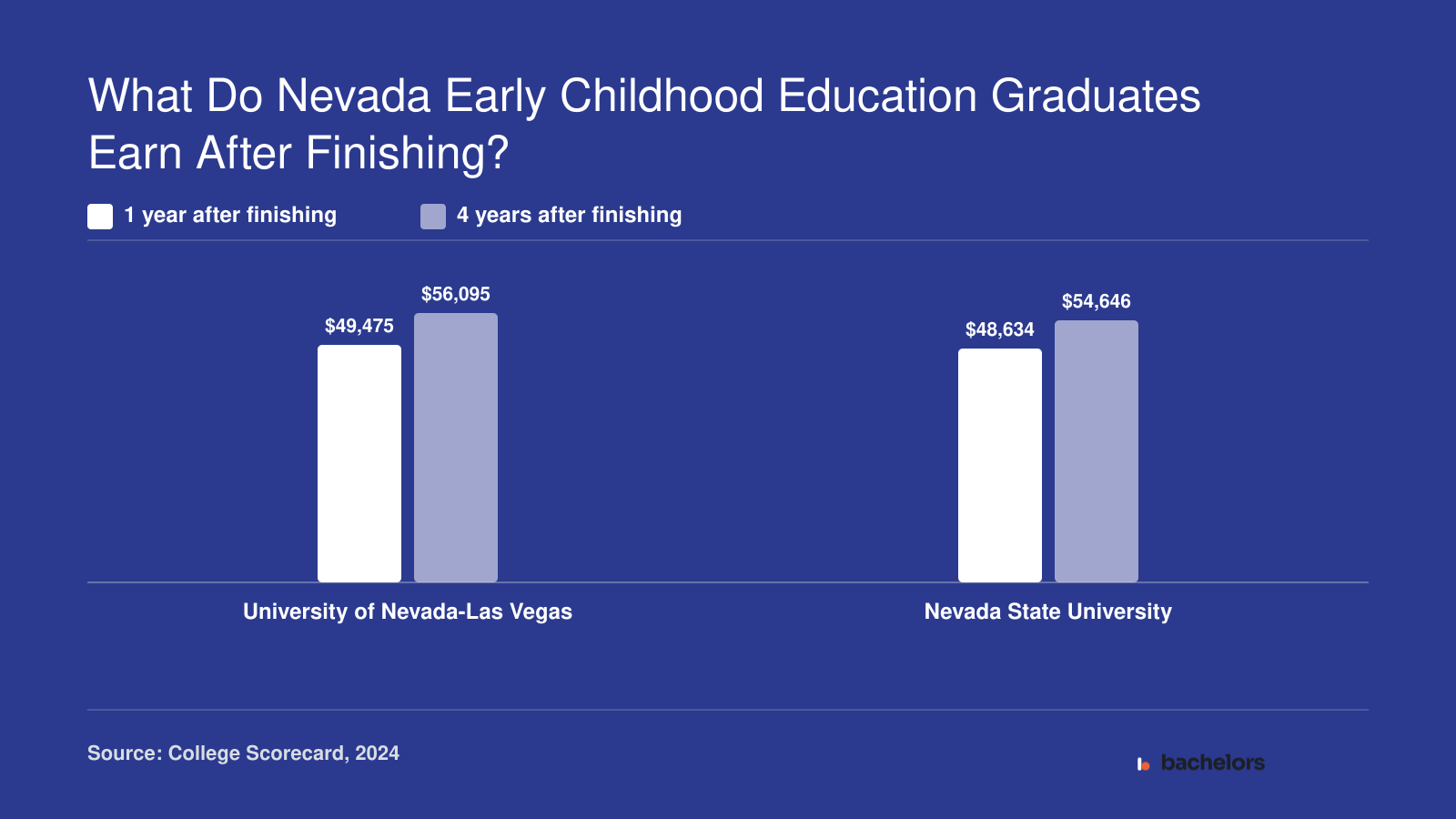
What Do Nevada Early Childhood Education Graduates Earn After Finishing?
Graduates of UNLV's Bachelor of Science in Early Childhood Education earned a median $49,475 one year after finishing and $56,095 four years after finishing. Graduates of Nevada State University's Early Childhood & Early Childhood Special Education B.A. earned $48,634 at one year and $54,646 at four years. Great Basin College's program has no published program-level earnings figure, so it has no bar. These are medians for each program's own completers, not statewide wages for all early childhood workers in Nevada.
Questions to Ask Yourself
Do you want to teach in a Nevada public school, or work in childcare or Head Start?
Can you complete in-person student teaching during school hours?
Are you starting at CSN or GBC, and will your credits transfer?
Compare Early Childhood Education programs on the data that matters
Explore more Education & Teaching majors or browse every field of study.
All Education & Teaching programs Browse every field of study