Best Criminal Justice Schools in Nevada
Compare 3 accredited Criminal Justice programs in Nevada, with net price after aid, graduation rates, earnings and debt from IPEDS and the U.S. College Scorecard.

On campus in Reno, Las Vegas or Henderson, or online from a Nevada-based public university: both routes lead to a bachelor's degree in criminal justice, and the choice shapes your schedule, your costs and how soon you start working. The credential is commonly called the Bachelor of Science (B.S.) in Criminal Justice, though the Nevada programs here are awarded as Bachelor of Arts degrees.
Each school below is ranked on College Scorecard and IPEDS data for cost, graduation, earnings and debt, and the sections that follow cover online options, admissions, costs, timelines and Nevada careers.
One constraint outlasts the diploma. Nevada POST certifies peace officers only after an agency hires them, so the degree strengthens an application but does not replace the academy.
Key Points
- UNR expects a 3.0 weighted GPA in core high school courses.
- Nevada regents approved a 3.0% registration-fee increase for 2026-27.
- Nevada POST certifies only recruits already hired by a Nevada agency.
Best Bachelor's Degree in Criminal Justice Programs in Nevada, Ranked
Three Nevada public universities award a bachelor's degree in criminal justice, and each takes a different approach: a research-oriented flagship, a large urban department with a fully online route, and a small Henderson campus built around social justice. All three are regionally accredited public institutions with published admission standards. The order below reflects completion outcomes and net price after aid first, with program format and applied learning as tiebreakers.
University of Nevada-Reno
#1Reno, NV · $16,000/yr (est. net price)
Best for: Students drawn to law and justice theory
The University of Nevada, Reno is the state's flagship campus and runs a criminal justice department organized into two tracks: Justice Studies and Law and Justice. Undergraduates can intern alongside working justice professionals, and the university reports that 76% of students receive financial aid and 54% graduate with no debt. A five-year accelerated path lets strong students begin graduate coursework during their fourth year.
- Two concentration options: Justice Studies or Law and Justice
- Justice Studies covers inequality, ethics, and social change
- Law and Justice covers legal research, writing, and philosophy
- Internships place students with working justice professionals
- Accelerated B.A./M.A. path completes both degrees in five years
- Graduate coursework begins in the fourth year of the accelerated path
University of Nevada-Las Vegas
#2Las Vegas, NV · ~$10,000/yr (est.)
Best for: Online learners who want a research emphasis
UNLV's Department of Criminal Justice sits in the Greenspun College of Urban Affairs and graduates the largest bachelor's cohort in this ranking. Students enter as pre-criminal justice majors and must clear a credit and GPA gate before advancing, then carry an original research project from start to finish. The degree is offered online as well as on campus, which suits Las Vegas residents already working in the field.
- Housed in the Greenspun College of Urban Affairs
- Students hold pre-criminal justice status until 30 credits
- Advancement requires a 2.00 GPA including ENG 101, CRJ 104, and CRJ 270
- CRJ 301 and CRJ 302 must be completed at UNLV
- At least 30 upper-division credits must be earned at UNLV
- Capstone research project carried from start to finish
- Covers police, courts, corrections, and constitutional issues
Nevada State University
#3Henderson, NV · ~$14,000/yr (est.)
Best for: Clark County high school graduates starting locally
Nevada State University in Henderson awards a 120-credit criminal justice bachelor's with an in-person format and a full online catalog option. Class sizes stay small and coursework leans into social justice themes such as inequality, social exclusion, and human rights. The university expanded direct admissions to every Clark County School District high school in 2026 and publishes separate transfer procedures for students arriving from other Nevada System of Higher Education campuses.
- 120 credit hours required to graduate
- Fully online option alongside in-person classes
- At least 30 upper-division credits completed at Nevada State
- Coursework includes Vice, Drugs, and the Law (CRJ 326)
- Social justice focus on inequality, exclusion, and human rights
- Several internship placements supported
- Online pathway requires a minimum 2.0 GPA
Cost & outcomes by school
Federal data for the highest-earning Criminal Justice programs, independent of the ranking above. Earnings are this field's bachelor's graduates four years after completing where the Scorecard reports them, else the school's undergraduate median.
| School | Net price / yr | Grad rate | Earnings | Debt | Grads/yr | Format |
|---|---|---|---|---|---|---|
| University of Nevada-Reno NV | $15,927 | 61% | $60,614 | $18,922 | 140 | Online or campus |
| University of Nevada-Las Vegas NV | $10,359 | 51% | $57,556 | $17,572 | 273 | Online |
| Nevada State University NV | $14,068 | 34% | $46,443 | $13,750 | 52 | Online or campus |
Sources: U.S. Department of Education. Net price, graduation rate, earnings and debt: College Scorecard (earnings and debt for this field's bachelor's graduates where reported, else school-wide); graduates: IPEDS. A dash means no figure is reported.
Cost, debt & payoff
Median earnings of this field's bachelor's graduates (4 yrs after completing, else the school's undergraduate median) vs. their median federal loan debt · U.S. College Scorecard
Across these programs the median graduate earns about $57,556 and finishes with roughly $17,572 in debt — a ratio that clears a common rule of thumb (keep debt below first-year salary). Net price and debt vary widely school to school, so check the per-school figures in the table above before you shortlist.
How We Ranked Nevada Criminal Justice Schools
Choosing a criminal justice program now depends less on reputation and more on outcomes, because federal data reports what graduates earn and borrow at the program level. This ranking draws on two public sources from the U.S. Department of Education: the College Scorecard and the Integrated Postsecondary Education Data System (IPEDS).
What the Ranking Measures
- Net price: what students typically pay after grants and scholarships are subtracted.
- Graduation rate: the share of students who complete a bachelor's degree.
- Earnings: typical pay for graduates of each school's criminal justice program.
- Debt: typical federal loan balances for those same graduates.
- Format and location: whether the program runs on campus, online or both, and where the school is based.
Read Two Figures as Estimates
Both figures describe the whole institution, not the criminal justice department. A school's graduation rate blends every bachelor's student on campus. Net price is an average across students from all income levels, so your own cost could land well above or below it. Treat both numbers as approximations, and use each school's net price calculator for a figure based on your family's finances.
Who Qualifies
Only bachelor's programs at Nevada-based schools are ranked. Online and hybrid programs count when a Nevada school offers them. Online programs from schools based in other states are not part of this list.
What the Data Can't Show
Some factors that matter a great deal have no reliable public measure: faculty experience in policing, courts or corrections, internship placement with Nevada agencies, class sizes and advising quality. The ranking does not weigh them. Ask each admissions office directly about internship partners, who teaches upper-level courses and how graduates find their first jobs before you commit.
Online and Hybrid Bachelor's in Criminal Justice Options at Nevada Schools
A criminal justice bachelor's degree can be completed fully online at a Nevada-based public university, but delivery formats differ enough by campus that format should be one of your first questions.
University of Nevada, Reno: Fully Online and Asynchronous
UNR delivers its Bachelor of Arts in Criminal Justice through Nevada Online in a fully online, asynchronous format: no set class times, and no requirement to come to Reno. The program lists 120 credits, and out-of-state students are eligible to enroll. In-state base tuition runs $312.75 per credit before fees and differential tuition. UNR's general 2026-2027 nonresident undergraduate estimate is $31,268 for 30 credits, including $9,383 in base tuition, $20,189 in nonresident tuition and $1,696 in mandatory student fees. That figure is a general full-time estimate, not a program-specific online criminal justice total, and the criminal justice program page does not publish a separate out-of-state per-credit online rate. Ask admissions which nonresident rate applies to you before you build a budget.
University of Nevada, Las Vegas and Nevada State University
UNLV lists its Bachelor of Arts in Criminal Justice as an online program. Nevada State University's Criminal Justice B.A. is offered in both online and in-person formats, so students near Henderson can choose classroom instruction or study remotely. For both schools, confirm the current delivery format and out-of-state tuition with an advisor, since published details change from year to year.
What to Confirm Before You Enroll
- Field experience: Ask whether internships or practicums require in-person hours in Nevada, and who arranges placement.
- Residency and tuition: Confirm whether your home state changes your rate and whether online courses carry a separate fee.
- Nevada requirements: If you plan to pursue peace officer certification, ask how the program aligns with the state's training expectations.
Related Articles
Admission Requirements for a Bachelor's Degree in Criminal Justice in Nevada
The University of Nevada, Reno sets its freshman bar at a 3.0 weighted GPA in required core courses: English, math, and social and natural sciences. Of the three Nevada schools here, UNR is the only one whose admissions pages spell out its criteria in detail.
GPA and Test Policy
UNR does not require SAT or ACT scores. It does recommend them for first-year scholarship consideration and course placement, so submitting a score can still help if you want merit aid.
The admissions information reviewed for UNLV and Nevada State University does not state a freshman GPA minimum or a test policy. Rather than guess, treat those as unconfirmed and ask each admissions office directly before you apply.
Transfer Credit Rules
UNR's transfer requirements are specific:
- Credits and GPA: at least 24 transferable semester credits and a 2.5 cumulative GPA in all transferable coursework.
- Fewer than 24 credits: you apply as a freshman and submit a final official high school transcript.
- Credit limits: UNR states no maximum number of transfer credits.
- Residency: bachelor's candidates must complete at least 60 credits at a four-year institution, including 30 upper-division credits in residence at UNR.
Credit from regionally accredited institutions is generally granted for completed courses that meet baccalaureate requirements, subject to exceptions and a course-equivalency review. UNLV and Nevada State University do not have undergraduate transfer-credit rules confirmed in the material reviewed here.
Starting at a Community College
Starting at a Nevada community college and transferring into a four-year criminal justice program is a common way to hold down early costs. Be aware that no criminal-justice-specific articulation agreement between a Nevada community college and UNR, UNLV or Nevada State University could be confirmed from official sources. At UNR, equivalency is decided by transcript and course review, and previously evaluated courses can be looked up in its transfer-equivalency resources. Do not assume your criminal justice electives will count toward the major just because they carry a similar title.
Confirm Credit Before You Enroll
Before paying for another semester, request a written credit evaluation from the university you plan to attend. Send your transcripts, ask which courses count toward the major and which count only as general electives, and keep the response. If the school offers a transfer-equivalency search tool, check your courses there first, then get the official evaluation in writing so any mismatch surfaces before you commit.
Questions to Ask Yourself
Do you need a fully online bachelor's degree in criminal justice, or can you attend class in Reno, Las Vegas or Henderson?
Are you starting as a first-year student or transferring in with college credits?
Is your目标 a Nevada police academy, corrections, probation, or a courts or forensics role?
Will you study full time, or will you keep working while you earn the degree?
Cost of a Criminal Justice Bachelor's Degree in Nevada
Nevada public tuition is rising again for 2026-27, with the Board of Regents approving a 3.0% registration-fee increase across the system.1
Tuition and What Students Actually Pay
At UNLV and UNR, undergraduate registration fees run $312.75 per credit in 2026-27, up from $288.50 in 2025-26.1 Annual tuition and fees in the latest federal data show the in-state versus out-of-state gap clearly:
- Nevada State University: $6,765 in-state, $21,833 out-of-state.
- UNR: $9,578 in-state, $27,720 out-of-state.
- UNLV: $9,748 in-state, $27,411 out-of-state.
Nonresident online rates are listed separately. UNLV and UNR show $144.25 per credit for 2026-27,1 and a Nevada State figure of $113.25 appears in system documents, though it is not clear whether that covers every course. Confirm your own rate with the bursar.
Net price is a better guide to real spending. It runs $10,359 at UNLV, $14,068 at Nevada State and $15,927 at UNR. These are institution-wide averages, not criminal justice figures, and they include living costs, so Nevada State's lower tuition does not translate into a lower net price. Pell Grant recipients make up about 70% of students at UNLV and Nevada State and roughly 58% at UNR.
Nevada Aid Programs
- Millennium Scholarship: Awards up to $10,000 in total, paid per enrolled credit (up to 15 per semester): $80 at UNLV and UNR, $60 at Nevada State, $40 at community colleges.2 You need a Nevada high school diploma, a 3.25 GPA or an SAT of 1070 or higher, and enough credits each term (9 at a community college, 12 elsewhere). Students must keep a 2.60 college GPA.
- Nevada Promise: Community college students only. It is last-dollar aid, covering up to three years of tuition and fees left after other gift aid.3
- Silver State Opportunity Grant: For Nevada residents without a prior bachelor's degree who file the FAFSA with a Student Aid Index of $8,500 or less. In 2025-26 it paid up to $5,500, or $4,400 at 12 credits.4 Funds are limited, and full-time students with the greatest need come first.
The Cheapest Route
Starting at a Nevada community college, then transferring to a bachelor's program, usually costs least. Promise and Millennium both work at community colleges, and lower-division rates there rose just 2.0% for 2026-27. Meet a transfer advisor early so every credit counts toward the degree.
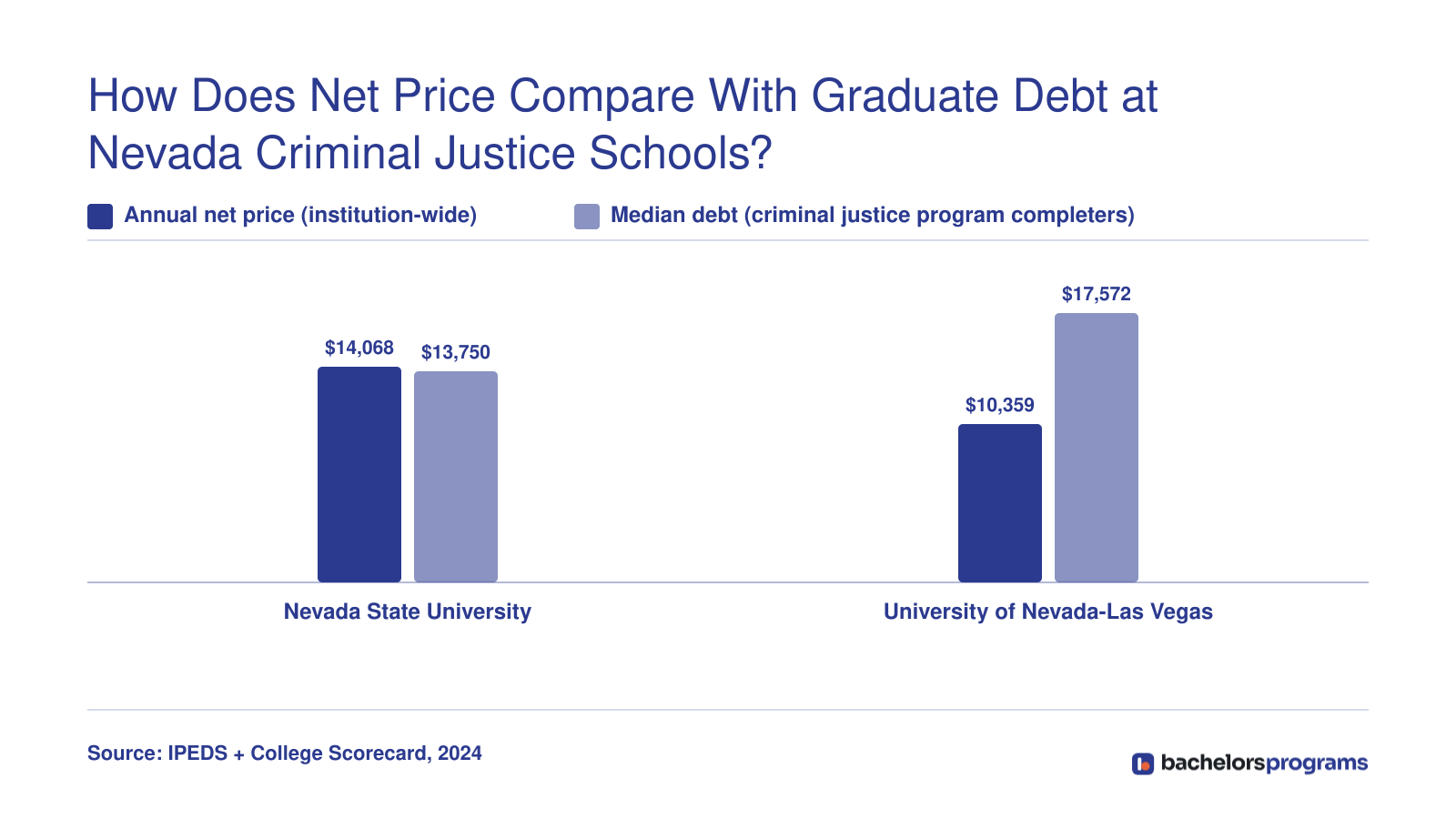
How Does Net Price Compare With Graduate Debt at Nevada Criminal Justice Schools?
Net price is each school's institution-wide average annual cost after grants and scholarships for aided students. Debt is the median loan balance of graduates from each school's criminal justice bachelor's program, so the two figures measure different things. Nevada State University's program debt of $13,750 is just below one year of its $14,068 net price, while UNLV criminal justice graduates owe a median $17,572 against a $10,359 yearly net price, so budget for net price in every year you enroll, not just for what you might borrow. The University of Nevada-Reno's net price is $15,927 a year, but debt for its criminal justice graduates is not reported, so it is left out of the chart.
How Long a Criminal Justice Bachelor's Degree Takes in Nevada
In Nevada, a criminal justice bachelor's degree is a four-year, 120-credit commitment for a full-time student, and that timeline holds only if you keep a steady course load every semester.
Credit Totals and the Four-Year Path
UNR's Bachelor of Arts in Criminal Justice requires a minimum of 120 units, including at least 42 units in courses numbered 300 or above. Its catalog lays out a recommended eight-semester plan, with 15 units in each of the semesters shown. UNLV and Nevada State University also offer the degree, and four-year bachelor's programs of this kind generally sit near 120 credits. Confirm each school's exact total in its current catalog before you plan around it.
Full-Time vs. Part-Time
The math is simple. At 15 credits per semester, 120 credits takes eight semesters. At 12 credits, it stretches to ten semesters, or five years. A working adult taking 9 credits each fall and spring would need roughly 13 to 14 semesters, closer to seven years. Summer and winter terms can pull that number down.
Shortening the Path
Credits from a Nevada community college can cut the timeline considerably. An associate degree that transfers cleanly may cover about half the bachelor's requirements, though how much counts toward the major depends on course matching. UNR publishes transfer pathways with Nevada community colleges, and one of them shows a recommended schedule running seven or more semesters after transfer. Meet with a transfer advisor early so general education and lower-division credits line up.
UNR also offers its criminal justice degree online, which helps with scheduling. The sources reviewed do not describe a separate accelerated or degree-completion track there, so ask the department before assuming one exists. The same goes for UNLV and Nevada State.
Capstone and Internship Requirements
UNR's curriculum includes a 3-unit capstone, so plan for it in your final year. Its internship course, CRJ 491, is an elective rather than a stated graduation requirement. An internship can still add a semester if it forces a lighter course load or a schedule conflict, so build it in deliberately.
Nevada POST Peace Officer Certification at a Glance
Criminal Justice Careers and Pay in Nevada
BLS files police and sheriff's patrol officers under occupation code 33-3051, correctional officers and jailers under 33-3012, probation officers and correctional treatment specialists under 21-1092, and paralegals under 23-2011. Those codes are the quickest route to current pay and hiring numbers for each occupation. Wage, employment and projection figures change with every release, so check them at the source before you rely on them.
Where to Find Current Nevada Numbers
Start with the BLS Occupational Employment and Wage Statistics (OEWS) pages at BLS.gov. Choose the state of Nevada, then repeat the search for the Las Vegas-Henderson-Paradise and Reno metro areas. For each of the four occupations above, the tables list median annual wages and total employment by area.1 Metro figures often differ sharply from the statewide number, so check both.
For job-growth estimates, use Nevada DETR labor market information (the Department of Employment, Training and Rehabilitation) and the BLS Employment Projections program, which currently covers 2025 to 2035. National context helps only as a benchmark. For example, the BLS Occupational Outlook Handbook projects a 7 percent decline from 2025 to 2035 for correctional officers and bailiffs nationwide, a reminder that outlook varies by occupation.
Be careful with titles. "Correctional officers and jailers" and "correctional officers and bailiffs" are different categories with different numbers. Also check each publication date before you rely on a figure.
Verification Checklist
Before you treat any number as the pay you can expect, confirm these four items:
- Occupation title: Match the exact title and code to the job you want.
- Geographic area: Confirm whether the figure covers Nevada, Las Vegas-Henderson-Paradise, or Reno.
- Data year: Look for the latest OEWS release, not an archived table.
- Pay measure: Check that it is median annual wage, not a mean, an hourly rate, or an entry-level figure.
Then cross-check locally. City, county, and state agency job postings show actual starting pay and hiring requirements, such as age, education, and background standards. The career offices at UNR, UNLV, and Nevada State University can tell you where recent graduates have been hired. Professional associations in law enforcement, corrections, probation, and paralegal work often publish salary surveys and hiring news that BLS tables lack.
Compare Criminal Justice programs on the data that matters
Explore more Criminal Justice & Law majors or browse every field of study.
All Criminal Justice & Law programs Browse every field of study